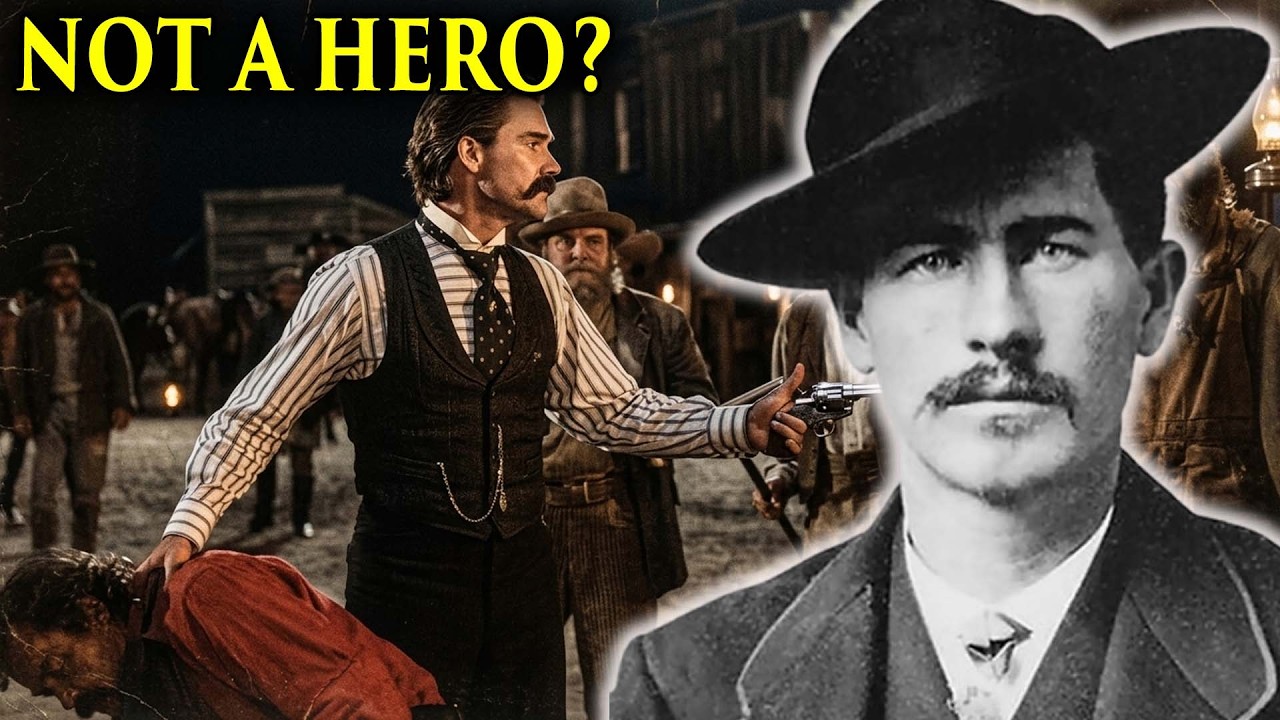
Wyatt Earp became one of the cleanest symbols in one of America’s messiest periods.
The badge.
The long coat.
The steady eyes.
The calm lawman walking toward armed Cowboys near the O.K. Corral.
Hollywood eventually turned him into something close to the embodiment of frontier justice.
But the historical Wyatt Earp was much harder to categorize.
He was a constable.
A deputy marshal.
A gambler.
A Faro dealer.
A businessman.
A saloon figure.
A stagecoach guard.
A mining speculator.
A man repeatedly arrested in his younger years.
A political operator who openly hoped law-enforcement success would help him win elected office.
And after his brother Morgan was murdered, he became the leader of an armed posse that pursued suspected enemies through Arizona while arrest warrants were being issued for members of his own group.
That does not automatically make Wyatt Earp a villain.
It does make the spotless Hollywood lawman difficult to defend.
The darker truth is that Earp spent much of his life on a frontier where the line between lawman and gambler, policeman and businessman, deputy and vigilante was astonishingly thin.
Sometimes he stood on one side of that line.
Sometimes he crossed it.
Before the Badge Came the Reinvention
Wyatt Berry Stapp Earp was born in Illinois in 1848.
His childhood was shaped by migration.
The Earp family moved repeatedly, first through the Midwest and eventually westward.
His older brothers served during the Civil War while Wyatt, still too young to enlist, remained behind helping manage the family farm.
According to the source, he reportedly tried more than once to follow his brothers into military service before his father brought him home.
By his mid-teens, he was already working around stage lines and freight operations.
Later he hauled cargo over long western routes and spent time around railroad camps.
These were not simply adventures.
They introduced Wyatt to the economy that would define most of his adult life:
Transportation.
Gambling.
Transient boomtowns.
Male violence.
Fast money.
And towns where legal authority often depended on whoever happened to be wearing the badge that month.
His First Attempt at Respectability Ended in Tragedy
Wyatt returned to Lamar, Missouri, where his father had served as constable.
In 1869, Wyatt himself became constable.
He also married Urilla Sutherland.
He bought land.
Built a house.
For a brief period, his life looked surprisingly conventional.
Then Urilla died while pregnant.
The source attributes her death to typhoid fever.
Whatever future Wyatt imagined disappeared with her.
And the years immediately afterward bear almost no resemblance to the heroic lawman biography later popular culture preferred.
Instead came lawsuits.
Accusations.
Arrests.
And flight.
Wyatt Earp Was Accused of Keeping Money That Belonged to the County
In March 1871, Barton County sued Wyatt and several guarantors, including his father.
The dispute involved licensing money Wyatt had been responsible for collecting as constable.
County officials alleged that approximately $200 had not been properly turned over.
Another man, James Cromwell, separately accused Wyatt of altering the amount of a judgment and retaining money collected from it.
Neither dispute fits easily beside the later image of Earp as the incorruptible face of law and order.
They also do not by themselves prove every accusation against him.
The source presents them as allegations and civil proceedings rather than simple convictions.
But they establish something important.
Wyatt Earp’s early career with a badge was already controversial.
Then Came the Horse-Theft Case
Only weeks later, Wyatt Earp, Edward Kennedy, and John Shown were accused of stealing two horses in Indian Territory.
Horse theft was a serious allegation in the nineteenth-century West.
A good horse represented transportation, labor, wealth, and sometimes survival.
A deputy U.S. marshal arrested Earp.
Bail was set.
Then Wyatt left.
The source says he sold remaining property and disappeared from the area before the proceedings could be completed.
A formal indictment followed.
Kennedy was eventually acquitted.
The cases involving Earp and Shown remained unresolved after Earp could no longer be located.
That does not mean history can confidently label Wyatt Earp a convicted horse thief.
He was never convicted of that charge.
But neither can the episode simply be erased because it interferes with the legend.
The future frontier lawman once fled while facing a federal horse-theft accusation.
Peoria Was Even Further From the Myth
Wyatt next appears in records connected to Peoria, Illinois.
And this portion of his life is one Hollywood biographies historically preferred to move through quickly.
Police raided establishments associated with prostitution.
Wyatt was arrested.
So was his brother Morgan.
The source cites repeated encounters with authorities involving houses connected to sex work.
A city directory placed Wyatt at an address associated with Jane Haspel.
Later he was arrested aboard a converted keelboat operating as another disreputable establishment.
A contemporary newspaper reportedly referred to him as a “Peoria bummer.”
These were not the experiences of an established lawman.
They belonged to a young drifter living within the gambling, prostitution, riverfront, and entertainment economy of a nineteenth-century town.
Years later, Wyatt emphasized buffalo hunting when discussing this portion of his past.
The transcript notes that documentary support for some of those later buffalo-hunting stories is limited.
Perhaps the future legend had already begun editing himself.
Wichita Changed Everything
By 1874, Wyatt was in Wichita, Kansas.
His brother James and James’s wife were already connected with a brothel there.
The source suggests Wyatt probably functioned more as a protector or enforcer around that environment than as a direct brothel manager.
Then something changed.
He began cooperating with police.
In October 1874, he helped track suspected wagon thieves.
The following April, Wyatt officially joined Wichita’s law-enforcement force.
Now the man who had recently been arrested around prostitution establishments was wearing a badge.
This transition tells us something fundamental about frontier law enforcement.
The worlds were not separate.
Gamblers became deputies.
Saloon men became marshals.
Former criminals sometimes became peace officers.
Men could move back and forth between respectable and disreputable occupations because the frontier needed people who understood both environments.
Wyatt Earp understood them extremely well.
He Could Be Honest — and Violent
One Wichita newspaper praised Wyatt after he jailed an intoxicated traveler carrying a large amount of money and returned the man’s cash untouched.
That is important.
A darker biography should not erase evidence that reflects well on him.
But his Wichita career still ended after a confrontation.
Former Marshal Bill Smith accused Wyatt of using his influence to help obtain jobs for his brothers.
The dispute became physical.
Wyatt was fined.
He was not reappointed.
Then he moved to Dodge City.
This pattern would follow him repeatedly.
Earp could be effective.
He could also create enemies.
Dodge City Built the Wyatt Earp People Remember
Dodge City was the environment that transformed Earp into a recognizable frontier lawman.
Cattle.
Cowboys.
Saloons.
Gambling.
Weapons.
Money.
Wyatt served as assistant marshal.
But he also dealt Faro.
That double role was not necessarily considered contradictory.
Gambling was central to many cattle towns.
A law officer could enforce municipal rules and then earn additional income around gaming tables.
The romantic sheriff standing outside civilization is therefore misleading.
Wyatt was deeply inside the commercial machinery of the town.
He knew gamblers.
Saloon owners.
Cowboys.
Sex workers.
Businessmen.
Lawmen.
And eventually Doc Holliday.
Even His Gun Went Off Accidentally
One incident cuts directly against the myth of the perfectly controlled gunfighter.
While Wyatt was sitting in a saloon, his revolver reportedly slipped from its holster and struck a chair.
The gun discharged.
A bullet passed through his coat.
No one was injured.
But the episode illustrates the mundane danger of nineteenth-century firearms.
Guns were not magical extensions of frontier masculinity.
They were mechanical objects.
They could fire accidentally.
Even when carried by Wyatt Earp.
He Was Fined After Striking a Woman
The transcript also contains an incident that darker retellings of Earp cannot ignore.
A Dodge City newspaper reported that Wyatt struck a woman named Frankie Bell during an argument.
Bell was jailed and fined twenty dollars.
Wyatt received a one-dollar fine, described in the source as the minimum permitted.
The imbalance itself tells a story about the law.
The future legend of frontier justice operated inside a legal culture in which enforcement and punishment could look very different depending on who you were.
The incident does not define Wyatt’s entire life.
But it belongs in it.
Doc Holliday Entered the Story Through Gambling and Police Work
Wyatt’s pursuit of outlaw Dave Rudabaugh brought him into closer contact with Doc Holliday.
Holliday was not simply a gunfighter.
He was a gambler.
That made him useful.
Gamblers heard things.
They moved between towns.
They knew men police wanted.
Later accounts credited Holliday with helping Wyatt during a dangerous disturbance in Dodge City.
Whether every dramatic detail survived intact is another question.
What matters is that Wyatt and Doc developed a relationship that connected law enforcement with the gambling world.
Again, the two worlds were not opposites.
They overlapped constantly.
Tombstone Was Not About Justice Alone
When Wyatt arrived in Tombstone in 1879, he did not arrive solely because a lawless town desperately needed him.
He arrived looking for opportunity.
Stage transportation.
Mining.
Water rights.
Gambling.
Wells Fargo work.
Real estate.
Tombstone was booming because silver was booming.
That meant money.
Wyatt and his brothers invested.
They gambled.
They worked.
They pursued government positions.
This is essential context.
The conflict that eventually produced the O.K. Corral was not simply law against crime.
It involved economics.
Business.
Politics.
Party affiliation.
Reputation.
Government appointments.
And competing groups trying to control a fast-growing county.
Even “Cowboy” Did Not Mean What Hollywood Says
In southeastern Arizona, the word “Cowboy” acquired a particular meaning.
It could refer to men suspected of livestock theft, smuggling, robbery, and related criminal activity.
Legitimate ranch hands often preferred terms such as cattlemen or ranchers.
The Earp conflict with these men escalated after investigations involving stolen U.S. Army mules.
Newspapers became weapons.
Threats were exchanged.
Public accusations followed.
By the time Tombstone exploded, both sides already believed the other represented something larger than individual disputes.
Politics Made Everything Worse
Arizona law enforcement was intensely political.
Sheriffs controlled more than arrests.
Their offices could generate significant income through taxes, fees, and assessments.
Wyatt wanted political advancement.
Johnny Behan became a major rival.
The transcript also describes a disputed Pima County sheriff election involving allegations of fraudulent voting.
Witnesses and later historians disagreed over various details.
Eventually the original result was overturned.
Then Cochise County was created, changing the political geography entirely.
This matters because Wyatt Earp was not operating in some neutral world where “the law” existed above politics.
The law was politics.
Wyatt Wanted to Become Sheriff
One particularly revealing episode concerns a stage robbery.
Wyatt testified that he approached Ike Clanton and Frank McLaury about helping capture suspects connected to the crime.
Wells Fargo offered substantial rewards.
Wyatt admitted that successfully solving the robbery could improve his public reputation and help his chances of being elected sheriff.
That is a remarkable admission.
Law enforcement.
Reward money.
Personal reputation.
Electoral ambition.
All were operating at the same time.
Ike Clanton later gave a much darker version, alleging Wyatt wanted certain suspects killed rather than captured.
That accusation was contested.
The transcript does not establish it as fact.
What it does establish is how completely trust between the factions had collapsed.
The O.K. Corral Was Only Thirty Seconds
October 26, 1881.
Virgil Earp learned that armed Cowboys were gathered in town.
Tombstone had restrictions on carrying weapons.
Virgil decided to disarm them.
Wyatt, Morgan, and Doc Holliday accompanied him.
The groups met in a narrow lot near the O.K. Corral.
Then everything happened incredibly fast.
Roughly thirty seconds.
Tom McLaury died.
Frank McLaury died.
Billy Clanton died.
Virgil was wounded.
Morgan was wounded.
Doc Holliday was grazed.
Wyatt was untouched.
The most famous gunfight in the history of the American West was over almost before anyone could understand what had happened.
And Then Wyatt Was Accused of Murder
Ike Clanton filed murder charges.
A long preliminary hearing followed.
Sheriff Johnny Behan testified against the Earps.
He claimed the Cowboys had attempted to surrender and that Earp’s group fired first.
Other testimony conflicted with parts of Behan’s account.
Defense attorney Thomas Fitch attacked inconsistencies in prosecution testimony.
Justice Wells Spicer eventually ruled that the evidence did not justify sending the Earps and Holliday to trial.
Legally, Wyatt walked away.
Politically, nothing was resolved.
Half the town could read Spicer’s ruling as vindication.
The other half could see powerful armed men escaping responsibility.
The O.K. Corral did not end the conflict.
It removed the possibility of ending it peacefully.
Then Somebody Shot Virgil
On December 28, 1881, Virgil Earp was ambushed.
Shotgun blasts struck him as he walked through Tombstone.
His arm was permanently damaged.
Wyatt sought additional federal authority.
He assembled men around him.
The family increasingly believed its enemies could attack them while the courts failed to respond effectively.
Then, on March 18, 1882, the conflict became personal beyond repair.
Morgan Earp was murdered.
Morgan’s Death Changed Wyatt
Morgan was playing billiards when gunfire came through a window from a dark alley.
He was hit.
He died within roughly forty minutes.
For Wyatt, the legal system had now failed in the most intimate possible way.
First Virgil.
Then Morgan.
The transcript describes Wyatt becoming convinced that ordinary legal mechanisms might never adequately protect his family or punish those responsible.
This is the moment when the traditional lawman story becomes something else.
Wyatt formed a posse.
Then he began hunting.
The Vendetta Ride Is Where the Legend Becomes Darkest
Wyatt still possessed federal authority as a deputy U.S. marshal.
That gave his posse legal standing.
But Arizona authorities were also issuing warrants connected to killings attributed to his group.
Almost immediately, Frank Stilwell was found dead near the Tucson railroad tracks.
He had been shot repeatedly.
Wyatt and members of his party were accused.
Warrants followed.
The posse moved on.
At a wood camp they encountered Florentino “Indian Charlie” Cruz.
Cruz was killed.
Later came Iron Springs.
There Wyatt’s group confronted Curly Bill Brocius and other Cowboys.
Gunfire erupted.
Wyatt shot Curly Bill with a shotgun.
According to Wyatt’s later account, he remained astonishingly exposed while bullets struck his clothing and equipment without seriously wounding him.
That encounter became another major piece of the legend.
But Was It Law Enforcement or Revenge?
That is the question no clean Western can comfortably answer.
Wyatt possessed a badge.
He also had a murdered brother.
He was pursuing men he believed responsible.
He was simultaneously wanted in connection with killings.
Sheriff Johnny Behan organized forces against him.
Both groups could claim some form of legal authority.
The difference between posse and vigilante had become almost impossible to define.
This was not Wyatt Earp bringing civilization to lawless Arizona.
This was competing armed groups, political factions, warrants, federal authority, county authority, family vengeance, and frontier justice collapsing into one another.
That is much darker.
Wyatt Survived Because He Left
Eventually the Earp party moved out of Arizona.
They traveled through New Mexico and Colorado.
The Tombstone chapter was over.
But Wyatt’s life continued for nearly five decades.
That alone distinguishes him from many frontier legends.
Billy the Kid died young.
Doc Holliday died at thirty-six.
Morgan Earp was murdered.
Wyatt lived until eighty.
He therefore had decades to participate in shaping his own story.
His Later Life Was Still Filled With Gambling and Schemes
After Tombstone, Wyatt continued gambling and moving through boom economies.
He dealt Faro.
Explored mining opportunities.
Owned or operated businesses.
Joined friends in disputes.
The transcript even mentions a debated allegation that Wyatt and associates attempted a gold-brick confidence scheme in Colorado.
Later he participated in the so-called Dodge City War, when friends rallied to support saloon owner Luke Short against local political authorities.
No great gun battle occurred.
The reputations of men like Wyatt Earp and Bat Masterson were enough to influence the outcome.
By then, Wyatt’s name itself had become a weapon.
Even in His Sixties, Trouble Followed Him
In 1910, Wyatt briefly worked on special assignments connected with Los Angeles law enforcement.
He also became involved in a bitter mining-property dispute.
He reportedly appeared armed with a Winchester while protecting surveyors.
Federal authorities eventually arrested him and others for contempt connected to the disputed property.
The following year, Wyatt was arrested again.
This time he was accused of attempting to deceive a real-estate broker through a staged Faro game.
Because money apparently had not changed hands, the initial charge was reduced.
He posted bail.
He was now in his sixties.
The O.K. Corral was decades behind him.
Yet gambling, questionable schemes, disputed property, weapons, and law enforcement were still orbiting his life.
The Legend Was Built While Wyatt Was Still Alive
In old age, Earp lived in Los Angeles.
Hollywood itself was beginning to turn the frontier into mythology.
Actors and filmmakers met men who had actually lived through that era.
Wyatt became a living connection to the West movies wanted to recreate.
He could tell stories.
Writers could listen.
Each retelling polished the legend.
Memories changed.
Details shifted.
Events became cleaner.
Wyatt’s own later accounts sometimes differed from contemporary records.
That does not necessarily mean he deliberately invented everything.
Memory changes.
People emphasize different details over time.
But it means historians must constantly separate late reminiscence from documentation created when events actually occurred.
He Outlived Almost Everyone
By the late 1920s, Wyatt Earp was the last surviving Earp brother and the last living participant from his side of the O.K. Corral confrontation.
He died in Los Angeles on January 13, 1929.
He was eighty.
Actors attended his memorial.
Tom Mix, one of early Hollywood’s great Western stars, reportedly became emotional.
The symbolism was almost perfect.
The real frontier lawman was dying just as cinema was preparing to make men like him immortal.
From that point forward, Hollywood could finish the transformation.
The Myth Removed the Uncomfortable Parts
The Wyatt Earp most people inherited did not need the Peoria arrests.
He did not need the horse-theft indictment.
He did not need the brothel connections.
He did not need the woman he was fined for striking.
He did not need political ambition.
He did not need gambling income.
He did not need disputed reward schemes.
He certainly did not need the moral ambiguity of the Vendetta Ride.
Those details complicated the story.
Hollywood wanted something simpler.
Lawman versus outlaw.
Civilization versus chaos.
Earp versus Cowboys.
Good versus evil.
The historical record refuses to cooperate.
Wyatt Earp Was Not Fake — The Simplicity Was
This is the mistake people make when myths collapse.
They assume that if Wyatt was not the spotless hero, he must therefore have been a fraud.
The evidence is more interesting.
Wyatt genuinely served as a law officer.
He pursued criminals.
He helped maintain order in violent communities.
He guarded valuable shipments.
He stood beside his brothers when armed men threatened them.
He survived extraordinary violence.
But he also lived economically and socially inside the same frontier underworld he policed.
He gambled.
Associated with prostitution establishments.
Faced criminal allegations.
Used political connections.
Sought office.
And eventually took justice into his own hands when he decided formal institutions had failed his family.
Those realities can exist together.
The Darkest Part of Wyatt Earp Is the Question He Leaves Behind
When does a lawman stop being a lawman?
When he gambles?
No.
Many frontier officers did.
When he associates with brothels?
Not necessarily.
That world overlapped heavily with the saloon economy.
When he punches someone?
When he shoots someone?
When he pursues suspects outside his jurisdiction?
When revenge becomes part of the motive?
When another court issues a warrant for him?
At some point during the Vendetta Ride, those questions stopped having easy answers.
And perhaps that is why Wyatt Earp remains so fascinating.
He represents a frontier where the government was present but weak.
Where private interests and public office overlapped.
Where sheriffs were politicians.
Where deputies were gamblers.
Where businessmen hired guns.
Where newspapers belonged to factions.
Where courts operated inside political networks.
And where men sometimes used a badge until the badge no longer gave them what they wanted.
Then they used the gun.
Hero, Villain, or Something Worse for the Legend?
Wyatt Earp does not fit comfortably into either category.
That may be the most historically accurate answer.
He was capable of restraint.
Capable of loyalty.
Capable of violence.
Capable of self-promotion.
Capable of operating within the law.
And capable of moving beyond it.
The man was messier than the monument.
That is why his real life is darker than the legend.
Not because Wyatt Earp was secretly some one-dimensional monster.
But because he lived in a world where morality, money, politics, law, family, and vengeance were so tightly connected that even the men wearing badges could no longer always tell where one ended and another began.
Hollywood gave Wyatt Earp a clean line in the sand.
History gave him dust.
And footprints on both sides.


