On November 22, 1963, Winston Churchill was eighty-eight years old, physically weakened by age and illness, and living far removed from the extraordinary political battles that had defined his life.
At his home on Hyde Park Gate in London, the former British prime minister learned that President John F. Kennedy had been shot in Dallas, Texas.
The news was almost impossible to comprehend.
Kennedy was only forty-six.
He was the young American president who had repeatedly expressed admiration for Churchill, studied his writings, and publicly celebrated his contribution to the defense of freedom.
Only seven months earlier, Kennedy had presided over a ceremony granting Churchill honorary citizenship of the United States.
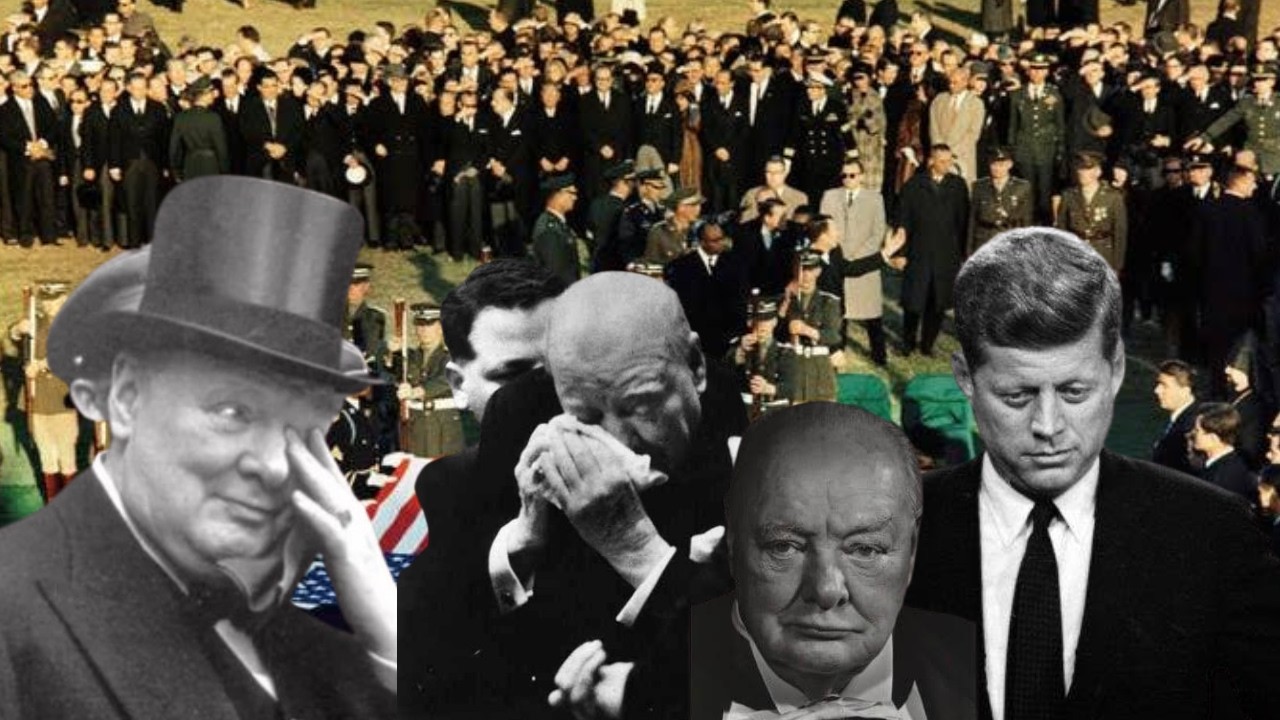
Now that same president was dead.
According to accounts cited by the Churchill Project at Hillsdale College, Churchill watched television coverage of the assassination and wept.
The man who had led Britain through the Second World War, endured the destruction of European cities, and witnessed the deaths of countless soldiers and civilians was overcome by the killing of a much younger leader.
His public response was equally powerful.
In a statement reported by United Press International on the evening of November 22, Churchill described Kennedy’s assassination as a “monstrous act.”
He said the loss to America and the wider world was “incalculable.”
He also urged those who followed Kennedy to continue pursuing the ideals of peace, human happiness, and dignity associated with his presidency.
Those words were brief.
But they carried the weight of a lifetime spent confronting war, political extremism, and the consequences of failed leadership.
Churchill had witnessed the collapse of empires, the rise of dictatorships, two world wars, and the emergence of nuclear confrontation.
He had known presidents, prime ministers, monarchs, generals, and revolutionaries.
He understood how suddenly history could change.
Yet Kennedy’s death affected him in a way that went beyond ordinary diplomatic mourning.
The relationship between the two men had never resembled Churchill’s extraordinary wartime partnership with Franklin D. Roosevelt.
They had not spent years coordinating military strategy or conducting lengthy negotiations together.
They belonged to different generations.
Their political careers reached their greatest prominence at different moments.
But their connection was genuine.
Kennedy had grown up reading Churchill.
He had studied his interpretation of history.
He had witnessed his political rise during the crisis preceding the Second World War.
And he had come to regard Churchill as an example of the relationship between language, courage, and democratic leadership.
For Churchill, Kennedy represented something equally meaningful.
He was a young American president who understood the historical importance of the Anglo-American relationship and had chosen to honor an aging British statesman at a moment when Churchill’s physical world was becoming increasingly restricted.
The assassination therefore brought together two profoundly different experiences of time.
One man had lived through nearly nine decades of extraordinary history.
The other had been killed while still in the early years of his presidency.
To understand Churchill’s reaction, it is necessary to examine the relationship that developed between them long before November 1963.
John Fitzgerald Kennedy was born on May 29, 1917, in Brookline, Massachusetts.
Churchill was already forty-two years old.
He had served in the British government, experienced political controversy, and participated in the First World War.
Kennedy entered a world already shaped by events Churchill had helped influence.
The future president grew up in a wealthy and politically ambitious American family.
His father, Joseph P. Kennedy Sr., became an influential businessman and public figure.
The family encouraged education, competition, and political awareness.
But Kennedy’s childhood and adolescence were also marked by recurring health problems.
He spent significant periods receiving medical treatment and recovering from illness.
Those experiences encouraged extensive reading.
History became one of his principal interests.
Churchill’s writings were especially important.
One account, later discussed in Robert Dallek’s biography An Unfinished Life, describes the young Kennedy reading Churchill’s multivolume history of the First World War, The World Crisis, while hospitalized.
The image is revealing.
A teenager struggling with illness was studying the work of a British politician whose own career had been shaped by war, controversy, and historical judgment.
Churchill was not simply an admired public figure to Kennedy.
He was an author whose interpretation of events helped shape the young American’s understanding of leadership.
The World Crisis combined historical analysis with personal experience.
Churchill had participated in many of the decisions he described.
His writing therefore offered more than an account of military events.
It explored the responsibilities of political leaders, the consequences of strategic mistakes, and the unpredictability of international affairs.
For a young reader interested in history and government, those themes were compelling.
Kennedy’s admiration continued as he grew older.
His interest in Churchill eventually became connected to direct experience of the political world Churchill inhabited.
In 1938, Joseph P. Kennedy Sr. became the United States ambassador to Britain.
The appointment placed the Kennedy family close to the center of European diplomacy during one of the most dangerous periods of the twentieth century.
Adolf Hitler’s Germany was expanding its influence.
European governments were struggling to determine whether confrontation or negotiation offered the best chance of avoiding another major war.
British Prime Minister Neville Chamberlain pursued a policy of appeasement.
Churchill, who had spent years warning about the dangers of Nazi Germany, remained one of the most prominent critics of that approach.
His warnings were frequently dismissed as excessive or politically inconvenient.
But the international situation continued deteriorating.
Young John Kennedy witnessed these events while studying and traveling in Europe.
He observed the growing crisis from a position unusually close to diplomatic power.
His father’s role as ambassador gave him access to political conversations and public events that few students could experience firsthand.
The relationship between Joseph Kennedy and Churchill’s political outlook was complicated.
The elder Kennedy was deeply skeptical about Britain’s ability to withstand a major European war.
His public and private assessments became increasingly controversial.
Churchill, by contrast, believed that resisting Nazi expansion was essential to Britain’s survival.
Their differences reflected opposing interpretations of the international crisis.
Joseph Kennedy feared the consequences of war and doubted Britain’s prospects.
Churchill believed that continued concessions would ultimately make the danger greater.
For John Kennedy, the contrast between his father’s position and Churchill’s warnings became part of his political education.
He admired his father but also developed an independent understanding of international affairs.
The young Kennedy’s academic work reflected these concerns.
His Harvard senior thesis examined Britain’s failure to prepare adequately for the threat posed by Nazi Germany.
The thesis became the basis for his first book, Why England Slept, published in 1940.
The title itself suggested the central question.
Why had a major democratic power failed to recognize and respond effectively to a growing military threat?
Kennedy explored political institutions, public opinion, military preparedness, and the difficulties democratic governments face when confronting danger.
These were subjects Churchill had been addressing for years.
The book did not simply reproduce Churchill’s arguments.
Kennedy developed his own analysis of British policy and the constraints facing democratic leaders.
But Churchill’s influence was unmistakable within the broader intellectual context.
The young American was studying the same historical failures that Churchill had warned against.
By the time Why England Slept appeared, Churchill had become British prime minister.
Germany’s military campaigns had transformed the European war.
Britain faced an existential struggle.
Churchill’s speeches during 1940 became defining expressions of national resistance.
His language combined realism about the danger with determination to continue fighting.
He did not promise an easy victory.
He acknowledged the severity of Britain’s situation while insisting that surrender was unacceptable.
For Kennedy, who had studied Churchill’s warnings before the war, the transformation was significant.
The politician once dismissed by much of the British establishment had become the leader responsible for guiding the country through its greatest crisis.
Churchill’s example reinforced the importance of political judgment, historical awareness, and the ability to communicate difficult truths.
Those qualities remained central to Kennedy’s understanding of leadership.
The Second World War also brought the Kennedy family into direct contact with tragedy.
John Kennedy served in the United States Navy in the Pacific.
In August 1943, the patrol torpedo boat he commanded, PT-109, was struck by a Japanese destroyer.
Kennedy helped surviving crew members reach safety.
The experience became an important part of his public biography.
His older brother, Joseph P. Kennedy Jr., was killed during a wartime aviation mission in 1944.
The loss profoundly affected the family.
John Kennedy’s own political future became more important within the expectations of his father.
After the war, he entered public life.
He was elected to the United States House of Representatives in 1946.
He later became a senator from Massachusetts.
Throughout his political career, Kennedy continued demonstrating an interest in history and political biography.
He admired leaders who had confronted difficult choices under extraordinary pressure.
Churchill remained among his most important examples.
Kennedy frequently referred to Churchill’s speeches and writings.
He understood that language could influence public confidence during moments of danger.
He also recognized that historical memory could provide guidance when contemporary circumstances appeared uncertain.
This intellectual relationship became especially important as Kennedy developed his own presidential ambitions.
By the late 1950s, Churchill had already retired from the premiership.
His second period as prime minister had ended in 1955.
Age and illness increasingly limited his activities.
But his reputation remained enormous.
He was celebrated internationally as the leader who had helped Britain resist Nazi Germany and sustain the wartime alliance with the United States.
Kennedy’s admiration for Churchill was therefore both personal and politically meaningful.
It reflected his reading and historical interests.
It also aligned with his belief that the United States and Britain shared important strategic responsibilities.
One unusual encounter between the two men occurred in 1958.
Kennedy and Churchill met aboard the yacht of Greek shipping magnate Aristotle Onassis.
The meeting later became the subject of recollections emphasizing the contrast between the young American senator and the elderly British statesman.
Churchill was in declining health.
His memory and alertness were not always as reliable as they had once been.
Kennedy, who had admired him for years, reportedly found the encounter less emotionally satisfying than he might have hoped.
Accounts associated with Jacqueline Kennedy suggest that Churchill may not have fully recognized the significance of the young senator’s presence.
The meeting illustrates a painful reality that often accompanies encounters between admirers and aging historical figures.
Kennedy had spent much of his life studying Churchill at the height of his intellectual and political power.
But the man he encountered in 1958 was no longer the commanding wartime prime minister of 1940.
He was an elderly former leader whose physical and mental energy had diminished.
The contrast did not destroy Kennedy’s admiration.
If anything, it highlighted the importance of preserving Churchill’s legacy while he was still alive.
By 1959, Kennedy was supporting efforts to grant Churchill honorary citizenship of the United States.
The idea carried enormous symbolic significance.
Churchill had been born in Britain to a British father and an American mother, Jennie Jerome.
His family background therefore embodied a personal connection between the two countries.
But honorary American citizenship would recognize something larger than ancestry.
It would acknowledge Churchill’s contribution to the defense of democratic institutions and the wartime partnership between Britain and the United States.
The proposal developed over several years.
Kennedy supported the effort while serving in the Senate.
When he became president in January 1961, the possibility acquired greater political momentum.
Churchill was then eighty-six.
His health made international travel increasingly difficult.
Kennedy invited him to visit Washington, but the elderly statesman was unable to make the journey.
The inability to meet did not prevent the president from continuing the effort to honor him.
In 1963, Congress authorized the granting of honorary United States citizenship to Churchill.
Kennedy signed the necessary proclamation.
A ceremony was arranged at the White House.
On April 9, 1963, guests gathered in the Rose Garden for an event that would become one of the most memorable public tributes of Kennedy’s presidency.
Churchill could not attend.
His son Randolph Churchill and grandson Winston Churchill represented him.
The absence of the man being honored gave the occasion a bittersweet quality.
The audience was celebrating one of the twentieth century’s most influential leaders, but the leader himself was too frail to cross the Atlantic.
Kennedy nevertheless treated the ceremony with extraordinary seriousness.
His remarks went beyond the routine language of diplomatic courtesy.
He spoke about Churchill’s place in history and the exceptional power of his words.
The president described him as one of the most honored figures of the age.
He celebrated Churchill’s ability to transform language into an instrument of national resistance.
The speech reflected Kennedy’s long familiarity with Churchill’s writings.
It was a tribute from a younger leader who had studied the older man’s career for decades.
Kennedy understood the historical importance of the moment.
Churchill had helped preserve Britain’s resistance during the Second World War.
He had worked closely with Franklin D. Roosevelt to sustain the alliance that eventually defeated Nazi Germany.
He had also warned about the dangers of Soviet expansion after the war.
For Kennedy, whose presidency was shaped by the Cold War, Churchill’s career offered lessons about the responsibilities of democratic leadership.
The Cuban Missile Crisis had brought the United States and Soviet Union dangerously close to nuclear confrontation only six months earlier.
Kennedy had experienced the pressure of making decisions that could determine the fate of millions.
He understood more clearly than most people the burden Churchill had carried during wartime.
The Rose Garden ceremony therefore connected two generations of leadership.
Churchill represented the struggle against fascism and the formation of the wartime alliance.
Kennedy represented a younger generation confronting the dangers of nuclear rivalry and ideological conflict.
Both understood that the survival of democratic institutions depended upon political judgment and international cooperation.
Kennedy’s tribute emphasized the importance of the English language in Churchill’s leadership.
Churchill’s speeches had become essential to Britain’s wartime identity.
They gave expression to fear, determination, sacrifice, and resistance.
The words did not replace military strength.
But they helped sustain public morale when the country’s future appeared uncertain.
Kennedy recognized that power.
His own presidency had become closely associated with memorable speeches.
His inaugural address in January 1961 emphasized public service, sacrifice, and the responsibilities of freedom.
His speeches during the Cold War frequently connected immediate political decisions to larger historical principles.
The influence of Churchill’s rhetorical example was evident in Kennedy’s appreciation of language as an instrument of leadership.
The honorary citizenship ceremony therefore celebrated more than Churchill’s military and political achievements.
It acknowledged the enduring influence of his words.
Churchill reportedly followed the event from Britain.
The ceremony carried personal significance for him.
He had devoted much of his political career to strengthening the relationship between Britain and the United States.
During the Second World War, he had worked tirelessly to secure American support.
After the war, he continued emphasizing the strategic and cultural importance of the Anglo-American partnership.
To receive honorary American citizenship from a president who admired his work was a remarkable acknowledgment.
Churchill sent Kennedy a letter expressing gratitude.
The correspondence emphasized the friendship between the two countries and the honor represented by the gesture.
The event also had a personal dimension for the Churchill family.
Randolph Churchill accepted the recognition on his father’s behalf.
The younger members of the family understood that the ceremony might be among the final great public honors of Winston Churchill’s life.
He had already received numerous awards and distinctions.
But the American citizenship carried a unique symbolic meaning.
It connected his personal heritage with the international alliance that had defined his greatest political achievement.
The ceremony took place only seven months before Kennedy’s assassination.
At the time, there was no reason to imagine that the young American president would die before the elderly British statesman.
Kennedy was forty-five.
He would turn forty-six in May.
His presidency was still in its first term.
He was preparing for the political challenges of the coming election year.
Churchill, by contrast, was approaching his eighty-ninth birthday.
His public career had largely ended.
His health was deteriorating.
The contrast between their circumstances was profound.
One man appeared to be approaching the end of a long life.
The other seemed to have decades of political influence ahead of him.
Then came November 22, 1963.
Kennedy traveled through Dallas as part of a political visit to Texas.
He rode in an open presidential limousine with Jacqueline Kennedy, Texas Governor John Connally, and Connally’s wife, Nellie.
Crowds gathered along the motorcade route.
The president was greeted by enthusiastic spectators.
Shortly after 12:30 p.m. Central Standard Time, shots were fired as the motorcade passed through Dealey Plaza.
Kennedy was critically wounded.
He was taken to Parkland Memorial Hospital.
Doctors attempted emergency treatment.
At approximately 1:00 p.m., the president was pronounced dead.
The announcement sent shock waves across the United States and around the world.
Television and radio broadcasts interrupted regular programming.
Government officials, foreign leaders, and ordinary citizens struggled to understand the sudden loss.
In Britain, the news arrived during the evening.
The assassination was not merely an American tragedy.
Kennedy had become a prominent international figure.
His youth, public speaking, family image, and handling of major Cold War crises had made him widely recognizable.
Britain’s relationship with the United States gave the event particular significance.
The two countries had maintained a close partnership during the Second World War and the postwar period.
Kennedy’s presidency had continued that relationship.
For Churchill, the assassination struck at both personal memory and political conviction.
He had spent decades advocating cooperation between the English-speaking democracies.
He believed the partnership between Britain and the United States was essential to international stability.
Kennedy had publicly honored that relationship through the honorary citizenship ceremony.
Now the president who had delivered that tribute was dead.
Accounts cited by the Churchill Project describe the elderly statesman watching the news and weeping.
The image is extraordinary.
Churchill had become famous for his defiance during moments of national catastrophe.
His wartime speeches emphasized courage in the face of overwhelming danger.
He had witnessed the destruction of cities, the deaths of soldiers, and the immense suffering of civilians.
He had also experienced personal grief throughout his long life.
Yet Kennedy’s assassination visibly affected him.
The tears suggested the emotional significance of the loss.
They also reflected the circumstances of Churchill’s own declining health.
By 1963, he was living within a much smaller world than the one he had once commanded.
His physical condition limited his public activities.
He spent considerable time at home.
The international stage on which he had exercised extraordinary influence was increasingly distant.
He could still follow events, but he could no longer participate in them as he once had.
The assassination of a younger leader therefore arrived at a moment when Churchill was already confronting the passage of time.
He had outlived many friends, colleagues, and political opponents.
Franklin D. Roosevelt had died in April 1945.
Numerous figures from the wartime generation were gone.
Churchill had witnessed the transformation of international politics after the war.
He had seen the emergence of the United States and Soviet Union as rival superpowers.
He had watched the British Empire decline and the Cold War reshape the global balance of power.
Kennedy belonged to the generation that inherited those changes.
His presidency represented the continuation of political leadership beyond Churchill’s own era.
The assassination violently disrupted that expectation.
Instead of the elderly statesman departing first, the younger president was killed.
Churchill’s public statement expressed the moral horror of the event.
United Press International reported his response on November 22.
He condemned the assassination as a monstrous act.
He described the loss as incalculable.
And he urged Kennedy’s successors to continue working toward peace, happiness, and dignity.
Each part of the statement reflected a different dimension of Churchill’s reaction.
The condemnation emphasized the brutality of political murder.
Churchill had spent much of his life confronting governments and movements that used violence as an instrument of power.
He understood that assassination could destabilize political institutions and threaten public confidence.
The description of the loss as incalculable reflected uncertainty about the future.
Kennedy had been president for less than three years.
His administration had confronted the Berlin crisis, the Cuban Missile Crisis, and difficult questions about civil rights and international security.
Many of his political objectives remained unfinished.
No one could know how his presidency might have developed had he survived.
Churchill’s statement acknowledged that uncertainty.
The final part of his response looked forward.
Rather than focusing entirely upon grief, he urged those who followed Kennedy to continue pursuing the ideals associated with his presidency.
That emphasis was consistent with Churchill’s broader understanding of leadership.
He believed that political responsibility extended beyond the life of any individual statesman.
Governments and societies had to continue confronting danger even after losing important leaders.
The death of a president was a tragedy.
But it could not become an excuse for abandoning the responsibilities of government.
Churchill’s words therefore combined sorrow with determination.
They recognized the severity of the loss while emphasizing the importance of continuing the work.
The statement also reflected his understanding of the international consequences.
Kennedy’s assassination occurred during the Cold War.
Relations between the United States and Soviet Union remained tense.
The world had narrowly avoided nuclear conflict during the Cuban Missile Crisis in October 1962.
The sudden death of an American president created uncertainty about the direction of foreign policy.
Lyndon B. Johnson assumed office under extraordinary circumstances.
Foreign governments needed reassurance that American institutions would remain stable.
Churchill had lived through enough political crises to understand the importance of continuity.
His appeal for Kennedy’s successors to continue pursuing peace was therefore both a tribute and a statement of political responsibility.
Britain’s broader reaction reflected the close relationship between the two countries.
The assassination produced widespread mourning.
British newspapers devoted extensive coverage to the tragedy.
Political leaders expressed condolences.
Members of the public gathered to follow developments and remember the president.
Kennedy had been particularly recognizable in Britain because of his family connections and earlier experiences in London.
His father had served as ambassador.
He had studied British history and politics.
He had admired Churchill.
And his presidency had reinforced the importance of Anglo-American cooperation.
The grief was therefore both diplomatic and personal.
The assassination also produced a powerful response from the British royal family and government.
International leaders prepared to travel to Washington for Kennedy’s funeral.
The event became one of the largest gatherings of foreign dignitaries associated with an American presidential funeral.
Representatives from countries across the world attended.
French President Charles de Gaulle was among the prominent leaders present.
Emperor Haile Selassie of Ethiopia also attended.
Prince Philip represented the British royal family.
The funeral demonstrated Kennedy’s international stature.
It also reflected the global anxiety produced by the assassination.
The death of an American president during the Cold War affected governments far beyond the United States.
Churchill did not attend.
His health made the transatlantic journey impossible.
He remained in Britain while the world gathered in Washington.
The absence was significant.
Churchill had participated in some of the most important international meetings of the twentieth century.
He had traveled extensively during the Second World War.
He had crossed oceans to meet Roosevelt and coordinate Allied strategy.
He had attended conferences that helped determine the postwar order.
But by November 1963, he could no longer make such journeys.
The contrast between his earlier life and his final years was striking.
The man who had once crossed the Atlantic to shape world events now experienced them largely through television and reports.
His inability to attend Kennedy’s funeral symbolized the physical limitations of old age.
Yet his statement ensured that his response became part of the international record of mourning.
The relationship between Churchill and Kennedy also acquired a new historical meaning after the assassination.
The honorary citizenship ceremony had been intended as a tribute from a young president to an elderly statesman.
After Kennedy’s death, it became one of the final public connections between two major figures of the twentieth century.
The photographs and speeches from April 1963 preserved a moment of optimism.
Kennedy was celebrating Churchill’s achievements while presenting himself as part of a continuing tradition of democratic leadership.
Seven months later, the president was gone.
The ceremony became a reminder of how unexpectedly history can change.
It also highlighted the importance of political memory.
Kennedy had understood Churchill’s career through books, speeches, and historical study.
He had admired the older man’s ability to recognize danger and communicate determination.
Churchill, in turn, had seen the young president publicly acknowledge the importance of those achievements.
Their relationship did not require years of personal friendship to possess significance.
It was built upon intellectual influence, historical continuity, and shared political traditions.
Kennedy’s admiration for Churchill also reflected a broader characteristic of his leadership.
He believed that political decisions should be informed by historical experience.
His speeches frequently drew upon examples from earlier conflicts.
He understood the dangers of military escalation and the responsibilities associated with nuclear weapons.
During the Cuban Missile Crisis, he confronted choices that carried potentially catastrophic consequences.
The crisis reinforced the importance of judgment, restraint, and communication.
Churchill had faced different circumstances during the Second World War.
But both men understood that political leadership could require decisions with consequences extending far beyond national borders.
Their shared interest in history and language provided an important connection.
Churchill’s speeches during the war helped sustain British morale.
Kennedy’s public addresses helped define the aspirations and anxieties of the early 1960s.
Both recognized that words could shape public understanding of national responsibility.
Their rhetoric was not identical.
Churchill spoke with the authority of a leader confronting immediate military invasion.
Kennedy spoke as the president of a nuclear superpower navigating ideological rivalry and domestic change.
But each treated language as an essential part of political leadership.
That shared understanding explains why Kennedy’s tribute to Churchill carried such emotional force.
He was honoring a man whose example had helped shape his own understanding of the presidency.
For Churchill, the recognition offered reassurance that his legacy would continue influencing younger leaders.
The assassination made that relationship more poignant.
Churchill lived for approximately fourteen months after Kennedy’s death.
His health continued deteriorating.
He remained one of Britain’s most celebrated public figures, but his ability to participate in public life was increasingly limited.
On January 24, 1965, Winston Churchill died at the age of ninety.
The date carried an extraordinary historical coincidence.
It was exactly seventy years after the death of his father, Lord Randolph Churchill, who had died on January 24, 1895.
Winston Churchill’s death marked the passing of a political figure whose career had stretched across an immense period of modern history.
He had been born during the Victorian era.
He had served in the British Army.
He had worked as a war correspondent.
He had entered Parliament at the beginning of the twentieth century.
He had held major government offices before and after the First World War.
He had led Britain during the Second World War.
And he had remained influential during the early Cold War.
Few political careers encompassed so many transformations.
His funeral became an event of extraordinary national and international significance.
The British government organized a state funeral.
Leaders and representatives from around the world traveled to London.
The ceremony reflected Churchill’s unique place in British history and his importance to the Allied victory in the Second World War.
The gathering also created a poignant parallel with Kennedy’s funeral.
Fourteen months earlier, world leaders had assembled in Washington to mourn a young American president.
Now they gathered in London to honor an elderly British statesman.
The two funerals belonged to different traditions and reflected different lives.
Yet both demonstrated the international importance of the men being remembered.
Kennedy had died at forty-six.
Churchill had lived to ninety.
One career had been violently interrupted.
The other had reached the conclusion of an unusually long public life.
Their deaths marked different kinds of historical loss.
Kennedy’s assassination raised questions about what he might have accomplished.
Churchill’s death encouraged reflection upon what he had already achieved.
But the relationship between them remained visible in the records of the honorary citizenship ceremony and Churchill’s response to the assassination.
Those documents preserve a remarkable exchange between generations.
The younger leader honored the older man’s achievements.
The older statesman mourned the younger man’s sudden death.
The emotional significance of that exchange becomes clearer when considering Churchill’s broader relationship with the United States.
His American mother gave him a personal connection to the country.
But his political relationship with America developed through decades of international events.
During the First World War, he observed the growing importance of American power.
During the Second World War, he understood that Britain’s survival and eventual victory depended heavily upon American involvement.
His relationship with Roosevelt became one of the defining political partnerships of the conflict.
The two leaders coordinated strategy, exchanged extensive correspondence, and developed a complicated but essential working relationship.
After Roosevelt’s death in April 1945, Churchill continued emphasizing the importance of American leadership.
He believed that cooperation between Britain and the United States remained necessary in the emerging postwar world.
His famous 1946 speech in Fulton, Missouri, warned about the division of Europe and the growing influence of Soviet communism.
The speech became associated with the phrase “Iron Curtain.”
It also reinforced Churchill’s belief that the English-speaking democracies needed to maintain close cooperation.
Kennedy inherited a world shaped by those developments.
His presidency unfolded during the Cold War confrontation Churchill had warned about.
The Berlin crisis, nuclear arms competition, and Cuban Missile Crisis demonstrated the dangers of ideological rivalry.
Kennedy’s admiration for Churchill therefore involved more than nostalgia for wartime leadership.
He was studying a figure whose decisions and warnings had helped shape the international environment in which he governed.
Churchill’s honorary citizenship represented a public acknowledgment of that historical continuity.
It also reflected the personal significance of recognition late in life.
By 1963, Churchill’s physical condition had reduced his ability to participate in the world.
He could no longer deliver major speeches with the energy that had once captivated Parliament.
He could not travel freely.
He depended increasingly upon family members and assistants.
Yet his reputation remained immense.
The American honor demonstrated that his achievements continued influencing people far beyond Britain.
Kennedy’s role in the ceremony made the recognition especially meaningful.
The president was not merely fulfilling a diplomatic obligation.
His admiration had developed over decades.
He had read Churchill’s works as a young man.
He had studied the political failures that preceded the Second World War.
He had watched Churchill’s rise to the premiership.
He had built a political career in which historical knowledge and public language became important elements of his identity.
The tribute therefore connected Kennedy’s personal intellectual history with his presidential responsibilities.
When Churchill learned of Kennedy’s death, he was mourning a man who had publicly recognized that connection.
His tears and statement reflected the human dimension of an international relationship often described through formal diplomatic language.
The phrase “special relationship” is frequently used to characterize the partnership between Britain and the United States.
But relationships between nations are sustained through individuals as well as institutions.
Personal respect, historical memory, and shared experiences can influence how leaders understand one another.
Churchill and Kennedy did not possess the close working relationship Churchill had developed with Roosevelt.
But Kennedy’s admiration for Churchill helped reinforce the symbolic foundations of Anglo-American cooperation.
The honorary citizenship ceremony gave that admiration an official form.
The assassination transformed the ceremony into a final tribute exchanged between two generations.
The story also reveals the emotional vulnerability of famous leaders.
Churchill’s public image was dominated by determination.
His wartime speeches became symbols of resistance.
His cigar, distinctive appearance, and forceful language contributed to a larger-than-life reputation.
But the elderly Churchill of November 1963 was not simply the heroic figure preserved in wartime photographs.
He was a man confronting declining health, isolation, and the loss of contemporaries.
He could still respond emotionally to the death of someone whose career represented hope for the future.
The accounts of his tears therefore reveal an important dimension of his final years.
The man who had spent decades projecting strength could also experience profound sorrow.
That sorrow did not diminish his historical stature.
It made the moment more human.
The same is true of Kennedy.
His public image emphasized youth, confidence, and energy.
His presidency became associated with a new generation of American leadership.
But his personal life included serious health problems, family tragedies, and difficult political decisions.
His admiration for Churchill reflected an awareness that leadership required more than charisma.
It demanded historical understanding and the ability to confront danger.
The two men therefore shared more than a commitment to democratic institutions.
They understood, in different ways, the burdens associated with public responsibility.
The assassination exposed the fragility of those responsibilities.
No amount of political authority could protect Kennedy from the gunfire in Dallas.
No amount of historical achievement could protect Churchill from the limitations of age.
Their lives were shaped by forces that extended beyond individual control.
Yet both left records of how they responded to those circumstances.
Kennedy’s speeches and decisions became part of the historical record of the early 1960s.
Churchill’s writings and wartime leadership became central to the memory of the Second World War.
The honorary citizenship ceremony preserved their connection.
And Churchill’s statement on November 22 preserved his response to the younger man’s death.
More than six decades later, the words remain powerful because they were delivered without the benefit of historical distance.
Churchill did not know how the assassination would be investigated.
He did not know how Johnson’s presidency would develop.
He could not know how Kennedy’s legacy would be interpreted by later generations.
He was responding to the immediate news of a political murder.
His statement condemned the violence, acknowledged the magnitude of the loss, and urged continuity in the pursuit of peace.
Those themes were consistent with the responsibilities he had emphasized throughout his career.
The assassination also occurred during a period when political violence threatened public confidence in democratic institutions.
Churchill had spent much of his life opposing political movements that used intimidation and force.
He understood the danger of allowing violence to determine political outcomes.
His condemnation of Kennedy’s murder therefore reflected a broader moral principle.
Political disagreement, however intense, could not justify assassination.
The loss of a leader through violence threatened not only an individual life but also the stability and legitimacy of public institutions.
Churchill’s response emphasized that danger without descending into speculation about responsibility.
The statement was direct and restrained.
It did not attempt to explain the assassination before the facts were known.
Instead, it focused upon the moral character of the act and the responsibilities facing Kennedy’s successors.
That restraint is one reason the response remains historically significant.
It reveals how Churchill chose to address a moment of profound uncertainty.
He used the authority of his reputation to condemn violence and defend continuity.
He also acknowledged the human cost of the tragedy.
Kennedy’s death deprived his family of a husband, father, and son.
It deprived the United States of its president.
And it deprived the international community of a leader whose future contributions could never be known.
Churchill’s description of the loss as incalculable captured that uncertainty.
The historical consequences of an assassination cannot be measured simply by examining the achievements already completed.
They also involve the possibilities that disappear.
Kennedy had been preparing for another presidential election.
His administration was addressing civil rights legislation, nuclear diplomacy, economic policy, and international conflict.
Many questions remained unresolved.
Churchill could not know what decisions Kennedy might have made in the years ahead.
He could only recognize that those possibilities had ended abruptly.
The tragedy was therefore both immediate and historical.
It involved the death of a person and the sudden disappearance of a potential future.
That understanding helps explain why Churchill’s reaction carried such emotional weight.
He had lived long enough to see how individual decisions could alter the course of nations.
He had also witnessed how unexpected deaths could change political history.
Roosevelt’s death in 1945 had occurred shortly before the end of the European war.
Kennedy’s death came during another period of international tension.
Churchill understood that leadership transitions could create uncertainty even when constitutional institutions remained stable.
His statement therefore looked beyond mourning toward the responsibilities of those who would govern next.
In 2026, the relationship between Churchill and Kennedy remains a compelling example of how political influence can cross generations.
A young American studied the writings of an older British leader.
He developed his understanding of international affairs during the crisis that brought Churchill to power.
He later became president of the United States.
And he used that office to honor the man whose example had influenced him.
Seven months later, the elderly Churchill mourned the president’s assassination.
The sequence is extraordinary because it reverses the expectations normally associated with age and historical succession.
The older man lived to witness the younger man’s death.
The wartime leader survived the Cold War president.
The man whose career had begun in the nineteenth century outlived a president born during the First World War.
Their relationship became part of the larger story of twentieth-century political leadership.
It connected the world of imperial Britain and the First World War with the nuclear age of the 1960s.
It connected Churchill’s struggle against Nazi Germany with Kennedy’s efforts to manage Cold War confrontation.
And it connected the language of wartime resistance with the rhetoric of a new American presidency.
The emotional climax of that relationship came not during a diplomatic meeting or public ceremony, but in the aftermath of an assassination.
Churchill was no longer capable of crossing the Atlantic to participate in the funeral.
He could not stand beside the international leaders gathered in Washington.
He could only respond from London.
His statement was brief, but it carried the authority of a lifetime.
He condemned the killing.
He recognized the magnitude of the loss.
And he urged the continuation of the ideals Kennedy had represented.
Those words remain among the most revealing expressions of international grief following November 22, 1963.
They also remind us that historical figures are connected through more than formal alliances and official meetings.
Influence can begin with a book read by a teenager.
It can develop through decades of political study.
It can emerge publicly through a ceremony honoring a lifetime of service.
And it can become painfully visible when one generation unexpectedly loses a leader from the next.
For John F. Kennedy, Winston Churchill had represented courage, historical understanding, and the power of language.
For Winston Churchill, Kennedy had become a young American president who publicly honored those values.
The relationship was not intimate, but it was meaningful.
It was built upon respect, memory, and a shared belief that democratic leadership carried responsibilities extending beyond personal ambition.
On November 22, 1963, that relationship ended in tragedy.
Churchill learned that Kennedy had been killed.
He watched the reports.
According to contemporary accounts, he wept.
And in words reported that evening, he condemned the assassination while urging future leaders to continue working toward peace and human dignity.
Fourteen months later, Churchill himself was dead.
The two men now belong to history, separated by age, experience, and circumstance but connected by one of the most memorable tributes of Kennedy’s presidency.
The image of the elderly Churchill mourning the young American president remains powerful because it captures a moment when the passage of generations was violently interrupted.
The man who had helped lead the democratic world through its greatest twentieth-century war was watching a younger leader disappear before his time.
His response was not a lengthy speech.
It was an expression of grief, moral condemnation, and responsibility.
And behind those few words stood the extraordinary history of a statesman who understood better than most how much the world could lose when leadership was suddenly taken away.


