On January 20, 1961, John F. Kennedy stood before the United States Capitol and delivered an inaugural address that would become one of the most celebrated speeches in American political history. His words announced the arrival of a new generation of leadership, promising energy, determination, and a renewed American commitment to confronting the challenges of the Cold War.
Only a short distance away sat Dwight D. Eisenhower, the outgoing president whose eight years in the White House had shaped the nation Kennedy was about to inherit. Eisenhower had commanded Allied forces during World War II, presided over an era of remarkable American prosperity, and navigated some of the most dangerous international confrontations of the nuclear age.
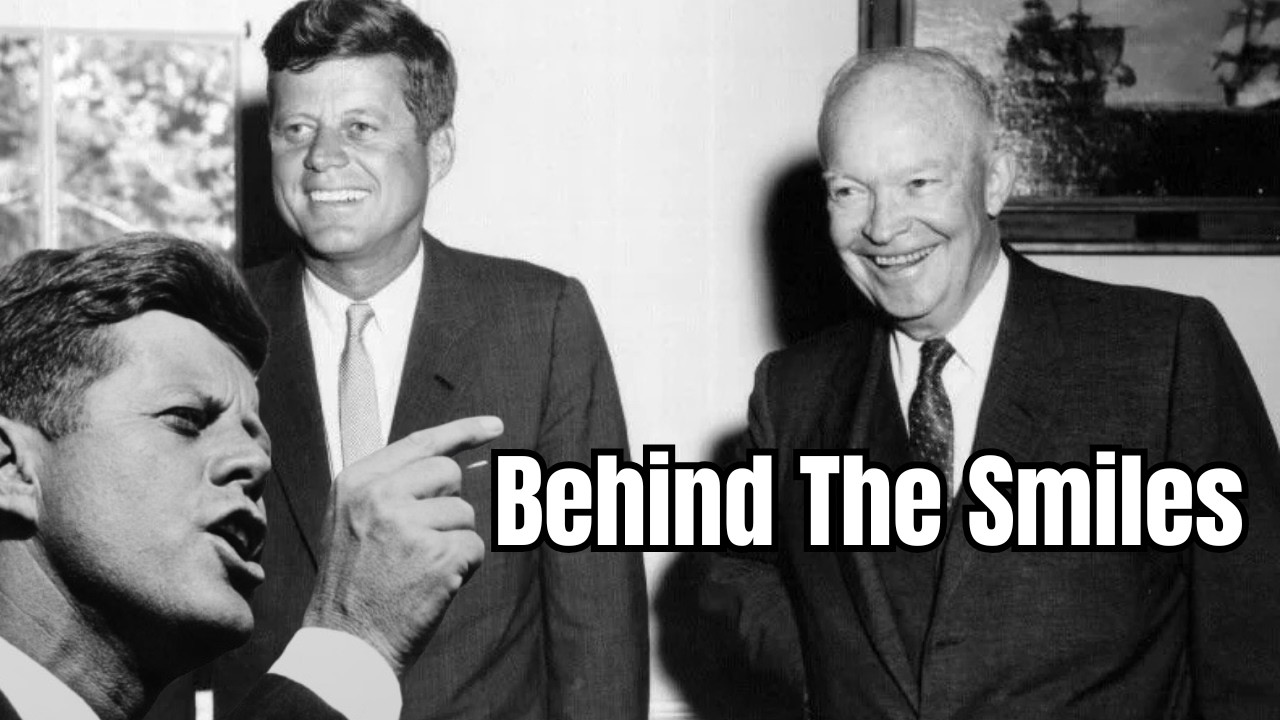
To the public, the transfer of power represented constitutional continuity and democratic stability. The two men exchanged the customary gestures of respect, demonstrating that even fierce political opponents could participate peacefully in the transition of presidential authority.
Privately, however, their relationship was considerably more complicated.
Kennedy had spent years criticizing Eisenhower’s leadership, sometimes in language far harsher than anything he expressed during public appearances. He considered the older president politically unimaginative, personally distant, and insufficiently responsive to the changing international environment. Eisenhower, meanwhile, had reservations about Kennedy’s youth, experience, and readiness to assume the responsibilities of the presidency.
Yet the most revealing aspect of their relationship was not the hostility that preceded Kennedy’s election. It was the unexpected respect that developed after the younger president began confronting the extraordinary responsibilities of the office.
Behind the public rivalry emerged a complicated relationship shaped by generational differences, political competition, military experience, and the sobering realities of governing during the Cold War.
Kennedy entered national politics within a Democratic intellectual environment that was deeply skeptical of Eisenhower’s presidency. Liberal historians, journalists, and political advisers frequently portrayed the Republican administration as passive, complacent, and overly dependent on the prestige Eisenhower had earned during World War II.
Among the most influential voices in that environment was historian Arthur M. Schlesinger Jr., who later joined Kennedy’s White House staff as a special assistant. Schlesinger believed the Eisenhower years had failed to address emerging domestic and international challenges with sufficient imagination or urgency.
His criticism reflected a broader political argument that became central to Kennedy’s presidential campaign: America possessed enormous economic and military power but lacked the dynamic leadership necessary to use that power effectively.
Kennedy absorbed much of this perspective during his rise from congressman to senator and ultimately presidential candidate.
His criticism was not limited to disagreements over government spending or foreign policy. According to accounts recorded by Schlesinger, Kennedy also held distinctly unfavorable personal impressions of Eisenhower.
During a private conversation at Hyannis Port in July 1959, Kennedy reportedly criticized Eisenhower’s loyalty toward longtime associates and described him as emotionally cold and vain.
The remarks revealed a personal judgment that went beyond ordinary partisan disagreement.
Kennedy saw Eisenhower as a man whose public reputation concealed characteristics he found unattractive. The older president’s extraordinary popularity did not impress Kennedy as much as his supporters might have expected.
The younger politician belonged to a generation eager to challenge established assumptions about leadership. He admired intelligence, energy, intellectual curiosity, and a willingness to confront difficult problems directly.
Eisenhower’s public manner appeared restrained and occasionally detached. His presidential style emphasized delegation, consensus, and the careful management of competing interests.
To Kennedy and many of his advisers, that approach could look like indecision.
Yet the appearance of passivity was not necessarily an accurate reflection of Eisenhower’s leadership.
As Supreme Allied Commander during World War II, Eisenhower had coordinated enormous military operations involving competing national interests, powerful personalities, and unprecedented logistical challenges.
His ability to manage disagreement without publicly displaying every internal conflict had been essential to his wartime success.
In the White House, he applied many of the same principles.
He frequently preferred to influence decisions through carefully structured meetings, private negotiations, and the management of advisers rather than through dramatic public declarations.
Kennedy’s political circle often interpreted this style as evidence that Eisenhower lacked intellectual engagement.
Later historians would challenge that interpretation, demonstrating that the president exercised considerably more control over his administration than many contemporary critics recognized.
The disagreement also reflected different experiences of war.
Eisenhower had commanded millions of Allied personnel during the campaign to defeat Nazi Germany. His wartime responsibilities required decisions affecting entire armies, national governments, and the future of Europe.
Kennedy had served courageously as a naval officer in the Pacific, commanding a patrol torpedo boat during World War II. His wartime experience was dangerous and personally formative, but it occurred at a very different level of military responsibility.
Both men understood sacrifice and national service.
Their experiences nevertheless shaped contrasting assumptions about the exercise of power.
Eisenhower had witnessed the consequences of large-scale military operations and understood the difficulty of coordinating military force with political objectives.
Kennedy belonged to a younger generation increasingly concerned that traditional American strategies were inadequate for confronting communist influence in newly independent nations.
Those differences became particularly important during the presidential campaign of 1960.
Kennedy argued that the United States needed to recover its momentum after eight years of Republican leadership.
His campaign repeatedly suggested that Eisenhower had allowed the country to drift while the Soviet Union expanded its international influence.
Kennedy’s language sometimes portrayed the 1950s as a period of wasted opportunity.
The argument appealed to voters concerned about Soviet technological achievements, the nuclear arms race, and the growing competition for influence in Asia, Africa, and Latin America.
The Soviet launch of Sputnik in 1957 had intensified public anxiety about American scientific and technological leadership.
The revolution in Cuba had brought Fidel Castro to power only ninety miles from the American mainland.
Conflicts in Southeast Asia raised difficult questions about how the United States should respond to communist movements without provoking a wider war.
Kennedy presented these developments as evidence that the country required a more vigorous president.
His promise to get America moving again became one of the defining messages of his campaign.
Eisenhower’s supporters viewed the criticism differently.
They argued that the outgoing president had preserved peace during an exceptionally dangerous period, avoided direct military confrontation with the Soviet Union, and maintained American prosperity.
They also believed Kennedy underestimated the dangers of aggressive foreign policy.
Eisenhower had spent years balancing military commitments against the possibility of nuclear escalation.
His caution reflected experience rather than indifference.
The older president was not enthusiastic about the Democratic candidate who hoped to succeed him.
Accounts of Eisenhower’s private conversations indicate that he questioned Kennedy’s political maturity and experience.
He was particularly skeptical of the role played by the Kennedy family’s wealth and political connections.
The contrast between the two men could hardly have been more striking.
Eisenhower had risen from modest circumstances through military service, eventually becoming one of the most recognizable commanders in modern history.
Kennedy came from a wealthy and politically ambitious family whose resources had helped support his public career.
Their different backgrounds encouraged mutual suspicion.
Eisenhower saw a younger politician who appeared impatient with experience.
Kennedy saw an older leader whose caution seemed indistinguishable from complacency.
Yet the relationship began changing before Kennedy even entered the White House.
On December 6, 1960, the president-elect met Eisenhower for an important transition discussion.
The meeting provided Kennedy with an opportunity to hear directly from the man whose administration he had criticized throughout the campaign.
The conversation covered major national security and foreign policy challenges facing the incoming government.
Europe, NATO, Cuba, Laos, and the broader struggle with the Soviet Union all required immediate attention.
Kennedy discovered that Eisenhower possessed a detailed understanding of the issues.
The outgoing president was not the disengaged figure suggested by some Democratic critics.
He demonstrated familiarity with the machinery of government, the personalities involved in international negotiations, and the consequences of different strategic choices.
His command of complex information made an impression on Kennedy.
According to historical accounts discussed in William I. Hitchcock’s The Age of Eisenhower, Kennedy later acknowledged privately that Eisenhower was more impressive than he had expected.
The admission was significant because it challenged an image Kennedy had developed over years of political opposition.
Eisenhower possessed a strong personality, and Kennedy could understand why Americans had repeatedly entrusted him with the presidency.
That realization did not transform Kennedy into an admirer of Republican policies.
But it complicated his earlier assumptions.
For the first time, Kennedy encountered Eisenhower primarily as an experienced president rather than as a political opponent.
The distinction mattered.
Campaigning allowed Kennedy to criticize decisions from the outside.
Preparing to govern required him to understand the difficult circumstances under which those decisions had been made.
The transition also revealed the extent to which presidential responsibility depended on information unavailable to ordinary political observers.
Kennedy was about to inherit intelligence assessments, military contingency plans, diplomatic commitments, and international disputes that could not be reduced to campaign slogans.
Eisenhower understood those responsibilities intimately.
His willingness to brief Kennedy reflected the institutional importance of continuity during a period of international tension.
The two presidents remained politically divided, but the meeting established a more serious foundation for their relationship.
That foundation would be tested almost immediately.
In April 1961, Kennedy authorized a CIA-supported invasion of Cuba by anti-Castro exiles.
The operation, later known as the Bay of Pigs invasion, had roots in planning conducted during the Eisenhower administration.
Eisenhower had approved efforts to develop a covert capability against Castro’s government.
The plan evolved during the transition, however, and Kennedy ultimately authorized the operation that was carried out.
On April 17, 1961, Cuban exile forces landed on the island.
The invasion rapidly collapsed.
Castro’s military defeated the attacking force, and the operation became a major embarrassment for the new American president.
Kennedy accepted public responsibility for the failure.
Privately, the disaster prompted intense anger and a reconsideration of how national security decisions were made.
The president had relied heavily on experienced advisers who had presented the operation as feasible.
Yet the assumptions underlying the plan proved deeply flawed.
Kennedy confronted a fundamental problem of presidential leadership: experts could agree with one another and still be wrong.
The failure also raised questions about whether the administration had adequately examined alternative outcomes.
On April 22, 1961, Kennedy met Eisenhower at Camp David.
The meeting occurred only days after the invasion’s collapse.
Eisenhower listened as Kennedy explained the circumstances surrounding the operation.
The former president questioned aspects of the planning and decision-making process.
Accounts of the meeting indicate that Eisenhower emphasized the importance of rigorous debate among advisers.
He understood from military experience that leaders needed to expose competing assumptions to direct examination.
Private consultations with individual officials could create the appearance of consensus without ensuring that disagreements had been fully explored.
The lesson was especially relevant to Kennedy.
His administration had assembled a group of exceptionally educated and accomplished advisers.
Yet intellectual distinction had not prevented a disastrous decision.
Eisenhower’s criticism suggested that effective leadership required more than surrounding oneself with talented people.
It required establishing procedures that encouraged disagreement, challenged assumptions, and clarified responsibility.
The meeting also exposed differences in how the two presidents understood military operations.
Eisenhower had extensive experience evaluating strategic objectives, logistical requirements, and the relationship between military plans and political outcomes.
Kennedy was still learning how to manage those considerations from the Oval Office.
The Bay of Pigs demonstrated that presidential authority carried consequences far beyond those encountered during a campaign.
Kennedy could no longer attribute national security failures solely to the previous administration.
He had approved the operation.
He now had to confront its consequences.
Eisenhower’s perspective offered a reminder that the presidency was an institution requiring disciplined judgment rather than simply political energy.
The encounter did not eliminate disagreements between them.
Eisenhower remained critical of Kennedy’s handling of Cuba.
Kennedy continued questioning aspects of Eisenhower’s foreign policy legacy.
But the older president had become a figure whose advice Kennedy could not easily dismiss.
That development was important because the international environment was becoming increasingly dangerous.
The Soviet Union was testing the new administration’s resolve.
Berlin remained a major source of tension between East and West.
Communist influence in Cuba posed a direct challenge to American strategic interests.
Laos and other conflicts in Southeast Asia presented difficult choices about intervention.
Kennedy’s early presidency therefore unfolded under pressures that made Eisenhower’s experience increasingly relevant.
The younger president continued pursuing a different approach to foreign policy.
His administration emphasized flexible response, counterinsurgency capabilities, and the need to compete with communism across multiple political and military settings.
These priorities reflected Kennedy’s belief that nuclear threats alone could not address every Cold War confrontation.
Eisenhower’s administration had relied heavily on deterrence and the threat of massive retaliation.
Kennedy believed that approach left American policymakers with too few options between diplomatic protest and nuclear war.
The disagreement was substantive.
It reflected competing assessments of how best to preserve American security.
Yet Kennedy’s growing respect for Eisenhower demonstrated that policy disagreement did not require dismissing an opponent’s competence.
The distinction became particularly visible during the Cuban Missile Crisis.
In October 1962, American reconnaissance revealed that the Soviet Union was installing nuclear missiles in Cuba.
The discovery created one of the most dangerous confrontations of the Cold War.
Kennedy faced military and diplomatic choices carrying extraordinary risks.
An immediate airstrike could destroy some missile installations but might fail to eliminate every weapon.
An invasion could trigger a wider conflict.
Doing nothing could undermine American security and credibility.
The administration debated different responses while attempting to prevent the crisis from escalating into nuclear war.
Kennedy eventually chose a naval quarantine designed to prevent additional offensive military equipment from reaching Cuba.
He also pursued diplomatic efforts to secure the withdrawal of the missiles already present.
Before announcing the crisis publicly, Kennedy contacted Eisenhower.
On October 22, 1962, the sitting president briefed his predecessor by telephone.
The conversation demonstrated that Kennedy recognized the value of consulting someone who had confronted Soviet pressure for eight years.
Eisenhower offered his assessment of the situation.
The exchange reflected both the continuity of American national security policy and the differences between the two presidents.
Kennedy remained responsible for the final decision.
But he was willing to seek the former president’s perspective during a moment of extraordinary danger.
That willingness represented a considerable change from the dismissive attitudes associated with Kennedy’s earlier political circle.
Only a few years before, Eisenhower had been portrayed as an unimaginative leader whose presidency symbolized national stagnation.
Now Kennedy was discussing the possibility of nuclear confrontation with him.
The older president’s experience had become an asset rather than merely a target of criticism.
The crisis continued for several tense days.
American forces prepared for possible military action.
Soviet and American officials exchanged messages while both governments assessed the consequences of escalation.
The confrontation eventually ended through a combination of public commitments and confidential diplomacy.
Soviet leader Nikita Khrushchev agreed to remove the missiles from Cuba.
Kennedy publicly pledged that the United States would not invade the island, subject to the conditions of the settlement.
A confidential understanding also involved the eventual removal of American Jupiter missiles from Turkey.
The agreement helped resolve the immediate crisis without direct military conflict between the superpowers.
On October 28, Kennedy again contacted Eisenhower.
The conversation occurred after the announcement that Soviet missiles would be withdrawn.
Kennedy did not disclose every confidential element of the settlement.
The secrecy surrounding the Turkish missile arrangement reflected the diplomatic sensitivities of the crisis.
It also demonstrated that Kennedy was managing relationships with former officials while protecting information considered essential to the agreement.
By this stage, the relationship between Kennedy and Eisenhower had become more complex than the original political rivalry.
Kennedy still disagreed with many aspects of Eisenhower’s foreign policy.
But he recognized the former president as an experienced leader whose judgment deserved consideration.
Eisenhower, for his part, continued evaluating Kennedy’s decisions critically.
He was not transformed into an unconditional supporter of the Democratic administration.
The relationship therefore combined respect, disagreement, caution, and political calculation.
That combination is more historically revealing than a simple narrative of mutual hostility.
Presidential relationships rarely fit neatly into categories of friendship or rivalry.
Former presidents possess experience that sitting presidents may value even when they reject their political philosophies.
They also remain influential public figures whose statements can shape political opinion.
Kennedy had reasons to consult Eisenhower and reasons to manage carefully what information he shared.
The same was true of Eisenhower’s assessment of Kennedy.
He could criticize the younger president’s decisions while recognizing the difficulty of governing under Cold War pressure.
Their interactions reflected the practical demands of national leadership.
The office itself imposed responsibilities that transcended the personal judgments formed during political campaigns.
Kennedy’s changing view also anticipated a broader transformation in historical assessments of Eisenhower.
During the early 1960s, many prominent intellectuals ranked Eisenhower relatively poorly among American presidents.
They considered his administration uninspiring and insufficiently responsive to major social problems.
His understated public style contributed to the impression that he had delegated too much authority.
Over subsequent decades, historians gained access to additional documents and reconsidered the administration’s internal decision-making.
Research revealed a president who frequently exercised influence through private meetings, careful planning, and deliberate restraint.
Eisenhower’s leadership appeared more purposeful than many early critics had recognized.
His management of Cold War tensions received greater appreciation.
His efforts to avoid direct conflict with the Soviet Union became increasingly significant in historical assessments.
Scholars also examined his role in building the interstate highway system, managing federal spending, enforcing school desegregation in Little Rock, and navigating the political pressures of the 1950s.
These achievements did not eliminate criticism of his presidency.
Historians continued debating his responses to civil rights, McCarthyism, covert foreign operations, and the developing American involvement in Southeast Asia.
But the overall assessment became more favorable.
Eisenhower increasingly appeared as a disciplined and strategically cautious leader rather than a passive figurehead.
That historical reassessment echoed the private reconsideration Kennedy had begun after meeting him in December 1960.
The younger president had discovered that Eisenhower possessed greater command and political strength than he expected.
Later historians reached a similar conclusion through documentary research.
The parallel is striking.
Kennedy’s initial criticism reflected the political assumptions of his generation.
His later experience forced him to confront evidence that complicated those assumptions.
Historical scholarship followed a comparable path.
As researchers moved beyond contemporary political commentary, Eisenhower’s presidency became more difficult to dismiss.
The change also highlights the limitations of judging presidents primarily through public style.
Some leaders communicate through dramatic speeches and highly visible initiatives.
Others prefer administrative discipline, private persuasion, and the careful management of institutions.
Both approaches can produce important results.
Kennedy excelled at public communication.
His inaugural address, televised press conferences, and speeches during international crises demonstrated his ability to inspire audiences and frame national challenges.
Eisenhower possessed a different form of authority.
His military reputation, measured manner, and broad public credibility allowed him to reassure Americans during a period of international uncertainty.
Their strengths were not identical.
Neither man’s style guaranteed successful decisions.
Kennedy’s administration experienced the Bay of Pigs disaster despite its reputation for intellectual energy.
Eisenhower’s administration faced serious criticism despite its commitment to careful planning.
The comparison reveals that effective presidential leadership requires balancing confidence with humility.
Kennedy’s early assumptions about Eisenhower were shaped partly by his confidence that a new generation could govern more effectively.
The realities of office challenged that confidence.
He discovered that national security decisions involved uncertainty, incomplete intelligence, and competing risks.
Even experienced advisers could misunderstand events.
Military operations could fail despite extensive preparation.
Diplomatic concessions could be necessary even when politically uncomfortable.
Eisenhower had confronted similar difficulties for eight years.
Kennedy’s growing appreciation of that experience was therefore not simply a change in personal opinion.
It reflected his developing understanding of the presidency.
The responsibilities of the office encouraged him to distinguish political rhetoric from practical judgment.
That distinction is central to understanding their relationship.
Kennedy never needed to agree with Eisenhower’s entire record to recognize his abilities.
He could believe that the United States required a different foreign policy while acknowledging that Eisenhower had managed dangerous international circumstances with considerable skill.
He could criticize the older president’s caution while appreciating the experience behind it.
He could reject specific recommendations while valuing the perspective from which they came.
The relationship also demonstrates how personal impressions can change through direct contact.
Kennedy’s early views had been reinforced by advisers who shared his political assumptions.
His transition meeting with Eisenhower exposed him to a different reality.
The former president was informed, forceful, and deeply engaged with the challenges facing the country.
That encounter did not erase years of criticism.
But it weakened the caricature.
Subsequent events made the revision more difficult to ignore.
The Bay of Pigs demonstrated the danger of flawed decision-making.
The Cuban Missile Crisis illustrated the importance of restraint, consultation, and careful strategic calculation.
Both experiences placed Kennedy in situations where Eisenhower’s perspective could be useful.
The younger president learned that criticism was easier than responsibility.
From outside the White House, it was possible to condemn caution as weakness.
From inside, caution could represent an effort to prevent catastrophe.
From outside, decisive action could appear unquestionably desirable.
From inside, decisive action could produce consequences that could not be reversed.
Eisenhower understood those dangers through decades of military and political experience.
Kennedy came to understand them through the pressures of his own presidency.
The difference between their generations remained significant.
But experience created a point of connection that had been less visible during the campaign.
Their relationship also offers a lesson about the role of former presidents in American government.
A former president may possess information, judgment, and institutional knowledge that cannot easily be replaced.
That experience can be valuable even when the former president belongs to a different political party.
Consultation does not require agreement.
Respect does not eliminate criticism.
And political rivalry does not necessarily prevent cooperation during a national emergency.
Kennedy’s telephone conversations with Eisenhower during the Cuban Missile Crisis demonstrated those principles.
They occurred at a moment when partisan disagreements were secondary to the possibility of nuclear confrontation.
The conversations did not determine the outcome by themselves.
But they showed that Kennedy was willing to draw upon the experience of a predecessor he had once criticized sharply.
That willingness reflected political maturity.
It also revealed how much his private assessment had evolved.
The public image of Kennedy and Eisenhower remained shaped by their contrasting styles.
Kennedy represented youth, eloquence, and the promise of change.
Eisenhower represented military achievement, stability, and the experience of an older generation.
Those differences were real.
But they obscured a more complicated private history.
Kennedy’s early remarks revealed impatience and contempt.
His later comments revealed surprise and respect.
His presidential decisions demonstrated both disagreement with Eisenhower’s policies and recognition of the former president’s experience.
The transformation was neither complete nor sentimental.
Kennedy did not abandon his Democratic convictions.
Eisenhower did not cease being a Republican critic.
Their relationship remained shaped by competing political philosophies.
Yet the evidence suggests that direct experience made Kennedy’s judgment more nuanced.
The man he had once regarded as cold and unimaginative proved capable of commanding a serious policy discussion.
The president he had criticized for excessive caution had successfully navigated years of nuclear tension.
The older leader whose administration Kennedy had portrayed as stagnant possessed insights that became relevant during the younger president’s most difficult crises.
Those discoveries complicated the political story Kennedy had told during his campaign.
They also complicated the historical story told by many of his intellectual allies.
Kennedy’s assassination in November 1963 prevented any further development of the relationship.
He never had the opportunity to reflect publicly on Eisenhower’s full legacy after completing his own presidency.
He could not write a retrospective account comparing their approaches to leadership.
He could not explain how his private impressions had changed over a longer period.
What remains is a collection of recorded conversations, contemporary recollections, presidential documents, and historical interpretations.
Together, they reveal a relationship that evolved under the pressure of responsibility.
The evidence does not support reducing the two men to permanent enemies.
Nor does it justify portraying them as close political partners.
Their relationship occupied the complicated territory between rivalry and respect.
Kennedy’s private criticism was genuine.
His later admiration for aspects of Eisenhower’s leadership was also genuine.
Both belong to the historical record.
The contrast matters because it reveals something fundamental about political judgment.
Public figures are often evaluated through the simplified narratives of election campaigns.
Opponents become symbols of failure, weakness, arrogance, or outdated thinking.
Those narratives can be politically effective.
But governing frequently exposes their limitations.
A president must confront problems that do not disappear through rhetorical confidence.
The consequences of decisions become immediate and personal.
Responsibility creates an understanding that political opposition alone cannot provide.
Kennedy learned that lesson quickly.
Within months of entering office, he faced a failed invasion, growing international tension, and the realization that expert advice could be dangerously incomplete.
Within two years, he confronted a nuclear crisis that threatened the survival of millions.
During those experiences, Eisenhower’s record became more relevant than Kennedy’s earlier caricature had allowed.
The former president had not solved every problem.
He had made controversial decisions and left difficult challenges for his successor.
But he had also preserved peace between the nuclear superpowers during an exceptionally dangerous period.
Kennedy came to appreciate at least part of that accomplishment.
His private reassessment was therefore a recognition of the difference between criticizing a presidency and occupying it.
The lesson extends beyond the personalities of Kennedy and Eisenhower.
It illustrates the importance of intellectual humility in political leadership.
A leader can disagree with a predecessor while recognizing that predecessor’s competence.
A new administration can pursue different policies without assuming that every earlier decision resulted from ignorance.
And political opponents can possess valuable experience even when their philosophies remain incompatible.
Kennedy’s relationship with Eisenhower embodied those tensions.
The two presidents belonged to different generations and represented different political traditions.
Their personalities, backgrounds, and public styles encouraged comparison.
Their private interactions revealed a more complex reality.
The younger president discovered that the older man was more capable than he had expected.
The older president remained skeptical of his successor but participated in consultations during moments of national danger.
Their exchanges demonstrated that mutual criticism and institutional respect could coexist.
The image from January 20, 1961, therefore deserves a second look.
Kennedy stood at the Capitol, announcing the beginning of a new era.
Eisenhower sat nearby, preparing to leave the office he had occupied for eight years.
The public saw a peaceful transfer of power.
Behind that ceremony were years of disagreement, personal suspicion, and competing visions of American leadership.
But the relationship was not finished.
The challenges of governing would force Kennedy to reconsider the man he had succeeded.
The Bay of Pigs would expose the dangers of overconfidence.
The Cuban Missile Crisis would demonstrate the value of experience and restraint.
And Kennedy’s private reflections would reveal that his judgment of Eisenhower had become more complicated than his campaign rhetoric suggested.
The most revealing part of their story is not that Kennedy once spoke harshly about Eisenhower.
Political rivals have always criticized one another.
What makes the relationship historically significant is that Kennedy eventually encountered evidence that challenged his assumptions and was capable of acknowledging it.
He discovered that Eisenhower was neither the passive figurehead imagined by some critics nor a leader whose experience could be casually dismissed.
The former president had strengths Kennedy had underestimated.
Recognizing those strengths did not require abandoning political differences.
It required a more serious understanding of presidential responsibility.
That understanding became one of the quieter lessons of Kennedy’s brief presidency.
The young leader who had promised to move America forward came to appreciate that governing also required learning from those who had come before him.
Eisenhower’s caution, experience, and institutional knowledge offered lessons that campaign rhetoric had obscured.
Their relationship ultimately reflected the difficult transition from political ambition to presidential judgment.
Kennedy entered office determined to distinguish himself from Eisenhower.
He discovered that some of the qualities he had criticized deserved closer examination.
And in the process, he demonstrated that even the most confident political leader can revise an opinion when confronted with the realities of power.
Behind the formal smiles of the 1961 inauguration was a rivalry shaped by personal criticism and political competition.
Behind the private conversations that followed was something more revealing: the gradual recognition that presidential leadership is far more complicated than it appears from the outside.
Kennedy’s changing assessment of Eisenhower remains a reminder that the presidency can transform not only the country a leader governs, but also the leader’s understanding of those who governed before him.


