What FDR Did in the First 24 Hours After Pearl Harbor
At 1:47 in the afternoon on December 7, 1941, Franklin D. Roosevelt was told that Japan had attacked Pearl Harbor.
What happened during the next twenty-four hours would determine how the United States entered the Second World War.
But the famous photograph of Roosevelt delivering his “Day of Infamy” speech has hidden something from history.
There was no finished speech waiting on his desk.
There was no complete picture of what had happened in Hawaii.
And there was no certainty about what Japan would do next.
There were fragments.
Telephone calls.
Military reports.
Conflicting information.
Ships burning thousands of miles away.
And a president who had to move from shock to decision while the situation was still unfolding.
The Roosevelt Presidential Library describes those twenty-four hours as among the most dramatic and consequential of his presidency, beginning with the first notification of the attack and ending with his address to Congress the following afternoon.
This is the story of what Franklin Roosevelt actually did during those hours.
1:47 P.M.: The News Reaches the White House
It was Sunday.
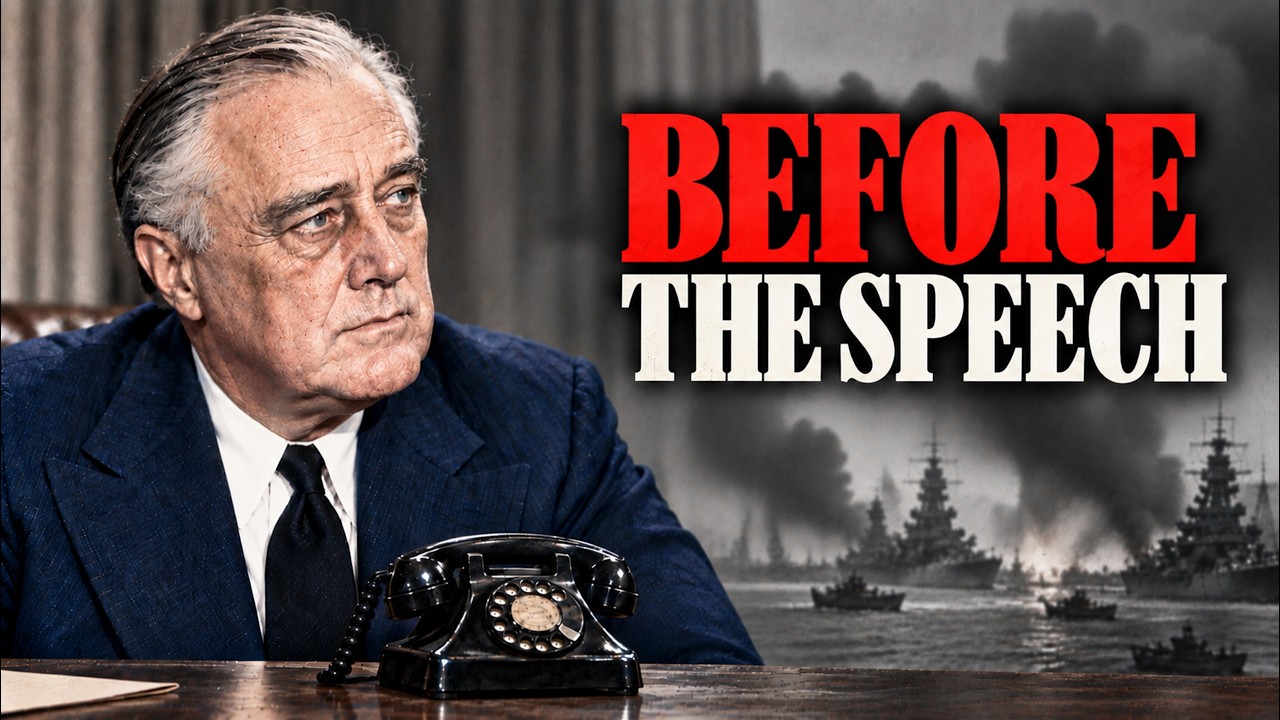
Roosevelt was at the White House with his close adviser Harry Hopkins when Secretary of War Henry Stimson’s telephone call interrupted the afternoon.
The message was devastating.
Japanese forces had attacked Pearl Harbor.
The information arriving at Washington was still incomplete.
The full scale of the destruction was not yet known.
Reports were coming in from Hawaii while the attack itself was still developing.
Roosevelt therefore faced a problem that would define the next several hours.
He knew that the United States had been attacked.
He did not yet know the complete military consequences.
And he did not know where the Japanese offensive would strike next.
The Roosevelt Library records that throughout the afternoon, the president met with advisers and monitored the rapidly developing crisis.
This is important because later generations remember December 7 as a single historical moment.
For Roosevelt, it was not one moment.
It was an unfolding emergency.
The Reports Kept Coming
The attack on Pearl Harbor lasted less than two hours.
But the Japanese offensive did not end there.
Japanese forces were attacking American and Allied positions across the Pacific.
Roosevelt’s eventual speech would mention attacks on Hong Kong, Guam, the Philippines, Wake Island and Midway.
The reports reaching Washington were therefore not simply about one naval base in Hawaii.
They indicated a much broader offensive.
The National Archives records that the United States suffered thousands of casualties and enormous losses of ships and aircraft during the attack.
Yet during those first hours, Roosevelt did not have the benefit of historical hindsight.
He had to make decisions with information arriving piece by piece.
That distinction matters.
The president knew enough to understand that the country was at war in everything but name.
But the government still had to determine what to do next.
The White House Goes Into Crisis Mode
As the afternoon continued, Roosevelt’s advisers gathered around him.
Military information was being collected.
Communications were being monitored.
Security around the White House was increased.
Plans were made for emergency protection of the president, including preparations involving a bomb shelter beneath the nearby Treasury Department building.
The atmosphere was therefore not simply political.
Washington itself was preparing for the possibility that the Japanese attack could expand to the American mainland.
The president’s immediate task was not to deliver a great speech.
It was to understand the danger.
And then communicate what the government knew.
Roosevelt Makes the First Big Decision
At some point during the afternoon, the central political question became unavoidable.
Would the United States declare war on Japan?
Roosevelt had already been dealing with a deteriorating relationship with Tokyo for years.
But now the decision was no longer theoretical.
The United States had been attacked.
Roosevelt decided he would go before Congress the following day and ask for a declaration of war.
According to the National Archives, shortly before 5 P.M., after meetings with his military advisers, Roosevelt began dictating his message to Congress.
The person taking the dictation was his secretary, Grace Tully.
Roosevelt reportedly told her that he intended to go before Congress the next day and wanted the message to be short.
That decision shaped one of the most famous speeches in American history.
He Didn’t Write the Speech the Way You Think
Roosevelt’s first draft was remarkably direct.
He did not attempt to produce a massive historical explanation of Japanese-American relations.
He did not spend pages describing every diplomatic dispute that had preceded the attack.
Instead, he focused on the immediate facts.
Japan had attacked.
The United States was in danger.
And Congress needed to declare war.
The National Archives notes that Secretary of State Cordell Hull had favored a longer treatment of Japanese actions, but Roosevelt rejected that approach in favor of a short appeal.
Roosevelt himself dictated the first version.
Grace Tully typed it.
Then the president took the document and began making handwritten changes.
And one of those changes would become legendary.
“World History” Becomes “Infamy”
The original opening was not:
“Yesterday, December 7, 1941—a date which will live in infamy…”
The first draft said that December 7 was a date that would live in “world history.”
Roosevelt crossed those words out.
He wrote “infamy.”
He also changed “simultaneously” to “suddenly.”
That was not a cosmetic edit.
It changed the emotional force of the entire opening.
The final sentence became:
“Yesterday, December 7, 1941—a date which will live in infamy—the United States of America was suddenly and deliberately attacked…”
The National Archives preserves Roosevelt’s handwritten corrections on the original draft.
This is one of the rare moments when historians can literally see a president shaping history with a pen.
The Speech Changed as the Information Changed
Roosevelt did not simply write the speech once and leave it alone.
As reports arrived, he updated it.
More Japanese attacks became known.
The geographical scope of the offensive became clearer.
The speech was modified to mention additional targets.
The president also strengthened the conclusion.
The message was becoming something more than a request for Congress to declare war.
It was becoming an explanation of why the American people should understand the attack as deliberate and why the nation had to respond.
The National Archives notes that Roosevelt added references to attacks on Guam, the Philippines, Hong Kong, Wake Island and Midway as information became available.
The famous speech therefore contains something unusual.
You can see the crisis developing inside the document itself.
Harry Hopkins Makes One Important Addition
Roosevelt’s closest adviser, Harry Hopkins, also suggested a significant addition.
Near the end of the speech appeared the words:
“With confidence in our armed forces—with the unbounding determination of our people, we will gain the inevitable triumph—so help us God.”
The National Archives identifies the “so help us God” addition as one associated with Hopkins during the editing process.
The speech was becoming shorter than the drafts some advisers wanted.
But it was also becoming more forceful.
Roosevelt was not trying to explain everything.
He was trying to establish certainty at a moment when almost everything else remained uncertain.
Overnight: America Waits
While Roosevelt worked on his message, Americans across the country were trying to understand what had happened.
Radio reports carried fragments of information.
Families gathered around radios.
Military bases went on alert.
Government agencies prepared for further attacks.
The United States had entered a fundamentally different reality.
But the formal declaration of war had not yet occurred.
That would require Congress.
And Roosevelt knew exactly what he needed to ask for.
December 8: Roosevelt Walks Into Congress
The following day, Roosevelt went to Capitol Hill.
At 12:30 P.M., he addressed a joint session of Congress.
The speech lasted only a few minutes.
But it contained one of the most consequential requests ever made by an American president.
Roosevelt asked Congress to recognize that a state of war existed between the United States and Japan.
He did not ask Congress to debate whether Pearl Harbor had been important enough.
He did not ask lawmakers to investigate the attack first.
He presented the attack as the decisive fact.
Japan had attacked the United States.
The United States would respond.
The National Archives preserves both the final speech and the congressional record surrounding the declaration.
Congress Responds Almost Immediately
The Senate voted unanimously for war.
In the House, the vote was overwhelmingly in favor, with Representative Jeanette Rankin of Montana—the only member to vote against the declaration.
The speed was extraordinary.
Less than twenty-four hours earlier, Americans had been living through a devastating surprise attack.
Now Congress had formally placed the country at war with Japan.
At 4 P.M. on December 8, Roosevelt signed the declaration.
The United States was officially at war.
What Makes Those 24 Hours So Extraordinary?
It is tempting to remember Pearl Harbor through the finished product.
The famous speech.
The famous phrase.
The declaration of war.
The beginning of America’s full mobilization.
But the surviving documents reveal something different.
Roosevelt did not experience December 7 as a perfectly organized historical sequence.
He experienced it as uncertainty.
Reports arrived.
He evaluated them.
He met with advisers.
He monitored the military situation.
He began preparing a speech before every detail was known.
Then he repeatedly revised that speech as new information arrived.
The famous words were not simply sitting inside his head waiting for the right microphone.
They emerged from a rapidly changing crisis.
And we can see that process because Roosevelt’s own handwritten corrections survived.
The Real Story Was in the Draft
The most revealing artifact from those twenty-four hours may therefore be a piece of paper.
Not the microphone.
Not the photograph.
Not even the final speech.
The draft.
On it, Roosevelt changed “world history” to “infamy.”
He changed “simultaneously” to “suddenly.”
He considered adding “without warning,” then crossed it out.
He altered the wording as military reports changed.
The National Archives describes the handwritten document as one of the pivotal records of American history.
That document allows us to see something the famous recording cannot.
It shows the president thinking.
Editing.
Rejecting.
Choosing.
And preparing to move a stunned country from uncertainty toward war.
Twenty-Four Hours That Changed Everything
At 1:47 P.M. on December 7, Roosevelt was told that Japan had attacked Pearl Harbor.
By roughly 5 P.M., he was dictating a request for a declaration of war.
Overnight, he refined the message while new reports arrived.
At 12:30 P.M. on December 8, he stood before Congress.
And by 4 P.M., the United States had formally declared war on Japan.
The entire transformation happened in roughly twenty-six hours from the initial notification to the signing of the declaration, with the critical first twenty-four hours carrying the country from shock to decision.
That is why the “Day of Infamy” speech deserves to be remembered as more than a famous piece of political rhetoric.
It was the final product of a night of incomplete information, military uncertainty, hurried drafting and deliberate presidential choices.
And perhaps the most remarkable part is that we can still see those choices.
They remain on the page.
In Roosevelt’s handwriting.
One crossed-out phrase at a time.


