On April 22, 1961, a military helicopter descended toward Camp David in the mountains of Maryland. Inside was Dwight D. Eisenhower, the former president of the United States, a five-star general, and the man who had commanded Allied forces in Europe during World War II. Waiting to receive him was John F. Kennedy, the forty-three-year-old president whose administration had just suffered one of the most humiliating foreign policy disasters in modern American history.
Only three days earlier, the Bay of Pigs invasion had collapsed on the southern coast of Cuba. A CIA-trained force of Cuban exiles had attempted to overthrow Fidel Castro’s government, only to find itself trapped, overwhelmed, and ultimately defeated. More than a thousand men had been captured, others had been killed, and the United States faced international embarrassment over an operation that was supposed to remain plausibly deniable.
Kennedy had been president for barely three months. He had entered office promising renewed American strength, confidence, and leadership in the Cold War. Now, his administration was confronting accusations of incompetence, deception, and reckless intervention.
The president needed advice. More importantly, he needed to understand how an operation approved under Eisenhower’s administration had become a catastrophe under his own.
So he invited the former president to Camp David.
What followed was not a dramatic confrontation filled with shouting or public accusations. It was a private conversation between two men who represented different generations of American leadership. Eisenhower asked pointed questions about military planning, air support, logistics, and presidential decision-making. Kennedy explained the assumptions behind his decisions and the circumstances in which the invasion had failed.
Their discussion was recorded in notes Eisenhower prepared afterward. Those notes reveal a striking contrast between the former president’s private concerns and his public support for his successor.
They also illuminate one of the most important lessons Kennedy carried into the Cuban Missile Crisis the following year.
The story begins long before that April afternoon, when the United States was struggling to decide how to respond to Fidel Castro’s revolution.
In January 1959, Castro’s revolutionary forces completed their overthrow of Cuban dictator Fulgencio Batista. The new government initially presented itself as a nationalist movement determined to end corruption and foreign domination. But its relationship with Washington deteriorated rapidly.
Castro’s government nationalized property, pursued sweeping economic reforms, and developed increasingly close relations with the Soviet Union. American officials feared that Cuba could become a communist foothold only ninety miles from Florida.
For Eisenhower, the situation represented a serious strategic challenge. He had spent eight years managing the Cold War, balancing military deterrence against the danger of direct confrontation with Moscow. His administration had relied heavily on covert operations as instruments of foreign policy, including CIA-backed interventions in Iran and Guatemala during the 1950s.
Cuba appeared to present another opportunity for covert action.
In March 1960, Eisenhower approved a CIA program intended to organize, train, and equip Cuban opponents of Castro. The objective was to create conditions under which Castro’s government might be overthrown without an overt American military invasion.
The plan developed under CIA Director Allen Dulles and senior operations official Richard Bissell. Cuban exiles were recruited and trained, while American officials considered how an armed landing might encourage resistance within Cuba.
The underlying assumption was that Castro’s government remained vulnerable and that an organized opposition force might trigger a broader uprising.
That assumption would prove deeply consequential.
By the time Kennedy won the presidential election in November 1960, the operation was already under development. But it had not reached its final form, and many important decisions remained unresolved.
Kennedy had campaigned against Republican Vice President Richard Nixon, who represented continuity with Eisenhower’s administration. During the campaign, Kennedy accused the administration of allowing the Soviet Union to gain a dangerous advantage in strategic missiles.
The alleged missile gap became one of the election’s most prominent national security issues.
Eisenhower considered the accusation misleading. Classified intelligence available to his administration indicated that the United States was not suffering the disadvantage Kennedy suggested.
Because much of the evidence was secret, Eisenhower could not publicly rebut the charge as forcefully as he wished.
The dispute contributed to an already complicated relationship between the outgoing and incoming presidents.
Eisenhower was seventy years old, a former supreme military commander who valued institutional procedures, established chains of command, and disciplined planning.
Kennedy was forty-three, energetic, intellectually confident, and determined to distinguish his administration from the one that preceded it.
Their political styles differed substantially.
Eisenhower had built a formal national security decision-making system that emphasized coordinated staff work and structured meetings. Kennedy preferred smaller discussions, personal relationships, and more flexible channels of advice.
Neither approach was inherently incapable of producing good decisions. But the differences would become important when the new president confronted the Cuban operation.
During the transition, Eisenhower’s administration briefed Kennedy on major national security matters, including Cuba.
Kennedy inherited an evolving CIA plan, not a completed military operation that required only presidential approval.
That distinction matters because responsibility for the Bay of Pigs cannot be assigned accurately by treating the invasion as entirely Eisenhower’s creation or entirely Kennedy’s invention.
The original covert action program began under Eisenhower. The final invasion plan, its modifications, and its execution occurred under Kennedy.
The CIA carried assumptions and planning weaknesses from one administration into the next.
Kennedy and his advisers made additional decisions that shaped the operation’s outcome.
The disaster emerged from that combination.
In early 1961, Kennedy’s administration reviewed plans for an exile invasion.
The CIA argued that the operation could succeed if Cuban forces were sufficiently weakened and the exile brigade established a defensible position.
The proposed landing site changed during the planning process. The eventual choice was the Bay of Pigs, on Cuba’s southern coast.
The area offered certain advantages for a covert landing, but its geography also created serious vulnerabilities.
Swamps surrounded much of the region. Access roads were limited. A force that failed to control the approaches could become trapped against the sea.
The operation also depended on assumptions about Cuban public opinion and military resistance.
CIA planners expected that the landing might encourage opposition to Castro.
They underestimated the government’s ability to respond and overestimated the prospects for a broader uprising.
The invasion was supposed to appear primarily Cuban rather than American. That requirement created a contradiction at the heart of the operation.
The exile brigade needed substantial military support to defeat Castro’s forces. But providing that support openly would reveal the United States as the power behind the invasion.
Kennedy wanted to avoid an overt American military intervention.
He was concerned about international reaction, particularly in Latin America and at the United Nations.
He also feared that visible American participation might create opportunities for Soviet propaganda or escalation.
The result was a plan attempting to combine military effectiveness with political deniability.
Those objectives were increasingly difficult to reconcile.
On April 15, 1961, aircraft flown by Cuban exiles attacked Cuban airfields. The aircraft were American-built B-26 bombers, and the operation was intended to weaken Castro’s air force before the invasion.
The attacks did not eliminate Cuba’s remaining combat aircraft.
They also generated immediate international controversy.
The attempt to present the strikes as an internal Cuban military revolt quickly came under scrutiny.
Photographs and inconsistencies in the official explanation undermined the claim that the operation was independent of Washington.
American involvement was becoming increasingly obvious before the main invasion had begun.
A further air strike planned for the morning of April 17 became a central point of dispute.
Kennedy’s administration restricted the operation amid concerns about diplomatic exposure and the political consequences of further attacks.
The decision reduced the exile force’s prospects for obtaining effective air superiority.
But it is important not to reduce the entire invasion’s failure to that single decision.
The plan already contained serious weaknesses involving intelligence, logistics, geography, and expectations of internal resistance.
Even stronger air support would not necessarily have guaranteed success.
The question is whether the operation had a realistic chance of achieving its political objective without a much larger American commitment.
That was a question Kennedy and his advisers had not adequately resolved.
On April 17, Brigade 2506 began landing at the Bay of Pigs.
The invasion quickly encountered severe difficulties.
Cuban government forces responded rapidly. Aircraft attacked ships and supply vessels. The exile brigade struggled to maintain its logistical support and establish a sustainable defensive position.
The geography that planners had expected to provide protection became a trap.
The invading force could not advance effectively.
It lacked sufficient air cover.
Its supplies were threatened.
The anticipated widespread uprising against Castro did not materialize.
By April 19, the invasion had collapsed.
The exact casualty figures vary among historical accounts, but approximately 1,200 members of the exile force were captured, and more than one hundred were killed.
The United States had suffered a humiliating defeat without achieving its principal objective.
Castro remained in power.
His government emerged politically strengthened.
The operation provided Cuba and the Soviet Union with evidence that Washington was willing to support an attempt to overthrow the revolutionary government.
For Kennedy, the consequences were immediate.
The invasion exposed weaknesses in his administration’s decision-making.
It damaged American credibility.
It raised questions about CIA judgment.
And it created uncertainty about how the young president would respond to future Cold War crises.
Kennedy publicly accepted responsibility.
He recognized that the operation had occurred under his authority, regardless of its origins in the previous administration.
But privately, he wanted to understand the chain of decisions that had produced the defeat.
That desire led him to Eisenhower.
On April 22, 1961, the former president arrived at Camp David.
The setting carried special meaning.
Eisenhower had used the presidential retreat extensively during his administration. He had named it Camp David after his grandson and had hosted important diplomatic meetings there.
In September 1959, Soviet Premier Nikita Khrushchev had visited the retreat during a period of cautious superpower diplomacy.
Eisenhower regarded the mountain setting as a place where leaders could discuss difficult matters away from the pressures of Washington.
Now the retreat belonged to Kennedy.
The former president was returning not as commander in chief but as an adviser.
Kennedy met Eisenhower when his helicopter arrived.
The two men proceeded to Aspen Cottage, where they began discussing the Cuban operation.
Eisenhower’s notes indicate that Kennedy reviewed the invasion’s planning, intended objectives, and eventual failure.
The former president had already received a briefing from CIA Director Allen Dulles, arranged at Kennedy’s suggestion.
That preparation allowed Eisenhower to compare the president’s account with information provided by the intelligence agency.
According to Eisenhower’s record, Kennedy’s description generally agreed with the briefing he had received.
But Eisenhower was less interested in hearing the broad outline again than in understanding the specific decisions that had led to disaster.
He began with military questions.
One of the most important concerned air support.
Eisenhower wanted to know why the operation had proceeded without ensuring that Castro’s remaining aircraft could not threaten the landing force.
The original concept had depended heavily on neutralizing the Cuban air force.
Without control of the skies, the exile brigade’s ships and supply lines were vulnerable.
Kennedy explained the political concerns surrounding additional air strikes.
He had wanted to avoid making American participation unmistakable.
That concern was understandable in diplomatic terms.
But Eisenhower viewed the situation from the perspective of a military commander.
He had spent decades planning operations in which success depended on the coordination of air, ground, and logistical forces.
For him, launching a military operation while withholding support essential to its success was deeply troubling.
He regarded the attempt to preserve deniability as particularly problematic.
An invasion involving trained exiles, aircraft, ships, weapons, and substantial American planning was unlikely to remain secret.
If the United States was already widely suspected of involvement, restricting military support might preserve little political advantage while creating enormous operational risk.
The invasion could fail, and American responsibility could still become obvious.
That was precisely the outcome the administration now faced.
Eisenhower’s criticism was not simply that Kennedy had been too cautious.
It concerned the relationship between political objectives and military requirements.
If a president approved an operation, Eisenhower believed he needed to ensure that its means were sufficient to accomplish its purpose.
If the political constraints made success unlikely, the president needed to reconsider whether the operation should proceed at all.
That principle had guided much of Eisenhower’s military thinking.
It reflected the experience of planning large operations in World War II, where inadequate coordination could have catastrophic consequences.
But the former president’s most important question may have concerned not aircraft or ammunition, but the process through which Kennedy had reached his decision.
Eisenhower asked whether the president had brought all the relevant advisers together and required them to debate the plan openly.
Had Kennedy listened to the arguments for and against the invasion in the same room?
Or had he consulted individual advisers separately?
The distinction was fundamental.
Eisenhower believed that the president needed to hear disagreements directly.
A military commander might recommend one course of action.
A diplomat might identify political risks.
An intelligence official might present evidence about the enemy’s capabilities.
A president needed those perspectives to confront one another before making a final decision.
Otherwise, each adviser could present a persuasive argument without facing questions from colleagues who possessed different information.
Eisenhower’s approach emphasized institutional debate.
He wanted competing assumptions exposed before an operation began.
Kennedy indicated that he had held meetings involving the relevant officials.
But the former president’s questions revealed concern about whether those meetings had produced genuine disagreement and rigorous scrutiny.
The Bay of Pigs planning process had been marked by a dangerous tendency toward consensus.
Officials who doubted the operation’s prospects did not always challenge the prevailing assumptions forcefully enough.
Some advisers believed the invasion was unlikely to succeed without direct American military intervention.
Others assumed that Kennedy would eventually authorize additional support rather than allow the exile brigade to be defeated.
Those expectations were not necessarily communicated clearly.
The CIA’s confidence in the plan also influenced the president’s assessment.
Kennedy entered office with limited executive experience and inherited an intelligence organization whose senior officials had developed the operation over many months.
He faced the difficult task of evaluating expert assurances while attempting to impose his own political limits.
The result was a decision-making process in which critical contradictions were insufficiently resolved.
Eisenhower’s questions exposed those contradictions.
He was not merely asking whether Kennedy had listened to advice.
He was asking whether the president had created a process capable of testing the advice before accepting it.
That lesson would become one of the most consequential consequences of the invasion.
The conversation then turned to the battlefield itself.
Eisenhower examined the geography of the Bay of Pigs and the defensive arrangements of the exile brigade.
The landing area was surrounded by swampy terrain with a limited number of access routes.
In theory, the invaders might have delayed Cuban government forces by blocking those approaches.
Eisenhower wanted to know whether the brigade had properly distributed equipment and organized defensive positions at the necessary points.
His questions reflected practical military concerns.
A force operating in difficult terrain needed clear defensive assignments.
It needed reliable communications.
It needed ammunition and equipment positioned where they could be used.
And it needed the ability to prevent enemy forces from rapidly penetrating its defensive perimeter.
Kennedy believed that the troops had been trained and equipped for those tasks.
But the speed of the defeat raised doubts about how effectively the plans had been executed.
Eisenhower’s notes did not resolve every tactical question.
He acknowledged uncertainty about why Cuban government forces had penetrated the defensive area so quickly.
That uncertainty is important.
The former president did not possess complete information during the meeting.
He was examining the failure in its immediate aftermath, when reports remained incomplete and some details were disputed.
His notes reflected an effort to identify questions rather than produce a definitive military history.
Another issue concerned logistics.
The invasion force depended on ships carrying ammunition, weapons, communications equipment, fuel, and other supplies.
The loss or damage of critical vessels could have devastating consequences.
Eisenhower identified the concentration of specialized equipment in a single ship as a serious weakness.
When that vessel was damaged, the troops lost access to supplies they needed.
This problem could not be explained solely by Kennedy’s restrictions on air strikes.
It reflected the planning and organization of the operation itself.
The CIA had designed an amphibious invasion that required effective military logistics.
Yet the agency was not a conventional military command responsible for conducting large-scale landing operations.
Its officers had experience with covert action, intelligence collection, and support for irregular forces.
But organizing a landing against a prepared government required coordination on a different scale.
The Bay of Pigs exposed the limitations of treating a military invasion as though it could be managed primarily as a clandestine intelligence operation.
The distinction mattered because the original program had been developed under Eisenhower.
The former president could criticize Kennedy’s decisions without denying that the plan contained earlier weaknesses.
The failure was not the product of one president’s judgment alone.
It involved institutional assumptions, intelligence shortcomings, and operational errors that crossed the presidential transition.
Eisenhower’s notes recognized several of those problems.
He was particularly concerned about the inadequate relationship between the plan’s objectives and its available resources.
A successful invasion required more than brave soldiers.
It required realistic intelligence, secure supply lines, effective air support, and a political environment in which the invading force could achieve its objective.
The exile brigade lacked several of those conditions.
Its members fought under circumstances that became increasingly hopeless.
The absence of the expected uprising left them isolated.
The inability to sustain the beachhead made defeat increasingly likely.
For Kennedy, the human consequences were severe.
Men who had been recruited and trained with American assistance were dead or imprisoned.
Their families demanded answers.
The United States faced responsibility for an operation that had failed while exposing those who participated to extraordinary danger.
The president could not reverse what had happened.
But he could attempt to understand the mistakes and prevent their repetition.
That was the practical purpose of his conversation with Eisenhower.
The former president’s private assessment was severe.
In his writings from the period, Eisenhower compared the Bay of Pigs unfavorably with the U-2 incident of May 1960.
The U-2 crisis had occurred when a Soviet missile brought down an American reconnaissance aircraft piloted by Francis Gary Powers.
The incident embarrassed Eisenhower’s administration and contributed to the collapse of a planned summit in Paris.
For Eisenhower, it had been one of the most damaging diplomatic episodes of his presidency.
Yet he regarded the Bay of Pigs as an even more troubling failure in certain respects.
The U-2 flights had produced valuable intelligence despite the eventual exposure of the program.
The Bay of Pigs had achieved none of its central objectives.
It had damaged American credibility without producing a compensating strategic gain.
Eisenhower’s private language reflected frustration with an operation that appeared both ineffective and poorly concealed.
But the public presentation after the Camp David meeting was entirely different.
When reporters were allowed to question the two men, Eisenhower did not launch a public attack on Kennedy.
He avoided revealing the critical details of their conversation.
Instead, he emphasized the principle that Americans should support the constitutional president in matters of foreign policy.
His statement reflected a longstanding view of the presidency.
Eisenhower had spent eight years bearing responsibility for decisions whose full complexity could not always be explained publicly.
He understood the pressures facing a commander in chief.
He also believed that public attacks from a former president could weaken American leadership during an international crisis.
Kennedy had requested advice, not a political confrontation.
Eisenhower was willing to provide criticism privately while avoiding public humiliation of his successor.
The contrast was striking.
Behind closed doors, he questioned Kennedy’s decisions about air support and the administration’s planning procedures.
In front of reporters, he demonstrated national solidarity.
That combination reflected a distinction between private counsel and public responsibility.
Eisenhower was a Republican who had supported Nixon in the previous election.
Kennedy was a Democrat whose campaign had criticized the outgoing administration.
Their political disagreements were real.
But Eisenhower did not treat the Bay of Pigs as an opportunity to damage the presidency for partisan advantage.
He believed the United States needed to present a united position during a dangerous period of the Cold War.
The former president’s restraint did not mean he approved of the invasion.
It meant he regarded the office Kennedy held as more important than the political satisfaction of publicly criticizing him.
The meeting continued over lunch and during a walk through the Camp David grounds.
The two men discussed additional aspects of the situation.
Eisenhower’s notes concluded without suggesting that the conversation produced a dramatic agreement.
He observed that their discussion had no definite conclusion.
They had talked extensively, eaten together, and walked through the retreat while continuing to consider the problems before them.
The absence of a decisive conclusion was itself revealing.
The Bay of Pigs could not be repaired through one conversation.
The captured exiles remained imprisoned.
Castro remained in power.
American prestige had suffered.
And Kennedy still faced the challenge of governing in a world where Soviet leaders were watching closely.
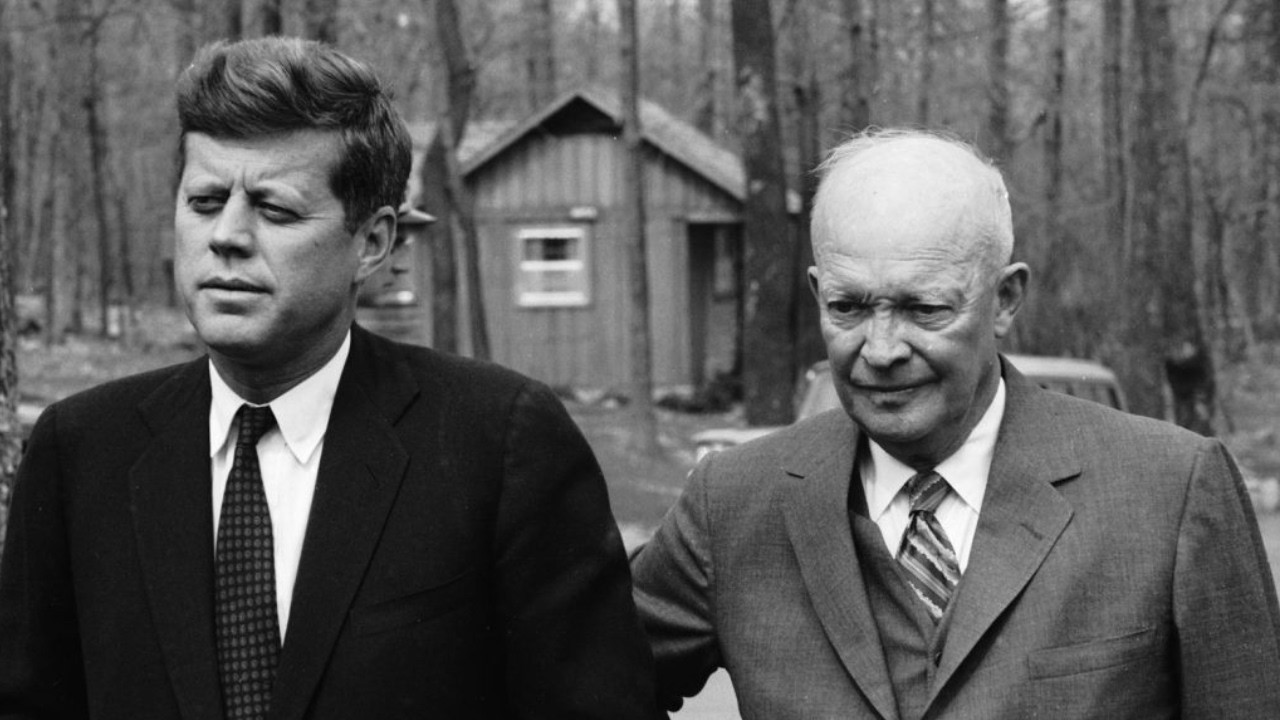
A photograph from the meeting captured the two presidents walking together at Camp David.
Kennedy appeared beside the older Eisenhower, both men engaged in serious conversation.
The image became a symbol of the transfer of experience between generations.
One man had commanded armies during World War II and governed through the early Cold War.
The other had inherited a dangerous international system and was learning the consequences of presidential power.
The photograph suggested mentorship, but the historical record reveals something more complicated.
Eisenhower was not simply teaching Kennedy how to be president.
He was examining a failure rooted partly in decisions made during his own administration.
Kennedy was not simply receiving criticism.
He was attempting to understand an operation whose planning had crossed administrations and whose failure now belonged to him.
Their conversation therefore represented a shared examination of institutional responsibility.
It also raised a larger question about American power.
Could the United States conduct covert military operations on a scale large enough to overthrow a foreign government while still denying responsibility?
The Bay of Pigs suggested that the answer was far more complicated than planners had assumed.
A small clandestine operation might remain concealed.
A major amphibious invasion involving aircraft, ships, weapons, and hundreds of trained fighters was another matter.
The attempt to preserve deniability had constrained military planning.
Yet it had not prevented international exposure.
The United States suffered the consequences of intervention without achieving the intended result.
Eisenhower considered that combination particularly damaging.
He believed American credibility depended partly on the willingness to use power decisively when national leaders had chosen to act.
But his broader record also demonstrated the importance he placed on avoiding unnecessary wars.
His presidency had been defined by efforts to contain Soviet expansion without provoking direct superpower conflict.
He had rejected some proposals for major military intervention when he considered the risks excessive.
His criticism of Kennedy therefore should not be interpreted as a blanket argument for unlimited military force.
The central issue was consistency between objectives, resources, and political constraints.
If a plan could not succeed within acceptable limits, the decision to proceed required serious reconsideration.
That lesson became increasingly important as Kennedy faced additional Cold War crises.
In June 1961, only weeks after the Camp David meeting, Kennedy met Soviet Premier Nikita Khrushchev in Vienna.
The summit was difficult.
Khrushchev pressed Kennedy over Berlin and other issues.
The young president later acknowledged that the encounter had been exceptionally demanding.
Historians have debated how much the Bay of Pigs influenced Khrushchev’s assessment of Kennedy.
The Soviet leader undoubtedly knew that the American administration had suffered an embarrassing defeat in Cuba.
But it would be too simplistic to claim that the invasion alone determined Soviet behavior.
Khrushchev’s policies reflected his own strategic calculations, domestic pressures, and perceptions of the global balance of power.
Nevertheless, the Bay of Pigs contributed to the international environment in which Kennedy was judged.
It raised questions about his experience and resolve.
Those questions mattered during the Berlin crisis.
In August 1961, East German authorities began constructing the Berlin Wall.
The barrier became one of the most visible symbols of the Cold War.
Kennedy confronted the challenge of defending Western access to Berlin without provoking a military confrontation that could escalate into nuclear war.
The experience required a careful balance of firmness and restraint.
It also demanded coordination among military advisers, diplomats, intelligence officials, and allied governments.
The lessons of the Bay of Pigs remained relevant.
A president could not afford to make decisions based solely on optimistic assumptions.
He needed to understand what military action could accomplish and what consequences might follow.
Those concerns became even more urgent in October 1962.
American reconnaissance photographs revealed Soviet nuclear missile installations under construction in Cuba.
The discovery created the most dangerous confrontation of Kennedy’s presidency.
Soviet missiles stationed in Cuba could threaten American territory and alter the strategic balance.
Kennedy faced several possible responses.
He could launch air strikes.
He could order a full invasion.
He could attempt diplomatic negotiations.
Or he could impose a naval quarantine intended to prevent further offensive weapons from reaching the island.
Each option carried risks.
An air strike might fail to destroy every missile.
An invasion could produce heavy casualties and provoke Soviet retaliation.
Diplomacy might appear too slow.
A quarantine could lead to a confrontation at sea.
The president needed to evaluate those alternatives without allowing one institution or adviser to dominate the discussion.
This time, Kennedy organized a different decision-making process.
He established the Executive Committee of the National Security Council, commonly known as ExComm.
The group brought senior officials together to examine the evidence and debate possible responses.
The president encouraged disagreement.
Advisers questioned one another’s assumptions.
Military proposals were evaluated against diplomatic and political consequences.
Intelligence assessments were scrutinized.
The process was not flawless, and Kennedy continued using private conversations and smaller groups.
But it was more deliberate than the decision-making that had preceded the Bay of Pigs.
The contrast is one of the most important developments of his presidency.
At the Bay of Pigs, the administration had struggled to confront the contradictions between covert action, military requirements, and political limits.
During the missile crisis, Kennedy demanded more explicit examination of those contradictions.
He wanted to know not only whether an option could achieve an immediate objective but also what might happen afterward.
What would the Soviet Union do if American aircraft attacked Cuba?
Would Soviet forces retaliate in Berlin?
Could a limited military action trigger a larger war?
How would Washington distinguish between a demonstration of resolve and an escalation that neither side could control?
Those questions reflected the kind of rigorous debate Eisenhower had urged at Camp David.
It would be an exaggeration to claim that the former president alone transformed Kennedy’s leadership.
The Bay of Pigs failure itself was a powerful lesson.
Kennedy also learned from advisers, intelligence officials, military officers, and his own experience.
But Eisenhower’s April 1961 questions fit directly into the broader change.
The president had been challenged to bring competing views into the same room and examine them before making a decision.
During the Cuban Missile Crisis, that principle became central to his approach.
Eisenhower remained involved as an outside adviser.
On October 17, 1962, CIA Director John McCone briefed him about the Soviet missile buildup in Cuba.
The former president expressed concern but reportedly did not consider the development entirely surprising.
He had anticipated that the Soviet Union might attempt a more aggressive military presence on the island.
He also continued criticizing the earlier failure at the Bay of Pigs.
His assessment reflected a belief that American weakness or indecision could encourage adversaries to take greater risks.
Yet Kennedy’s eventual response to the missile crisis demonstrated a more complex understanding of resolve.
The president chose a naval quarantine rather than immediately launching an air strike or invasion.
He combined military pressure with diplomatic communication.
He also sought to preserve options that might allow Khrushchev to retreat without catastrophic humiliation.
The crisis ended with the Soviet Union agreeing to remove its offensive missiles from Cuba.
The United States publicly pledged not to invade Cuba and privately agreed to remove obsolete Jupiter missiles from Turkey.
The resolution did not eliminate Cold War tensions.
But it avoided a direct military confrontation between the two nuclear superpowers.
The contrast with the Bay of Pigs was dramatic.
In April 1961, Kennedy had approved an operation based on assumptions that were insufficiently challenged.
In October 1962, he oversaw a decision-making process that repeatedly examined worst-case scenarios and the consequences of escalation.
The difference helped define his developing presidency.
Eisenhower’s influence should also be understood in the context of his own national security philosophy.
As president, he had established formal structures intended to coordinate military, diplomatic, and intelligence advice.
He believed that complex decisions required disciplined procedures.
His experience during World War II reinforced that conviction.
Planning the Allied invasion of Normandy had required coordination among commanders, governments, intelligence agencies, and logistical organizations.
Success depended on bringing different perspectives into a coherent strategy.
The operation also demanded a clear understanding of what resources were available and what risks could be accepted.
Eisenhower carried those lessons into the presidency.
He valued the National Security Council as an institution capable of presenting competing arguments.
He wanted disagreements documented and considered.
Kennedy initially regarded some of those procedures as cumbersome.
His administration sought greater flexibility.
But the Bay of Pigs demonstrated the danger of informal decision-making when responsibility became fragmented.
Advisers might assume someone else had raised an objection.
Military planners might believe political leaders understood operational requirements.
Political officials might assume intelligence professionals had accounted for diplomatic risks.
Without structured debate, those assumptions could remain untested.
Eisenhower’s questions exposed precisely that problem.
His criticism was therefore broader than the cancellation of an air strike.
He was challenging the way the administration had integrated intelligence, military planning, diplomacy, and presidential judgment.
The former president’s approach did not guarantee success.
His own administration had experienced serious failures, including the U-2 crisis.
His covert operations had produced controversial consequences.
And the original Cuban exile program had been authorized under his leadership.
But his experience gave him a clear understanding of how complex operations could fail when objectives and methods became disconnected.
That understanding made his advice valuable even when Kennedy disagreed with aspects of his assessment.
The meeting also revealed something important about the relationship between former and sitting presidents.
American political life often emphasizes competition between parties and administrations.
Presidential elections involve criticism of previous policies and promises of change.
But the responsibilities of national security can create moments when those divisions become secondary.
Eisenhower had supported Nixon against Kennedy.
Kennedy had criticized Eisenhower’s record.
Their political differences had not disappeared.
Yet the former president agreed to provide counsel during a moment of crisis.
He did not insist on public vindication.
He did not use the meeting primarily to assign blame.
He examined the failure and offered his judgment.
Kennedy, for his part, demonstrated a willingness to seek advice from a political opponent.
That decision required a degree of humility.
The young president had won the election by presenting himself as a new generation of leadership.
Now he was asking his predecessor to help him understand a humiliating defeat.
The invitation acknowledged the value of experience.
It also demonstrated that Kennedy understood the presidency could not be mastered through confidence alone.
The Camp David conversation did not repair the Bay of Pigs.
It did not free the captured exiles.
It did not remove Castro from power.
It did not eliminate tensions with the Soviet Union.
But it became part of Kennedy’s education as commander in chief.
The president had confronted the limits of intelligence assurances.
He had seen how political restrictions could undermine military operations.
He had learned that expert consensus might conceal unresolved disagreements.
And he had received a direct warning from a former supreme military commander about the importance of structured debate.
Those lessons mattered because Kennedy would face even greater dangers.
The Cuban Missile Crisis was not simply another covert operation.
It involved nuclear weapons, Soviet military forces, and the possibility of global catastrophe.
A poorly examined decision could have consequences far beyond the defeat of an exile brigade.
The experience of April 1961 helped shape the caution and scrutiny Kennedy brought to October 1962.
That does not mean the missile crisis was resolved without danger.
Several moments brought the superpowers close to uncontrolled escalation.
Military officers faced incomplete information.
Communications between Washington and Moscow were imperfect.
Actions by individual commanders could have triggered consequences neither government intended.
The eventual resolution depended on decisions made by both Kennedy and Khrushchev, as well as the restraint of numerous officials and military personnel.
But the American decision-making process had improved.
The president had learned to demand alternatives and challenge assumptions.
The Bay of Pigs remained a failure.
Its lessons became part of the administration’s later successes.
Eisenhower’s private notes provide a rare window into that transformation.
They show a former president examining an operation with the habits of a military commander.
He asked about air superiority.
He asked about defensive positions.
He asked about equipment distribution.
He asked about logistics.
And he asked whether the president had forced his advisers to debate openly.
Those questions were practical rather than theatrical.
They did not require dramatic accusations to reveal serious problems.
Their power came from the gap between what the invasion required and what its planners had actually provided.
The notes also show Eisenhower’s restraint.
He recorded uncertainties.
He did not claim to possess every answer.
He recognized that some failures originated in the operation’s earlier planning.
His assessment was critical, but it was not a complete effort to transfer responsibility to Kennedy.
That makes the document more historically valuable.
It reveals how an experienced leader examined failure while acknowledging that the available information remained incomplete.
The public record of the meeting adds another dimension.
Eisenhower’s remarks to reporters demonstrated his belief that a former president should avoid undermining the incumbent during an international crisis.
He could disagree privately while supporting the constitutional office publicly.
That distinction was particularly important in 1961.
The Cold War was not merely a domestic political contest.
Foreign governments were assessing American leadership.
The Soviet Union was watching for signs of division.
Castro’s government had just defeated an American-backed invasion.
Eisenhower understood that public conflict between presidents could intensify doubts about Washington’s resolve.
His public restraint was therefore a strategic choice.
It did not erase his private criticism.
It placed that criticism within a broader understanding of national responsibility.
The meeting became especially memorable because of the setting.
Camp David had been Eisenhower’s retreat.
He had used it for diplomacy, recreation, and reflection.
Its wooded paths and mountain atmosphere were associated with his presidency.
Now he walked those same grounds beside the man who had succeeded him.
The photograph of the two leaders together captured a moment of transition.
Eisenhower’s generation had fought World War II and established many of the institutions of the early Cold War.
Kennedy’s generation was inheriting those institutions and confronting new forms of danger.
The older president brought decades of command experience.
The younger president brought political energy and a willingness to reconsider his methods.
Between them stood the wreckage of the Bay of Pigs.
Their conversation did not produce a dramatic declaration.
It produced questions.
That is why it remains significant.
The most important lesson was not a simple command to use more military force.
It was the need to align objectives, capabilities, intelligence, and political constraints before committing lives to an operation.
It was also the need to ensure that advisers confronted one another’s assumptions in the president’s presence.
A leader who hears only polished recommendations may never discover the disagreements hidden beneath them.
A leader who encourages debate can identify weaknesses before they become disasters.
The Bay of Pigs demonstrated the cost of failing to do so.
The Cuban Missile Crisis demonstrated the value of a more rigorous approach.
Kennedy did not become an infallible decision-maker after April 1961.
His administration continued making controversial choices.
His foreign policy remained shaped by Cold War assumptions and political pressures.
But the experience changed how he approached major national security decisions.
Eisenhower’s counsel formed part of that change.
The former president died in March 1969, more than five years after Kennedy’s assassination.
Kennedy never had the opportunity to complete his presidency or reflect publicly on the full historical consequences of the Bay of Pigs.
But the record of their Camp David meeting survives.
It preserves an unusual exchange between two presidents whose political differences were substantial but whose responsibilities overlapped.
The older man had authorized the beginnings of the covert operation.
The younger man had approved its final execution.
The intelligence agency had developed the plan.
The exile brigade had paid the immediate price.
And the United States had suffered an international defeat.
No single conversation could resolve every question of responsibility.
Yet Eisenhower’s notes reveal how the two leaders attempted to examine what had happened.
The former president pressed Kennedy about military support, logistical planning, and the structure of presidential advice.
Kennedy explained the political constraints and decisions that had shaped the invasion.
Their discussion continued through lunch and a walk around the retreat.
Then Eisenhower departed.
The public saw an image of presidential solidarity.
The private record preserved a much sharper examination of failure.
More than six decades later, that contrast remains the most revealing aspect of the meeting.
Eisenhower did not need to denounce Kennedy publicly to make his criticism clear.
Kennedy did not need to agree with every criticism to learn from the encounter.
Their conversation demonstrated that serious leadership sometimes requires uncomfortable questions rather than dramatic declarations.
The Bay of Pigs had exposed the danger of approving a military operation whose political limits and operational requirements were fundamentally misaligned.
It had also shown how an administration could become trapped by the confidence of its own advisers.
At Camp David, Eisenhower challenged Kennedy to examine both failures.
The following year, when Soviet nuclear missiles appeared in Cuba, Kennedy approached the crisis with a more deliberate system of debate.
He encouraged competing arguments.
He examined alternatives.
He questioned military assumptions.
And he resisted the pressure to choose the most aggressive response simply because it appeared decisive.
The connection between the two episodes is not proof that one conversation transformed an entire presidency.
It is evidence of a broader process of learning in which Eisenhower’s advice played a meaningful role.
The former president had spent his career understanding the relationship between planning and responsibility.
The young president had just discovered how costly failures in that relationship could become.
Their meeting joined those experiences.
In the end, Eisenhower’s most consequential message was not about Cuba alone.
It concerned the burden of presidential judgment.
A president must listen to experts without surrendering responsibility to them.
He must understand military requirements without ignoring political consequences.
He must encourage disagreement without allowing indecision to paralyze action.
And he must recognize that an operation’s success depends not on the confidence of its planners but on the realism of its assumptions.
Those were the lessons hidden inside Eisenhower’s questions on April 22, 1961.
The meeting ended without a formal conclusion.
But its significance continued far beyond the wooded paths of Camp David.
The Bay of Pigs remained a national embarrassment.
The captured exiles remained a painful reminder of the operation’s human cost.
Castro remained in power.
And Kennedy faced an increasingly dangerous Cold War.
Yet the president who left Camp David that afternoon had been confronted with a challenge that would shape his future decisions.
He had been asked whether he truly understood the arguments against the plans placed before him.
It was a question every commander in chief must eventually answer.
For Kennedy, the answer would become especially important when the world approached nuclear confrontation in October 1962.
That is the enduring significance of Eisenhower’s private conversation with JFK: not a dramatic rebuke delivered for the cameras, but a disciplined examination of failure that helped illuminate the difference between receiving advice and genuinely testing it.


