On November 22, 1963, President John F. Kennedy was assassinated in Dallas, Texas. Thousands of miles away, in Israel’s Negev Desert, a former prime minister listened to the news that one of the world’s most powerful leaders was dead.
David Ben-Gurion was seventy-seven years old. He had spent much of his life fighting to establish and defend the State of Israel. He had survived political upheaval, wars, assassination threats, and decades of confrontation with foreign governments.
Yet the death of Kennedy reportedly left him returning to one question.
“Where were his security forces?”
According to an account of Ben-Gurion’s private diary cited by historian Warren Bass, the former Israeli leader repeated that question before describing Kennedy as brave, sensible, and remarkably young.
It was an unusual response from a man who had spent the final months of his premiership in an increasingly difficult diplomatic confrontation with the American president.
Kennedy had demanded reliable information about Israel’s nuclear program.
Ben-Gurion had resisted American pressure for intrusive inspections of the nuclear facility at Dimona.
Their correspondence had become increasingly urgent during the spring of 1963.
Then Ben-Gurion resigned in June.
Five months later, Kennedy was dead.
The proximity of those events has attracted historical attention for decades. It has also encouraged speculation that extends far beyond what the documentary record can establish.
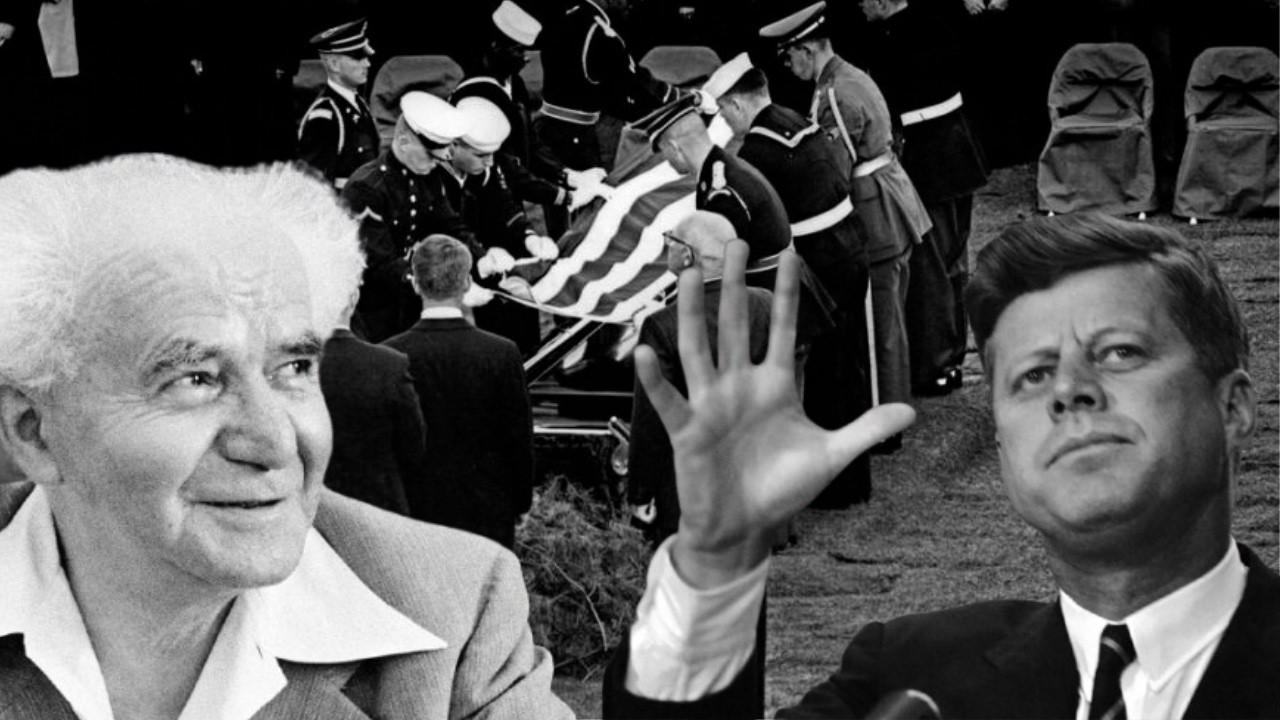
The surviving correspondence demonstrates that Kennedy and Ben-Gurion disagreed sharply over Israel’s nuclear ambitions. It does not establish that their dispute caused Ben-Gurion’s resignation, nor does it provide evidence connecting Israel or its leadership to Kennedy’s assassination.
The historical significance lies in a different, thoroughly consequential question: what happened to American pressure over Israel’s nuclear program after Kennedy’s death?
To understand that question, it is necessary to return to the years before Dallas, when the United States was becoming increasingly concerned about a nuclear installation rising in the Negev Desert.
David Ben-Gurion had been central to the creation of modern Israel.
Born in 1886 in what was then part of the Russian Empire, he immigrated to Ottoman Palestine as a young man and became a leading figure in the Zionist movement.
He devoted his political career to establishing a Jewish state.
The experience of European antisemitism, the Holocaust, and the struggle for independence reinforced his belief that Jewish security could not depend entirely on foreign powers.
On May 14, 1948, Ben-Gurion proclaimed the establishment of the State of Israel.
War followed almost immediately.
The newly established country faced military intervention from neighboring Arab states, and its leaders confronted the possibility that their state might not survive.
For Ben-Gurion, the experience became foundational.
He believed Israel required a military establishment capable of deterring enemies and ensuring that another catastrophe could not destroy the Jewish population.
His commitment to national security shaped decisions throughout his premiership.
It also helps explain why he regarded advanced military technology as a matter of national survival rather than merely international prestige.
The development of Israel’s nuclear program emerged from that strategic thinking.
During the 1950s, Israeli officials pursued scientific and military cooperation with France.
The relationship deepened amid shared concerns about Egyptian President Gamal Abdel Nasser and regional instability.
France provided significant assistance in developing the nuclear installation at Dimona.
Construction began in the late 1950s.
The facility was located in the Negev Desert, far from Israel’s principal population centers.
Its existence eventually attracted the attention of American intelligence agencies.
By 1960, U.S. officials had identified a substantial nuclear complex whose scale raised questions about Israel’s declared civilian intentions.
The facility appeared too significant to dismiss as an ordinary research project.
American intelligence analysts increasingly considered the possibility that Israel was pursuing the capability to produce nuclear weapons.
That possibility presented a serious problem for Washington.
The United States supported Israel’s security but also feared that the spread of nuclear weapons could destabilize the Middle East.
A nuclear-armed Israel might encourage other regional powers to pursue similar capabilities.
It could intensify existing conflicts and complicate American relations with Arab governments.
For John F. Kennedy, who entered the White House in January 1961, nuclear proliferation was a major international concern.
His presidency unfolded during an extraordinarily dangerous period of the Cold War.
The United States and the Soviet Union possessed arsenals capable of catastrophic destruction.
The Berlin crisis and the Cuban Missile Crisis demonstrated how rapidly international confrontation could approach nuclear war.
Kennedy’s concerns were therefore not limited to the Soviet Union.
He also wanted to prevent additional states from developing nuclear weapons.
Israel’s program became one of the most sensitive cases.
The difficulty was that Kennedy could not simply treat Israel as an adversary.
The United States had important political and strategic reasons to support the young state.
Kennedy had publicly expressed sympathy for Israel’s security concerns.
He understood the historical experiences that influenced Israeli policy.
Yet he also believed American support required reliable knowledge of what Israel was developing at Dimona.
Those two commitments eventually collided.
On May 30, 1961, Kennedy and Ben-Gurion met in New York.
Their discussion included Israel’s nuclear activities.
Ben-Gurion sought to reassure the American president about the country’s intentions.
Kennedy wanted greater clarity.
The meeting did not resolve the underlying disagreement.
Israeli officials continued to emphasize the peaceful character of their nuclear activities, while American intelligence agencies remained concerned about the facility’s potential military significance.
For the next two years, the issue developed through diplomatic correspondence, intelligence assessments, and negotiations over possible visits by American scientists.
Washington wanted inspections sufficiently thorough to determine whether Israel was pursuing weapons-related activities.
Israeli officials preferred more limited arrangements.
The disagreement was not merely about whether American visitors could enter the facility.
It concerned the scope of access, the frequency of visits, and the reliability of information that could be obtained.
An inspection limited to selected buildings or carefully prepared areas might not satisfy American intelligence requirements.
Kennedy wanted something more credible.
The president’s position became increasingly firm in 1963.
By that spring, he was pressing Israel to accept regular visits by qualified American scientists.
His administration sought arrangements that would provide meaningful access to the Dimona complex.
The objective was to determine whether the facility’s operations remained consistent with Israel’s public explanations.
Ben-Gurion viewed the issue through a different strategic lens.
For him, Israel’s security was inseparable from the experience of Jewish vulnerability.
He feared that neighboring governments might eventually acquire weapons or military capabilities capable of threatening Israel’s existence.
He also believed international guarantees could prove unreliable in a moment of crisis.
Those concerns were reflected in his correspondence with Kennedy.
In a lengthy letter dated May 12, 1963, Ben-Gurion emphasized the dangers confronting Israel.
He drew comparisons between the threats posed by Nasser and the catastrophic experience of European Jewry under Nazi Germany.
The letter presented Israeli security as an existential concern.
It argued, in effect, that the country’s survival could not be treated as an ordinary diplomatic matter.
But Kennedy was seeking a specific answer about Dimona.
The president wanted an inspection framework that could produce reliable information.
Ben-Gurion’s broader discussion of Israeli security did not fully address that demand.
Kennedy responded on May 18.
His letter acknowledged America’s commitment to Israel while warning about the consequences of nuclear proliferation.
He expressed concern that an Israeli nuclear weapons capability could have destabilizing effects beyond the immediate relationship between the two countries.
The language was diplomatic, but its meaning was serious.
Kennedy was making clear that American support and the nuclear question could not remain entirely separate.
The president believed Washington needed credible assurances.
He was unwilling to accept indefinite ambiguity.
This was a significant position because American-Israeli relations were already politically important.
A confrontation over Dimona risked creating tension between governments that otherwise shared substantial interests.
Nevertheless, Kennedy continued pressing.
By June 1963, the correspondence had become particularly urgent.
On June 15, Kennedy sent another communication intended for Ben-Gurion.
The letter reiterated American concerns and emphasized the importance of obtaining reliable information through regular inspections.
Historians examining the correspondence have described its tone as approaching an ultimatum.
The president was not merely asking Israel to provide a reassuring public statement.
He wanted concrete arrangements.
The following day, June 16, Ben-Gurion resigned as prime minister.
The timing was extraordinary.
It placed his departure immediately beside one of the most forceful American diplomatic initiatives concerning Israel’s nuclear program.
But chronology alone cannot establish causation.
Ben-Gurion had been struggling with serious domestic political problems.
The Lavon Affair, a controversy involving a failed Israeli covert operation in Egypt in 1954 and the subsequent disputes over responsibility, had created years of political conflict.
The affair damaged relationships within Israel’s leadership and contributed to divisions that continued into the 1960s.
Ben-Gurion’s resignation must be understood within that domestic context.
He cited personal and political reasons for leaving office.
Historians have examined whether the Dimona dispute added pressure to an already difficult situation.
Some have considered the possibility that Ben-Gurion was aware of Kennedy’s latest demands before the formal delivery of the June communication.
But the available record does not establish that he resigned specifically to escape American nuclear pressure.
Nor does it establish that the nuclear dispute was the decisive cause of his departure.
The more defensible conclusion is that Ben-Gurion left office during a period when the confrontation over Dimona had reached a particularly sensitive stage.
His successor, Levi Eshkol, inherited the problem.
Eshkol became prime minister in June 1963.
He faced the difficult task of preserving Israel’s relationship with Washington while maintaining the country’s nuclear development program.
Kennedy did not abandon the issue simply because Ben-Gurion was no longer in office.
On July 4, the American president sent Eshkol a message that combined congratulations with renewed pressure over Dimona.
The correspondence made clear that Washington expected the new Israeli government to address the inspection question.
Kennedy warned that American confidence could be seriously affected if the United States remained unable to obtain reliable information about Israeli nuclear activities.
That warning mattered because it demonstrated continuity.
The president’s concern was not a personal disagreement with Ben-Gurion.
It was an American policy objective.
The administration wanted to prevent the development of an Israeli nuclear weapons capability or, at minimum, obtain information sufficient to evaluate the risk.
Eshkol responded cautiously.
Negotiations continued over the terms of American visits.
Israel eventually accepted arrangements that allowed inspections, although their frequency and scope remained matters of concern.
The exchanges were handled with considerable secrecy.
Both governments understood that public disclosure of their disagreements could produce serious political consequences.
Washington did not want to undermine Israel unnecessarily.
Israel did not want to reveal sensitive information about its nuclear infrastructure.
The result was a difficult diplomatic process in which neither side fully trusted the other’s preferred arrangements.
As the summer of 1963 gave way to autumn, Kennedy remained concerned about nuclear proliferation.
The issue was part of a broader effort to limit the spread of nuclear weapons.
Earlier that year, the United States, the Soviet Union, and the United Kingdom had signed the Partial Nuclear Test Ban Treaty.
The agreement prohibited nuclear weapons testing in the atmosphere, outer space, and underwater.
It was a significant achievement during the Cold War.
Kennedy viewed arms control as an important means of reducing the danger of nuclear conflict.
But preventing the emergence of new nuclear powers remained difficult.
Israel’s nuclear activities presented a particularly sensitive challenge because of the country’s security concerns and close relationship with the United States.
Kennedy had to balance support for an ally with his determination to prevent regional nuclear proliferation.
That balancing act remained unresolved during his final months.
On November 16, 1963, six days before Kennedy’s assassination, Ben-Gurion gave an interview to journalist C. L. Sulzberger.
The former prime minister was no longer responsible for day-to-day government policy.
But he remained one of Israel’s most influential political figures.
The interview addressed Israel’s strategic position and the possibility of nuclear deterrence.
Ben-Gurion’s comments reflected the persistent security concerns that had shaped his leadership.
He did not view Israel’s strategic challenges as temporary.
He believed the country needed to prepare for threats that might emerge years or decades later.
His remarks demonstrated that leaving office had not eliminated his interest in nuclear policy.
Nor had it removed the underlying disagreement between Israeli strategic thinking and American nonproliferation objectives.
On November 20, two days before the assassination, Kennedy received an intelligence briefing that included information about Israeli missile procurement.
According to the transcript’s account of subsequently declassified material, American intelligence reported Israeli interest in French-developed Jericho missiles.
Such missiles raised questions because delivery systems could eventually be associated with nuclear weapons capabilities.
A missile program does not, by itself, establish the existence of operational nuclear weapons.
But intelligence analysts considered the relationship between nuclear technology and delivery systems important.
The briefing therefore belonged to the same broader pattern of American concern.
Kennedy’s administration was attempting to understand the direction of Israel’s strategic weapons development.
Then, on November 22, everything changed.
Kennedy traveled to Dallas as part of a political visit to Texas.
He was riding in an open presidential limousine through Dealey Plaza when shots were fired.
The president was gravely wounded.
He was taken to Parkland Memorial Hospital, where he was pronounced dead.
The assassination shocked the United States and the international community.
For Americans, the event created an immediate crisis of grief and uncertainty.
For foreign governments, it raised questions about the future direction of American policy.
Kennedy had been president for less than three years.
He had confronted the Soviet Union during the Cuban Missile Crisis.
He had delivered major speeches about freedom, civil rights, and the possibility of peace.
He had also developed personal relationships and disagreements with leaders around the world.
Ben-Gurion was one of those leaders.
The two men had not been close political partners on every issue.
Their confrontation over Dimona had become one of the most difficult episodes in American-Israeli relations during Kennedy’s presidency.
But disagreement did not eliminate personal respect.
When the news reached Israel, the country reacted with shock.
President Zalman Shazar, Prime Minister Levi Eshkol, and other Israeli officials expressed condolences.
The assassination was treated as a major international tragedy.
Israeli newspapers reported the event prominently.
The country’s political leadership recognized Kennedy’s importance to the United States and to Israel’s international position.
Ben-Gurion was no longer prime minister.
He had retreated from the daily demands of national leadership.
He spent much of his time at Sde Boker, the kibbutz in the Negev that had become closely associated with his vision of developing the desert.
There, he read, wrote, and followed world events.
He maintained a disciplined intellectual routine.
Even in retirement, he remained deeply interested in politics and national security.
The assassination reached him through radio reporting.
The transcript, drawing on an account attributed to historian Warren Bass, describes Ben-Gurion recording his reaction in his diary.
His first response centered on Kennedy’s protection.
“Where were his security forces?”
The question reportedly appeared repeatedly.
It was a striking reaction from a leader whose career had been shaped by security threats.
Ben-Gurion had spent decades confronting the possibility of political violence.
He understood that prominent national leaders could become targets.
He had also been responsible for protecting a state that he believed faced existential danger.
His attention to Kennedy’s security arrangements therefore reflected a familiar concern.
He wanted to understand how the president of the United States could have been exposed to such an attack.
The question was practical, urgent, and rooted in the assumptions of a lifelong political strategist.
But his diary reportedly contained another observation.
Kennedy had been brave, sensible, and young.
Those words conveyed something different.
They were not a demand for information.
They were an acknowledgment of character.
Kennedy had been forty-six years old.
Ben-Gurion was seventy-seven.
The difference in age was substantial.
Ben-Gurion had already spent decades in political struggle before Kennedy entered the White House.
He had witnessed the creation of Israel, multiple wars, and enormous changes in international politics.
Kennedy represented a younger generation of leadership.
His presidency had been defined partly by the language of youth, energy, and national renewal.
For Ben-Gurion, the sudden loss of such a leader was remarkable.
The words attributed to his diary also suggest that he distinguished personal qualities from policy disagreements.
Kennedy had challenged him over Dimona.
The American president had refused to accept vague reassurances.
He had pressed for inspections even though the issue threatened to complicate relations between two friendly governments.
Ben-Gurion had resisted those demands.
Yet he could still recognize Kennedy’s determination and courage.
That distinction is central to understanding the reported diary entry.
Political opponents do not necessarily regard one another as personal enemies.
Leaders may disagree sharply over national interests while respecting the judgment or resolve of their counterparts.
The Dimona dispute had been serious.
But the assassination was a human tragedy.
The former Israeli prime minister’s response reflected that difference.
It is also important to consider what the diary entry does not establish.
The quoted words do not explain Ben-Gurion’s private assessment of how Kennedy’s death might affect Israeli nuclear policy.
They do not indicate that he anticipated a change in American pressure.
They do not reveal satisfaction at the removal of a diplomatic obstacle.
Nor do they provide evidence of advance knowledge of the assassination.
Those conclusions cannot be drawn from the reported remarks.
The historical record permits a narrower interpretation.
Ben-Gurion reacted to Kennedy’s death by questioning the failure of presidential security and acknowledging the qualities of the man who had been killed.
Anything beyond that requires additional evidence.
Israel’s official response also reflected the importance of the moment.
Prime Minister Eshkol sent a message of condolence to President Lyndon B. Johnson, who had assumed office following Kennedy’s death.
The message expressed shock and grief.
It praised Kennedy’s leadership and recognized his friendship toward Israel.
President Shazar traveled to Washington for the funeral.
The Knesset held a commemorative session.
These actions demonstrated that the Israeli government treated the assassination as a major international loss.
They also reflected the complexity of Kennedy’s relationship with Israel.
His pressure over Dimona had created serious tension.
But his administration had also supported Israel’s security in important ways.
The disagreement over nuclear policy did not erase the broader relationship.
Kennedy was not simply an adversary of Israel.
He was an American president who supported the country’s security while opposing the possibility that it might develop nuclear weapons.
That combination made his policy difficult for Israeli leaders.
They valued American support.
But they resisted what they considered excessive interference in their strategic decisions.
The tension remained unresolved when Kennedy died.
His successor inherited both the alliance and the nuclear problem.
Lyndon B. Johnson became president on November 22, 1963.
He faced the immediate challenge of stabilizing the American government after an unprecedented national trauma.
He also inherited Kennedy’s foreign policy commitments.
These included the Cold War confrontation with the Soviet Union, the growing American involvement in Vietnam, and relations with allies across Europe and the Middle East.
Israel’s nuclear program was one issue among many.
The first American inspection of Dimona under the arrangements negotiated in 1963 took place in January 1964.
That was after Kennedy’s death.
The timing has attracted attention because Kennedy had wanted more regular and credible access before the end of his presidency.
The inspection program continued under Johnson.
American teams visited Dimona during the 1960s.
But the effectiveness of those inspections remained limited.
Questions persisted about whether the visits provided access sufficient to determine the full scope of Israeli nuclear activities.
The inspections did not produce a definitive public resolution of the nuclear issue.
Johnson’s approach also differed from Kennedy’s.
Historical accounts generally describe the Johnson administration as less confrontational toward Israel over Dimona.
That did not mean the United States abandoned all concern about nuclear proliferation.
American officials continued examining Israel’s capabilities.
But the intense presidential correspondence that had characterized Kennedy’s final months did not continue in the same form.
The relationship gradually developed along different lines.
The United States became increasingly important to Israel’s security.
Regional events, including the 1967 Six-Day War, transformed strategic calculations.
Israel’s military position changed significantly.
American policy toward the Middle East evolved.
The nuclear issue remained sensitive, but it became embedded within a broader relationship involving military assistance, diplomacy, and regional security.
By the end of the decade, the American approach had changed further.
In 1969, President Richard Nixon and Israeli Prime Minister Golda Meir reached understandings that became associated with a policy of nuclear ambiguity.
Israel maintained a position of neither confirming nor denying possession of nuclear weapons.
The United States generally avoided publicly challenging that ambiguity in the manner Kennedy had attempted through direct pressure over Dimona.
The inspection program ended.
The resulting policy became an enduring feature of American-Israeli relations.
Israel has not publicly acknowledged possessing nuclear weapons.
Independent analysts and international research organizations have long assessed that Israel possesses a nuclear arsenal.
But the country’s official posture of ambiguity remains distinct from the public declarations made by recognized nuclear-armed states.
This distinction is important when examining the historical record.
The end of inspections did not constitute a public Israeli admission of nuclear weapons development.
Nor did it resolve every question about the program’s history.
It represented a change in how the two governments managed a highly sensitive strategic issue.
The difference between Kennedy’s approach and the later American policy is historically significant.
Kennedy sought reliable information through direct diplomatic pressure and inspections.
His successors continued some inspection efforts but eventually moved toward a less confrontational arrangement.
The policy transformation occurred over several years.
It cannot be attributed solely to the assassination.
Changes in regional security, domestic politics, intelligence assessments, and presidential priorities also mattered.
Nevertheless, Kennedy’s death removed the individual who had personally pressed the issue with unusual urgency.
That is the strongest historically grounded connection between the assassination and the subsequent evolution of American policy.
It is a connection involving leadership and policy continuity, not evidence of responsibility for the assassination.
The distinction is essential.
A major political event can change international relations without having been caused by the governments or institutions that later benefit from a policy shift.
Historical analysis must separate consequences from causes.
Kennedy’s assassination altered the American presidency.
It changed the people making decisions.
It changed the immediate priorities of the administration.
It affected the tone and direction of numerous policy debates.
Israel’s nuclear program was among the issues whose diplomatic treatment evolved afterward.
But the existence of that change does not establish a conspiracy.
It establishes that presidential leadership matters.
Kennedy’s personal commitment to nuclear nonproliferation had shaped the pressure applied to Israel.
When he was gone, that particular combination of presidential attention, diplomatic urgency, and political calculation disappeared.
The broader problem remained.
But its management changed.
Ben-Gurion lived long enough to witness much of that transformation.
He remained an influential figure in Israeli political life after leaving the premiership.
His relationships with former colleagues and successors were often complicated.
He continued commenting on national affairs and maintaining strong views about security.
His retirement did not mean complete withdrawal from public life.
He formally left the Knesset in 1970.
He continued spending time at Sde Boker, where the desert environment reflected his belief in the importance of developing Israel’s southern regions.
His intellectual interests remained extensive.
He read widely and continued writing.
The former prime minister had devoted his life to a national project that he believed required constant vigilance.
Even after leaving office, he remained concerned about the country’s future.
Ben-Gurion died on December 1, 1973, at the age of eighty-seven.
His death came only weeks after the Yom Kippur War, another conflict that reinforced Israel’s security anxieties.
He had lived through the creation of the state, its early wars, and major transformations in its international relationships.
He had also outlived Kennedy by slightly more than a decade.
The two men belonged to different generations.
Ben-Gurion had emerged from the European Zionist movement of the early twentieth century.
Kennedy belonged to the postwar American political generation.
Their experiences produced different assumptions about security.
Ben-Gurion believed Israel’s survival required strategic independence and the ability to confront existential threats.
Kennedy believed the spread of nuclear weapons could create dangers that no individual country’s security calculations could fully justify.
Neither position can be understood without its historical context.
For Ben-Gurion, the Holocaust and the wars surrounding Israel’s establishment were not distant abstractions.
They were central to his political worldview.
For Kennedy, the possibility of nuclear catastrophe had become immediate during the Cuban Missile Crisis.
He had witnessed how rapidly superpower confrontation could threaten global destruction.
The two leaders therefore approached Dimona with different fears.
Ben-Gurion feared Israeli vulnerability.
Kennedy feared nuclear proliferation and regional instability.
Their disagreement was not simply a personal quarrel.
It reflected competing strategic priorities.
Both believed they were protecting essential national interests.
That is why their correspondence became so difficult.
Kennedy could acknowledge Israel’s security needs while insisting on inspections.
Ben-Gurion could value American support while resisting arrangements he believed threatened Israeli independence.
The letters exchanged in 1963 captured that tension.
They also reveal the importance of personal leadership in foreign policy.
Kennedy’s language became increasingly direct.
He wanted a specific inspection schedule.
He wanted meaningful access.
He wanted reliable information.
Ben-Gurion responded by emphasizing the broader threats facing Israel.
The exchange demonstrated two leaders talking about the same nuclear facility through different political frameworks.
The dispute did not end when Ben-Gurion resigned.
It continued under Eshkol.
And it did not disappear when Kennedy was assassinated.
It evolved under Johnson and Nixon.
The later policy of nuclear ambiguity represented a different approach to the problem.
But the underlying strategic questions remained.
How could Israel maintain security in a hostile region?
How could the United States prevent nuclear proliferation while supporting an ally?
How much transparency could Washington demand from a friendly government?
And what were the consequences of accepting uncertainty?
Those questions remain relevant to the history of nuclear diplomacy.
They also explain why the Kennedy-Ben-Gurion correspondence continues to attract scholarly attention.
The letters are valuable because they document an unusually direct confrontation between two governments that otherwise maintained important relations.
They reveal how close allies can disagree over matters they consider fundamental to national security.
They also show the limits of diplomatic reassurance.
Kennedy was not satisfied by general statements about peaceful intentions.
He wanted access capable of producing credible evidence.
Ben-Gurion was not satisfied by general assurances of American support.
He wanted Israel to retain control over its strategic future.
The resulting tension was difficult to resolve.
It became one of the most consequential unresolved issues of Kennedy’s final year.
But the dramatic sequence of June resignation, November assassination, and later policy change must be interpreted carefully.
The timing invites questions.
It does not answer them.
Ben-Gurion’s resignation followed years of domestic political conflict.
Kennedy’s assassination was investigated as a criminal act in the United States.
The later changes in American nuclear diplomacy developed through multiple administrations.
Connecting those events into a single deliberate plan would require evidence that the surviving correspondence does not provide.
The diary entry attributed to Ben-Gurion offers no such evidence.
Instead, it provides a glimpse of a former leader reacting to the sudden death of a younger counterpart.
His repeated question about Kennedy’s security is understandable in light of his own experiences.
His description of Kennedy as brave and sensible suggests respect despite disagreement.
And his observation about Kennedy’s youth reflects the shock of seeing a national leader killed before completing his political career.
The power of the episode lies partly in its restraint.
Ben-Gurion did not need to deliver a lengthy public statement for his reaction to be historically meaningful.
The reported diary entry contained a question and a brief judgment.
It did not settle the nuclear dispute.
It did not predict the future of American-Israeli relations.
It did not explain the assassination.
But it showed how a leader accustomed to conflict could respond to the death of someone who had recently challenged him.
The two men had disagreed over a subject that would shape Middle Eastern security for decades.
Kennedy had demanded inspections.
Ben-Gurion had defended Israel’s strategic concerns.
Their correspondence had reached an unusually tense stage before Ben-Gurion left office.
Then Kennedy’s life ended in Dallas.
The subsequent history of Dimona demonstrates that the issue outlived both men.
American inspections continued for several years.
The United States eventually adopted a less confrontational approach.
Israel maintained its policy of nuclear ambiguity.
The strategic questions that Kennedy had raised remained part of international debate.
Yet the most revealing detail from November 22, 1963, may still be the simplest.
A former Israeli prime minister, sitting far from Washington, heard that the American president had been assassinated.
He reportedly returned again and again to the failure of the president’s protection.
Then he acknowledged the courage and youth of the man who had confronted him.
The historical record does not reveal everything Ben-Gurion thought that evening.
It cannot establish whether he considered the future of Dimona, the inspection dispute, or the likely policies of Kennedy’s successor.
Those possibilities remain outside the documented diary account.
What survives is the contrast between a severe diplomatic confrontation and a brief personal tribute.
Kennedy and Ben-Gurion had disagreed about nuclear weapons, national security, and the responsibilities of allied governments.
Their differences were real.
Their correspondence was consequential.
And the policy questions they confronted did not disappear after either man left the political stage.
But when Kennedy was killed, Ben-Gurion’s reported words did not celebrate the end of a diplomatic confrontation.
They questioned how such an assassination could happen and recognized the character of the president who had died.
More than six decades later, that response remains a revealing moment in the history of American-Israeli relations.
It reminds us that diplomacy is conducted by individuals whose personal judgments coexist with national interests.
It also demonstrates why historical evidence must be handled carefully.
The documents establish a serious nuclear confrontation.
They establish Kennedy’s determination to obtain reliable information about Dimona.
They establish that American policy evolved after his death.
But they do not establish that the nuclear dispute caused Ben-Gurion’s resignation or that it explains Kennedy’s assassination.
The enduring story is therefore not a proven secret plot.
It is the documented history of two determined leaders, an unresolved nuclear disagreement, and a moment of extraordinary political tragedy.
Kennedy died before he could determine whether his pressure would ultimately change Israel’s nuclear course.
Ben-Gurion lived to see the relationship evolve in ways neither man could have predicted with certainty.
And the question reportedly written in his diary on the day of the assassination remains the human detail that connects their histories.
Where were the president’s security forces?
Behind that question stood decades of experience with war, vulnerability, and the dangers of political leadership.
Behind his tribute stood an acknowledgment that disagreement over national policy did not prevent respect for the man who had challenged him.
That is what makes Ben-Gurion’s reported response to Kennedy’s assassination historically compelling: not what it proves about hidden motives, but what it reveals about two leaders confronting the same dangerous world from profoundly different positions.


