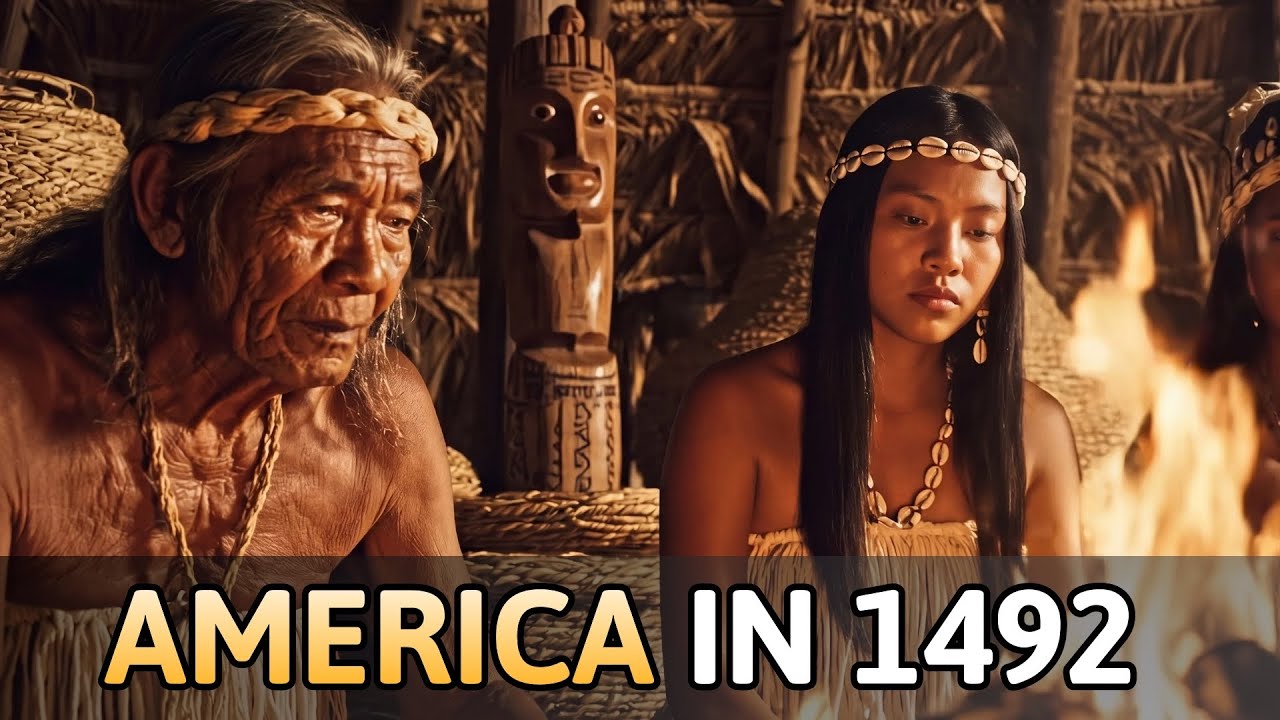
When Christopher Columbus reached the Caribbean in October 1492, he did not arrive in an empty wilderness waiting to be discovered.
He entered a hemisphere that human beings had inhabited for thousands of years.
Millions of Indigenous people already lived from the Arctic to Tierra del Fuego, speaking hundreds of languages and organizing their communities in radically different ways. Some lived in enormous cities. Others occupied farming villages, fishing settlements, mobile hunting camps, mountain communities or tropical forest landscapes carefully managed over generations. The precise population of the Americas in 1492 remains debated, with historical estimates varying enormously, but the existence of many millions of people is not in question. [Library of Congress](https://www.loc.gov/exhibits/1492/america.html?utm_source=chatgpt.com)
There was no single “Native American civilization.”
There was no single Native religion, government, house, diet or technology.
The Americas were approximately five times the size of Europe, and Indigenous societies had adapted to environments ranging from Arctic ice and Canadian forests to deserts, tropical islands, the Amazon Basin and some of the highest permanently occupied landscapes on Earth. The Library of Congress notes that by 1492 these societies had developed remarkably varied agriculture, hundreds of languages and numerous political systems, while major states had risen and fallen long before Europeans arrived. [Library of Congress](https://www.loc.gov/exhibits/1492/america.html?utm_source=chatgpt.com)
So asking what daily life was like before Columbus has no single answer.
A farmer outside Tenochtitlan would have experienced a world completely different from a Pueblo family in the American Southwest.
A Taíno fisherman in Hispaniola would not have lived like a llama herder high in the Andes.
A resident of a Mississippi Valley town would have known different foods, ceremonies and political institutions from someone living along the Pacific Northwest coast.
That diversity is the first thing popular history often loses.
The second thing it loses is scale.
Consider Tenochtitlan.
By the late fifteenth century, the Mexica capital stood on islands in Lake Texcoco in the Valley of Mexico.
Causeways connected it to the mainland.
Canals carried people and goods through the urban landscape.
Markets brought together farmers, craftspeople and merchants.
Temples and administrative buildings dominated the ceremonial center.
The National Museum of the American Indian estimates that Tenochtitlan may have contained around **200,000 inhabitants** at its height, making it one of the largest cities in the world. [National Museum of the American Indian](https://americanindian.si.edu/exhibitions/infinityofnations/mesoamerica-caribbean.html?utm_source=chatgpt.com)
This was not a cluster of temporary huts.
It was the capital of a powerful alliance.
The Mexica, together with Texcoco and Tlacopan, had constructed what historians commonly call the Aztec Triple Alliance, collecting tribute and projecting political influence across large areas of Mesoamerica.
Yet even this empire did not erase local identities.
Conquered communities could retain their own rulers, languages, religious practices and lands while being drawn into systems of tribute and political obligation. [Library of Congress](https://www.loc.gov/exhibits/1492/america.html?utm_source=chatgpt.com)
For an ordinary household, however, daily life was less about imperial strategy than food.
Maize was central throughout much of Mesoamerica.
Families also cultivated beans, squash and chiles.
Cotton could be woven into clothing.
Markets supplied pottery, food, tools and luxury products.
Long-distance trade brought materials from regions hundreds of miles apart.
Obsidian could move from volcanic highlands.
Cacao and cotton traveled from warmer lowlands.
Bright feathers became prestigious objects.
Maya and other Mesoamerican societies connected distant communities through extensive land and water routes centuries before Europeans established Atlantic colonies. [National Museum of the American Indian](https://americanindian.si.edu/exhibitions/infinityofnations/mesoamerica-caribbean.html?utm_source=chatgpt.com)
Writing also existed.
The idea that Indigenous Americans lived without written intellectual traditions is another enduring misconception.
Maya scribes developed an elaborate writing system capable of recording rulers, wars, dynasties, ceremonies and calendrical information.
Mesoamerican societies produced manuscripts and complex calendrical systems.
Knowledge was preserved through combinations of writing, oral tradition, visual symbolism and ritual performance.
Elsewhere, information systems took different forms.
In the Andes, the Inca state did not use alphabetic writing, but employed devices known as **khipus**, collections of cords and knots used for recording information.
And daily life in the Andes presented completely different challenges.
The Inca realm—Tawantinsuyu—expanded rapidly during the fifteenth century across territory that now belongs to several South American nations.
Communities lived at elevations where freezing nights, steep slopes and thin air made agriculture extraordinarily difficult.
Instead of treating those conditions as barriers, Andean peoples engineered around them.
Terraces transformed mountainsides into agricultural landscapes.
Irrigation systems directed scarce water.
Farmers cultivated numerous varieties of potatoes at high elevations and maize at lower elevations.
Llamas and alpacas provided fiber, transport and other resources.
People exploited temperature extremes to preserve food, including forms of freeze-dried potatoes. [Library of Congress](https://www.loc.gov/exhibits/1492/america.html?utm_source=chatgpt.com)
Then there were the roads.
The Qhapaq Ñan eventually formed a communication, transportation and administrative network extending for more than **30,000 kilometers**, drawing upon infrastructure created by earlier Andean societies and reaching its greatest expansion under the Inca in the fifteenth century.
Roads crossed mountains, deserts and valleys.
They incorporated stairs, bridges, drainage systems and way stations.
Messengers, armies, travelers and llama caravans moved along them.
Storehouses positioned throughout the empire helped support transportation and state redistribution. [UNESCO World Heritage Centre](https://whc.unesco.org/en/list/1459/?utm_source=chatgpt.com)
This was infrastructure built without horses, wheeled freight vehicles or modern machinery.
The achievement depended on human labor, detailed environmental knowledge and political organization.
But life was not necessarily easy simply because the engineering was sophisticated.
Inca society contained hierarchy and compulsory obligations.
Communities owed labor to the state.
Political expansion could involve warfare and forced population movements.
Imperial systems could offer security and infrastructure while also demanding obedience.
Complexity should never be confused with utopia.
The same is true in North America.
One of the most spectacular examples stood near the Mississippi River, close to modern St. Louis.
Today it is called Cahokia.
At its height between roughly AD 1050 and 1200, Cahokia proper may have contained **10,000 to 20,000 people**. If surrounding settlements are included, estimates for “Greater Cahokia” can reach roughly **40,000 to 50,000**.
Its urban landscape stretched across thousands of acres and included houses, public spaces and monumental earthen architecture. [National Park Service](https://home.nps.gov/articles/000/cahokia-mounds-state-historic-site-world-heritage-site.htm?utm_source=chatgpt.com)
The largest structure, now called Monks Mound, rises roughly thirty meters high.
It was built from earth.
Not by machines.
By people transporting enormous quantities of soil and reshaping the landscape over time.
Cahokia also contained large plazas and circles of wooden posts whose positioning reflected solar cycles.
Its residents depended heavily on agriculture and participated in broader Mississippian cultural and economic networks. [National Park Service](https://www.nps.gov/articles/000/cahokia-mounds-state-historic-site-world-heritage-site.htm?utm_source=chatgpt.com)
Imagine daily life there around AD 1100.
Smoke rising from household fires.
Farmers moving between maize fields and residential neighborhoods.
Craft workers shaping stone, shell and pottery.
Children moving through crowded settlements.
Political and religious ceremonies occurring around enormous earthworks.
Visitors arriving from distant communities.
Food being stored, cooked and exchanged.
The sounds would have been human and urban.
Yet when many Americans are taught pre-Columbian history, Cahokia is barely mentioned.
That omission creates the false impression that cities suddenly appeared in North America only after Europeans arrived.
Cahokia had already risen, flourished and begun declining centuries before Columbus crossed the Atlantic.
Farther west, Pueblo societies constructed another kind of sophisticated landscape.
At Mesa Verde and throughout the Four Corners region, Ancestral Pueblo peoples lived in farming communities for centuries.
Corn, beans and squash formed essential parts of their diet.
Agriculture was supported by techniques including terraces, dams and reservoirs, while surplus food could be stored to survive winters and poor harvests. [National Park Service](https://home.nps.gov/meve/learn/historyculture/people.htm?utm_source=chatgpt.com)
Their famous cliff dwellings represent only part of their history.
For long periods, many people lived on mesa tops where access to agricultural land was easier.
Homes changed across generations from pithouses to larger above-ground pueblos and multi-story masonry settlements.
By the 1200s, some families were living inside spectacular cliffside villages constructed from stone, timber, earth and plaster. [National Park Service](https://www.nps.gov/meve/learn/historyculture/places.htm?utm_source=chatgpt.com)
At Spruce Tree House around 1250, perhaps sixty to ninety people occupied a settlement containing 129 rooms and eight kivas.
During autumn, people harvested maize, beans and squash.
Food was dried on rooftops.
Women ground corn.
Children played.
Hunters left the village.
Dogs and domesticated turkeys moved through the courtyards.
Stored harvests could help families survive drought years. [National Park Service](https://www.nps.gov/meve/learn/education/sprucetreehouse_scene.htm?utm_source=chatgpt.com)
That reconstruction is important because it restores ordinary life to archaeology.
Ruins can make the past appear silent.
They were not silent when people lived there.
Someone was preparing food.
Someone was repairing a roof.
Someone was teaching a child.
Someone was weaving.
Someone was arguing.
Someone was telling stories.
Someone was worrying about rain.
These were homes, not monuments built for modern tourists.
And even communities separated by immense distances were not necessarily isolated.
Long-distance trade networks connected Native societies throughout much of the hemisphere.
Long before 1492, materials traveled astonishing distances.
In the Hopewell networks of eastern North America, objects and raw materials connected communities from the Atlantic to the Rocky Mountains.
Archaeologists have found copper, marine shells, mica, shark teeth and obsidian from distant sources at Hopewell ceremonial centers in what is now Ohio. [National Park Service](https://www.nps.gov/hocu/learn/historyculture/index.htm?utm_source=chatgpt.com)
Trade did more than move objects.
Ideas traveled.
Artistic styles moved.
Stories moved.
Ceremonial practices moved.
Marriage connected communities.
Political relationships changed.
Languages influenced neighboring languages.
People migrated.
America before Columbus was not a collection of frozen tribes living eternally within fixed boundaries.
It was dynamic.
Communities formed alliances.
Empires expanded.
Towns disappeared.
People relocated after droughts.
Wars changed borders.
New technologies spread.
Religious movements developed.
The archaeological record documents change everywhere.
Even the Amazon—once popularly imagined as a nearly untouched wilderness occupied only by tiny scattered populations—is forcing scholars to reconsider older assumptions.
LiDAR scanning in the Bolivian Amazon has revealed large pre-Hispanic settlements associated with the Casarabe culture, which flourished approximately AD 500–1400.
Researchers mapped major centers containing monumental earthen structures connected by raised causeways and canals, alongside many smaller settlements. [Nature](https://www.nature.com/articles/s41586-022-04780-4?itid=lk_inline_enhanced-template\&utm_source=chatgpt.com)
The discovery does not mean the entire Amazon was covered by cities.
It means the old assumption that tropical forests could support only very small, socially simple populations was wrong.
Indigenous peoples modified landscapes.
They farmed.
Managed forests.
Constructed earthworks.
Built transportation systems.
And created settlement patterns that vegetation later concealed.
The same misunderstanding affected Caribbean history.
When Columbus entered the Caribbean in 1492, he encountered islands already linked through maritime travel and exchange.
Taíno communities occupied much of the Greater Antilles.
People cultivated crops, fished, traveled by canoe, produced cotton textiles and created elaborate objects from wood, stone and shell.
Political authority could be organized around leaders known as caciques.
Communities participated in networks that connected islands rather than treating the Caribbean Sea simply as a barrier. [National Museum of the American Indian](https://americanindian.si.edu/exhibitions/infinityofnations/mesoamerica-caribbean.html?utm_source=chatgpt.com)
The sea was a highway.
Native mariners had been moving across it for generations.
That context fundamentally changes what October 1492 means.
Columbus did not bring mobility to isolated islanders.
He entered an existing maritime world.
He did not introduce organized society.
He encountered it.
He did not encounter people without agriculture, politics or religion.
He encountered societies whose institutions Europeans initially understood only imperfectly.
And the consequences were catastrophic.
European arrival introduced not just ships and new trade relationships, but conquest, enslavement, forced labor, land seizure and epidemic diseases.
The effects unfolded differently from region to region and over different timelines, but population losses became enormous.
The Smithsonian’s National Museum of the American Indian emphasizes that disease, warfare, enslavement and displacement devastated Indigenous communities after sustained European contact. [National Museum of the American Indian](https://americanindian.si.edu/nk360/informational/columbus-day-myths?utm_source=chatgpt.com)
That demographic collapse profoundly affected later European perceptions.
This is one of the darkest reasons pre-contact America could later be misremembered as an empty continent.
Europeans who arrived generations after initial epidemics sometimes encountered landscapes whose populations had already declined.
Villages had disappeared.
Fields had been abandoned.
Political systems had been disrupted.
Forests returned to previously managed landscapes.
To someone arriving later, the land could look sparsely inhabited.
That did not mean it always had been.
Then written histories often centered Europeans.
American history became Columbus.
Cortés.
Jamestown.
Plymouth.
Spanish missions.
British colonies.
The people already living there were often reduced to background characters who appeared only when Europeans encountered them.
But Indigenous history does not begin with contact.
The National Museum of the American Indian explicitly emphasizes that Indigenous peoples had lived in the Western Hemisphere for tens of thousands of years before Columbus and that Native histories continued through—and survived—the colonial catastrophes that followed. [National Museum of the American Indian](https://americanindian.si.edu/nk360/informational/columbus-day-myths?utm_source=chatgpt.com)
The word **survived** matters.
Another common distortion describes the pre-1492 world as though every society vanished.
They did not.
The descendants of these communities are alive.
Millions of Maya people live today.
Pueblo nations maintain living connections with ancestral landscapes such as Mesa Verde.
Andean communities continue languages and traditions associated with landscapes crossed by the Qhapaq Ñan.
Indigenous peoples throughout North, Central and South America continue to maintain distinct political, linguistic, religious and cultural identities. [National Park Service](https://www.nps.gov/meve/learn/historyculture/people.htm?utm_source=chatgpt.com)
So what did daily life really look like before 1492?
It depended where you stood.
Wake before sunrise near Lake Texcoco and you might see canoes moving toward one of the largest cities on Earth.
Wake in a Pueblo village and your attention might turn toward maize fields, water supplies and stored food.
Wake in the Andes and a llama caravan might be preparing to move along a mountain road connecting communities separated by hundreds of miles.
Wake beside the Mississippi and monumental earthworks might dominate the horizon.
Wake on Hispaniola and the Caribbean might connect your community to neighboring islands.
Wake in the Amazon and the forest around you might not be untouched wilderness at all, but a landscape shaped by generations of human management.
There was hardship.
Disease existed before Europeans.
Warfare existed.
Political inequality existed.
Drought could destroy harvests.
Empires demanded tribute and labor.
Communities competed for territory.
People experienced hunger, conflict and environmental crisis.
The goal of correcting the old stereotype should not be to replace it with another fantasy in which pre-contact America was perfect.
It was human.
That is precisely the point.
People fell in love.
Raised children.
Built houses.
Farmed.
Hunted.
Traded.
Fought wars.
Created art.
Prayed.
Played games.
Calculated seasons.
Watched the stars.
Governed communities.
Challenged rulers.
Migrated after environmental change.
Remembered ancestors.
And imagined futures.
Long before Columbus appeared on the horizon, those futures already belonged to millions of people.
1492 did not mark the beginning of American history.
It marked the beginning of a new and often catastrophic phase in histories that were already ancient.
And perhaps the biggest misconception is not that people underestimate one city, one empire or one technology.
It is that popular history has so often taught us to look at the Americas **from the moment Europeans arrived**.
Turn the perspective around, and Columbus suddenly becomes what he actually was in 1492:
A newcomer entering worlds that had been built without him.


