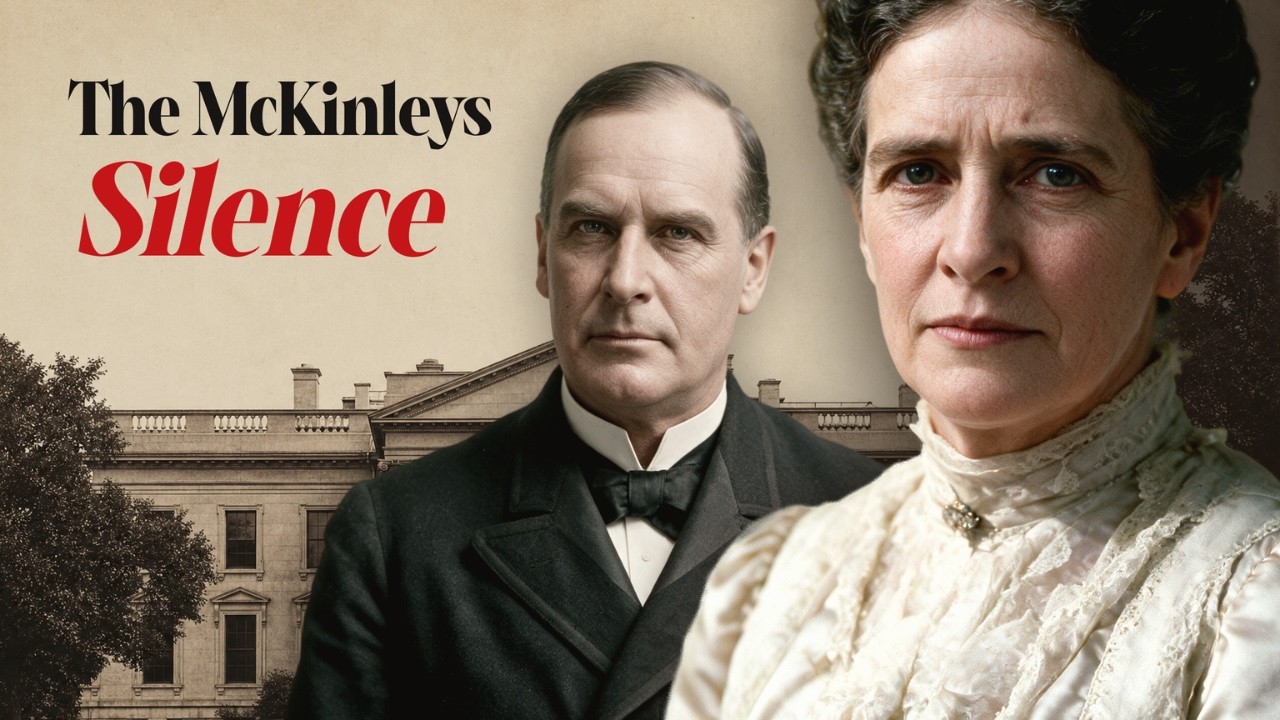
On the afternoon of September 6, 1901, President William McKinley stood inside the Temple of Music at the Pan-American Exposition in Buffalo, New York, doing something presidents of his era still did with astonishing informality.
He was shaking hands with ordinary citizens.
The line had been moving for only a few minutes when a twenty-eight-year-old anarchist named Leon Czolgosz stepped forward with his right hand wrapped in a handkerchief.
Hidden underneath it was a revolver.
McKinley extended his hand.
Czolgosz fired twice.
One bullet struck the president.
Another penetrated deep into his abdomen.
Men in the crowd immediately tackled the assassin and began beating him.
McKinley, pale and wounded, reportedly intervened.
“Go easy on him,” the president told them.
Then his thoughts turned somewhere else.
Not to the presidency.
Not to Vice President Theodore Roosevelt.
Not to whether the bullet would kill him.
To Ida.
George Cortelyou, McKinley’s presidential secretary, was close enough to catch the wounded president as he collapsed.
According to the White House Historical Association, Cortelyou remembered McKinley saying:
“My wife… be careful, Cortelyou, how you tell her. Oh, be careful.”
It was not an accidental concern.
For roughly three decades, William McKinley had organized an extraordinary portion of his private and public life around protecting Ida Saxton McKinley.
She suffered unpredictable attacks that could leave her briefly unresponsive or convulsing.
Today, the condition is commonly described as epilepsy, sometimes specifically petit mal epilepsy, although modern historians caution that a precise retrospective diagnosis is impossible from the surviving evidence. She also experienced migraines, weakness and periods of severe ill health.
In nineteenth-century America, such symptoms carried far more than medical consequences.
Epilepsy was poorly understood.
It could be associated with insanity, inherited “degeneracy,” nervous instability or even supernatural explanations.
For a political family living under relentless public observation, an uncontrolled seizure could become spectacle.
William and Ida developed a system.
At formal dinners, McKinley did something unusual for a president.
He insisted that Ida sit beside him.
Not merely near him.
Beside him.
That seating arrangement meant that if an attack suddenly began, William could respond before everyone else in the room understood what was happening.
When Ida experienced a seizure, historical accounts describe McKinley calmly placing a napkin or handkerchief over her face, shielding her from the gaze of the room.
Then he continued the conversation.
Guests learned to do the same.
The moment would pass.
McKinley would remove the cloth.
Ida would recover.
Dinner continued.
It became one of the most intimate rituals ever carried into the ceremonial life of the White House.
A president could be discussing diplomacy with senators, cabinet officers or foreign dignitaries while simultaneously watching the woman beside him for the first warning signs that she was slipping into another seizure.
To everyone else, the table represented national power.
To McKinley, it also represented a medical emergency that could begin at any second.
The story did not begin in the White House.
It began with a woman who, before illness transformed her life, had been unusually independent for her time.
Ida Saxton was born in Canton, Ohio, in 1847 into a prosperous banking family.
She was educated, traveled widely and spent roughly six months touring Europe with her sister in 1869.
After returning to Ohio, she worked at her father’s bank—an uncommon professional experience for a young woman of her social class in the nineteenth century.
Then she met William McKinley.
He was a Civil War veteran and young lawyer whose political ambitions were beginning to grow.
They married on January 25, 1871.
Their first daughter, Katherine—known as Katie—was born later that year.
A second daughter, Ida, followed in 1873.
Then everything collapsed.
Baby Ida died when she was only a few months old.
Not long afterward, Katie died before reaching her fifth birthday.
Ida also lost close family members around this period and had experienced difficulties related to pregnancy and previous physical injuries.
It was amid this accumulation of grief and physical trauma that her recurrent medical problems became a defining part of her life.
William McKinley did not withdraw from her.
He adapted his life around her.
As his career carried him to Congress, the Ohio governor’s mansion and eventually the presidency, Ida remained beside him whenever her health allowed.
The popular caricature of her as a permanently secluded invalid is misleading.
The National Park Service notes that she listened to political discussions, offered William advice and remained interested in public affairs.
She corresponded with women’s-rights advocates, including Susan B. Anthony, and publicly supported women’s suffrage.
Her health nevertheless imposed real restrictions.
At public receptions, Ida sometimes held flowers so she would not have to shake hands continuously.
She used a cane or wheelchair when necessary.
She spent significant periods resting.
When she was unable to perform some of the traditional duties expected of a first lady, others helped with White House hospitality.
But William resisted the idea that she should simply disappear.
That matters.
It would have been easier politically to leave Ida upstairs.
Instead, she attended official dinners.
And McKinley changed presidential custom to accommodate her.
The National First Ladies Library notes that he insisted she sit immediately next to him at meals, including formal functions, specifically so he could protect her privacy if an attack occurred.
The gesture appears simple until one imagines it happening.
Crystal glasses.
Silverware.
Foreign representatives.
Senators.
Military officers.
Political rivals.
Reporters waiting for fragments of information.
Then Ida’s expression changes.
Perhaps her hands tighten.
Perhaps she becomes still.
William notices first.
He reaches for a napkin.
He gently covers her face.
Nobody announces what is occurring.
Nobody rushes across the room.
The president keeps talking.
Minutes—or perhaps moments—later, Ida returns.
The napkin disappears.
Dinner resumes.
What guests witnessed was not merely a husband helping a sick wife.
They were watching two people manage disability inside one of the most public institutions in the United States at a time when disability could carry enormous stigma.
The McKinleys did not reveal every detail of Ida’s condition to the public.
Yet it would also be inaccurate to say absolutely nobody knew she was ill.
Newspapers occasionally discussed her poor health, especially when it disrupted travel or public appearances.
In 1901, for example, a major presidential trip across the country had to be shortened after Ida suffered a serious health episode in California.
What remained guarded was the exact nature and intimacy of her attacks.
Modern retellings sometimes claim that simply admitting Ida had epilepsy would certainly have destroyed William McKinley’s political career.
The evidence does not allow that conclusion to be stated so absolutely.
What can be said is that epilepsy carried substantial social stigma in the nineteenth century, and the couple carefully managed Ida’s privacy while allowing her to remain visible in political life.
William’s protection was practical as much as political.
He did not want his wife turned into a public spectacle.
By 1896, McKinley became the Republican presidential nominee.
Instead of traveling constantly around the country, he ran what became famous as the “front porch campaign.”
Delegations came to Canton, Ohio, to see him.
Hundreds of thousands eventually made the journey.
McKinley defeated William Jennings Bryan and became the twenty-fifth president of the United States.
Ida entered the White House with him in 1897.
Four years later, McKinley won reelection.
Then came Buffalo.
The McKinleys were originally supposed to visit the Pan-American Exposition earlier in 1901, but Ida’s illness forced changes to their plans.
They finally arrived in September.
On September 5, William delivered a major address at the exposition.
The following day, the couple visited Niagara Falls before the president returned to Buffalo for the public reception at the Temple of Music.
Ida did not accompany him inside.
At approximately 4 p.m., Czolgosz reached the front of the receiving line.
The assassin had wrapped a handkerchief around the hand concealing his weapon, something that did not immediately attract attention because the day was hot and many visitors carried handkerchiefs.
He fired twice at close range.
McKinley was transported to the exposition hospital.
The conditions there were far from what a modern presidential medical team would consider acceptable.
Doctors operated in a facility designed largely for first aid.
According to the National Park Service, they lacked ideal surgical equipment, operated without modern sterile precautions and could not locate one of the bullets.
An X-ray apparatus was available, but it was not ultimately used to locate the projectile.
At first, remarkably, McKinley seemed to improve.
The nation began hoping he would survive.
He was moved to the home of John Milburn, president of the exposition, where Ida could remain close to him.
Visitors came and went.
Theodore Roosevelt visited and left believing the president was recovering.
Robert Todd Lincoln, Abraham Lincoln’s surviving son, also visited and came away encouraged.
Then McKinley’s condition changed.
Infection and gangrene developed around the internal wound.
By September 13, doctors understood that the apparent recovery had ended.
William McKinley was dying.
Now the protective roles reversed.
For thirty years, he had watched Ida.
He had caught her.
Covered her face.
Controlled rooms around her.
Changed schedules for her.
Protected her from embarrassment.
Made sure she remained near him.
Now Ida sat beside his bed.
The White House Historical Association records that in McKinley’s final periods of consciousness, he spoke words of comfort to his wife.
He died early on September 14, 1901.
He was fifty-eight.
Ida had already buried both of their daughters.
Now she had lost the person who had structured much of his adult existence around ensuring she was never left helpless in public.
The image of McKinley after the shooting therefore becomes difficult to separate from the decades before it.
When he told Cortelyou to be careful about how Ida learned what had happened, he was repeating an instinct that had become automatic.
Protect Ida first.
Even after being shot.
Even while bleeding.
Even before anyone knew whether he would live.
The concern was not irrational.
Emotional stress could worsen Ida’s condition.
McKinley knew that better than almost anyone.
He had witnessed her attacks for decades.
He understood that telling her brutally—“Your husband has been shot”—might itself create a medical crisis.
So while doctors worried about his abdomen, McKinley worried about how somebody would construct a sentence.
Not what to tell her.
How to tell her.
Carefully.
That one word captures much of their marriage.
Carefully walking through political events.
Carefully arranging dinner seating.
Carefully holding flowers instead of shaking hands.
Carefully covering her face.
Carefully planning travel.
Carefully allowing the country to see a first lady without letting every vulnerable moment become public property.
The marriage also complicates the common image of late nineteenth-century political wives as decorative figures.
Ida was physically limited but intellectually engaged.
The National Park Service describes her listening to political meetings from outside William’s office and later discussing them with him.
She followed public affairs.
She maintained relationships with reformers.
She traveled when her body allowed it.
William, meanwhile, did something unusual for the era.
He accommodated her disability rather than simply removing her from public view.
That did not mean the couple challenged every nineteenth-century assumption about illness.
They clearly valued privacy.
But within those limits, McKinley made space for Ida at the presidential table.
The famous napkin ritual represents that balance perfectly.
Hide the seizure.
Not the woman.
After William’s death, Ida returned to Canton.
She lived for nearly another six years.
Her life became quieter.
She remained deeply attached to her husband’s memory and regularly visited his resting place.
At least one later account described her simply saying that he was gone and life had become dark.
Ida died on May 26, 1907.
She was buried with William and their two daughters at the McKinley National Memorial in Canton.
By then, the political world had changed.
Theodore Roosevelt had become president.
The United States was entering a new century.
Presidential security had taken on new urgency.
And the private medical reality the McKinleys had managed for decades became part of historical memory.
Today, historians are more cautious about labeling Ida.
Some older biographies treated her primarily as an invalid.
Newer scholarship stresses that the exact cause of her symptoms cannot be diagnosed with certainty and that illness did not erase her intelligence, interests or participation in public life.
That correction makes William’s behavior more meaningful, not less.
He was not merely taking care of a helpless woman.
He was helping his wife remain present in a world whose physical and social structures were poorly designed for someone with her condition.
Sometimes that help looked dramatic.
A presidential train turned home.
A political engagement changed.
A state dinner rearranged.
Sometimes it looked almost invisible.
A chair positioned beside his.
A hand ready under the table.
A folded napkin waiting within reach.
Then, on September 6, 1901, that private ritual suddenly collided with national tragedy.
A gun fired.
The president fell.
Men seized his attacker.
History began moving toward Theodore Roosevelt and a new administration.
But William McKinley’s mind went back to the same person it had watched over since the 1870s.
“My wife.”
“Be careful.”
Those words do not prove that McKinley died protecting a political secret in the conspiratorial sense.
There was no hidden government file and no evidence of a cover-up that determined the presidency.
The truth is quieter.
And perhaps more extraordinary.
For thirty years, William McKinley protected Ida McKinley’s dignity whenever her body betrayed her in public.
He positioned her beside him when etiquette said she should sit elsewhere.
When a seizure came at dinner, he covered her face and continued speaking so that an illness would not become entertainment for the room.
When travel became impossible, plans changed.
When her health weakened, he stayed attentive.
And when an assassin’s bullets entered his own body, one of his first recorded concerns was still the same:
Someone had to protect Ida from the shock of what had just happened.
Eight days later, the president was dead.
The secret he spent years guarding was no longer simply a medical condition.
It was the private architecture of a marriage that had been hiding in plain sight at the center of American power.
A chair beside the president.
A folded napkin.
And a husband who never stopped watching for the moment his wife might need him.


