December 9, 1944.
Third Army headquarters near the Luxembourg border.
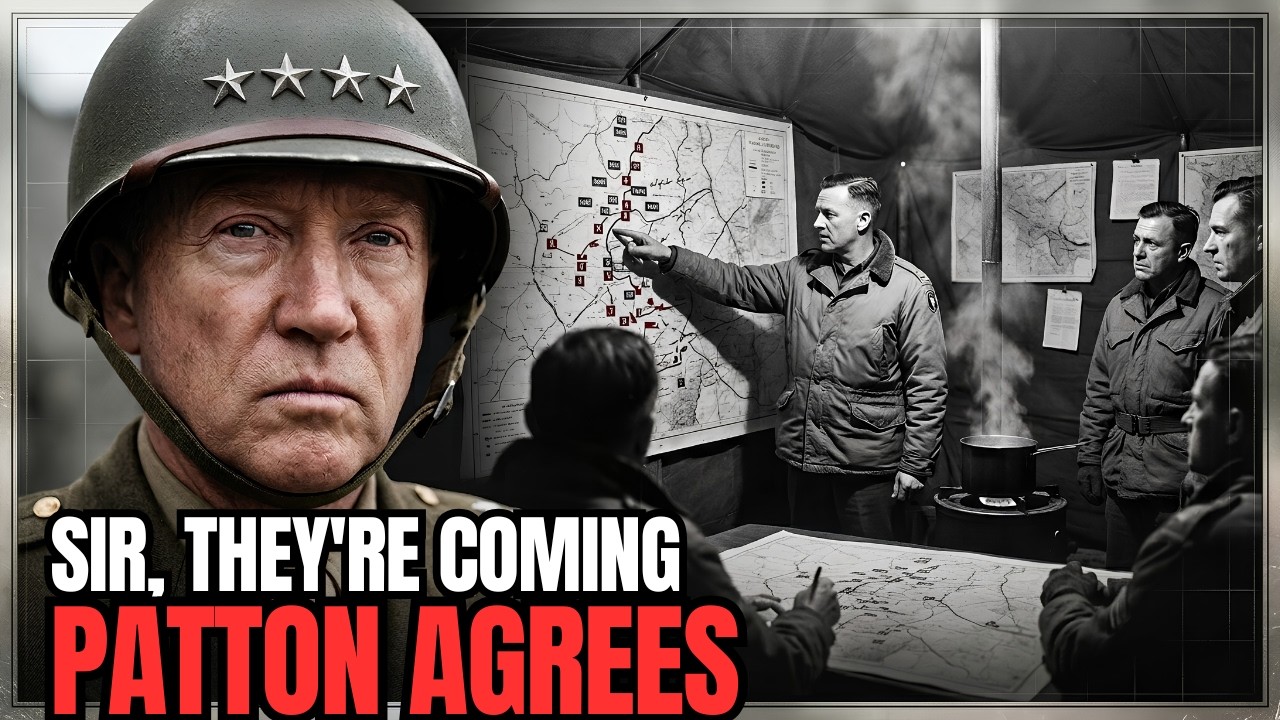
Colonel Oscar Koch stood in front of a map and prepared to tell General George S. Patton something almost nobody else in the Allied command wanted to believe.
Germany was not finished.
The Wehrmacht was not merely preparing to defend its homeland.
And the forces quietly assembling opposite the Ardennes were not behaving like troops expecting to sit behind defensive lines.
Koch believed they were preparing to attack.
One week later, German forces would explode through the Ardennes in the largest German offensive on the Western Front since Normandy.
Most of the Allied command would be caught by surprise.
Third Army would not.
That difference would help create one of the most famous moments of Patton’s career: the rapid turn north toward Bastogne.
But the famous turn was not simply an act of battlefield instinct.
Before Patton could move his army with extraordinary speed, somebody had to convince him that the apparently impossible threat was real enough to plan for.
That man was Oscar Koch.
And his warning came before the German guns opened fire.
Koch was not the kind of officer whose name naturally dominated newspaper headlines.
He was an intelligence officer.
His battlefield was information.
Enemy formations.
Rail movements.
Fuel.
Ammunition.
Replacement patterns.
Unit locations.
The unglamorous pieces of military information that become meaningful only when someone connects them correctly.
His approach was built around a distinction that would prove crucial in December 1944.
Do not focus primarily on what you think the enemy intends to do.
Focus on what the enemy is capable of doing.
Intent is difficult to know.
It exists inside another commander’s mind.
Capability can be measured.
How many divisions are available?
Where are they?
Which formations are being withdrawn from combat?
Which are receiving replacements?
Where is ammunition accumulating?
Where is fuel moving?
What can the enemy physically do with what he has assembled?
Through the autumn of 1944, Koch kept asking those questions.
And the answers increasingly disturbed him.
Across much of the Allied command, optimism had become difficult to separate from intelligence assessment.
The German Army had been driven out of most of France.
Allied forces had reached Germany’s western approaches.
The Wehrmacht had suffered enormous losses.
Its fuel situation was desperate.
Its air power had deteriorated.
Its armies had spent months retreating.
To many Allied planners, the trajectory seemed obvious.
Germany could still resist.
It could still launch local counterattacks.
It could still make the final advance costly.
But the idea that Hitler could assemble enough men, armor, fuel and ammunition for a major offensive in the west appeared increasingly unrealistic.
That assumption shaped how new information was interpreted.
German formations disappearing from the front?
They must be refitting for defense.
Panzer units concentrating?
Probably preparation to stop the expected Allied penetration into Germany.
Fuel and ammunition accumulating?
Defensive stockpiles.
More troops appearing east of the Ardennes?
Reinforcement of the homeland.
Koch looked at many of the same indicators.
He reached the opposite conclusion.
A truly exhausted army preparing only to defend should not behave this way.
Panzer divisions were being withdrawn and rebuilt rather than simply fed back into the defensive line.
Fuel was accumulating.
Ammunition was accumulating.
Units were concentrating in a particular geographical area.
And that area faced one of the thinnest sections of the American front.
The Ardennes.
The terrain itself helped hide the danger.
The region was heavily wooded.
Roads were narrow.
Winter conditions made movement difficult.
The Allied command did not expect Germany to choose such ground for a massive armored offensive.
That expectation created its own blind spot.
If planners believed a large attack through the Ardennes made little operational sense, evidence of German concentration there could be interpreted as something else.
Koch refused to make that assumption.
Terrain could make an attack difficult.
It did not make an attack impossible.
And Hitler did not need Allied planners to consider his plan sensible.
He only needed enough divisions, enough fuel, enough surprise and enough time.
By early December, Koch believed those pieces were coming together.
So on December 9, he put his assessment in front of Patton.
German strength was building opposite the Ardennes.
The pattern looked offensive.
Not defensive.
According to the source, Koch’s operations officer, Colonel Halley Maddox, reinforced the warning.
For the Germans to launch the attack Koch feared, they would have to commit their reserve.
And the reserve appeared to be sitting in position to do exactly that.
The implication was serious.
Third Army was operating farther south.
The Ardennes belonged primarily to General Courtney Hodges’ First Army.
It was not Patton’s immediate sector.
Patton had his own offensive responsibilities.
His staff had its own problems.
His divisions had their own objectives.
Planning for a major German offensive outside Third Army’s zone meant spending scarce staff time on a scenario that higher headquarters largely did not believe would happen.
Patton could easily have listened to Koch, thanked him and continued with the existing plan.
Instead, according to the source, he told the room:
“We’ll be in a position to meet whatever happens.”
Then he authorized contingency planning.
Quietly.
Third Army would continue preparing for its offensive toward the east.
But behind that plan, the staff would prepare another possibility.
If Koch was right and the Germans attacked through the Ardennes, Third Army would need to disengage, turn north and intervene.
That decision came before the crisis.
That is the part of the Battle of the Bulge story that often disappears behind what happened later.
Patton did not know with certainty that Koch was right.
Koch did not possess Hitler’s operational order.
He did not know every detail of the German plan.
The intelligence picture remained incomplete.
Patton was therefore spending real planning resources on an assessment that contradicted the broader consensus.
That is not the same as knowing the future.
It is risk management.
Patton did not have to believe Koch with absolute certainty.
He only had to believe the potential consequences of Koch being right were serious enough to justify preparation.
That distinction matters.
Commanders rarely receive perfect information.
If they wait until uncertainty disappears, planning begins too late.
Patton’s decision was not:
Koch has proven the Germans will attack.
It was closer to:
Koch has shown enough evidence that we cannot afford to be unprepared if they do.
Over the next several days, the indicators continued accumulating.
Then came December 16.
German units were leaving assembly areas.
Radio traffic changed.
Some formations went silent.
Radio silence before a major operation could be deeply significant.
An army preparing to attack did not want the enemy building an electronic picture of its movements.
According to the source, Koch warned Patton that morning:
“I believe the Germans are launching an attack, probably at Luxembourg.”
Hours later, the German offensive began.
The Ardennes erupted.
German artillery opened fire.
Infantry moved forward.
Armored columns pushed into American positions.
The attack struck a sector many Allied commanders had regarded as comparatively quiet.
That was one reason the Germans had chosen it.
The American line contained units recovering from earlier fighting.
Other formations included inexperienced troops.
The sector was thin.
It was not configured to absorb the scale of attack now hitting it.
The German objective was enormous.
Break through the Ardennes.
Cross the Meuse.
Drive toward Antwerp.
Split the Allied armies.
Disrupt their logistics.
Potentially force the Western Allies into a strategic crisis.
Whether Hitler’s plan had a realistic chance of achieving all of those objectives is a separate question.
In the opening days, it did not need to achieve them all to create disaster.
It only needed surprise.
And it had it.
Across much of the front, the attack came as a shock.
American units were overrun.
Command structures became confused.
Roads filled with retreating troops, reinforcements, civilians and vehicles.
German spearheads penetrated west.
Thousands of American soldiers were captured.
Bastogne became one of the critical points.
The town sat on a network of roads vital to movement through the region.
The 101st Airborne Division and other American units were rushed into the area.
German forces eventually surrounded them.
Winter weather complicated everything.
Supply.
Air support.
Evacuation.
Movement.
Visibility.
The crisis was now undeniable.
But Third Army had one advantage.
It was not beginning the intellectual work from zero.
Koch had already warned of the possibility.
Patton had already ordered plans.
Between December 12 and 16, according to the source, Third Army staff developed three contingency concepts.
Sent.
Nickel.
Dime.
Different versions of the same fundamental maneuver.
Stop or disengage from the eastward orientation.
Pivot Third Army approximately 90 degrees.
Move north.
Attack the German southern flank.
The plans were not predictions carved in stone.
They were options.
That is what contingency planning is supposed to produce.
If event A occurs, what can we do?
Which divisions move?
Which roads can they use?
What happens to supply?
Where does artillery go?
How quickly can the army change direction?
What must happen first?
Which headquarters coordinates what?
Every question answered before the crisis is one less question consuming time after it begins.
That preparation became critical on December 19.
Eisenhower summoned senior commanders to an emergency conference at Verdun.
By then the situation in the Ardennes was unmistakably serious.
German forces had achieved substantial penetration.
American formations were under immense pressure.
Bastogne was threatened and becoming increasingly isolated.
The Allied command needed a counterattack.
The question was how quickly one could be launched.
Moving an army is not the same as turning an arrow on a map.
Third Army was oriented toward the east.
Its divisions were engaged.
Its artillery faced one direction.
Its supply network supported one axis of advance.
Fuel, ammunition, maintenance, medical support, traffic control and headquarters communications all reflected that orientation.
Now Patton was being asked how quickly he could turn significant combat power north.
Other commanders understandably spoke cautiously.
Days.
Time to reorganize.
Time to move.
Time to establish logistics.
Then Patton gave the answer that became legendary.
By most accounts, he said he could attack with multiple divisions within approximately 48 hours.
The room reportedly found the claim extraordinary.
It sounded like Patton being Patton.
Aggressive.
Confident.
Almost reckless.
But the confidence did not begin at Verdun.
The arithmetic had already been done.
Koch’s warning had bought the staff time.
The contingency plans existed.
Patton was not inventing an army-sized maneuver while sitting at Eisenhower’s conference table.
He was activating work already completed.
That is the hidden architecture behind the famous moment.
Patton could answer quickly because his staff had already asked the question.
He left the conference.
Contacted Third Army headquarters.
A code word activated the appropriate plan.
Then the army began one of the most celebrated operational turns of the war.
Divisions disengaged.
Columns changed direction.
Road priorities shifted.
Supply systems had to be redirected.
Men and vehicles moved through terrible winter conditions.
Third Army drove north toward Luxembourg and Belgium.
The maneuver was difficult even with planning.
Without preparation, it would have been harder still.
On December 26, the 4th Armored Division broke through near Assenois and opened a corridor into Bastogne.
The siege had not simply vanished.
Fighting continued.
But the encirclement was broken.
Patton’s relief of Bastogne became central to his legend.
And understandably so.
The operational achievement was enormous.
Yet the source argues that the dramatic turn has overshadowed the quieter decision that made it possible.
December 19 gets the glory.
December 9 supplied the preparation.
Ten days earlier, Patton had been sitting in a room listening to an intelligence colonel challenge the dominant Allied assessment.
Oscar Koch was telling him that the enemy was capable of something higher headquarters largely believed the enemy could no longer do.
Patton could have dismissed him.
Instead, he listened.
More importantly, he acted before Koch could be proven right.
That is the difference between appreciating intelligence and using intelligence.
Commanders receive warnings constantly.
Many never happen.
Some contradict each other.
Resources are finite.
A staff cannot build detailed contingency plans for every imaginable scenario.
Choosing which warning deserves preparation is itself a command decision.
Patton chose Koch’s.
The source therefore challenges the familiar interpretation that Patton simply looked at the crisis on December 19 and, through some almost mystical battlefield instinct, instantly saw the solution.
There was instinct.
There was confidence.
There was operational aggressiveness.
But there was also homework.
Maps.
Unit locations.
German capabilities.
Supply calculations.
Staff studies.
Contingency plans.
The famous 90-degree turn was the visible result of invisible preparation.
And much of that preparation began because Oscar Koch refused to accept the intelligence consensus.
Koch’s method deserves closer attention.
His guiding principle was to separate capability from intent.
That sounds simple.
In practice, it is difficult.
Human beings naturally build narratives.
Germany had been retreating.
Therefore Germany would probably continue retreating.
The Wehrmacht had suffered catastrophic losses.
Therefore it probably could not mount a large offensive.
The Allies were advancing.
Therefore the next major movement would probably be Allied.
Each statement contained logic.
Together they could become a trap.
Because intelligence is not only about identifying the most likely future.
It is also about identifying dangerous futures that remain possible.
Koch looked at German forces and asked:
Regardless of what we think Hitler should do, what can these formations do?
Panzer units were being rebuilt.
Reserves existed.
Fuel was moving.
Ammunition was accumulating.
Forces were concentrating.
The Ardennes line was thin.
Put those pieces together and a major offensive became physically possible.
Once it became possible, dismissing it required stronger reasoning than simply saying Germany looked exhausted.
The broader Allied intelligence community had information about German movements.
The source’s argument is that the failure lay in evaluation.
The data existed.
The interpretation failed.
Koch himself reportedly emphasized this after the war.
The Battle of the Bulge was not simply a case in which the Allies knew nothing.
They had pieces.
They did not assemble them correctly.
That is a much more uncomfortable kind of intelligence failure.
Missing information can be blamed on collection.
A reconnaissance aircraft never saw the formation.
A radio message was never intercepted.
An agent could not reach the target.
A prisoner did not talk.
But when the information is available and still produces the wrong conclusion, the failure moves deeper.
Assumptions.
Bias.
Institutional confidence.
Consensus.
The inability to imagine that an enemy might choose an option you consider irrational.
By December 1944, months of German retreat had created a powerful expectation.
Germany was collapsing.
Every new piece of intelligence was interpreted through that expectation.
A buildup became defensive because Germany was assumed to be incapable of offense.
Koch reversed the process.
He looked at the buildup first.
Then asked what it made possible.
That is why the source treats his warning as more than luck.
He had been reporting the pattern since November.
December 9 was not a sudden guess.
It was the culmination of weeks of analysis.
And Patton trusted it enough to prepare.
That relationship between commander and intelligence officer may be more important than either man’s individual brilliance.
The best intelligence in the world is useless if the commander ignores it.
The most decisive commander in the world is dangerous if his intelligence staff tells him only what he wants to hear.
Koch needed the independence to contradict prevailing assumptions.
Patton needed the confidence to hear him.
Both pieces had to exist.
According to the source, Patton later summarized his confidence in Koch with characteristic bluntness:
“I ought to know what I’m doing. I have the best damned intelligence officer in any United States command.”
The line is revealing because Patton was not claiming supernatural intuition.
He was crediting his intelligence officer.
That matters when assigning credit for the Ardennes response.
History naturally gravitates toward commanders.
Patton’s name was attached to Third Army.
Patton attended the Verdun conference.
Patton promised the counterattack.
Patton issued the orders.
Patton became the public face of the turn toward Bastogne.
Koch’s contribution happened earlier and largely inside staff work.
That kind of contribution is easier to forget.
There is no dramatic photograph of an intelligence estimate.
No famous newsreel showing an analyst comparing German unit locations.
No cinematic sequence built around a G-2 section updating a map.
Yet the tanks that moved north depended on decisions made before their engines started.
The source argues that Koch deserves a much larger share of the story.
That does not require taking credit away from Patton.
The two contributions were different.
Koch recognized the threat.
Patton decided the threat deserved preparation.
Koch provided analysis.
Patton converted analysis into operational readiness.
Without Koch, Third Army might not have prepared early.
Without Patton, Koch’s warning might have remained another intelligence memorandum filed inside headquarters.
This is why framing the story as either Patton’s triumph or Koch’s triumph misses part of the point.
It was the relationship between analysis and command that mattered.
There is also an important caution in how the surprise itself is described.
It is tempting to say that nobody except Koch saw the offensive coming.
That is too absolute for the source’s own argument.
Indicators existed across Allied intelligence.
People were observing German concentrations.
The failure was not universal blindness to every movement.
It was failure to interpret those movements as evidence of a major offensive on the scale Hitler was preparing.
Koch’s distinction was his evaluation.
He treated the pattern as offensive.
Others largely treated it as defensive.
That is more precise—and more interesting—than saying one man alone knew everything.
Likewise, Third Army’s preparedness should not be exaggerated into perfect foreknowledge.
Koch did not provide Patton with every German operational detail.
Third Army did not know the exact course the battle would take.
Patton did not spend December 9 waiting with his entire army pointed north.
Third Army continued its own operations.
The contingency plans existed in parallel.
That was the smart part.
Patton prepared without prematurely committing.
If Koch was wrong, Third Army had not abandoned its mission.
If Koch was right, the staff had options ready.
This is what sophisticated military planning looks like.
Not prophecy.
Optionality.
The German attack transformed the option into necessity.
Then the planning translated into speed.
That sequence is the real story.
Intelligence.
Assessment.
Contingency.
Crisis.
Execution.
The dramatic part came last.
After the war, Koch worked to make sure his role—and the analytical failure surrounding the Ardennes—was understood.
According to the source, he wrote about the experience in G-2: Intelligence for Patton.
His central lesson remained consistent.
Do not confuse what you expect the enemy to do with what the enemy is capable of doing.
The distinction survived the war because it applied far beyond December 1944.
Intelligence organizations are vulnerable to consensus.
Consensus is useful when it reflects independent analysis converging on the same conclusion.
It becomes dangerous when analysts unconsciously begin fitting evidence into a shared narrative.
By late 1944, the shared narrative said Germany was nearly finished.
Strategically, that was true.
Germany was losing the war.
But a country can be losing a war and still possess the capability to launch a devastating offensive.
Those statements are not contradictory.
That was the analytical trap.
Allied intelligence could correctly believe Germany was doomed and still incorrectly conclude Germany could no longer attack.
Koch separated the two.
Germany could not win the war.
Germany could still create a crisis.
Hitler did exactly that.
The Battle of the Bulge ultimately failed to achieve its strategic objectives.
German losses further weakened forces the Reich could not replace.
The Western Allies recovered.
The advance into Germany resumed.
But none of that makes the initial intelligence failure harmless.
Men in the Ardennes paid for it.
Units were overrun.
Thousands were captured.
Others fought desperate defensive actions under conditions they had not expected.
Bastogne became famous because American soldiers held under extraordinary pressure.
Their courage should not be used to obscure the fact that the offensive achieved surprise in the first place.
That is why Koch’s warning matters.
It shows the surprise was not inevitable.
The Germans concealed their plan effectively.
Weather and terrain helped.
Radio discipline helped.
Allied assumptions helped enormously.
But at least one important intelligence section looked at the available evidence and reached the right broad conclusion before the attack.
And at least one army commander considered that conclusion serious enough to prepare for it.
Oscar Koch remained with Patton through the rest of the war.
According to the source, he later commanded an infantry division during the Korean War and retired from active service in 1954.
He continued working to clarify the historical record surrounding Third Army intelligence.
In 1993, years after his death, the U.S. Army’s Military Intelligence Corps inducted him into its Hall of Fame.
Institutional recognition arrived long after Patton’s role in the Bulge had already become legend.
That difference is almost appropriate.
Patton’s contribution was visible.
Koch’s contribution was analytical.
Patton’s decision moved divisions.
Koch’s decision moved markers on a map before anyone else understood why those markers mattered.
One became a famous battlefield story.
The other became a lesson taught inside military intelligence.
But the two cannot really be separated.
When Eisenhower asked Patton on December 19 how quickly Third Army could counterattack, Patton’s answer seemed almost impossible.
Approximately 48 hours.
What looked like audacity was partly preparation.
What looked like instinct was partly intelligence.
What looked like one general making a brilliant decision at the perfect moment had actually begun ten days earlier with a colonel standing in front of a map and saying something his superiors had little reason to want to hear.
The Germans are building for an offensive.
Patton listened.
Then he did the most important thing a commander can do with an uncomfortable warning.
He prepared before he knew for certain that it was true.
That may be the fairest way to divide the credit.
Oscar Koch saw the danger.
George Patton believed him enough to act.
And when the German attack finally came, Third Army possessed something much of the Allied command did not.
Not perfect knowledge.
Not certainty.
Time.


