THE LEGAL FALLOUT: New Court Filings Uncover Needle Struggles, Blown Veins, and the Desperate Hours Behind Christa Pike’s Botched Execution
The emergency motions filed by the legal defense team of Christa Gail Pike immediately following the catastrophic events at the Riverbend Maximum Security Institution have ripped open the veil of secrecy surrounding Tennessee’s execution protocol. Submitted to federal and state courts as the hours-long ordeal unfolded inside the death chamber, the documents provide a harrowing, step-by-step account of systemic failure, detailing how an execution intended to conclude with clinical precision devolved into an agonizing medical disaster.
According to the emergency filings and statements from defense attorneys Randy Spivey and Steve Ferrell, the disaster was rooted in catastrophic vascular complications that were ignored or mismanaged by the state’s execution team. Because Pike had spent nearly three decades in maximum-security confinement and suffered from lifelong issues with fragile veins, her physical condition made intravenous access exceptionally difficult. Defense attorneys revealed that the execution team struggled for an extended period, logging at least seven separate needle insertion attempts into her left arm alone. During the struggle, a visibly distressed Pike even attempted to assist the team, pleading with officials to try alternative sites higher on her shoulder.
Once the lines were ostensibly secured and the first dose of pentobarbital was administered, the procedure immediately went off script. Journalists and witnesses in the viewing gallery heard Pike call out in pain, stating that her arm felt like it was “about to bust” and that a specific spot was intensely throbbing and burning. According to the legal motions, the execution team failed to recognize that the veins had “blown” or that the intravenous placement was fundamentally flawed. Rather than entering the bloodstream directly to shut down her central nervous system, the potent barbiturate leaked entirely or partially into the surrounding subcutaneous tissue—a painful process known as extravasation.
Instead of halting the procedure to reassess the compromised site, executioners pressed forward, preparing and administering a second full dose of pentobarbital into an already failing system. The emergency filings argue that this decision violated basic medical logic and constitutional protections, plunging Pike into prolonged physical and mental torment. When the viewing curtains were briefly reopened, witnesses and legal advisors watched in horror as Pike remained conscious, breathing heavily, and eventually lapsing into deep, audible snoring while trapped behind closed barriers for over an hour.
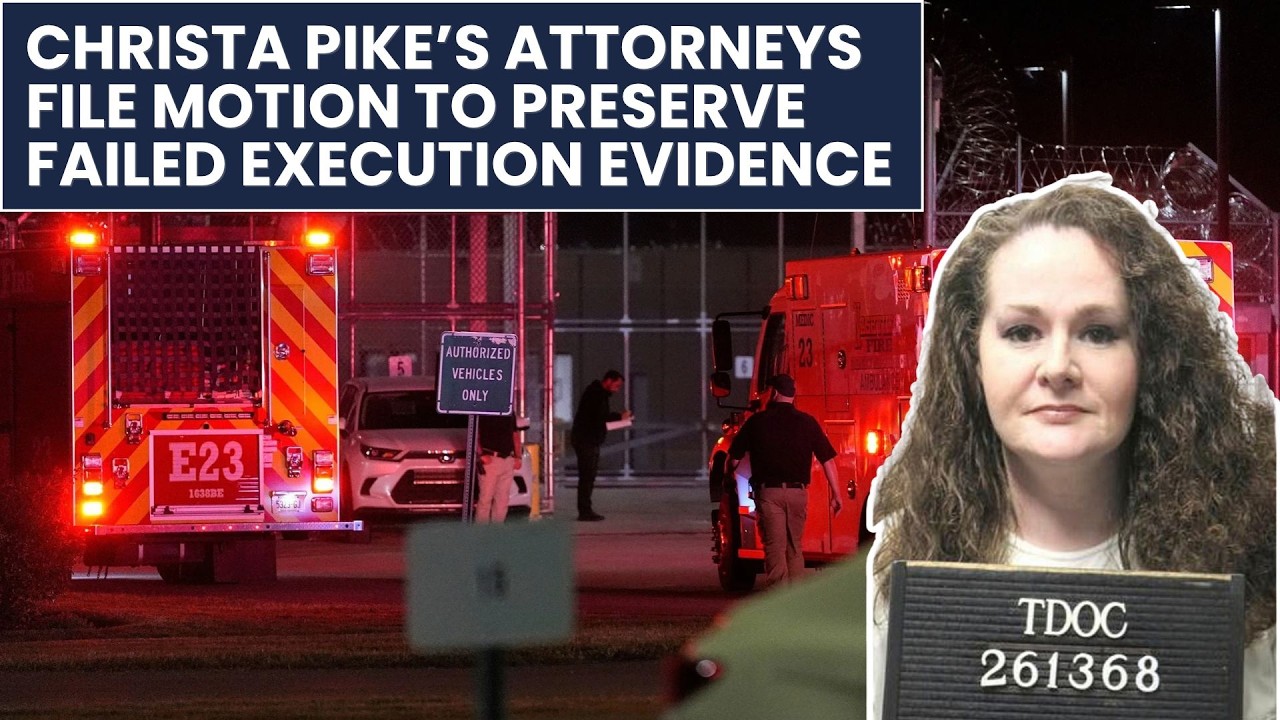
In their emergency filings, Pike’s attorneys formally requested court orders demanding that the Tennessee Department of Correction preserve all physical evidence from the chamber—including needles, syringes, medical logs, and chemical remnants. They argued that safeguarding this evidence is essential to establish accountability, prove that the state subjected her to “torture” in violation of the Eighth Amendment, and demonstrate that the state completely exhausted and failed its legal authority to execute her.
While a federal judge ultimately ruled parts of the emergency motion moot after the state confirmed Pike was being rushed to an off-site hospital, the details brought to light by her legal team have permanently altered the landscape of the case. As Pike remains unconscious on a mechanical ventilator under heavy armed guard, her attorneys’ explosive disclosures have forced Governor Bill Lee to order an independent third-party investigation and indefinitely pause all remaining state executions.


