Another explosive Caitlin Clark scandal surged across social media, promising corruption, betrayal, secret documents, and an immediate basketball investigation.
The headline claimed assistant coach Nate Tibbetts finally snapped after watching Kara Lawson bench Clark during America’s victory over Czechia.
According to the post, Tibbetts hijacked the press conference, revealed Lawson’s hidden motive, and delivered a cold-blooded ultimatum before stunned reporters.
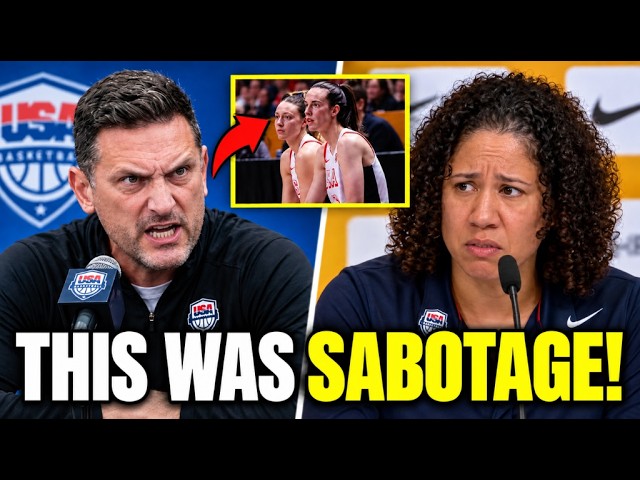
Readers were then directed toward a supposedly terrifying document that Tibbetts allegedly displayed while cameras captured the entire dramatic confrontation.
It sounds engineered for maximum outrage, but searches of official records and credible reporting reveal no evidence that anything similar occurred.
No authenticated document has emerged, no governing body announced an investigation, and no reputable journalist reported Tibbetts confronting Lawson publicly.
The viral narrative therefore should not be presented as breaking news, although the basketball debate underneath it remains legitimate and fascinating.
Clark did come off the bench against Czechia, extending Lawson’s decision to retain an experienced starting lineup throughout World Cup competition.
However, Team USA did not stagger through a crisis or survive because somebody rebelled against a supposedly corrupt head coach.
The Americans overwhelmed Czechia 105–64, completed group play undefeated, and advanced as the leading team from their preliminary pool.
Breanna Stewart scored nineteen points, while Napheesa Collier and Jackie Young helped establish the aggressive opening that Lawson wanted.
Clark contributed nine points, seven assists, one rebound, one steal, and two blocks during nearly twenty-two active minutes.
She shot three-for-eight overall and one-for-six from long distance, demonstrating productive playmaking alongside an imperfect individual shooting performance.
Those numbers describe a meaningful reserve role, not captivity, disappearance, professional destruction, or evidence of an organized campaign against her.
Clark’s seven assists tied directly into America’s depth-driven attack and helped maintain control after the veteran starters built momentum.
One particularly popular sequence featured Clark delivering to Angel Reese, highlighting how young stars can create compelling chemistry beyond manufactured rivalries.

That genuine development deserved attention because it offered insight into Team USA’s future, its speed, and its changing generational identity.
Instead, sensational publishers transformed a forty-one-point victory into a story about mutiny, corruption, hostage-taking, and secret institutional punishment.
The transformation begins by misrepresenting Tibbetts, whose actual position makes the alleged public ambush especially difficult to accept without extraordinary proof.
Tibbetts is not an unaffiliated WNBA coach observing Lawson’s decisions from television and suddenly deciding to intervene on Clark’s behalf.
USA Basketball officially named him among Lawson’s World Cup assistants alongside Golden State coach Natalie Nakase and Indiana coach Stephanie White.
He therefore participated within the staff responsible for preparation, scouting, substitutions, player communication, and tactical decision-making throughout the tournament.
That does not make internal disagreement impossible, because healthy coaching staffs regularly challenge assumptions and debate rotations behind closed doors.
It does mean claims of a public rebellion require verifiable footage, direct quotations, named witnesses, and confirmation from accountable organizations.
Nothing approaching that evidentiary standard accompanies the caption, which substitutes emotional certainty for documentation and dramatic adjectives for sourcing.
The claim that Tibbetts “hijacked” a press conference should be easily verifiable through complete media video, transcripts, and reporting from Berlin.
Yet available coverage focuses upon America’s commanding response after its narrow Italy victory, not an unprecedented confrontation between national-team coaches.
Lawson had challenged her players to bring greater passion, and the Americans answered through pace, defensive pressure, and improved offensive execution.
Stewart scored eleven of her nineteen points during the first quarter, immediately establishing authority after struggling badly against Italy.
Collier then helped control the second period, while America’s reserves extended advantages rather than allowing Czechia meaningful recovery opportunities.
The performance represented exactly what championship teams seek during tournament play: correction without panic, accountability without public fracture, and collective improvement.
Clark remained central to that improvement, even if her reserve designation continued frustrating supporters who consider her America’s best offensive organizer.
Her argument for starting began powerfully against China, when she produced fourteen points and eleven assists during her World Cup debut.
FIBA identified those eleven assists as an American record for a player appearing in her first Women’s World Cup contest.
Lawson publicly praised Clark afterward, describing her impact as terrific and emphasizing how effectively she changed the game’s tempo.
That verified statement carries considerably greater weight than anonymous assertions that Lawson secretly wants to ruin the most visible American player.
Clark’s performance against Italy complicated the discussion because her shot deserted her while the United States barely escaped with victory.
Still, the entire offense labored during that 55–52 result, making it simplistic to assign collective stagnation entirely to one reserve guard.
Against Czechia, the starters responded forcefully, giving Lawson statistical support for maintaining continuity despite ongoing demands to promote Clark immediately.
Meanwhile, Clark’s passing remained valuable, giving her supporters additional evidence that America operates differently whenever she directs possession tempo.
Both interpretations can be reasonable because lineup analysis concerns combinations, matchups, timing, and roles rather than a single isolated box score.
Lawson may believe Chelsea Gray’s experience and command best stabilize the opening minutes against physical, tactically disciplined international opponents.
She may also value Clark as an immediate acceleration point whose passing can overwhelm opposing reserves and energize America’s second unit.
Critics can respond that Clark’s gravity benefits elite starters even more, creating easier opportunities for Stewart, Collier, Copper, and Young.
That is a serious tactical disagreement, but calling the strategy corrupt requires evidence of misconduct rather than dissatisfaction with basketball judgment.
Tibbetts brings his own relevant perspective because he coaches the Phoenix Mercury and has extensive professional experience across men’s and women’s basketball.
His presence on Lawson’s staff reflects USA Basketball’s preference for diverse coaching backgrounds, not a designated role as Clark’s public defender.
During games, assistants handle scouting details, matchup suggestions, communication, and adjustments, but Lawson remains accountable for the final rotation.
If Tibbetts believed Clark should start, professional disagreement would ordinarily occur through staff meetings rather than theatrical press-conference sabotage.
Even genuine internal tension would not automatically prove a secret agenda, because elite staffs debate personnel constantly while pursuing shared competitive goals.
The most extraordinary allegation concerns the leaked document, yet the caption provides no provenance, date, author, metadata, or independently verified contents.
It merely promises that readers can see the evidence after clicking, a familiar mechanism designed to convert emotional arousal into traffic.
Real documents must survive authentication through original files, corroborating witnesses, organizational confirmation, and examination for manipulation or missing context.
A photograph showing somebody holding paper would prove only that paper existed, not that every printed allegation was genuine or accurate.
Digitally circulated screenshots deserve even greater caution because names, timestamps, messages, and institutional branding can be manufactured within several minutes.
The alleged investigation is similarly unsupported, with no identified investigating authority, announced scope, formal complaint, or official case reference.
Neither FIBA nor USA Basketball publicly announced an inquiry into Lawson’s treatment of Clark following the victory over Czechia.
The WNBA would also have limited reason to investigate a national-team lineup decision inside a competition governed through USA Basketball and FIBA.
Invoking “the league” without naming an organization creates deliberate ambiguity, allowing audiences to imagine consequences the caption never demonstrates.
This rhetorical technique appears frequently in viral sports misinformation, alongside unnamed insiders, emergency meetings, leaked audio, and career-ending ultimatums.
Every element sounds specific enough to feel credible, yet remains vague enough to avoid providing a verifiable evidentiary trail.
Clark’s popularity makes her an ideal center for this content because millions of supporters closely monitor her treatment and opportunity.
Many remember her exclusion from the 2024 Olympic roster and interpret later national-team decisions through that unresolved emotional controversy.
Clark herself has taken a considerably calmer approach, emphasizing patience within America’s unusually deep collection of elite basketball talent.
Before her World Cup debut, she described representing the United States as special and focused upon growing women’s basketball globally.
Her perspective does not eliminate competitive ambition, but it contradicts the portrayal of a powerless superstar publicly trapped by hostile institutions.
She has played substantial minutes, led creative stretches, established assist records, and influenced every opponent’s defensive preparation during the tournament.
Reserve status can carry symbolic importance, especially for a player whose production often appears strong enough to justify starting recognition.
Nevertheless, symbolism should not erase practical usage, and Clark’s minutes demonstrate that Lawson considers her essential rather than expendable.
Against China, Clark played twenty-five minutes and finished with a plus-thirty rating, exceeding every starter’s playing time in that opener.
Against Czechia, she again approached twenty-two minutes while producing seven assists despite struggling from beyond the three-point arc.
Those deployment patterns suggest Lawson prioritizes specific sequencing, although reasonable observers may still conclude that sequencing should now change.
The quarterfinal against Hungary intensified that argument when Clark recorded ten points and nine assists during America’s 108–56 victory.
She narrowly missed another double-double, controlled transition opportunities, and reinforced her position among the tournament’s most influential passers.
America advanced into an eleventh World Cup semifinal, meaning Lawson’s rotation has produced results even while attracting relentless criticism.
Success never makes coaching decisions immune from evaluation, but it weakens claims that the program is collapsing under a destructive secret agenda.
An actual agenda to ruin Clark would also conflict with USA Basketball’s long-term interests heading toward the 2028 Los Angeles Olympics.
Clark offers generational popularity, distinctive basketball skills, international marketability, and a realistic opportunity to lead the program’s next era.
Developing her alongside Bueckers, Reese, Citron, and Iriafen provides strategic continuity as older champions eventually transition away from international play.
Sabotaging that development would harm both competitive planning and commercial momentum, requiring convincing evidence before anyone attributes such irrational motives.
The simpler explanation is that Lawson trusts veterans to begin games while trusting Clark to reshape them after entering.
Coaches often separate their best creators to prevent offensive droughts and ensure every lineup includes someone capable of organizing possessions.
Whether that logic maximizes Clark is debatable; whether it constitutes corruption is an entirely different question demanding entirely different proof.
Supporters should also resist language describing Clark as a hostage, because exaggerated victimhood diminishes her visible agency and competitive success.
She is not watching entire games helplessly; she is producing records, directing teammates, and earning important minutes for the defending champions.
Presenting every setback as persecution can obscure her resilience, adaptability, leadership, and willingness to contribute without turning roles into public conflict.
It can also direct harassment toward coaches and players based upon events that never occurred, damaging real people through fictional narratives.
Lawson deserves criticism expressed through basketball evidence, including offensive efficiency, lineup differentials, pace, turnover rates, and opponent-specific matchup outcomes.
Tibbetts deserves accurate representation as a participating assistant, not automatic conversion into a whistleblower because a caption requires another dramatic character.
Clark deserves coverage emphasizing what she actually accomplishes, not stories repeatedly reducing her career to conspiracies invented around her fame.
Audiences deserve links to complete press conferences, official box scores, direct statements, and records that can withstand basic inspection.
The Czechia evidence provides exactly that foundation: America won decisively, Stewart led scoring, and Clark facilitated effectively from the bench.
No verified confrontation interrupted the media session, no authenticated paper exposed Lawson, and no documented ultimatum initiated an immediate investigation.
Until those elements receive credible confirmation, publishers should clearly label them as unsupported allegations rather than report them as established events.
The distinction protects readers without requiring silence about the genuine strategic controversy surrounding Clark’s continuing reserve role today.
Indeed, the factual version offers richer questions about leadership, generational transition, roster balance, and how superstars adapt within national programs.
Should Lawson prioritize chemistry accumulated by veteran champions, or accelerate a system built around Clark’s unprecedented passing range and shooting gravity?
Does Clark create more value beside elite finishers, or against reserve defenders less prepared for her speed and improvisational vision?
Should starting status reward the most impactful player, or can strategically staggered minutes produce better results across forty international minutes?
Those questions cannot be solved through outrage alone, but upcoming elimination games will supply increasingly useful evidence under championship pressure.
If the veteran group struggles early while Clark repeatedly repairs the offense, demands for a lineup change will become stronger.
If America controls opening quarters and Clark dominates later rotations, Lawson’s sequencing will continue receiving persuasive competitive justification.
Either result should be judged openly through film and statistics, not retrofitted around a document nobody can authenticate.
Women’s basketball has entered an era where audience attention brings unprecedented opportunity alongside an industrial appetite for continuous controversy.
Expansion, global tournaments, labor discussions, and rising television interest have made every Clark-related storyline commercially valuable across multiple platforms.
That value encourages fabricated urgency, especially when algorithms reward anger faster than context and repetition faster than verification.
Responsible fans can interrupt that cycle by checking official sources before sharing claims designed primarily to trigger emotional reactions.
They should search for full quotations, identify the investigating organization, inspect original documents, and compare assertions with complete video.
When only anonymous accounts repeat identical dramatic language, the repetition establishes virality rather than truth, sourcing, or independent confirmation.
In this instance, the confirmed record contradicts the central scandal: Tibbetts works with Lawson rather than publicly overthrowing her authority.
His professional role does not guarantee perfect harmony, but it renders the claimed spectacle implausible without compelling, independently verified evidence.
The Americans’ 105–64 victory also contradicts descriptions of chaos, showing a team responding effectively after an uncomfortable performance against Italy.
Clark remained prominent within that response, contributing seven assists and meaningful defensive activity despite an inefficient long-range shooting afternoon.
Her influence continues pressing Lawson toward difficult choices, which is what exceptional players should force from ambitious coaching staffs.
That pressure is basketball pressure, visible in possessions and rotations, not proof of corruption hidden within an unnamed terrifying document.
The real developing story concerns whether Lawson will eventually start Clark as the tournament reaches its most dangerous opponents.
Every successful reserve appearance strengthens both sides: it proves Clark deserves greater responsibility while validating her impact within Lawson’s current structure.
That paradox is more interesting than invented villainy because it reflects the genuine complexity of coaching twelve world-class competitors.
Tibbetts may influence those decisions through ordinary professional collaboration, film study, candid discussion, and tactical recommendations inside the staff.
Unless credible evidence establishes otherwise, there is no factual basis for portraying him as a rogue whistleblower issuing public threats.
There is likewise no factual basis for claiming Lawson operates a secret campaign intended to destroy Clark’s career or reputation.
What exists is an undefeated national team, a debated lineup, a transformative guard, and enormous public interest surrounding every substitution.
That verified reality can support passionate reporting without borrowing fabricated documents, imaginary investigations, or confrontations that credible observers never recorded.
Clark’s supporters should keep demanding thoughtful answers, because her production warrants serious discussion about America’s strongest possible starting unit.
They should also reject unsupported stories that exploit their loyalty, since misinformation ultimately weakens legitimate criticism by making everything appear conspiratorial.
Lawson must answer through results, lineup performance, player development, and the medal America ultimately brings home from Berlin.
Tibbetts must perform his actual responsibility by helping the staff evaluate opponents, communicate clearly, and maximize every available player.
Clark will answer as she usually does, creating shots, stretching defenses, and making arguments through basketball rather than invented backstage theatrics.
Until verifiable evidence changes the record, the terrifying leaked document belongs to clickbait mythology, not responsible American sports journalism.
The scandal changes nothing because it establishes nothing; the real debate changes constantly with every pass, rotation, victory, and difficult decision.


