Michael Jordan, Sophie Cunningham And The Truth Behind The $27 Million Power Move….
A viral video claims Michael Jordan orchestrated a $27 million endorsement agreement for Indiana Fever guard Sophie Cunningham.
The story further alleges Caitlin Clark personally recommended Cunningham after admiring her outspoken defense of teammates and criticism of officiating.
According to the narration, Cunningham received a life-changing telephone call and reacted with laughter, tears, and complete disbelief.
The video presents the announcement as an unprecedented Jordan Brand investment capable of dramatically reshaping power across women’s basketball.
However, no official statement from Jordan Brand, Nike, Cunningham, Clark, or Indiana currently confirms that extraordinary agreement.
No credible sports-business outlet has reported a $27 million contract connecting Cunningham with Jordan Brand or Michael Jordan.
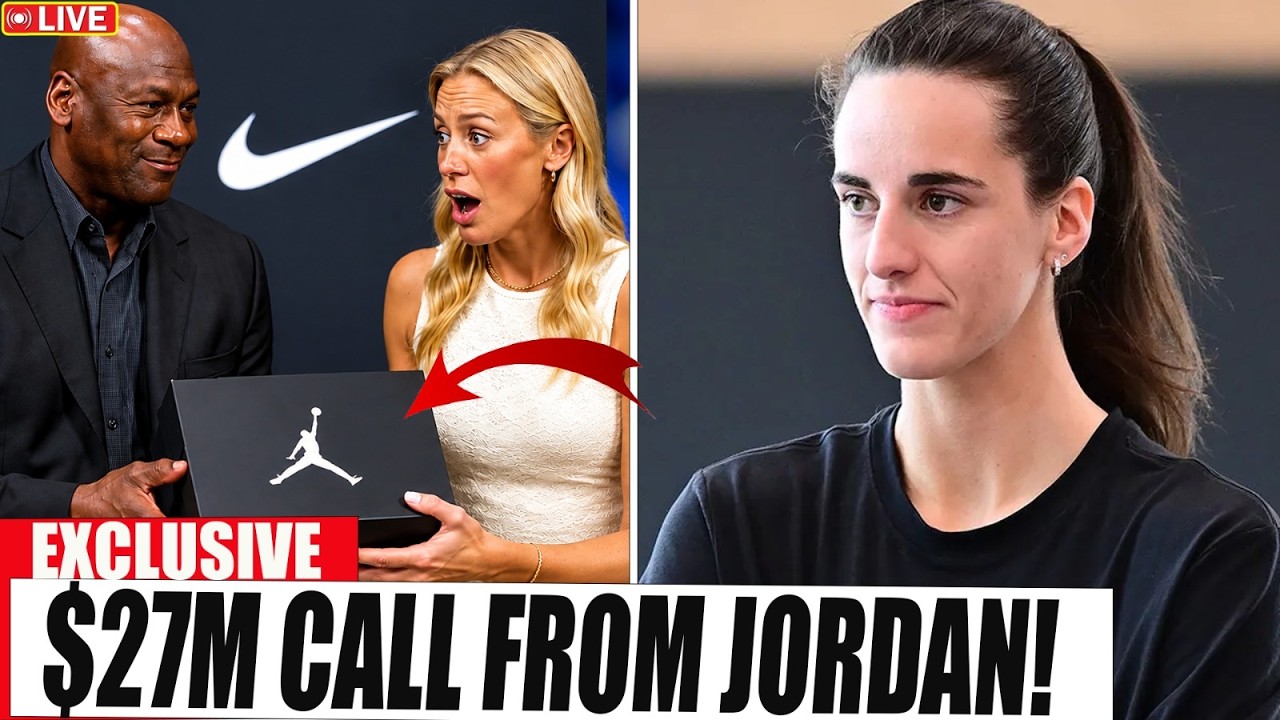
There is no authenticated agreement, campaign announcement, signature product, contract duration, executive quotation, or confirmed launch schedule.
The available evidence supports a far simpler story: Cunningham recently met Jordan during a major NASCAR event.
She attended the Enjoy Illinois 300 and participated in activities surrounding the sold-out Cup Series race.
Jordan attended because he co-owns 23XI Racing, making his appearance entirely consistent with his motorsports business interests.
Reporting from the event confirms Cunningham interacted with Jordan, racing personalities, fans, and television representatives during race weekend.
Photographs and short video clips from that meeting quickly circulated because both personalities possess significant public recognition.
That genuine encounter appears to have provided the visual foundation for claims about a secret multimillion-dollar basketball endorsement.
A photograph can establish that Cunningham and Jordan occupied the same location, but not that they negotiated a contract.
It cannot prove Jordan evaluated Cunningham’s marketability, offered money, contacted Nike executives, or requested Clark’s participation.
Those additional details require independent confirmation through documents, named sources, representatives, or official corporate communications.
None appears within the viral presentation, despite the narrator repeatedly using confident language implying direct inside knowledge.
The story never identifies its sources, explains their access, or provides documentation supporting the precise $27 million figure.
It also fails to explain the proposed contract’s length, guaranteed compensation, bonuses, royalties, licensing rights, or promotional obligations.
Those omissions immediately weaken the claim because major endorsement contracts involve far more than one dramatic headline number.
A genuine Jordan Brand campaign would likely appear across official Nike channels, professional advertising platforms, and footwear publications.
Cunningham’s representatives would probably celebrate the agreement publicly because visibility represents an important component of athlete sponsorship value.
Indiana would also acknowledge a landmark partnership strengthening one of its most recognizable players’ expanding commercial profile.
Instead, the supposed announcement appears primarily across recycled social-media posts and anonymous entertainment videos repeating identical language.
Repetition can make a claim seem established, but copied captions do not constitute independent confirmation from separate sources.
Many accounts simply reuse the same footage, narration, and financial figure without identifying the original source.
The $27 million number may deliberately resemble Clark’s widely reported Nike agreement, valued around $28 million across eight years.
That authentic deal transformed Clark into one of women’s basketball’s most commercially significant athletes before her professional debut.
The viral story appears to shift a similar financial scale onto Cunningham while adding Jordan and Clark as powerful sponsors.
Such borrowing makes the rumor sound plausible because audiences already associate Clark, Nike, and massive endorsement figures.
Yet resemblance between two numbers cannot establish that a second agreement exists for a completely different athlete.
The actual Clark footwear development currently receiving attention is the release of her first Nike signature basketball shoe.
Nike scheduled the United States launch for October 1, following an earlier introduction within the Chinese market.
Clark became only the fifth active women’s basketball player possessing a signature shoe from a major athletic company.
She joins Nike athletes Sabrina Ionescu and A’ja Wilson, while Angel Reese and Breanna Stewart represent competing brands.
Clark also gave pairs to Indiana teammates after returning from the FIBA Women’s World Cup with a gold medal.
That confirmed gift offers a genuine Clark-Cunningham footwear connection without establishing any multimillion-dollar Jordan Brand agreement.
Cunningham can wear team-issued Nike products or receive Clark’s shoes without becoming a separately contracted Jordan Brand athlete.
Nike also sells officially licensed Cunningham Fever jerseys through its consumer website, another fact easily misunderstood by casual viewers.
A Nike-manufactured WNBA jersey does not establish that the named player possesses an individual personal endorsement contract.
League-wide apparel arrangements routinely place many athletes’ names on products without creating separate signature partnerships for everyone.
The distinction between licensed merchandise and personal sponsorship becomes critical when evaluating claims based upon website product listings.
Cunningham’s Fever jersey appearing on Nike’s website proves commercial availability, not a private $27 million agreement.
The viral video never carefully explains these distinctions because ambiguity allows unrelated Nike connections to reinforce its preferred narrative.
Its strongest visual evidence remains Cunningham meeting Jordan at a racetrack where Jordan’s NASCAR team was participating.
That moment became widely discussed after Cunningham responded briefly when asked about Clark’s World Cup championship.
She explained that she had been busy, and subsequent coverage connected that answer with her NASCAR attendance.
Reports noted that she greeted Jordan during the event, creating understandable excitement among fans following both basketball and racing.
Yet none of those reports announced a Jordan Brand contract, Clark recommendation, or forthcoming Cunningham signature campaign.
The leap from public greeting to $27 million agreement represents speculation unsupported by the verified event.
The narration attempts to bridge that evidence gap by claiming unnamed sources described Jordan’s fascination with Cunningham’s personality.
No source is identified, and no direct Jordan quotation confirms that Cunningham reminded him of his competitive younger self.
Jordan’s reputation makes the comparison emotionally effective because he symbolizes intensity, confidence, and uncompromising competitive standards.
Cunningham likewise possesses an outspoken public identity, making the proposed personality connection intuitively appealing to many viewers.
She plays physically, speaks directly, defends teammates, and refuses to soften every opinion for universal approval.
Those characteristics could attract sponsors seeking authenticity, humor, toughness, and a recognizable social-media presence.
However, strategic marketing compatibility remains merely analysis until Jordan Brand or Cunningham announces an actual relationship.
The video also claims Clark personally recommended Cunningham to Nike executives after observing her handling intense media scrutiny.
That allegation has not been verified through statements from Clark, Cunningham, their agents, or Nike representatives.
Clark undoubtedly possesses considerable influence because her signature platform and enormous audience make her commercially valuable to Nike.
Still, influence does not mean she selects Jordan Brand athletes or controls corporate endorsement decisions across Nike’s portfolio.
Major sponsorship decisions involve marketing executives, financial projections, legal teams, agents, product strategists, and audience research.
Athlete recommendations might matter, but claiming one occurred requires stronger evidence than anonymous voice-over narration.
Clark and Cunningham’s documented relationship nevertheless explains why the imagined recommendation resonates strongly with Indiana supporters.
Cunningham joined the Fever and became publicly associated with protecting Clark during physical and emotionally charged games.
Her aggressive response during Indiana’s 2025 game against Connecticut accelerated that reputation among Clark’s passionate national fan base.
The WNBA assessed Cunningham a flagrant foul during a confrontation following repeated physical contact involving Clark and Connecticut players.
The league later added disciplinary consequences after reviewing several incidents, although the punishment was not a massive suspension.
Many supporters celebrated Cunningham as an enforcer willing to respond when they believed officials failed Clark.
Other observers criticized the foul as unnecessary escalation that could have injured another player or intensified the situation.
That disagreement helped turn Cunningham from a respected veteran into one of the league’s most polarizing personalities.
Her following grew substantially, while advertisers increasingly recognized that strong audience reactions can produce significant commercial attention.
The Guardian reported that Cunningham’s public profile expanded after her enforcer image attracted followers and sponsorship opportunities.
That rise makes future endorsement growth realistic, but it still does not confirm this specific Jordan Brand contract.
The distinction matters because realistic rumors often spread more effectively than obviously impossible claims.
Cunningham already possesses public momentum, a memorable personality, an Indiana connection, and a recent photograph with Michael Jordan.
Clark already has Nike influence, a major signature product, and an established relationship with Cunningham as a teammate.
Combining those verified pieces produces a compelling commercial story, even if its central contract remains entirely unverified.
The video strategically includes authentic interview clips so audiences may assume the surrounding narration carries equal reliability.
Several clips show Cunningham describing her competitive personality, loyalty toward teammates, and desire to entertain basketball fans.
Those statements appear consistent with her public character, but they never confirm that Jordan offered her $27 million.
Other segments discuss Nike’s broader investment in women’s basketball without naming Cunningham as a Jordan Brand campaign representative.
Editing those clips together creates an implied connection that the individual speakers never explicitly established themselves.
This technique is common within speculative sports videos because authentic footage gives unsupported narration an appearance of legitimacy.
Viewers hear Cunningham’s real voice, see Jordan’s real image, and watch Clark’s real Nike-related coverage.
The narrator then supplies the invisible connections, transforming unrelated moments into one apparently continuous corporate announcement.
A responsible report should separate what each clip actually demonstrates from what the narrator merely claims happened afterward.
The opening bench conversation provides another example because it has no obvious connection with a Jordan Brand endorsement.
Cunningham jokes about sitting on the sideline and talking, while teammates laugh about her energetic personality.
That amusing exchange demonstrates team chemistry and Cunningham’s restlessness, not a multimillion-dollar footwear negotiation.
Its inclusion adds entertainment while delaying the point where viewers might demand evidence supporting the headline.
The video later shows Cunningham discussing a fine, but its chronology and explanation remain confusing.
Cunningham received a $500 punishment connected with a TikTok video mocking WNBA officiating through a Sabrina Carpenter song.
She later discussed an additional $1,500 fine for criticism involving league officiating and treatment of players.
Coverage indicated her 2025 punishments totaled approximately $2,000 across those separate incidents and public comments.
The viral narration compresses these details into a turning point supposedly attracting Jordan’s personal attention.
No evidence shows Jordan evaluated those fines, watched Cunningham’s podcast, or contacted her because of the controversy.
The fines demonstrate that Cunningham speaks bluntly and accepts potential financial consequences for criticizing league decisions.
They do not establish that a corporate sponsor rewarded her with an agreement worth thousands of times more.
The story’s dramatic economic contrast nevertheless makes the rumor emotionally satisfying for audiences frustrated by WNBA discipline.
A $1,500 fine becomes the injustice, while a $27 million Jordan contract becomes the triumphant retaliation.
Clark’s supposed recommendation adds loyalty, allowing viewers to imagine her privately rewarding Cunningham’s public defense.
Jordan’s supposed involvement adds legendary authority, suggesting basketball’s greatest commercial icon personally validated both women.
The resulting structure resembles a sports revenge story more than a carefully sourced business report.
Every character performs a convenient role, while no corporate representative appears to confirm the transaction’s basic existence.
Cunningham becomes the fearless underdog, Clark becomes the powerful ally, and Jordan becomes the decisive kingmaker.
The WNBA becomes the institution embarrassed after punishing an athlete whose authenticity allegedly produced enormous financial success.
That narrative can entertain audiences, but entertainment should be labeled clearly when real people and financial claims are involved.
Presenting fictionalized contract details as breaking news may mislead fans and distort Cunningham’s actual commercial relationships.
It can also complicate her legitimate sponsorship discussions by establishing unrealistic expectations about compensation and brand affiliation.
If Cunningham negotiates another agreement, audiences might incorrectly compare it against a nonexistent $27 million benchmark.
Brands may face false assumptions about promises, campaign commitments, or relationships they never announced publicly.
Clark can also be misrepresented as interfering within corporate decisions outside her documented endorsement responsibilities.
Her genuine accomplishments are already significant enough without assigning her secret authority over Nike’s athlete recruitment strategy.
Jordan likewise remains connected with Jordan Brand historically and symbolically, but that does not make every sponsorship his personal decision.
Nike manages Jordan Brand through a sophisticated corporate operation extending far beyond Jordan individually choosing each athlete.
A credible report would clarify whether Jordan personally participated, whether brand executives approved, and which company signed Cunningham.
The viral video simply moves between “Nike,” “Jordan,” and “Michael Jordan” as though these terms mean precisely identical things.
They are connected, but their corporate and contractual roles remain distinct when analyzing a claimed endorsement agreement.
Jordan founded the iconic athlete-brand relationship underlying Jordan Brand, while Nike owns and operates the broader business structure.
An individual athlete deal would require confirmation about which entity contracted, paid, licensed, and promoted the athlete.
The lack of such information further suggests the story was constructed for engagement rather than business accuracy.
The supposed campaign theme emphasizing authentic voices and raw passion also appears plausible but remains unsupported by official materials.
No verified campaign name, advertising artwork, product lineup, photographer, launch date, or retailer announcement accompanies that description.
Marketing campaigns usually require coordinated creative development long before a large public financial commitment becomes visible.
Retailers and industry publications often receive advance information concerning shoes, apparel, release dates, and athlete partnerships.
A campaign supposedly worth $27 million would not ordinarily exist only through anonymous narration and recycled interview footage.
The story also calls Cunningham a Phoenix Mercury star even though she currently plays for the Indiana Fever.
That outdated description suggests portions of the narration may have been assembled from older biographical information.
Cunningham spent several seasons with Phoenix before joining Indiana and becoming Clark’s teammate during the 2025 campaign.
A source claiming exclusive knowledge about a current contract should accurately identify the athlete’s present team and professional circumstances.
The outdated reference does not independently disprove everything, but it reduces confidence in the narrator’s attention to accuracy.
The most reliable recent Cunningham development involves her conversation with NBA commissioner Adam Silver about WNBA leadership.
Cunningham discussed qualities she wants within the league’s next commissioner, including stronger communication and supportive player relationships.
Reuters confirmed that conversation while noting neither participant disclosed every detail from their private discussion.
That documented exchange shows Cunningham’s platform growing beyond her role as an energetic Indiana guard.
It also demonstrates how credible reporting handles private conversations by identifying what was confirmed and what remained undisclosed.
The $27 million story uses the opposite approach, filling evidentiary gaps with precise but unattributed insider claims.
Cunningham’s personality certainly offers strong material for a campaign centered on confidence, competitiveness, and unapologetic self-expression.
She has described basketball as entertainment and emphasized her desire to energize crowds while remaining herself publicly.
Her humor surrounding league fines demonstrates an ability to convert criticism into content that audiences remember and share.
Those characteristics may create future commercial opportunities, especially as women’s basketball attracts larger audiences and increased investment.
However, commercial potential should be presented as analysis rather than disguised as an already completed transaction.
The most accurate current conclusion is straightforward: Cunningham met Jordan, but no $27 million agreement was confirmed.
Clark’s documented connection is her teammate relationship with Cunningham and her own major Nike signature footwear program.
No verified statement establishes that Clark persuaded Nike or Jordan Brand executives to sign Cunningham.
No authenticated Instagram livestream shows Cunningham receiving and reacting to the specific contract described within the video.
If such a broadcast exists, reporters should provide the original link, date, complete context, and Cunningham’s explicit confirmation.
A facial expression from an unrelated livestream cannot prove she received an endorsement offer worth $27 million.
Creators frequently reuse emotional footage from earlier events while narrating a completely different supposed development.
Viewers should compare clothing, background details, hairstyles, dates, and platform interfaces when evaluating claimed reaction videos.
They should also search Cunningham’s verified accounts for the complete original post rather than trusting cropped reposts.
Any contract screenshot should identify parties, dates, compensation structure, signatures, and relevant representation before receiving credibility.
Even then, confirmation from Cunningham’s agent or Jordan Brand would remain important because digital documents can be fabricated.
The strongest financial stories normally provide several independent sources rather than one anonymous narrator repeating unexplained numbers.
The current narrative provides drama, recognizable names, authentic footage, and a satisfying loyalty storyline.
What it does not provide is credible evidence supporting its most important and commercially consequential assertion.
Fans can still celebrate Cunningham’s rising profile without presenting speculation as a confirmed Jordan Brand partnership.
They can appreciate her willingness to defend teammates while debating whether her confrontational style sometimes crosses competitive boundaries.
They can recognize Clark’s influence while avoiding claims that she privately controls sponsorship decisions throughout Nike.
They can enjoy Jordan’s genuine meeting with Cunningham without transforming a racetrack greeting into a secret contract negotiation.
Those real elements already reveal how women’s basketball increasingly intersects with racing, fashion, media, and corporate marketing.
Cunningham’s presence at NASCAR demonstrates that WNBA personalities can attract audiences beyond traditional basketball environments.
Her conversation with Jordan created a memorable crossover moment precisely because few people expected them to appear together.
That organic surprise explains the viral attention more convincingly than a contract unsupported by either participant.
Perhaps Jordan Brand will eventually pursue Cunningham because her personality aligns with its celebrated image of competitive boldness.
Perhaps Clark will support teammates seeking larger commercial opportunities as her own platform continues expanding internationally.
Perhaps Cunningham’s audience growth will produce a major footwear partnership with Jordan Brand, Adidas, Nike, or another company.
All remain plausible future developments, but none proves the specific $27 million transaction described today.
Responsible coverage can explore those possibilities while clearly distinguishing rumor, inference, confirmed information, and promotional fantasy.
The video instead presents speculation with absolute certainty, encouraging viewers to comment before investigating its unsupported foundation.
Its early question about accepting $27 million is designed to produce engagement rather than supply evidence.
The phrase “this next section is unbelievable” signals entertainment pacing, not the evidentiary structure of financial journalism.
Background music, repetition, reaction clips, and dramatic transitions further emphasize emotional momentum over careful sourcing.
These techniques are effective for retention because viewers remain curious about a payoff continually delayed by additional commentary.
When the supposed announcement finally arrives, audiences have already absorbed enough authentic clips to lower their skepticism.
That does not automatically make the creator dishonest, because some channels intentionally produce speculative or fictionalized entertainment.
The problem emerges when viewers receive no clear disclaimer separating creative storytelling from verified sports news.
Real athletes deserve that distinction because invented contracts can alter public expectations and reputational perceptions.
Cunningham’s actual trajectory remains noteworthy without fictional assistance from a secret Jordan-Clark power alliance.
She transformed outspoken play and teammate loyalty into a recognizable public identity extending beyond ordinary role-player coverage.
She built a passionate following capable of turning racetrack photographs and short answers into national conversations.
Clark’s authentic trajectory remains even larger, culminating in a signature Nike shoe reaching international consumers this autumn.
Jordan’s authentic role remains substantial through motorsports ownership and the enduring global influence of his basketball brand.
Those three verified stories briefly intersected when Cunningham met Jordan while remaining professionally connected to Clark in Indiana.
That intersection explains the headline’s appeal, but it does not authenticate the promised $27 million agreement.
The clearest five-word verdict is therefore: The Jordan Deal Remains Unverified.
Until official confirmation appears, the story should be labeled rumor rather than breaking endorsement news.
Cunningham may deserve a major contract, but deserving an opportunity does not prove that corporate executives already delivered it.
Clark may advocate for teammates privately, but no evidence confirms the specific recommendation described in the narration.
Jordan may admire fierce competitors, but no direct statement connects that philosophy with an offer to Cunningham.
Fans should celebrate what happened, question what remains unsupported, and resist turning one photograph into a signed contract.
Watch Cunningham’s verified NASCAR appearance and complete interviews below before believing the alleged $27 million announcement. 👇


