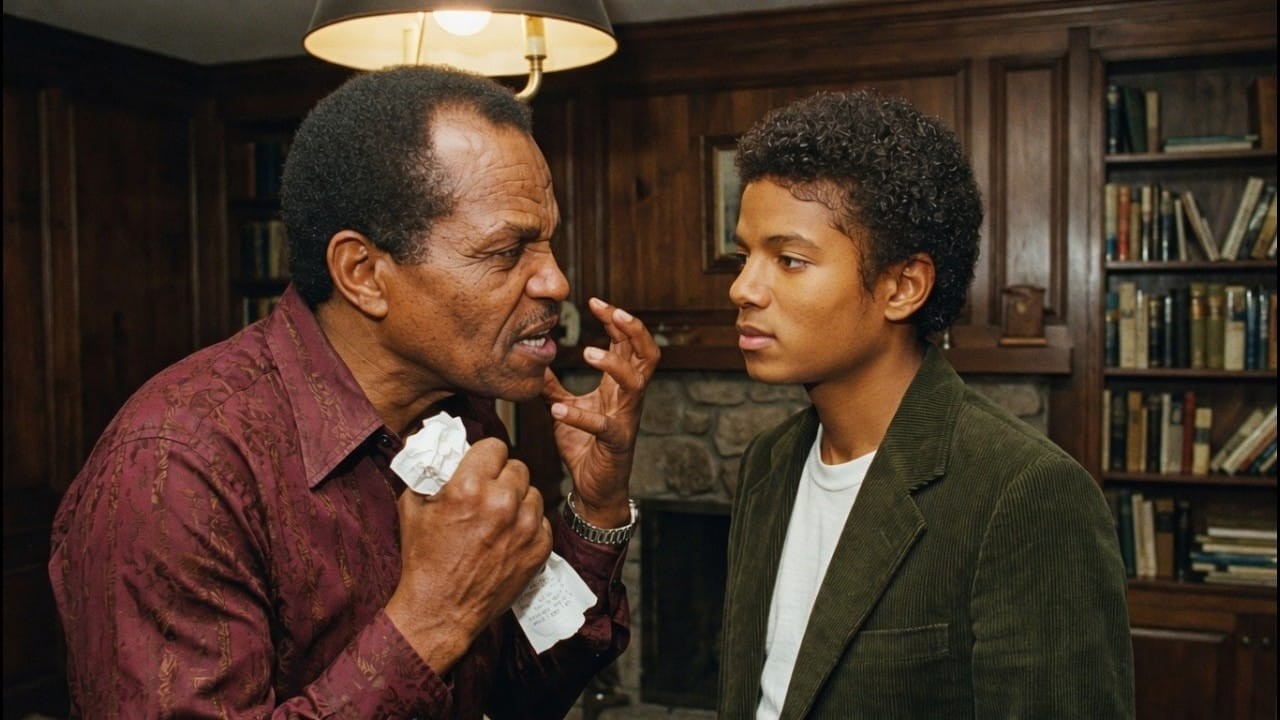
By the time Michael Jackson turned twenty-one, he had already spent most of his life working for somebody else.
Record companies decided what he recorded.
Executives decided how he was marketed.
Promoters decided where he performed.
And standing closer than all of them was the man who had discovered his extraordinary talent before almost anyone else.
His father.
Joseph Jackson.
Joe had taken a group of working-class children from Gary, Indiana, drilled them relentlessly, pushed them into talent competitions, secured professional opportunities and eventually helped turn the Jackson 5 into international stars.
Without Joe Jackson, there might never have been the Jackson 5 as the world knew them.
Michael understood that.
He would acknowledge his father’s extraordinary business instincts even after describing the painful childhood that came with them.
But by 1979, Michael wanted something Joe had never been accustomed to giving him.
Control.
And when Michael turned twenty-one, the professional relationship between father and son changed permanently.
Major accounts of Joe Jackson’s career report that Michael’s management contract with his father expired when Michael reached twenty-one.
Michael then ended Joe’s role as his personal manager and began constructing an independent professional team around himself.
It sounds simple when written in one sentence.
Michael Jackson fired his father.
But almost nothing about the Jackson family was that simple.
There was no single documented fax that instantly erased Joe Jackson from Michael’s life.
No verified dramatic scene in which security guards physically removed Joe from a studio.
No credible evidence that Michael’s lawyers secretly dismantled every corporate tie before Joe even realized what was happening.
What occurred was more gradual—and more consequential.
Michael had begun to realize that if he wanted to become the artist he imagined himself becoming, he could no longer allow his father to control every major professional decision.
The seeds of that separation had been planted years earlier.
Joe Jackson had run the Jackson children’s careers with extraordinary discipline.
He supervised rehearsals.
Negotiated.
Pushed.
Corrected.
Punished.
Michael later said those rehearsals could be terrifying.
In interviews as an adult, he described Joe standing nearby with a belt and physically punishing the children when mistakes were made.
Michael told Martin Bashir that his father had beaten him with belts and other objects.
He also told Oprah Winfrey that simply seeing Joe could make him physically ill with fear.
Joe later admitted using physical punishment, though he defended his methods as discipline that had kept his children out of trouble.
That contradiction remained at the center of Michael’s feelings toward his father.
Fear.
Resentment.
Gratitude.
Admiration.
Michael could condemn the way Joe treated him and still recognize that Joe possessed enormous determination and business instinct.
Joe had understood before almost anyone that the Jackson children could become stars.
He had pushed them until they became stars.
The problem was that Michael no longer wanted the man who had created the machine to remain in control of it forever.
The first major institutional break came before Michael’s personal emancipation.
In 1975, Joe helped negotiate the family’s departure from Motown for a deal with Epic Records.
The new arrangement offered significantly greater creative freedom and substantially improved royalties.
Because Motown controlled the name “Jackson 5,” the brothers became The Jacksons.
Jermaine remained with Motown.
Joe remained deeply involved as manager.
The move proved that Joe was not simply an overbearing stage father.
He could make sophisticated business decisions.
But it also exposed Michael to something new.
Creative autonomy.
Under the Epic arrangement, the Jackson brothers were eventually permitted greater involvement in writing and producing their own music.
Michael began discovering that he did not merely want to sing.
He wanted to shape the sound.
The arrangements.
The visual presentation.
The entire career.
Then came The Wiz.
Michael appeared as the Scarecrow in the 1978 film alongside Diana Ross.
During production, he met Quincy Jones.
That relationship would become one of the most important partnerships in modern popular music.
When Michael prepared his next solo album, he wanted Quincy to produce it.
The choice was important psychologically as well as musically.
Quincy Jones was not another father figure appointed by Joe.
Michael chose him.
The result was Off the Wall.
Released in 1979, it represented one of Michael’s clearest declarations that he could succeed as an adult artist independent of the child-star identity that had made him famous.
And its success gave him leverage.
Michael was no longer simply the youngest superstar inside a family act.
He was becoming a major commercial force on his own.
That year, he turned twenty-one.
And according to later accounts of Joe Jackson’s career, the management agreement binding Michael professionally to his father expired.
Michael did not renew the arrangement.
He dismissed Joe as his personal manager.
That was the genuine power shift.
Not a fax machine.
Not a locked studio door.
A son gaining the legal ability and commercial confidence to choose who represented him.
Michael began searching for people whose loyalty would be to Michael Jackson, rather than automatically to the Jackson family as a unit.
This distinction mattered enormously.
The Jackson family business had traditionally operated collectively.
Joe’s instinct was to think about the group.
The brothers.
The family.
Michael was beginning to think about an individual enterprise.
His own recordings.
His own publishing.
His own contracts.
His own future.
In January 1980, Michael met a young entertainment lawyer named John Branca.
Branca later testified that Michael was either twenty-one or had recently turned twenty-one and specifically wanted an independent team apart from his brothers and family.
Michael’s accountant arranged meetings with several attorneys.
Branca was among the first.
The two connected quickly.
Branca would become one of the most important business figures in Michael Jackson’s career.
He handled music agreements, contract negotiations, publishing matters and later helped engineer Jackson’s extraordinary purchase of the ATV publishing catalogue containing many Beatles compositions.
A Los Angeles Times account of Jackson’s business history described this period explicitly as the moment Michael began assembling his own advisers after years in which Joseph had guided the brothers’ affairs.
That is much closer to what “firing Joe” actually meant.
Michael was building an alternative power structure.
Joe had been father, disciplinarian, manager and negotiator.
Michael began separating those functions.
Quincy Jones could produce.
Independent managers could handle professional strategy.
Branca could handle law and negotiations.
Michael himself could make the final artistic decisions.
The change was enormous.
But Joe did not disappear.
That is another part often lost in sensational retellings.
Michael still lived within the Jackson family world.
Joe remained involved with The Jacksons.
Michael continued recording and performing with his brothers.
The family home in Encino remained an important center of his life.
And even after Michael was no longer professionally controlled by Joe, people around him described his father as an intimidating presence.
A detailed account of the Thriller era reported that by 1983 Joe was no longer Michael’s personal manager, yet Michael still sometimes relied on John Branca to communicate with his father about business because direct confrontation remained emotionally difficult.
That detail reveals why the separation was more complicated than a triumphant Hollywood firing scene.
Michael could fire the manager.
He could not fire the father.
Joe could no longer automatically negotiate Michael’s entire individual career.
But he was still Joseph Jackson.
The man whose footsteps Michael had learned to fear as a child.
The man who had driven the family from clubs in Gary to Motown.
The man whose approval had once determined whether a rehearsal ended peacefully.
Legal independence does not instantly erase childhood conditioning.
People around Michael during the early 1980s reportedly saw that contradiction firsthand.
One associate recalled Michael appearing physically frightened when Joe entered a room.
Vanity Fair’s account of the Thriller period described Michael using intermediaries rather than confronting his father directly over certain business matters.
Yet professionally, Michael was becoming stronger by the month.
Off the Wall had demonstrated that Michael Jackson could exist as an adult solo star.
Then Thriller changed the scale completely.
Released in 1982, the album grew into a cultural phenomenon.
Michael was no longer merely the most famous member of the Jackson family.
He was becoming one of the most famous people alive.
And with that success came something Joe had spent Michael’s childhood controlling.
Money.
A lot of it.
More importantly, Michael increasingly understood how to control it.
Frank DiLeo, who later managed Michael, told the Los Angeles Times that Jackson possessed unusually strong business instincts and involved himself deeply in career decisions rather than simply leaving them to others.
This is another reason the “naïve son finally rescued by lawyers” version does not fully work.
Michael sought advisers.
He depended on experts.
But the decision to create an independent career was his.
John Branca later remembered a young man who was ambitious, observant and extremely competitive.
Michael wanted the best.
And he wanted to understand what was happening around him.
The independence eventually produced financial decisions that would have been almost unimaginable during Michael’s childhood.
In the mid-1980s, with Branca advising him, Jackson purchased ATV Music Publishing for $47.5 million.
The catalogue contained thousands of compositions, including a large body of Beatles songs.
It became one of the defining business moves of his life.
A child who had once performed under contracts negotiated by adults now owned one of popular music’s most valuable publishing portfolios.
That transformation started with a seemingly mundane decision.
Choose his own representatives.
The psychological meaning was enormous.
For most of Michael’s childhood, Joe had made decisions because Michael was a child.
Then Michael became an adult.
The difficulty was convincing everyone—including himself—that adulthood changed the hierarchy.
The conflict became especially visible in 1983 and 1984.
By then Thriller had exploded.
The Jackson family saw an opportunity to reunite the brothers for what became the Victory Tour.
Accounts from people around Michael say he did not want to participate.
His solo career was moving at extraordinary speed.
He wanted to concentrate on his own projects.
But family pressure was powerful.
Katherine Jackson reportedly helped persuade him.
Michael ultimately agreed to tour with his brothers.
This is important because it shows that “firing Joe” had not liberated Michael from every Jackson family obligation.
Joe could no longer simply function as Michael’s personal manager in the old way.
But Michael remained emotionally tied to the family.
And those ties could still influence major professional choices.
The Victory Tour became enormous.
It also became notorious behind the scenes for disputes over promoters, ticketing, management, profits and control.
A 1985 Los Angeles Times investigation described a chaotic network of managers, advisers, attorneys and promoters surrounding the production.
Michael increasingly left many business details to his own lawyers, publicists and advisers rather than allowing a single family authority to control everything.
By the end of the tour, Michael made his position unmistakable.
At the final show in Los Angeles in December 1984, he announced onstage that it would be the last time the brothers performed together in that configuration.
The declaration reportedly surprised even members of the family.
Whatever ambiguity remained after 1979 was disappearing.
Michael Jackson was building a life outside the family act.
The separation from Joe therefore happened in stages.
First came artistic independence.
Then the expiration of the personal management arrangement.
Then Michael’s independent attorney and management network.
Then Thriller.
Then control over publishing and increasingly sophisticated financial decisions.
Then the final break from touring as one of The Jacksons.
There was no single magic piece of paper that created Michael Jackson’s independence.
It took years.
That gradual process also explains why Joe remained visible beside Michael long afterward.
Photographs from the 1980s sometimes show father and son together.
Joe attended public events.
The family continued gathering.
Michael never pretended Joe had not existed.
The relationship was too complicated for that.
Even decades later, when Michael spoke publicly about the beatings, he could also discuss his father’s drive and business ability.
Joe, for his part, continued insisting that his methods had helped create successful children.
The argument between those two truths never fully disappeared.
Joe had helped build Michael Jackson.
Michael also spent much of adulthood trying to escape the parts of Joe Jackson’s control that had shaped him.
That tension makes the real story far more interesting than the fictional termination fax.
Because Michael’s decision was not merely about management fees.
It was about identity.
For Joe, Michael had originally been part of a group.
A son.
A performer whose success belonged to the family enterprise.
For Michael, adulthood increasingly meant becoming something separate.
Not Jackson 5 Michael.
Not Joe Jackson’s boy.
Michael Jackson.
The distinction became visible even in the people he selected around him.
Quincy Jones was chosen because Michael trusted his musical judgment.
John Branca was chosen because Michael wanted an attorney representing his individual interests.
Ron Weisner and Freddy DeMann were among the professional managers associated with Michael’s early independent period, and DiLeo later became his personal manager during the height of Thriller and Bad.
Each relationship had its own complications.
Michael would eventually dismiss DiLeo in 1989.
He would part with Branca around 1990, later rehire him, separate again and bring him back shortly before his death.
Independence did not mean Michael suddenly became incapable of changing advisers.
Quite the opposite.
Once he learned that representatives worked for him, he became willing to replace them.
The most consequential firing was simply the first.
Joe.
But even that word—firing—can create the wrong picture.
Imagine instead a contract expiring.
A twenty-one-year-old superstar deciding not to renew the old order.
A young man telling the industry he wanted people who answered directly to him.
Then imagine how radical that decision would feel when the manager being replaced was also the father whose authority had defined almost every day of the young man’s childhood.
That was the real confrontation.
Not necessarily a shouting match.
Not security at a studio.
Not a fax machine spitting out a termination notice.
A son saying, through his actions:
You no longer decide everything for me.
And Joe had to live with it.
The irony is that Joe Jackson had trained Michael to demand perfection.
The endless rehearsals.
The corrections.
The discipline.
The obsession with putting on a show correctly every night.
Michael carried those qualities into adulthood.
But once he possessed them, he no longer needed Joe standing over him to enforce them.
He had internalized the system.
Michael became harder on himself than perhaps any manager could have been.
The boy Joe once forced to rehearse became the adult who would repeat dance sequences endlessly, demand new takes, challenge producers and obsess over every visual detail.
Joe had taught him control.
Then Michael took control away from Joe.
It was one of the great paradoxes of their relationship.
The father’s methods helped create the very ambition that eventually made the son impossible to manage as a child.
By 1983, Joe was still powerful enough emotionally that Michael reportedly avoided confronting him directly.
Professionally, however, the balance had reversed.
Michael had the bigger career.
His own advisers.
His own money.
His own contracts.
His own vision.
And eventually one of the most commercially successful albums ever made.
Joe Jackson had discovered Michael.
But he no longer owned the direction in which Michael was going.
That is why the real moment Michael “fired” his father matters.
Not because one fax supposedly reached an office at a particular hour.
No credible evidence establishes that dramatic detail.
It matters because Michael did something that children raised under authoritarian control often struggle to do even as adults.
He changed the rules of the relationship.
He could still love Joe.
Fear Joe.
Resent Joe.
Admire Joe.
Work beside members of the family Joe had created.
But he no longer had to let Joe manage Michael Jackson simply because Joe Jackson was his father.
The professional separation did not solve their personal relationship.
Nothing ever completely did.
Michael would spend decades talking about the scars of childhood.
Joe would continue defending his discipline.
And the two men remained bound together in public memory until Michael’s death in 2009 and Joe’s death in 2018.
But there was one boundary Michael established that never completely disappeared.
His career belonged to him.
The sensational version imagines a young lawyer hitting “send” on a termination fax while Joe Jackson suddenly realizes his empire has collapsed.
The documentary record shows something slower.
And more powerful.
At twenty-one, Michael began creating an independent team.
He hired people his father had not chosen.
He trusted a producer he selected.
He hired his own lawyer.
He began negotiating his own future.
Then he created Thriller.
Bought publishing rights.
Built a career larger than the Jackson family machine itself.
The real power shift did not happen when ink dried.
It happened when Michael Jackson understood that the man who had taught him how to become a star no longer had the right to decide what kind of star he would become.


