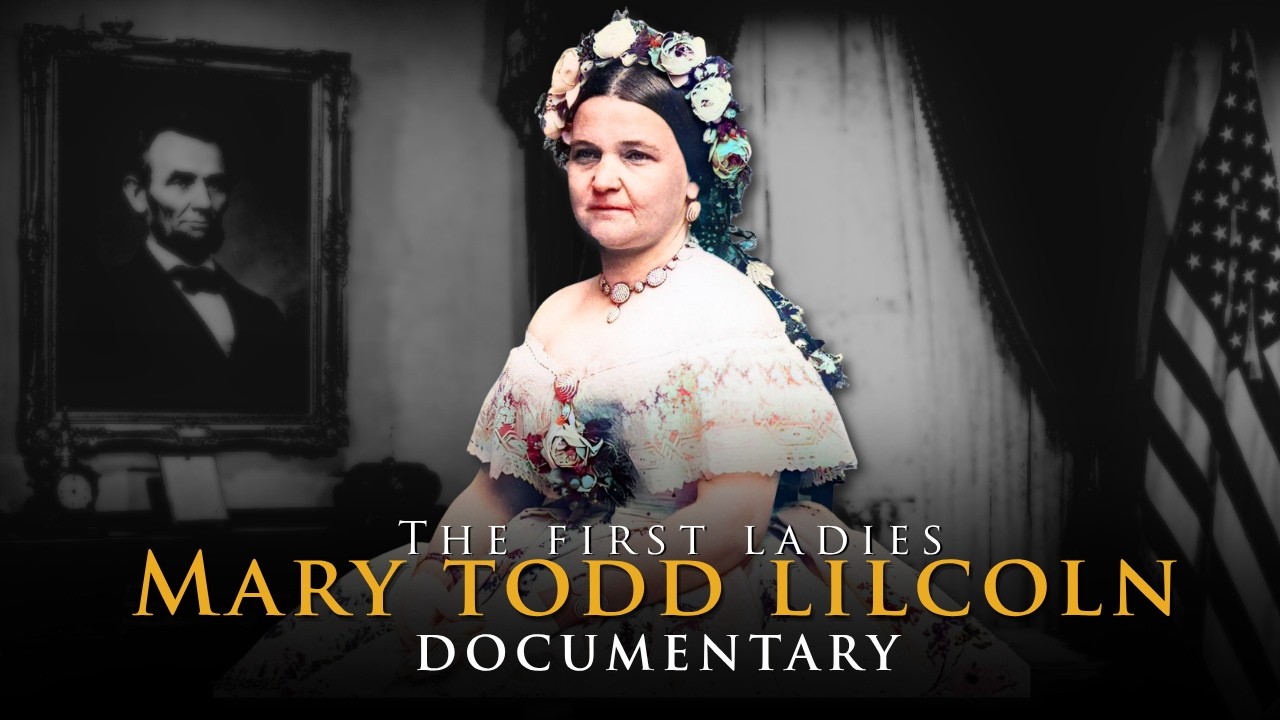
On the morning of May 19, 1875, Mary Todd Lincoln opened the door of her Chicago hotel room and discovered that several men had come for her.
She was fifty-six years old.
Ten years earlier, she had been First Lady of the United States.
Ten years earlier, she had been sitting beside Abraham Lincoln when John Wilkes Booth fired a bullet into the president’s head.
Now a lawyer named Leonard Swett showed her something she had never expected to see.
A legal order charging her with lunacy.
Mary had not been told there would be a trial.
She had not assembled witnesses.
She had not prepared a defense.
And she initially did not understand the most devastating part.
The person responsible for bringing the case against her was her only surviving child.
Robert Todd Lincoln.
By the time Mary reached the Cook County courthouse, Robert had spent weeks preparing.
Seventeen witnesses were ready to testify.
Doctors.
Hotel employees.
Store clerks.
Servants.
People who had watched Mary purchase expensive goods, express fears that others considered irrational, carry securities because she worried they would be stolen, and behave in ways Robert believed placed her in danger.
Mary had none of her own witnesses waiting.
The attorney nominally representing her offered no meaningful rebuttal and did not seriously challenge the testimony presented against her.
Then the case went to an all-male jury.
A contemporary newspaper account reported that the jurors deliberated for approximately ten minutes.
Then they returned.
Mary Lincoln was declared insane.
The widow of Abraham Lincoln was ordered confined to an institution.
The verdict represented an extraordinary reversal.
Fourteen years earlier, Mary had entered the White House beside a husband many Americans had initially dismissed as an awkward prairie lawyer.
She had believed deeply in his political possibilities long before he became president.
She had hosted allies, followed political developments and endured attacks against both of them.
Now Abraham was dead.
Three of her four children were dead.
And the surviving son was the man asking a court to take away her freedom.
To understand how the Lincoln family reached that courtroom, it is necessary to return to the night that shattered Mary’s life.
April 14, 1865.
Ford’s Theatre.
Washington, D.C.
The Civil War was effectively ending.
Five days earlier, Robert E. Lee had surrendered at Appomattox.
For the first time in years, Washington was celebrating.
Abraham and Mary Lincoln decided to attend the comedy Our American Cousin.
Major Henry Rathbone and Clara Harris joined them in the presidential box.
Witnesses remembered Lincoln appearing unusually happy.
The audience laughed loudly throughout the performance.
Ford’s Theatre notes that Lincoln, Mary, Rathbone and Harris were all laughing with the rest of the audience moments before Booth entered the box.
It is sometimes said that Mary’s laugh was the last thing Abraham Lincoln heard.
History cannot establish that so precisely.
The theater itself was roaring with laughter when Booth fired.
But Mary was sitting immediately beside her husband.
One moment they were watching a comedy together.
The next, Abraham Lincoln was unconscious.
He would never speak to her again.
Doctors carried Lincoln across Tenth Street to the Petersen boarding house.
Mary followed.
For hours she waited in the front parlor, repeatedly trying to reach her husband.
Robert arrived around 11:30 p.m. and attempted to comfort her while also spending much of the night near his father.
Mary was not beside Abraham at the exact moment of death.
Shortly before 7:22 a.m., after she entered the room and collapsed in anguish, Secretary of War Edwin Stanton had her removed.
She learned that her husband was dead from another room.
The assassination did not create all of Mary Lincoln’s suffering.
It landed on top of years of it.
She and Abraham had four sons.
Edward, called Eddie, died in 1850 at only three.
William, called Willie, died in the White House in 1862 at eleven.
His death devastated both parents, but Mary’s grief became especially consuming.
Then Abraham was murdered.
Only Robert and the youngest son, Tad, remained.
Mary left Washington financially anxious, politically isolated and emotionally shattered.
She wrote shortly after her husband’s death that there had never been “a more loving and devoted husband.”
She wore black mourning clothes for the remainder of her life.
She also turned increasingly toward spiritualism.
Séances promised something conventional religion could not guarantee in the same immediate way:
Contact.
Willie.
Eddie.
Abraham.
The dead might speak again.
Like many grieving Americans after the Civil War, Mary attended séances and sought mediums who claimed they could communicate with the other world.
Some exploited her grief.
The famous “spirit photograph” showing Abraham’s supposed ghost standing behind her was a hoax produced by William Mumler.
Then, in 1871, tragedy returned.
Tad Lincoln died at eighteen.
Mary had now buried her husband and three sons.
Robert was the only child left.
Their relationship became increasingly difficult.
Money was one source of conflict.
Mary had always been criticized for spending.
During the Civil War, newspaper attacks over White House purchases had humiliated her.
After Abraham’s death, her financial anxieties became more complicated.
She fought for a congressional pension.
She tried unsuccessfully and publicly to sell some of her clothing.
Robert was mortified by the episode.
By the mid-1870s, he had become deeply alarmed by behavior he believed went far beyond extravagance.
The National Park Service summarizes some of the conduct that frightened him.
Mary bought costly jewelry she did not wear.
She sometimes took items on approval without promptly paying for or returning them.
She carried significant financial securities on her person because she feared theft.
She developed intense fears about fire.
Robert wrote of fearing a “probable tragedy” if something was not done.
Then came the episode that seems to have accelerated his decision.
Early in 1875, Mary spent time in Florida.
While there, she experienced a dream or vision that Robert was dangerously ill.
She urgently telegraphed him and his law partner and hurried back to Chicago.
Robert was healthy.
To him, the episode became further evidence that his mother could no longer safely manage her affairs alone.
Robert consulted lawyers and physicians.
Then he turned to the legal system.
What followed remains controversial because two separate questions are often confused.
Was Robert genuinely worried about his mother?
The surviving record strongly indicates that he was.
Was the legal process fair to Mary?
Its procedures would be deeply troubling by modern standards.
Both facts can exist simultaneously.
Robert testified emotionally during the proceeding and reportedly broke down in tears.
The National Park Service portrays him not simply as a son trying to seize money, but as someone who believed his mother might injure herself and needed protection.
But Mary received almost no meaningful opportunity to prepare for the hearing.
She did not know it was coming.
She arrived to discover seventeen witnesses waiting against her.
Her own attorney mounted essentially no substantive countercase.
And after roughly ten minutes of reported deliberation, twelve men had legal authority to redefine the life of one of the most famous women in America.
The verdict stripped more than freedom from her.
Robert gained substantial control over her finances.
Mary was ordered to Bellevue Place, a private sanitarium in Batavia, Illinois.
The next day she entered the institution.
She was not entering a massive state madhouse of the sort associated with the darkest nineteenth-century imagery.
Bellevue Place was a private facility run by Dr. Richard Patterson.
Mary had her own room and was permitted certain privileges.
But that did not change the essential fact.
She had not chosen to be there.
She considered herself sane.
And she believed her own son had betrayed her.
According to National Park Service records, the night after the verdict she reportedly attempted suicide.
Then Mary did what Robert apparently had not anticipated.
She began fighting back.
She wrote letters.
Lots of them.
She contacted people who might help.
Among the most important were James and Myra Bradwell.
Myra Bradwell was a pioneering legal reformer and one of America’s earliest prominent women associated with the legal profession.
Mary’s surviving correspondence shows her desperately trying to obtain allies who would challenge the confinement.
Her letters are crucial because they complicate the easy image of a helpless, incoherent woman.
Whatever conclusions people reached about her condition, Mary could organize a campaign.
She understood that public opinion mattered.
She understood that the law mattered.
And she understood that her famous name could still be used.
News of her confinement began circulating.
The story was irresistible.
Abraham Lincoln’s widow.
Declared insane.
Committed by Abraham Lincoln’s son.
Public reaction divided.
Some observers considered Robert a responsible son who had taken painful action to save his mother.
Others saw something grotesque in a legal process where Mary had virtually no warning and no effective defense.
That argument has never entirely ended.
Even modern scholarship remains cautious about imposing a definitive retrospective psychiatric diagnosis on Mary Lincoln.
Historian Jason Emerson’s documentary study of the case deliberately assembles the primary sources without reducing the episode to a simple verdict that Mary was either unquestionably insane or merely a perfectly healthy victim of conspiracy.
What can be established is that the 1875 court declared her insane.
It can also be established that the verdict did not last.
Mary remained at Bellevue for less than four months.
Her increasingly effective campaign helped create pressure for release.
Eventually Dr. Patterson and Robert agreed that she could leave Bellevue and live with her sister Elizabeth Edwards in Springfield.
The house she entered carried extraordinary memories.
It was the same family home in which Mary Todd had married Abraham Lincoln in 1842.
Now she returned there after being confined by their son.
Mary was not satisfied merely with release.
She wanted the legal judgment erased.
On June 15, 1876, another jury heard her case.
This time, the result was different.
Mary Lincoln was declared sane.
Her legal control over her property was restored.
The second verdict did not heal the family.
Mary never fully forgave Robert.
Ford’s Theatre National Historic Site describes mother and son as remaining estranged after the confinement.
For Robert, the situation was equally tragic.
He had lost his father to assassination.
Two brothers had died before 1865.
Tad died in 1871.
By 1875, Robert was the lone surviving son of the Lincoln household.
He had watched his mother’s behavior grow increasingly alarming to him.
He acted.
And whatever his motive, the act permanently damaged the last immediate family relationship he had left.
This is why describing Robert simply as a villain misses the historical problem.
The records show real concern.
They also show a process stacked heavily against Mary.
Robert may have believed institutionalization was necessary.
Mary experienced it as betrayal.
Neither perception cancels the other.
After regaining legal independence, Mary eventually returned to Europe and spent years abroad.
Her health declined.
She experienced physical problems and eventually returned to the United States.
The final destination was again Springfield.
Again, Elizabeth Edwards’s house.
The place where she and Abraham had married four decades earlier.
Mary’s final years bore little resemblance to the ceremonial world of the White House.
The woman who had once welcomed politicians and diplomats now lived largely withdrawn.
Abraham had been dead for seventeen years.
Eddie had been dead for more than thirty.
Willie for twenty.
Tad for eleven.
And her relationship with Robert never returned to what it had been.
On July 16, 1882, Mary Lincoln died at her sister’s house in Springfield.
She was sixty-three.
The immediate cause was recorded as a stroke.
So the familiar line that Mary “died alone in an asylum” is wrong.
She did not die at Bellevue.
She had won her release years earlier.
She died surrounded by the world of her own family history, inside the house where her marriage to Abraham had begun.
Then came the ring.
Abraham Lincoln had given Mary a wedding ring when they married on November 4, 1842.
For years, historians repeated a shortened version of its inscription:
Love is Eternal.
The real wording was more personal.
According to the Lincoln Home National Historic Site, shortly before her death Mary removed the wedding ring from her finger.
The next day, after she had died, friends of Elizabeth Edwards found it.
Inside were the words:
“A.L. to Mary, Nov. 4, 1842. Love is Eternal.”
They placed the ring back on Mary’s finger.
She was buried wearing it.
That detail changes the ending.
Mary Lincoln did not literally die with Abraham’s ring on her hand.
She had taken it off.
But the people around her returned it.
Forty years after Abraham had given it to her, seventeen years after Booth destroyed their life together, seven years after their son placed her in an asylum, the inscription went into the grave with her.
Love is Eternal.
Few marriages in American history have accumulated more mythology than Abraham and Mary Lincoln’s.
It was not a peaceful marriage every day.
They argued.
They grieved.
They came from radically different backgrounds.
Mary could be volatile.
Abraham could withdraw emotionally.
Political life imposed pressures neither had experienced when they married in Springfield.
But reducing Mary to the “crazy wife” of a saintly president distorts both of them.
She was educated.
Politically interested.
Ambitious for her husband.
Supportive of his rise.
A wartime First Lady under extraordinary scrutiny.
A mother who buried three sons.
A wife sitting inches from her husband when a bullet entered his brain.
Then a widow whose grief unfolded publicly in an era with little understanding of trauma and little sympathy for women who behaved outside social expectations.
None of that determines what diagnosis, if any, should be assigned to her from a distance of more than a century.
Nor does suffering automatically prove that every action others found disturbing was simply grief.
The historical record is more complicated.
That complexity is why the insanity case still provokes argument.
Robert’s witnesses described behavior they considered alarming.
Mary’s supporters later described a woman capable of reasoning, correspondence and careful planning.
One jury declared her insane in 1875.
Another declared her sane in 1876.
The difference between those two verdicts was only thirteen months.
The stigma lasted far longer.
For generations, biographies often treated the first verdict as the final truth.
Mary Todd Lincoln became easy to caricature.
Spendthrift.
Hysterical.
Mad.
Institutionalized.
The labels were simpler than the life.
But the surviving letters and court records force a harder question.
What happens when grief, unconventional behavior, gender expectations, family fear and nineteenth-century mental-health law collide inside one famous household?
There is no clean answer.
Only consequences.
Robert spent the remainder of his life carrying the knowledge that he had committed his mother.
Mary spent her remaining years knowing her only living child had testified against her.
Their estrangement became the final fracture in a family already almost completely destroyed by death.
Abraham and Mary Lincoln had entered marriage with four sons still ahead of them.
By 1875, Abraham was dead.
Eddie was dead.
Willie was dead.
Tad was dead.
Only Mary and Robert remained.
And they had become opponents in a courtroom.
Perhaps that is the real tragedy of May 19, 1875.
Not that a famous First Lady was declared insane.
Not even that her son arranged it without telling her beforehand.
It is that the last two survivors of Abraham Lincoln’s immediate household had suffered so much loss that they ultimately came to see each other as threats.
Robert believed he was protecting his mother.
Mary believed her son had taken away her freedom.
History cannot make those two truths comfortably agree.
Seven years later, Mary died in the same Springfield house where she had married Abraham.
The ring he had given her was placed back on her hand.
And the words buried with her were not about presidents.
Not about war.
Not about insanity.
Not about betrayal.
They were words from before all of it.
Before the White House.
Before Willie’s death.
Before Ford’s Theatre.
Before Bellevue.
Before Robert stood in court against his mother.
“A.L. to Mary, Nov. 4, 1842. Love is Eternal.”
Everything else had fallen apart.
The inscription remained.


