John Gotti’s Swagger Intimidated Police, but No Verified Precinct Takeover or Leaked Shift Audio Exists
John Gotti spent much of his criminal career cultivating an image that made ordinary encounters with law enforcement look theatrical.
He wore expensive suits.
He smiled for cameras.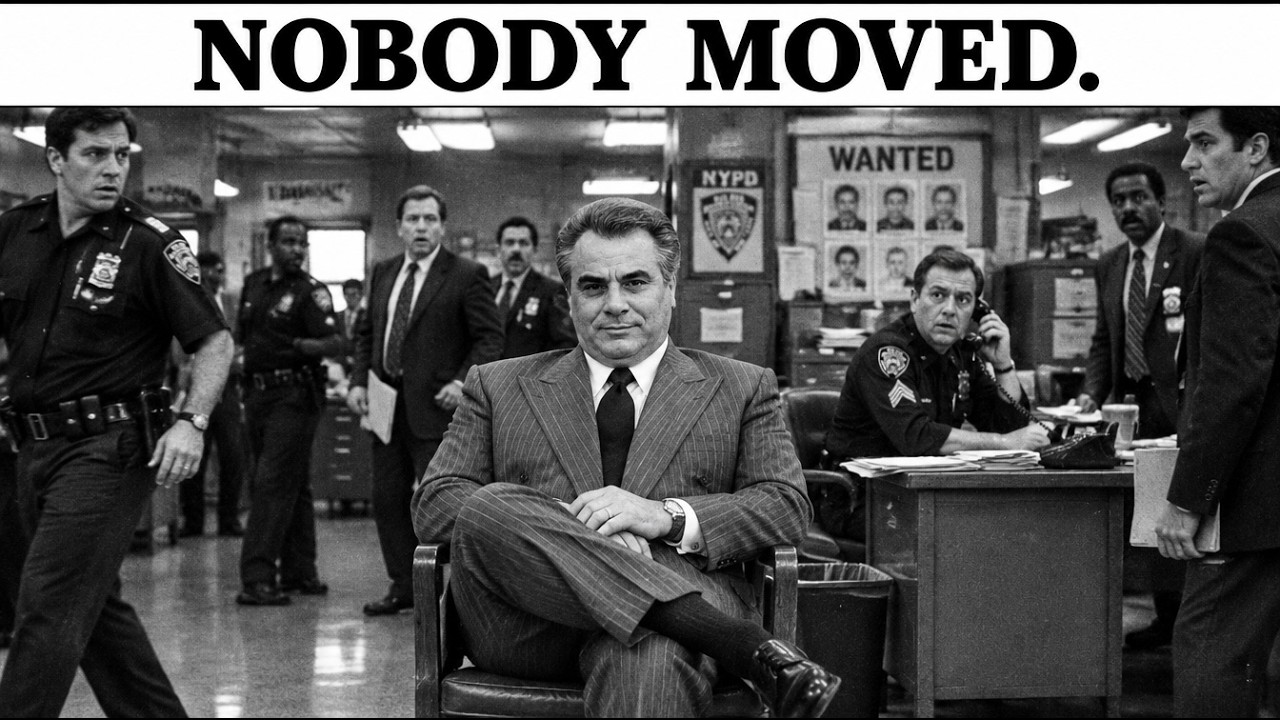
He walked through crowds of reporters as if criminal indictments were another appointment on his calendar.
And during the height of his power, repeated acquittals helped create the image of a Mafia boss whom prosecutors simply could not bring down.
That image eventually produced one of the most famous nicknames in American organized-crime history: the “Teflon Don.”
But a dramatic story now circulating takes Gotti’s genuine swagger and pushes it into a scene for which there is no authenticated historical evidence.
According to the claim, Gotti casually walked through the front doors of a police precinct wearing a bespoke suit, calmly sat in the waiting room, stared down armed detectives, and effectively transformed the station into his personal stage.
It further promises an internal police incident report and leaked shift audio documenting the confrontation.
The surviving historical record supports Gotti’s reputation for extraordinary confidence.
It does not currently support that specific precinct episode.
FBI records describe something considerably different.
Gotti had been arrested numerous times long before becoming the Gambino family’s most recognizable boss.
The FBI says he was arrested in 1968 for involvement in cargo theft and served prison time.
He was arrested again in connection with murder several years later.
By the 1980s, he had risen into the leadership structure of the Gambino crime family while becoming a central target of federal investigators and the New York Police Department.
The public persona was carefully cultivated.
Gotti became famous for expensive clothing, highly visible public appearances and an unusual willingness to interact with journalists.
The FBI itself notes that his expensive suits and lavish lifestyle helped inspire the nickname “Dapper Don.”
His repeated courtroom successes produced the more enduring “Teflon Don” label because serious criminal charges repeatedly seemed unable to stick.
That reputation was not entirely the result of legal brilliance.
The FBI later concluded that witness intimidation and jury tampering played important roles in Gotti’s ability to avoid conviction.
His apparent invulnerability therefore reflected organized criminal power as much as personal confidence.
Yet from the outside, the effect was extraordinary.
Here was a Mafia boss repeatedly photographed in tailored clothing, surrounded by associates, smiling while federal agents continued building cases against him.
The contrast between the seriousness of the allegations and Gotti’s public composure became part of his mythology.
That mythology makes the precinct story sound believable.
But believable is not the same as documented.
No FBI historical account reviewed here describes Gotti walking voluntarily into a New York police station and psychologically dominating the officers inside.
No reliable historical source identifies the precinct.
No date is supplied.
No arrest number is attached to the story.
No named detective has publicly authenticated the encounter.
And no original police shift recording matching the viral description has surfaced.
The absence matters because Gotti’s career was extraordinarily well documented.
He was the subject of extensive electronic surveillance.
Federal investigators followed his movements.
The FBI recorded activity around Gambino gathering places.
Court proceedings generated enormous paper trails.
Reporters followed him closely.
And decades later, FBI files involving Gotti remain publicly available through the Bureau’s records archive.
The FBI has even published surveillance footage showing Gotti walking New York streets with associates between 1988 and 1990.
Importantly, that FBI footage contains no audio.
The Bureau identifies it specifically as surveillance material rather than a dramatic police-station confrontation.
There are also extensive FBI surveillance records documenting Gotti’s activity around the Ravenite Social Club.
One FBI document from April 1989 describes surveillance of senior Gambino figures entering, leaving and holding guarded conversations around the club.
That material demonstrates how intensely law enforcement was monitoring Gotti.
It does not document him taking over a police waiting room.
The most consequential encounter between Gotti and law enforcement came in December 1990.
That episode ultimately destroyed the legend of the untouchable Teflon Don.
FBI agents and NYPD detectives arrested Gotti together with key Gambino figures after years of surveillance and investigative work.
The FBI says the prosecution relied heavily on court-authorized electronic surveillance, traditional investigative work and eventually the cooperation of Salvatore “Sammy the Bull” Gravano.
Historical accounts place the decisive arrests around the Ravenite Social Club, Gotti’s Manhattan headquarters.
History reports that detectives raided the club on December 11, 1990, arresting Gotti, Gravano and consigliere Frank LoCascio.
That scene is essentially the opposite of the viral precinct story.
Gotti did not control the environment.
Law enforcement did.
Investigators had spent years listening.
Watching.
Following.
Recording.
And assembling evidence.
The flamboyant Mafia boss who had previously walked away from major prosecutions finally faced a case designed specifically to prevent the methods that had helped him survive earlier trials.
The court used anonymous jurors so intimidation would become more difficult.
The government presented electronic surveillance.
And Gravano became a cooperating witness against his former boss.
On April 2, 1992, Gotti was convicted on 13 counts, including charges connected to the murders of Paul Castellano and Thomas Bilotti.
The head of the FBI’s New York office celebrated by saying that the Don was no longer coated in Teflon.
This time, the charges stuck.
That conviction permanently changed the meaning of Gotti’s swagger.
Before 1990, his confident appearances could be interpreted as evidence that prosecutors feared or could not defeat him.
After 1992, those same images became reminders of how temporary his apparent immunity had actually been.
Gotti’s power had been substantial.
His psychological effect on rivals and associates was real.
But he was never legally untouchable.
Nor were New York detectives literally powerless to arrest him.
Even during his years of courtroom victories, authorities continued investigating him.
The FBI explicitly states that agents and NYPD colleagues “refused to give up.”
That persistence is central to the actual story.
The viral phrase claiming officers had “no protocol to touch him” therefore exaggerates Gotti’s influence.
Police officers did arrest him.
Federal agents arrested him.
He served prison sentences before becoming Gambino boss.
And when the final federal case arrived, he was detained, prosecuted, convicted and ultimately sentenced to spend the remainder of his life in federal custody.
He died in prison in 2002.
What Gotti possessed was not legal immunity.
It was reputation.
That reputation could still have an intimidating effect.
Organized crime depends heavily on perceived consequences.
Witnesses may fear retaliation.
Jurors may feel pressure.
Associates may remain silent.
The FBI says witness intimidation and jury tampering helped Gotti evade justice before his final prosecution.
That is far more significant than whether a desk officer felt nervous when seeing him.
The real psychological battlefield was the courtroom and the witness stand.
If potential witnesses believed testifying could place them or their families in danger, the government’s ability to prosecute weakened.
If jurors could be corrupted or intimidated, even strong evidence could fail.
The nickname “Teflon Don” emerged from those failures.
It was not proof that police legally could not arrest him.
The same distinction applies to Gotti’s clothing.
His expensive suits absolutely mattered to his public image.
They helped separate him from stereotypical images of street-level criminals.
Gotti looked more like a wealthy businessman or celebrity than the leader of a violent criminal organization.
Photographers loved the contrast.
Newspapers loved it even more.
That visual identity became so famous that “Dapper Don” remains attached to his name decades after his death.
So a description of Gotti arriving somewhere in a bespoke-looking suit is consistent with his historical persona.
But clothing cannot authenticate an event.
Many fabricated historical stories survive because they combine accurate details with an invented central scene.
The suit is plausible.
The swagger is plausible.
The police recognition is plausible.
The intimidation is plausible.
The internal incident report is not currently verified.
The police-station takeover is not currently verified.
And the leaked shift recording is not authenticated.
That last claim deserves particular scrutiny.
Police and federal agencies certainly generated recordings during investigations of Gotti.
Court-authorized electronic surveillance became essential to the final prosecution.
The FBI monitored Gambino conversations and movements extensively.
But the existence of authentic Gotti surveillance does not authenticate every recording later labeled a “police leak.”
A real historical audio file would require provenance.
It should be possible to identify which agency created it.
There should be a date.
A location.
A case number or archive reference.
Someone should establish who is speaking.
If it is police dispatch or precinct audio, the responsible department should be identifiable.
If it came from an FBI investigation, the relevant investigative file should provide context.
The viral claim supplies none of that.
Instead, it promises a ten-second or otherwise hidden recording through a social-media call to action.
That is not historical verification.
The FBI archive provides a useful contrast.
Actual government records involving Gotti often contain file numbers, dates, classification markings, redactions and detailed investigative descriptions.
For example, surviving FBI material from April 1989 explicitly identifies surveillance around the Ravenite Social Club and records observed interactions among organized-crime figures.
That is what documentary provenance looks like.
An anonymous “internal police log” with no precinct, no date and no catalog reference does not meet the same standard.
This does not mean every dramatic Gotti story is impossible.
His life genuinely contained scenes that sound fictional.
He rose through organized crime.
He became Gambino boss after Paul Castellano was murdered outside Sparks Steak House in Manhattan in December 1985.
The FBI says Gotti watched from a vehicle and then had himself driven past the scene to confirm his orders had been carried out.
That event is more dramatic than many invented anecdotes.
Yet it is documented.
Gotti then became a tabloid celebrity.
He defeated major prosecutions.
He built a reputation for confidence.
He appeared publicly surrounded by powerful Gambino figures.
Federal investigators listened to conversations that ultimately helped dismantle his position.
And his own underboss eventually testified against him.
The verified history already contains the essential elements that made Gotti legendary.
Control.
Fear.
Theater.
Violence.
Surveillance.
Betrayal.
And eventual collapse.
The police-station story seems designed to compress those elements into one cinematic scene.
Gotti walks through the door.
Officers freeze.
Nobody knows what to do.
He sits.
Detectives stare.
He stares back.
The station supposedly becomes his territory.
It is an effective piece of storytelling because it turns Gotti’s reputation into a single visual metaphor.
But the historical record currently does not establish that the scene occurred.
The more accurate interpretation of his relationship with law enforcement is much more complicated.
Gotti was watched constantly.
He was arrested repeatedly.
He often escaped lasting consequences.
That enhanced his reputation.
But investigators continued adapting.
They changed tactics.
They relied on surveillance.
They protected juror identities.
They cultivated insiders.
They built racketeering cases designed to attack the criminal organization rather than isolated crimes.
Eventually, those methods succeeded.
The irony is that Gotti’s love of visibility may have contributed to the fascination that continues generating stories about him.
He did not behave like a secretive underworld figure avoiding every camera.
He became publicly recognizable.
His expensive wardrobe became news.
His courthouse arrivals became media events.
His confidence generated headlines.
The boundary between organized-crime boss and celebrity became unusually thin.
That made him ideal for mythology.
People could imagine him walking anywhere without fear because he often appeared to behave as though fear did not exist.
But institutional power ultimately mattered more than personal theater.
The government arrested him in 1990.
A jury convicted him in 1992.
He received a life sentence.
Crowds of his supporters reacted angrily outside the courthouse after sentencing, with History reporting that hundreds gathered and some overturned and damaged vehicles before police reinforcements restored order.
That genuine scene shows just how much symbolic power Gotti possessed.
He inspired intense loyalty.
He generated public spectacle.
Even after conviction, his supporters could create chaos outside a federal courthouse.
Yet inside the courtroom, the mythology had ended.
The Teflon had finally failed.
That is why the strongest factual version of the precinct story needs several distinctions.
John Gotti was famous for expensive suits.
Verified.
He cultivated an unusually confident public image.
Well documented.
He was repeatedly arrested before becoming Gambino boss.
Verified.
He won several highly publicized acquittals.
Verified.
Witness intimidation and jury tampering helped explain some of those legal victories.
Documented by the FBI.
The FBI and NYPD conducted extensive surveillance against him.
Verified.
Agents collected electronic evidence around Gambino operations.
Verified.
Gotti was arrested with senior Gambino figures in December 1990.
Verified.
He was convicted in April 1992.
Verified.
He eventually died in federal prison.
Verified.
Gotti casually walked into a police precinct and commandeered the waiting room through psychological intimidation.
Not established by the reliable records reviewed here.
Officers were legally unable or procedurally afraid to touch him.
Not established.
An internal precinct incident report documents the alleged showdown.
No authenticated report matching that description was located.
Armed detectives stood frozen while Gotti stared them down.
Not verified.
A police shift microphone recorded the encounter.
No authenticated recording located.
A leaked audio file is available containing officers reacting to Gotti’s alleged takeover.
No reliable evidence located.
The distinction does not make John Gotti less intimidating.
It makes the history more accurate.
His real power did not come from magically neutralizing an entire precinct by sitting in a chair.
It came from running one of New York’s most powerful organized-crime families.
It came from a network capable of intimidation.
It came from public victories against prosecutors.
It came from the fear surrounding Mafia retaliation.
And it came from a personality that understood perfectly how newspapers, cameras and public spectacle could turn a criminal defendant into a celebrity.
For years, that combination made Gotti appear larger than the justice system pursuing him.
Then investigators found the evidence and witness cooperation needed to reverse the story.
The image that survived was the Dapper Don entering courtrooms with confidence.
The reality that ultimately mattered was the man leaving the final courtroom as a convicted racketeer and murderer.
That ending is documented.
The extraordinary precinct waiting-room takeover and leaked police shift audio are not.


