John Gotti’s Restaurant Reputation Was Real, but the Defiant-Waiter Revenge Story Remains Entirely Unverified Today
John Gotti spent years cultivating the image of a Mafia boss who expected respect wherever he went.
He dressed extravagantly, appeared constantly at New York restaurants, surrounded himself with Gambino associates, and became one of America’s most recognizable organized-crime figures.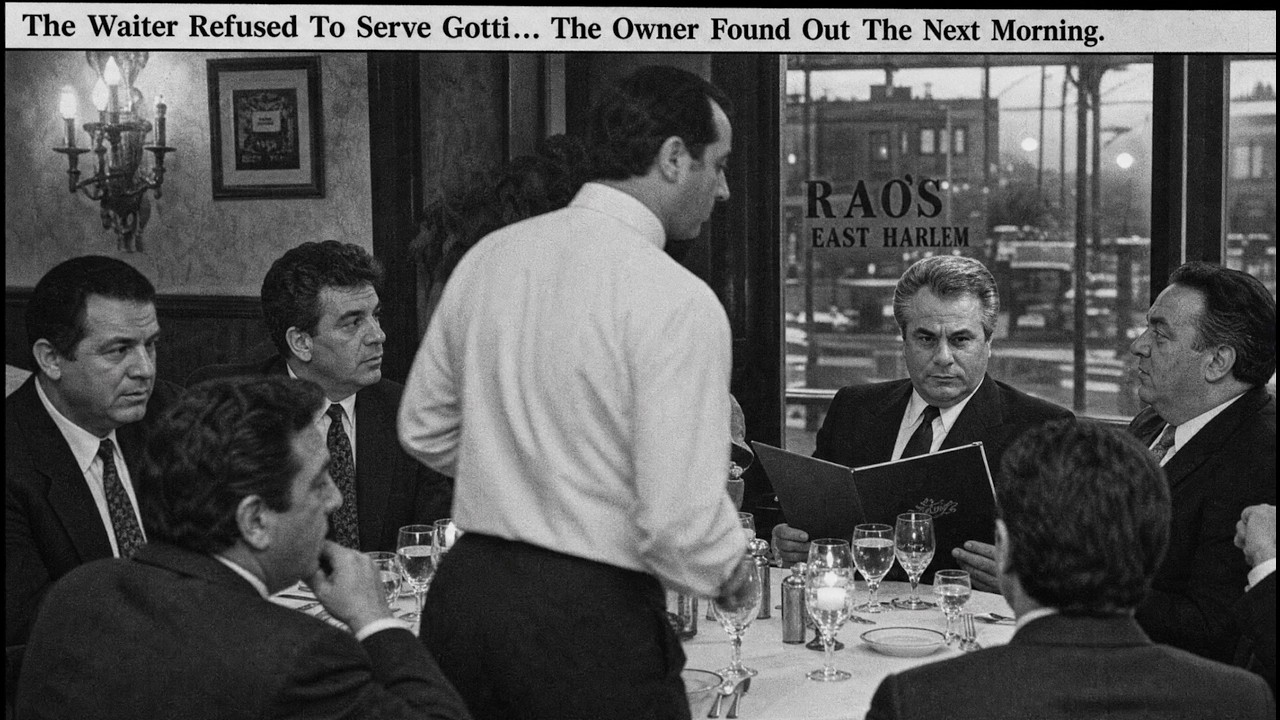
By the late 1980s, newspaper reporters were describing Gotti as a celebrity mobster whose arrival at restaurants could transform an ordinary evening into a public spectacle.
But a dramatic story now circulating about a waiter who supposedly refused to serve Gotti presents a much more specific sequence.
According to the story, an unidentified waiter openly defied the Gambino boss inside a crowded restaurant.
The dining room allegedly went silent.
Gotti supposedly left without immediately retaliating.
Then, at sunrise the following morning, the restaurant owner allegedly discovered black sedans waiting outside.
An enforcer was supposedly inside the kitchen.
And the establishment’s future allegedly changed forever because someone had disrespected the man newspapers called the “Teflon Don.”
The problem is simple.
I found no reliable historical evidence establishing that this particular restaurant confrontation happened.
No credible contemporary newspaper account identifies the restaurant.
No waiter has been reliably named.
No owner has been identified.
No FBI document reviewed for this story recounts the episode.
No court record establishes the alleged next-morning intimidation.
And no authenticated Gambino insider testimony located in the available sources describes black sedans surrounding a restaurant because a waiter refused Gotti service.
That does not mean Gotti was harmless.
The verified historical record shows precisely the opposite.
The FBI describes him as a violent and ruthless organized-crime leader involved in gambling, loansharking, narcotics trafficking, racketeering, extortion and murder.
Gotti’s reputation for intimidation also had a documented basis.
Federal authorities eventually linked his criminal organization to witness intimidation and jury tampering, two tactics that helped explain why several serious cases initially failed to remove him from the streets.
His rise to power was itself inseparable from violence.
On December 16, 1985, Gambino boss Paul Castellano and underboss Thomas Bilotti were shot outside Sparks Steak House in Manhattan.
The FBI says Gotti watched from a vehicle at a distance and later drove past the scene to confirm that the killings he had ordered were completed.
After Castellano’s death, Gotti emerged as the Gambino family’s dominant leader.
His public persona quickly became unusual even by Mafia standards.
Many organized-crime bosses historically tried to minimize public attention.
Gotti often seemed comfortable with it.
He wore expensive suits.
He moved through Manhattan surrounded by associates.
Photographers followed him.
Television cameras captured him entering courthouses.
Newspapers transformed him into a national character.
That combination produced two enduring nicknames.
“The Dapper Don” referred to his highly polished appearance.
“The Teflon Don” referred to the series of prosecutions that initially failed to convict him.
The FBI later emphasized that some of those apparent legal victories were not evidence of innocence.
Authorities uncovered witness intimidation and jury corruption surrounding his cases.
Restaurants were an important part of Gotti’s public image.
TIME reported in 1990 that Gotti was a familiar presence in New York restaurants and was known to leave hundred-dollar bills as tips while acknowledging other diners as he departed.
Vanity Fair published an extensive profile the same year describing an East Side Italian restaurant owned by a Gotti associate.
The restaurant contained a private downstairs room prepared for Gotti and his companions.
Associates occupied tables around the dining room.
Expensive wine was waiting.
A large man stood near the entrance.
The description illustrates how restaurants connected to Gotti’s social world could become heavily populated by mob associates.
That documented atmosphere helps explain why a story about a waiter refusing Gotti seems believable.
Imagine being a restaurant employee in late-1980s New York.
Gotti enters.
Several men accompany him.
Other associates may already be present.
His face appears regularly in newspapers.
Stories about Gambino violence circulate across the city.
Most employees would probably understand exactly who had just walked through the door.
A refusal of service under those circumstances would certainly have been memorable.
But plausibility is not evidence.
That distinction matters especially with Mafia history because decades of movies, memoirs, documentaries, television programs and oral storytelling have blended documented events with embellished legends.
The Gotti era is particularly vulnerable to this process.
He deliberately cultivated spectacle.
Journalists covered his clothes.
Crowds gathered around courthouses.
Neighborhood supporters treated him like a celebrity.
Mob associates told stories about him after his death.
Some were first-hand accounts.
Others were second-hand anecdotes.
Still others grew more dramatic with each retelling.
The “defiant waiter” story fits perfectly into that tradition.
It contains nearly every element of a classic Mafia legend.
A powerful boss enters a public place.
An ordinary worker refuses to show respect.
Everyone understands the danger except the worker.
The boss initially remains calm.
Nothing happens immediately.
Then the consequences arrive quietly the following morning.
Black cars appear.
An enforcer waits inside.
No explicit threat needs to be spoken.
The message alone is enough.
It is excellent dramatic structure.
It is not yet verified history.
Real evidence about Gotti shows that intimidation could occur in much less cinematic ways.
One particularly important example appears in a 1986 federal court decision involving Gotti.
The court examined whether Gotti posed a serious risk of influencing or intimidating witnesses.
The record discussed the case of Romual Piecyk, who had accused Gotti and another man of assaulting him.
Police testimony established that Piecyk appeared to have been beaten and had identified Gotti and another defendant as his attackers.
A government informant later reported that Gambino associates said Piecyk had been warned not to testify.
That case became one of the clearest demonstrations of the atmosphere surrounding Gotti.
Piecyk later became reluctant to testify.
The episode contributed to Gotti’s reputation for being able to make witnesses disappear from cases without literally making them disappear physically.
The federal court also heard information that approximately twenty alleged “shooters” or “enforcers” had been seen outside the Bergin Hunt and Fish Club while Gotti was inside.
That is documented.
It comes from a legal proceeding.
The restaurant waiter story does not currently have comparable evidentiary support.
There are also verified examples of organized crime targeting legitimate businesses.
The FBI says La Cosa Nostra historically infiltrated legitimate enterprises and engaged in extortion, labor racketeering, corruption, fraud, arson and violence.
Restaurants, construction companies, unions and other businesses were frequently vulnerable because organized-crime groups could combine economic pressure with physical intimidation.
That historical pattern makes another part of the viral story superficially plausible.
A restaurant owner in mob-influenced territory might genuinely fear consequences from humiliating a powerful Gambino figure.
But again, a general pattern cannot prove one specific anecdote.
The restaurant owner in this story remains unnamed.
The establishment remains unnamed.
The waiter remains unnamed.
The date remains unspecified.
The city is implied to be New York, but even that is not clearly documented.
No police complaint has surfaced.
No licensing record has been connected to the alleged incident.
No FBI surveillance memorandum found here describes the confrontation.
No restaurant closure has been tied to it.
No testimony from Sammy Gravano has been identified establishing it.
No reliable Gotti biography located in this review treats it as a documented episode.
Those omissions are significant.
John Gotti was one of the most heavily watched organized-crime figures in America.
By the early 1980s, federal agents were already using court-authorized wiretaps, confidential informants and undercover operations to understand Gambino leadership.
His movements were regularly monitored.
His social clubs were surveilled.
His associates were investigated.
His criminal cases generated extensive court records.
Journalists followed him relentlessly.
A restaurant incident dramatic enough to involve a public refusal, an organized intimidation response and a permanently altered business would therefore have had multiple opportunities to enter the historical record.
That does not guarantee every threat would have been documented.
Organized crime thrives partly because victims often refuse to speak.
Business owners may stay silent.
Witnesses may fear retaliation.
Restaurant employees may simply quit.
No police report may ever be filed.
That reality prevents a categorical statement that the incident was impossible.
But the correct historical description remains:
Unverified.
The black-sedan imagery also deserves scrutiny.
Black sedans became one of the most durable visual symbols of American Mafia storytelling.
Real mobsters certainly used sedans and luxury cars.
Gotti himself was often photographed traveling in expensive vehicles.
But the phrase “black sedans idling outside at sunrise” functions almost perfectly as cinematic shorthand.
Without a witness name, photograph, surveillance report or contemporary account, it cannot be treated as evidence merely because it sounds consistent with gangster imagery.
The same is true of the alleged kitchen enforcer.
Who was he?
Was he a made member?
An associate?
A bodyguard?
Was he armed?
Did he threaten the owner?
Did he demand the waiter be fired?
Did he demand money?
Did the restaurant later close?
None of those details has been established.
Instead, the viral account leaves the threat intentionally vague.
The restaurant’s fate was supposedly “permanently altered.”
That phrase sounds ominous.
But it avoids saying what actually happened.
Was the waiter fired?
Was the restaurant sold?
Was the owner extorted?
Was someone assaulted?
Was the business burned?
Did ownership change?
Did Gambino associates begin using the restaurant?
Historical claims require those questions to be answered.
The genuine story of Gotti’s control is far more concrete.
His criminal organization participated in traditional Mafia enterprises.
The FBI says gambling, loansharking and narcotics trafficking were among his activities.
He became boss after Castellano’s assassination.
Federal authorities spent years building a racketeering case against him.
Their eventual breakthrough came from electronic surveillance and cooperation from Salvatore “Sammy the Bull” Gravano.
In December 1990, federal agents and NYPD detectives arrested Gotti.
He was charged with racketeering, extortion, jury tampering and other crimes.
The trial that followed finally destroyed the aura of legal invincibility surrounding him.
Jurors were kept anonymous so they could not easily be pressured.
On April 2, 1992, Gotti was convicted on 13 counts, including charges connected to the murders of Castellano and Bilotti.
The celebrated “Teflon Don” image collapsed instantly.
An FBI official joked afterward that the don had become covered in Velcro because every charge finally stuck.
Gotti received life imprisonment.
He never again returned to the New York restaurant scene that had helped create his glamorous public image.
He died in federal custody in June 2002.
That documented history is more serious than the waiter legend because it reveals the actual machinery of Mafia power.
Gotti did not need to terrify every restaurant employee personally.
His reputation already did much of the work.
People understood the Gambino name.
They understood what happened to enemies.
They understood that witnesses could be pressured.
They understood that businesses could face extortion.
They understood that violence surrounded leadership struggles.
That reputation could make ordinary interactions feel threatening even when no explicit threat was spoken.
Gotti also understood the value of theatrical restraint.
His public persona often contrasted with the violence prosecutors attributed to his organization.
In front of cameras, he smiled.
He joked.
He dressed elegantly.
He waved to supporters.
He presented himself like a neighborhood celebrity.
Behind that image, prosecutors built a case involving murder, racketeering, extortion and corruption.
That contradiction made him unusually fascinating to the press.
It also helped generate mythology.
A story in which Gotti sits quietly after a waiter insults him, only for ominous consequences to arrive hours later, perfectly matches that mythology.
The boss does not lose control.
The boss does not need to shout.
The boss simply waits.
Then other people solve the problem.
It is an archetype familiar from gangster cinema.
Whether it describes this specific incident remains unproven.
One verified restaurant-related event demonstrates the difference between history and legend.
Sparks Steak House is real.
The date is known.
The victims are known.
The shooters were investigated.
Gotti’s role was established in the criminal case.
The FBI documents it directly.
Castellano and Bilotti were murdered outside the restaurant on December 16, 1985.
Gotti rose afterward.
That is historical evidence.
The defiant waiter story lacks those anchors.
There is no restaurant name.
No date.
No legal file.
No contemporaneous article.
No identified eyewitness.
No corroborating surveillance.
The responsible conclusion is therefore not that Gotti would never have retaliated against disrespect.
His documented history makes such retaliation conceivable.
The responsible conclusion is simply that this particular tale has not been authenticated.
That distinction actually makes the historical Gotti more interesting.
The fear surrounding him was not created by one waiter story.
It was built through decades of criminal activity, repeated prosecutions, courtroom intimidation, violent power struggles and highly visible public behavior.
By the time he became America’s most recognizable Mafia boss, people did not need an anonymous restaurant legend to understand why crossing him might feel dangerous.
Federal records already show what his organization was capable of.
Court records already document concerns about witness intimidation.
His eventual conviction already established his responsibility for major organized-crime offenses.
The restaurant mythology grew around that documented reality.
So the central claims can be separated clearly.
John Gotti was the boss of the Gambino crime family.
Verified.
He was known as the “Dapper Don” and “Teflon Don.”
Verified.
He was a frequent presence in New York restaurants.
Verified through contemporary reporting.
Restaurants associated with his circle could contain large numbers of mob associates and private spaces prepared for him.
Documented by contemporary journalism.
His criminal organization used intimidation.
Verified.
Federal courts examined evidence that witnesses connected to cases involving Gotti were pressured.
Verified.
The Gambino family belonged to a broader Mafia system involved in extortion and infiltration of legitimate businesses.
Verified.
Gotti ordered the murders of Castellano and Bilotti outside Sparks Steak House.
Established in the case that ultimately convicted him.
A waiter publicly refused to serve Gotti.
Not authenticated.
The restaurant dining room froze in fear.
Not independently documented.
Gotti retaliated the following morning.
Not authenticated.
Black sedans surrounded the restaurant at sunrise.
No reliable evidence located.
A Gambino enforcer waited inside the kitchen.
No reliable evidence located.
The restaurant owner received a secret warning.
Not verified.
The establishment’s fate was permanently changed because of the refusal.
No documented outcome has been identified.
An “underworld insider debrief” establishes the entire episode.
No authenticated source matching that description has been located.
The legend works because John Gotti’s real history gives it credibility.
He was violent.
He commanded a powerful Mafia organization.
His associates intimidated people.
His reputation preceded him.
But history cannot be reconstructed simply by asking whether a story sounds like something Gotti might have done.
The standard has to be evidence.
Until a named witness, contemporary report, FBI record, court filing or credible first-hand account identifies the restaurant and confirms what happened, the story of the waiter, the black sedans and the kitchen enforcer remains an unverified piece of Gotti mythology rather than established Mafia history.


