John Gotti’s Real War With Reporters Was Dangerous, but the Viral Shadow-Crew Story Remains Unproven
John Gotti understood something about fear that made him unusually dangerous even by the standards of organized crime.
Violence did not always have to happen.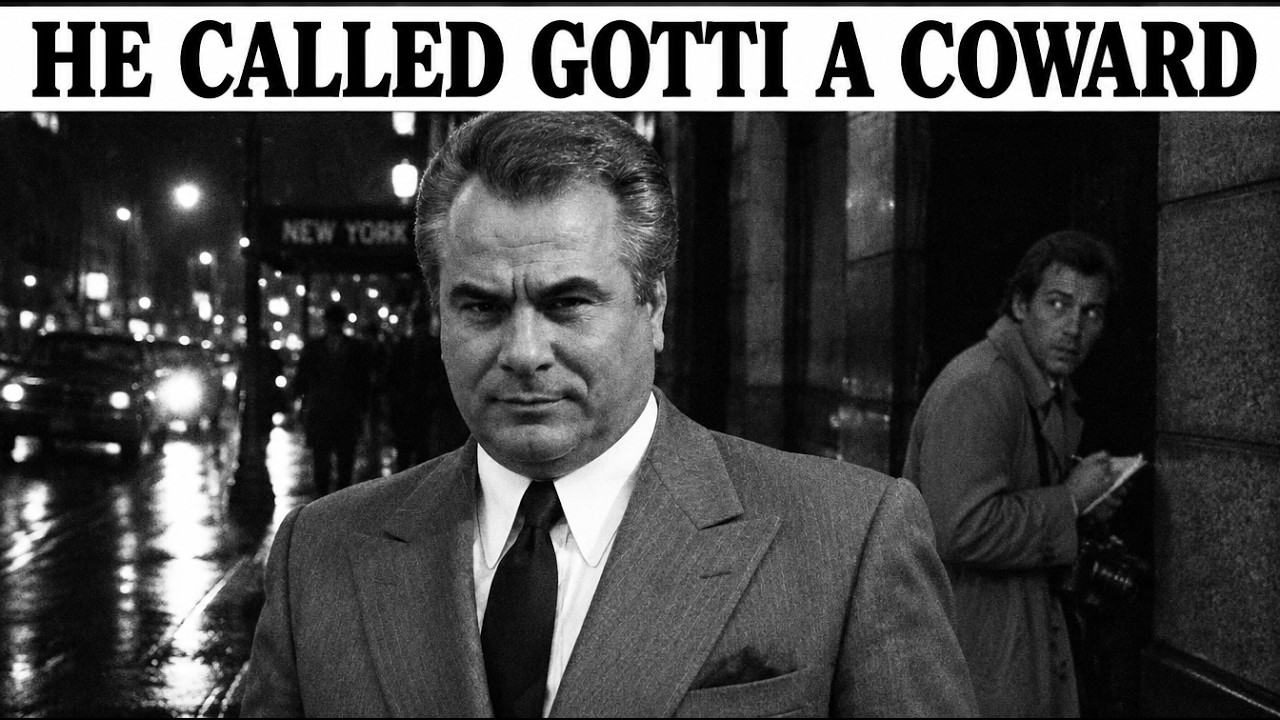
Sometimes people only needed to believe it could.
That reality sits at the center of a new story spreading around the legendary Gambino crime boss.
According to the viral account, an unnamed reporter once published a headline calling Gotti a coward.
Instead of immediately ordering the journalist killed or assaulted, Gotti allegedly chose a more calculated punishment.
The story claims Gambino associates began following the reporter everywhere.
Cars supposedly appeared behind him during his commute.
Men allegedly sat outside his apartment.
Others reportedly stared through his windshield at traffic lights.
Nobody touched him.
Nobody openly threatened him.
The point, according to the story, was psychological destruction.
Day after day, the reporter allegedly understood that professional killers could reach him whenever they wanted.
Eventually, the pressure supposedly shattered his mental health.
The viral account then promises secret surveillance logs and leaked mob wiretaps documenting the campaign.
It is a chilling story.
It also contains one major problem.
I found no reliable historical documentation establishing that this specific campaign occurred.
No authenticated FBI surveillance log located in the available record identifies a reporter who called John Gotti a coward and was subsequently subjected to continuous psychological surveillance.
No credible newspaper archive reviewed here documents such a reporter suffering a breakdown because Gotti ordered crews to follow him.
No identified FBI transcript contains the alleged order.
And no authenticated wiretap matching the viral promise has surfaced.
What is documented, however, is that Gotti was absolutely capable of intimidating journalists.
One of the clearest examples involved organized-crime reporter Jerry Capeci.
Capeci spent years covering New York’s Mafia families and became one of the best-known reporters on the subject.
His work routinely irritated mob figures.
Gotti was no exception.
During Gotti’s 1992 federal murder and racketeering trial, prosecutors played a wiretapped conversation in which Gotti angrily discussed Capeci.
According to the Los Angeles Times, Gotti suggested that someone should punch Capeci and then volunteered that he would do it himself.
That threat is real.
It was not invented decades later for social media.
It came from an FBI recording played during one of the most important Mafia prosecutions in American history.
The difference is that the documented threat involved physical violence.
It did not describe an elaborate shadow-surveillance operation intended to destroy Capeci psychologically.
That distinction matters.
Gotti’s actual history was already intimidating enough.
There is no need to attach an unsupported operation to it.
By the time Gotti became boss of the Gambino crime family, he had developed a reputation that combined violence, flamboyance and media savvy.
He had risen through organized crime over decades.
The FBI describes him as a violent and ruthless mobster involved in gambling, loansharking and narcotics trafficking before taking control of the Gambino organization.
His ascent became inseparable from the murder of Gambino boss Paul Castellano.
On December 16, 1985, Castellano and his underboss Thomas Bilotti were shot outside Sparks Steak House in Manhattan.
According to the FBI, Gotti watched events from a nearby vehicle and then had his driver pass the murder scene to confirm that the attack had succeeded.
With Castellano dead, Gotti emerged as the new boss.
His public image quickly grew.
Expensive suits.
Confident appearances outside court.
Crowds of supporters.
Constant newspaper coverage.
Photographers following him through Manhattan.
The media called him the “Dapper Don.”
After several high-profile acquittals, another nickname appeared.
The “Teflon Don.”
Charges seemed unable to stick.
But those courtroom victories were not simply proof that Gotti possessed extraordinary luck.
The FBI says witness intimidation and jury tampering played significant roles in helping him evade justice.
That fact changes how stories about Gotti’s intimidation tactics should be understood.
He did operate through fear.
He did benefit from people being afraid to testify.
His organization did use coercion.
And federal authorities considered the threat of interference serious enough that jurors in Gotti’s eventual successful prosecution were kept anonymous so they could not easily be pressured.
The underlying world described by the viral caption is therefore plausible.
But plausible is not the same as documented.
There is a tendency in Mafia storytelling to transform something a mobster could have done into something he definitely did.
Gotti is particularly vulnerable to that process because so many of his real statements already sound like dialogue written for a crime movie.
Federal recordings captured his temper.
His threats.
His contempt for people who disobeyed him.
And discussions involving murder.
In FBI recordings released before his 1992 trial, Gotti discussed one man who he said needed to be killed and another who he believed deserved death because he failed to respond when summoned.
Those recordings gave prosecutors extraordinary access to the culture surrounding the Gambino leadership.
They also gave historians something better than rumor.
Gotti’s own voice.
The FBI had spent years penetrating the Gambino organization.
Agents used court-authorized electronic surveillance, informants and undercover work to map Mafia hierarchy and criminal activity during the 1980s.
Gotti knew investigators were trying to record him.
According to accounts later discussed by his daughter Victoria and others, he sometimes walked outside during sensitive conversations because he distrusted enclosed spaces and feared hidden microphones.
It did not save him.
The FBI installed listening devices in locations associated with him and accumulated hundreds of hours of recorded Mafia conversations.
Those recordings eventually helped destroy the image of the untouchable Teflon Don.
Federal prosecutors also gained the cooperation of Salvatore “Sammy the Bull” Gravano, Gotti’s underboss.
Gravano admitted participation in numerous murders and testified against his former boss.
The tapes supplied Gotti’s words.
Gravano supplied insider explanation.
Together, they gave prosecutors a devastating case.
On April 2, 1992, Gotti was convicted on 13 counts.
The charges included murder and racketeering.
He would never again walk freely through New York as the most photographed Mafia boss in America.
That prosecution produced hundreds of pages of transcripts.
The Washington Post reported that more than 400 pages of government documents released in 1991 contained repeated references to killings and Gambino business.
That is important when evaluating the supposed journalist-surveillance story.
Gotti was one of the most heavily surveilled mobsters of his generation.
Federal agents recorded him extensively.
His criminal cases were covered obsessively.
Reporters followed virtually every development.
Books have been written about him.
Former associates have spoken publicly.
FBI records have been released under the Freedom of Information Act.
Yet the specific incident described in the viral caption remains difficult to trace.
Who was the reporter?
The viral version does not say.
Which publication printed the headline calling Gotti a coward?
It does not identify one.
When did the headline appear?
No date is supplied.
How long did the surveillance campaign continue?
No verified timeline exists.
Which Gambino associates supposedly participated?
No names are given.
Where are the surveillance logs?
No authenticated document has been produced.
Which FBI recording contains the order?
No tape number or transcript page is identified.
That absence does not mathematically prove that no intimidation campaign ever occurred.
Organized crime, by definition, often operates outside documented channels.
Many threats were never recorded.
Many victims never spoke publicly.
But a dramatic historical claim should not be presented as established simply because it resembles tactics the Mafia might plausibly have used.
There is a genuine reporter story that may have contributed to the legend.
Jerry Capeci repeatedly angered Gotti.
Capeci’s reporting exposed Mafia personalities and operations at a time when organized-crime journalism carried genuine personal risk.
The Los Angeles Times profiled Capeci in March 1992 and emphasized that his investigations had earned both respect and hostility from New York’s underworld.
The article specifically highlighted Gotti’s recorded threat to punch him.
That encounter reveals something important about Gotti’s relationship with the press.
He wanted publicity.
But he wanted publicity on his terms.
The contradiction defined his public persona.
Gotti enjoyed cameras.
He dressed carefully for photographers.
He smiled outside court.
He cultivated the image of a charismatic neighborhood figure who could walk through Queens surrounded by admirers.
Journalists helped create the Dapper Don.
Yet investigative journalism threatened the mythology surrounding him.
Reporters who dug into murders, racketeering, jury manipulation and internal Mafia politics could turn his theatrical public image into evidence of something much darker.
Gotti therefore existed in a strange relationship with the press.
He needed attention.
He also hated losing control of the story.
That tension makes the idea of a hostile reaction toward a reporter entirely believable.
But the verified Capeci threat gives us something stronger than belief.
It gives us evidence.
There is another reason the “shadow crew” story feels convincing.
Psychological intimidation has always been part of organized crime.
The threat of violence can sometimes be more useful than violence itself.
A victim who knows what the Mafia is capable of may comply without anyone firing a gun.
A witness can change testimony.
A business owner can make payments.
A juror can become vulnerable to influence.
A debtor can suddenly find money.
Fear functions as enforcement.
Gotti’s record fits that broader pattern.
The FBI explicitly identifies witness intimidation and jury tampering as tools that helped him escape conviction before the federal government finally built its successful case.
So the psychological logic of the viral story makes sense.
Imagine noticing the same sedan behind you every morning.
Then another outside your office.
A man in a dark coat standing across the street.
Someone watching you while you buy groceries.
Nobody speaks.
Nobody touches you.
Nobody commits an obvious crime.
Yet you know the organization watching you has killed people.
That could certainly terrify a journalist.
It is exactly the kind of story audiences associate with sophisticated Mafia intimidation.
But storytelling logic cannot replace documentary evidence.
That boundary becomes especially important when supposedly “leaked” documents are used as proof.
The caption promises an “unredacted surveillance log.”
The FBI really does maintain extensive historical Gotti records.
The Bureau’s public Vault contains multiple large collections of documents connected to John Gotti.
The FBI has also publicly released surveillance footage showing Gotti with associates in New York between 1988 and 1990.
But those authentic materials should not be confused with the specific log promised by the viral post.
A real FBI document should have provenance.
A file number.
Pages.
Dates.
Agency markings.
Context.
Names or redactions.
The claimed “shadow crew” document has none of those identifiers.
The same applies to the alleged mob wiretap.
Real Gotti wiretaps absolutely exist.
They were central to his prosecution.
They include threats.
They include discussions connected to murders.
They include angry comments about people who defied him.
And they include Gotti threatening journalist Jerry Capeci.
But the existence of hundreds of genuine recordings does not authenticate every audio clip later labeled “John Gotti leaked wiretap.”
An authentic tape should be traceable.
Was it recorded at the Ravenite Social Club?
An apartment?
A vehicle?
A telephone?
What date?
What case produced it?
Was it played at trial?
Does a transcript exist?
Who identified the voices?
Without those details, a supposed ten-second leak should be treated cautiously.
The final part of the viral story claims the unnamed reporter’s sanity was completely destroyed.
That is perhaps the most dramatic detail.
It is also one of the least documented.
I found no credible contemporary account describing a journalist suffering a verified psychological collapse after Gambino associates continuously followed him on Gotti’s orders.
There are journalists who received Mafia threats.
There were reporters who worked under genuine fear.
There were witnesses, prosecutors, investigators and informants who required protection.
But this specific mental-breakdown narrative lacks the identifiable victim and documentation necessary to present it as historical fact.
That does not diminish Gotti’s real capacity for intimidation.
The documented version is already remarkable.
A Mafia boss who became an international celebrity openly discussed violence on recordings.
He threatened people who ignored his calls.
He discussed killing enemies.
His organization intimidated witnesses.
His associates helped manipulate judicial processes.
He threatened a journalist whose reporting angered him.
Eventually, federal surveillance captured enough of that world to help put him away permanently.
In that sense, surveillance did destroy someone psychologically and strategically.
But the person under the most consequential surveillance was Gotti himself.
The irony is difficult to miss.
The viral story portrays Gotti as the master of invisible observation.
Men supposedly watched a reporter until the reporter became consumed by paranoia.
Meanwhile, the FBI was quietly watching Gotti.
Agents photographed him.
Recorded him.
Tracked his associates.
Bugged the places where he conducted business.
Collected his conversations.
And eventually turned his own words against him.
The FBI’s released surveillance footage shows Gotti walking through New York with associates, apparently unaware that those images would eventually become part of the historical record of his criminal career.
The Teflon Don had spent years using fear to control other people.
Federal investigators defeated him partly by making observation systematic.
Court-authorized.
Documented.
And legally usable.
By December 1990, Gotti was under arrest on the case that finally mattered.
In 1992, an anonymous jury convicted him.
The nickname “Teflon Don” suddenly stopped fitting.
The head of the FBI’s New York office famously joked afterward that the Don was now covered in Velcro because every charge had stuck.
Gotti received life imprisonment.
He died in federal custody in June 2002.
His myth survived him.
That mythology helps explain why stories like the shadow-reporter narrative spread so effectively today.
Gotti was simultaneously gangster, celebrity, neighborhood figure and tabloid character.
The documented facts surrounding him are already cinematic.
That makes fabricated or embellished episodes difficult to recognize.
A viewer hears that Gotti threatened a reporter.
True.
They hear that he used intimidation.
True.
They hear that the FBI recorded him discussing violence.
True.
They hear that witnesses and jurors were vulnerable to Mafia pressure.
True.
Then one additional detail gets added.
Gotti supposedly assigned silent hitmen to follow a reporter until the man psychologically collapsed.
Because everything surrounding the added detail sounds consistent with the real Gotti, the invention becomes difficult to detect.
That is why the evidence needs to be separated carefully.
John Gotti was a violent Gambino boss.
Verified.
His organization benefited from witness intimidation and jury tampering.
Verified.
The FBI used extensive electronic surveillance against him.
Verified.
Hundreds of pages of Gotti wiretap transcripts were publicly released.
Verified.
Gotti was recorded making threats involving violence and death.
Verified.
Gotti threatened investigative reporter Jerry Capeci with physical violence.
Verified through reporting about the tape played at his trial.
Gotti was furious at unfavorable media coverage.
Consistent with documented reporting and recordings.
An identified reporter published a headline calling Gotti a coward.
Not established by the sources reviewed.
Gotti responded by assigning continuous surveillance teams to that reporter.
Not established.
Hitmen followed the journalist day and night without touching him.
Not established.
The operation deliberately aimed to destroy the reporter psychologically.
Not established.
The reporter eventually lost his sanity.
Not established.
An authenticated mob surveillance log proves the operation.
No such specific document was located.
A leaked Gotti wiretap contains the order.
No authenticated recording matching that claim was located.
The real history therefore does not need to be softened.
Gotti was dangerous.
He had reason to frighten people.
People around him were murdered.
Federal investigators treated witness intimidation as a genuine threat.
A journalist who angered him really did become the subject of a recorded threat.
But the dramatic tale of a reporter being silently hunted through New York until paranoia destroyed his mind currently belongs in the category of unverified Mafia lore rather than established history.
Ironically, the surviving evidence tells an even stronger story.
John Gotti spent years cultivating the idea that he could see his enemies before they saw him.
He could punish betrayal.
He could intimidate witnesses.
He could manipulate juries.
He could glare at cameras outside court and appear untouchable.
Behind that spectacle, however, federal investigators were building their own surveillance network.
They were photographing him.
Listening to him.
Documenting his organization.
Recording his threats.
And waiting.
Eventually, those recordings helped remove the aura of invulnerability that had made Gotti famous.
The man who understood the psychological power of being watched ultimately discovered that surveillance could work in both directions.
That part of the story requires no secret “shadow crew” file.
It is already preserved in the FBI archive.


