John Gotti Ruled From Prison, but the Midnight Call That Terrified Wardens Remains Unverified
John Gotti entered federal prison in 1992 carrying something far more dangerous than the reputation of an ordinary convicted criminal.
He carried the mythology of the Gambino crime family.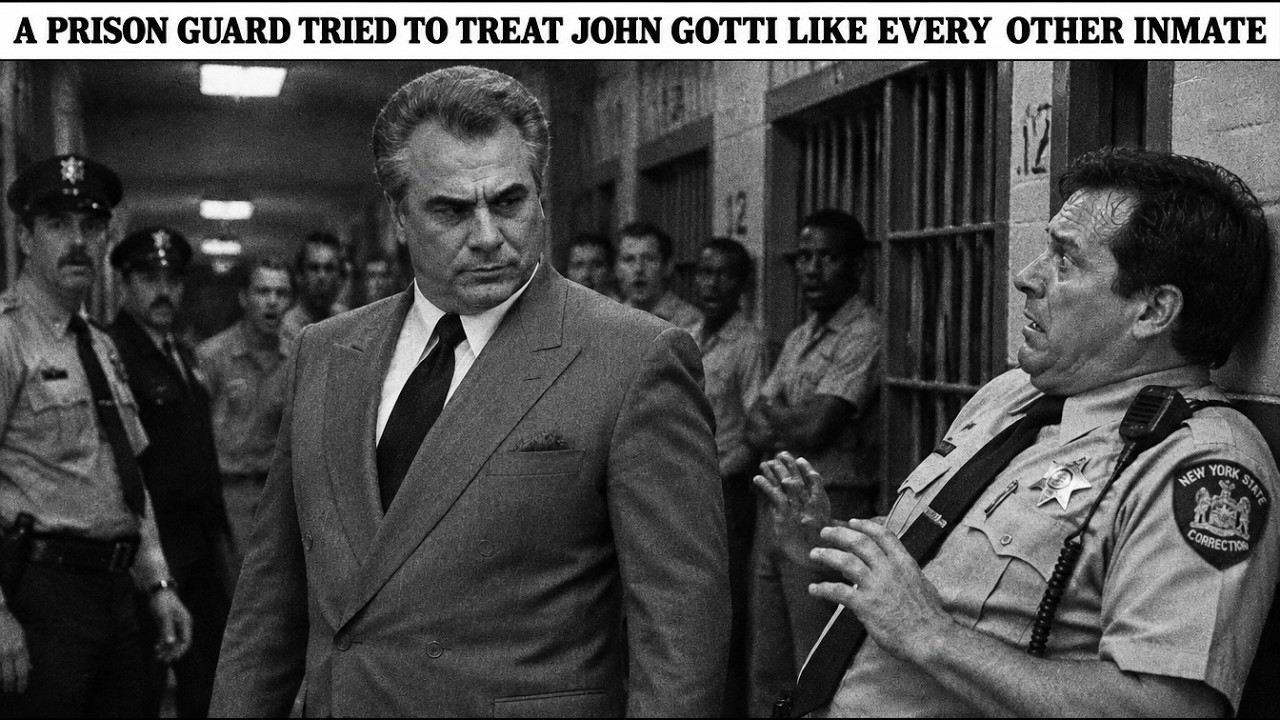
For years, Gotti had been one of the most recognizable organized-crime figures in America, a mob boss whose expensive suits, public swagger, courthouse appearances, and repeated acquittals had earned him the nickname “Teflon Don.”
That image finally collapsed in 1992.
A federal jury convicted him of racketeering, murder, obstruction, gambling, tax violations, and other crimes.
On June 23, 1992, Judge I. Leo Glasser sentenced him to life in prison without parole.
The following day, Gotti was sent to the federal penitentiary at Marion, Illinois, one of the most restrictive prisons in the country.
Marion was not designed to treat famous prisoners like celebrities.
It housed inmates considered exceptionally dangerous, disruptive, violent, or difficult to control.
Following the 1983 killings of two correctional officers and one inmate, Marion operated under an extraordinarily restrictive lockdown system.
Most prisoners spent approximately twenty-three hours each day inside their cells.
That environment should have stripped Gotti of everything that once defined his power.
No social clubs.
No Manhattan restaurants.
No late-night meetings.
No couriers arriving openly at neighborhood storefronts.
No entourage waiting outside.
Yet federal investigators remained deeply interested in whether prison had actually broken Gotti’s command over the Gambino family.
Historical reporting shows that authorities believed it had not.
That fact is important because it explains why stories about Gotti intimidating prison officials remain so durable decades later.
There really was concern that his influence did not end when the prison gates closed.
What is not established, however, is the highly specific viral story about a rookie correctional officer provoking Gotti during an ordinary cell inspection, followed by a single mysterious midnight telephone call that supposedly caused the prison warden and senior officials to panic over imminent street retaliation.
I found no authenticated Bureau of Prisons incident memo documenting that sequence.
No contemporary newspaper report identifies the rookie officer.
No verified internal-affairs file describes prison executives scrambling after one midnight call.
And no authenticated federal document reviewed here establishes that a single disciplinary encounter immediately triggered the underworld response described in the viral caption.
The historical record is more complex.
And in many ways, it is more revealing.
Gotti did retain influence after conviction.
According to reporting from the mid-1990s, law-enforcement authorities believed he continued attempting to direct Gambino family affairs through intermediaries.
The Los Angeles Times reported in 1995 that authorities believed Gotti was still exercising influence from Marion and using his son, John “Junior” Gotti, to carry orders back to New York.
That was not simply prison folklore.
The Gambino organization did not disappear when its boss was sentenced.
Federal investigators continued following the family.
Junior Gotti later emerged as an important figure in the organization and was eventually prosecuted himself.
The Washington Post reported that prosecutors considered the younger Gotti to have moved into a leadership position after his father’s imprisonment.
This created an extraordinary security challenge.
Ordinary prisoners might be dangerous because of what they personally could do inside a facility.
Gotti represented something different.
The concern was that his influence might extend hundreds of miles beyond the prison walls.
A message sent through a relative, visitor, lawyer, coded communication, or telephone conversation could potentially matter outside.
That was why federal investigators remained interested in Gotti’s communications.
And unlike the alleged secret midnight phone call, there is documented evidence that federal authorities recorded Gotti while he was imprisoned.
In 1998, the FBI conducted surveillance involving prison conversations at Marion because investigators wanted to determine whether Gotti continued trying to maintain his authority as Gambino boss.
Those recordings later became public enough to be discussed in media accounts.
The Washington Post reported that prison surveillance tapes showed Gotti arguing with relatives, complaining about prison conditions, and discussing the family organization.
Those tapes matter because they provide a real window into Gotti behind bars.
They also undermine the cinematic image of a mob emperor effortlessly terrifying prison officials with a single telephone call.
The recorded Gotti appeared frustrated.
He complained.
He argued.
He tried to maintain influence.
He was still feared because of who he had been and what federal investigators believed he continued trying to control.
But he was also a prisoner inside one of the most restrictive institutions in America.
The government monitored him precisely because officials did not assume he was powerless.
That distinction matters.
There is credible historical evidence of influence.
There is not equivalent evidence for the dramatic rookie-guard incident.
The viral story says a correctional officer committed a “fatal mistake” by treating Gotti like an ordinary inmate.
That description itself is misleading.
Federal prisons were legally required to treat Gotti as an inmate.
His organized-crime status did not entitle him to special privileges.
In fact, the entire purpose of placing him at Marion was to restrict his ability to operate like a crime boss.
When Gotti arrived there, contemporary coverage emphasized that the institution housed prisoners considered exceptionally dangerous and that the facility imposed severe controls on movement and communication.
There is no reliable evidence that correctional staff were officially instructed to treat him differently because of fear of the Gambino family.
There certainly may have been individual guards who understood his reputation.
It would have been impossible not to.
Gotti was nationally famous.
His murder and racketeering conviction had dominated headlines.
Supporters had even rioted outside the courthouse after his sentencing, attacking police and overturning a federal marshal’s vehicle.
So officers working around him knew exactly who he was.
But knowing an inmate’s reputation is different from being institutionally terrorized by him.
The claim that a rookie officer somehow failed to understand this distinction and provoked an immediate underworld crisis is not documented in the sources reviewed.
Nor is the alleged midnight telephone call.
Federal inmates did have controlled means of communication.
But high-risk organized-crime prisoners were subjected to substantial monitoring.
Prisons monitored calls, mail, visits, and other communication channels when security concerns justified it.
The Justice Department’s later inspector-general reporting shows how seriously federal prisons considered telephone monitoring for organized-crime inmates, although one later example involved John Gotti Jr., not his father.
That broader system makes the viral claim problematic.
A secret phone call by John Gotti from a highly controlled federal institution would not simply function like a mob movie scene in which an inmate lifts a private receiver and contacts the street without oversight.
Any credible allegation of such a call would need details.
Which prison telephone?
What date?
Who approved access?
Who received the call?
Was it monitored?
Was it recorded?
What did Gotti actually say?
What happened afterward?
No authenticated incident report answering those questions has surfaced in connection with the caption’s story.
The absence of that evidence does not mean Gotti never communicated with people outside prison.
He did.
That is historically established.
The important point is that no verified source currently links a single midnight call to an immediate campaign of intimidation against a rookie officer or prison administrators.
What federal investigators worried about was broader.
Gotti represented a continuing organizational network.
The Gambino family still existed.
Associates remained active.
His son remained connected to organized crime.
Federal law enforcement therefore watched whether Gotti could influence decisions, appointments, retaliation, or criminal activity from inside prison.
That concern had precedent.
Even before Gotti’s final conviction, testimony at his 1992 trial portrayed him as someone capable of maintaining tight control over Gambino affairs despite detention.
Former underboss Salvatore “Sammy the Bull” Gravano testified extensively about Gotti’s authority, his command structure, and the family’s internal discipline.
Government surveillance tapes were central to the case.
Gotti’s own recorded conversations helped destroy the aura that earlier prosecutions had failed to penetrate.
Those tapes showed how openly he discussed violence and internal family matters when he believed he was speaking privately.
That history is probably one reason later prison legends became so believable.
People already knew Gotti had commanded murders.
They knew he had led one of America’s most powerful Mafia organizations.
They knew members and associates sometimes acted violently in defense of family interests.
So a story about a frightened warden receiving news that Gotti had made a dangerous phone call feels plausible.
But plausible is not the same as verified.
Historical reporting instead shows the government responded to Gotti with increasingly restrictive incarceration.
Marion itself was one of the nation’s toughest prisons.
Later, federal authorities began transferring high-risk inmates to the new supermaximum-security facility in Florence, Colorado.
The Washington Post reported in 1994 that Gotti was among the notorious prisoners scheduled for transfer as the government expanded its capacity to isolate the country’s highest-risk inmates.
The Florence complex was designed with single cells, built-in showers and toilets, and self-contained housing blocks.
The architecture reduced opportunities for inmates to move freely, organize, communicate casually, or develop unchecked influence.
That institutional evolution is a more accurate explanation of how federal prisons dealt with men like Gotti.
Not panic.
Control.
Not whispered surrender.
Isolation.
Not allowing a Mafia boss to dominate a prison wing.
Restricting his ability to communicate.
The mythology surrounding Gotti nevertheless followed him.
Even after conviction, newspapers continued referring to him as the Gambino boss.
His name remained powerful.
His family connections continued producing prosecutions.
Junior Gotti became a major federal target.
Investigators continued examining whether senior Gambino figures were receiving direction connected to the imprisoned boss.
That created an unusual situation.
Gotti’s physical power had been reduced dramatically.
His symbolic power had not.
And symbolic power matters inside prisons.
Reputation can influence inmate behavior.
A famous organized-crime boss does not need to personally attack someone to create caution around him.
Other prisoners may behave differently.
Visitors may treat him differently.
Guards may be particularly attentive.
Investigators may monitor communication more aggressively.
But none of those realities proves officials were paralyzed by fear.
Federal authorities had spent years building the case that finally imprisoned him.
They did not abandon that effort once he reached Marion.
In fact, surveillance continued.
The 1998 prison recordings demonstrate that federal officials remained actively interested in whether Gotti was attempting to exercise authority from inside.
Those tapes are real.
That makes the alleged suppressed incident file especially easy to compare against the established record.
If a rookie officer had triggered a serious organized-crime retaliation threat, federal authorities would likely have treated the matter as a major security incident.
It could have involved the Bureau of Prisons.
The FBI.
Internal prison investigators.
Organized-crime squads.
Potential witness protection measures.
Possibly new criminal charges.
Yet no credible historical source reviewed here describes such a case.
The viral language also says prison officials were afraid “the street” would take revenge.
There is no doubt organized-crime retaliation was a serious federal concern during Gotti’s era.
Federal prosecutors and witnesses understood that cooperation against Mafia leaders could be dangerous.
Gravano himself entered government protection after testifying against Gotti.
Published reports later said Gotti had placed a large bounty on Gravano, although those accounts concerned organized-crime retaliation against a government witness, not a correctional officer performing a cell check.
That distinction is critical.
Documented evidence exists that violence and intimidation surrounded the Gambino organization.
It should not automatically be transferred to every dramatic prison story involving Gotti.
The claim that the Bureau of Prisons is somehow still trying to “bury the file forever” is equally unsupported.
The FBI has released substantial John Gotti material through its public Vault, including multiple files related to him and organized-crime investigations.
Those releases do not prove every government record is public.
Some records can remain restricted or redacted for legitimate reasons.
But the existence of unreleased material does not validate a specific suppressed report unless someone can identify it.
A credible internal memorandum would normally have a date.
Facility designation.
Incident number.
Staff names or redactions.
Investigative authority.
Chain of custody.
Or a Freedom of Information Act reference.
None accompanies the viral claim.
The strongest factual breakdown is therefore clear.
John Gotti was convicted of murder and racketeering offenses.
Verified.
He was sentenced to life without parole in 1992.
Verified.
He was imprisoned at the federal penitentiary in Marion, Illinois.
Verified.
Marion operated under extraordinarily restrictive conditions.
Verified.
Federal authorities believed Gotti continued trying to exercise Gambino influence from prison.
Supported by contemporary reporting.
Investigators believed his son played an important role in carrying or implementing family authority outside prison.
Supported by contemporary reporting.
The FBI recorded Gotti in prison during later surveillance.
Verified.
Those recordings were examined partly because authorities wanted to determine whether he still considered himself the Gambino boss.
Verified.
A rookie corrections officer provoked Gotti during a routine cell check.
Not established.
The confrontation occurred at midnight.
Not established.
Gotti then made one secret telephone call.
Not authenticated.
That call immediately activated Gambino retaliation.
No credible evidence found.
The warden panicked over an imminent street attack.
Not verified.
Federal prison officials scrambled to protect the rookie officer.
Not verified.
A suppressed penitentiary incident memorandum proves the sequence.
No authenticated document matching that description has surfaced.
A secret internal-affairs report is currently being buried by federal authorities.
No credible evidence establishes that claim.
The genuine story of John Gotti behind bars does not require an invented midnight phone call.
His imprisonment created a real federal-security problem because incarceration did not automatically erase the networks surrounding him.
Authorities believed he continued attempting to exert influence.
His son rose inside the Gambino hierarchy.
Federal investigators kept watching.
Prison conversations were recorded.
And the government eventually relied on increasingly sophisticated maximum-security facilities to isolate inmates whose influence could extend beyond their cells.
That history is more substantial than the viral legend.
Gotti was not an ordinary prisoner in terms of reputation.
But he was still a federal prisoner.
The government did not publicly surrender control of Marion because officers feared the Gambino family.
Instead, officials locked him down, monitored his communications, investigated his continuing influence, and kept him imprisoned for life.
The most chilling part of the real story is therefore not that one frightened rookie supposedly learned a lesson after midnight.
It is that federal investigators believed John Gotti’s power remained worth monitoring even after the courtroom, the streets, and his freedom had all been taken away.


