THE LEGAL BATTLEGROUND: Inside the Emergency Court Filings Revealing Catastrophic Intravenous Failures During Christa Pike’s Execution
The legal shockwaves generated by the catastrophic failure of Christa Pike’s execution at the Riverbend Maximum Security Institution have rapidly expanded from the hospital room to the federal courtrooms. In the frantic hours following the aborted procedure, Pike’s defense attorneys flooded state and federal courts with emergency legal motions, shedding critical new light on the mechanical, pharmacological, and procedural breakdowns that turned a state-sanctioned lethal injection into a multi-dose medical disaster.
The emergency filings submitted by Pike’s legal team provide a chilling, detailed breakdown of why the execution failed. According to the court documents, the primary catalyst for the disaster was a catastrophic failure of venous access. Because Pike had spent nearly three decades in maximum-security confinement, her peripheral veins were severely compromised and fragile. Defense attorneys stated in their filings that the execution team struggled extensively with needle placement—with witnesses noting at least seven needle insertions attempted on her left arm alone—before securing a line.
Crucially, the legal documents allege that at no point during the chaotic procedure did members of the execution team realize that the intravenous lines had failed or that her veins had “blown”. Instead of the pentobarbital flowing directly into her bloodstream to shut down her central nervous system, the chemical agent leaked entirely or partially into the surrounding subcutaneous tissue—a process known as extravasation. This structural failure explained why, rather than slipping quietly into unconsciousness, Pike remained fully conscious, raising her head in clear distress and vocalizing that her arm felt like it was “about to bust” and burning intensely.
Rather than pausing to reassess the compromised IV site or addressing the clear signs of distress, executioners pushed a second full dose of pentobarbital into an already failing system. The emergency motions argue that this decision violated all medical and constitutional standards, plunging Pike into prolonged physical agony characterized by heavy breathing, gasping, and loud snoring while trapped behind the closed viewing curtains for over an hour.
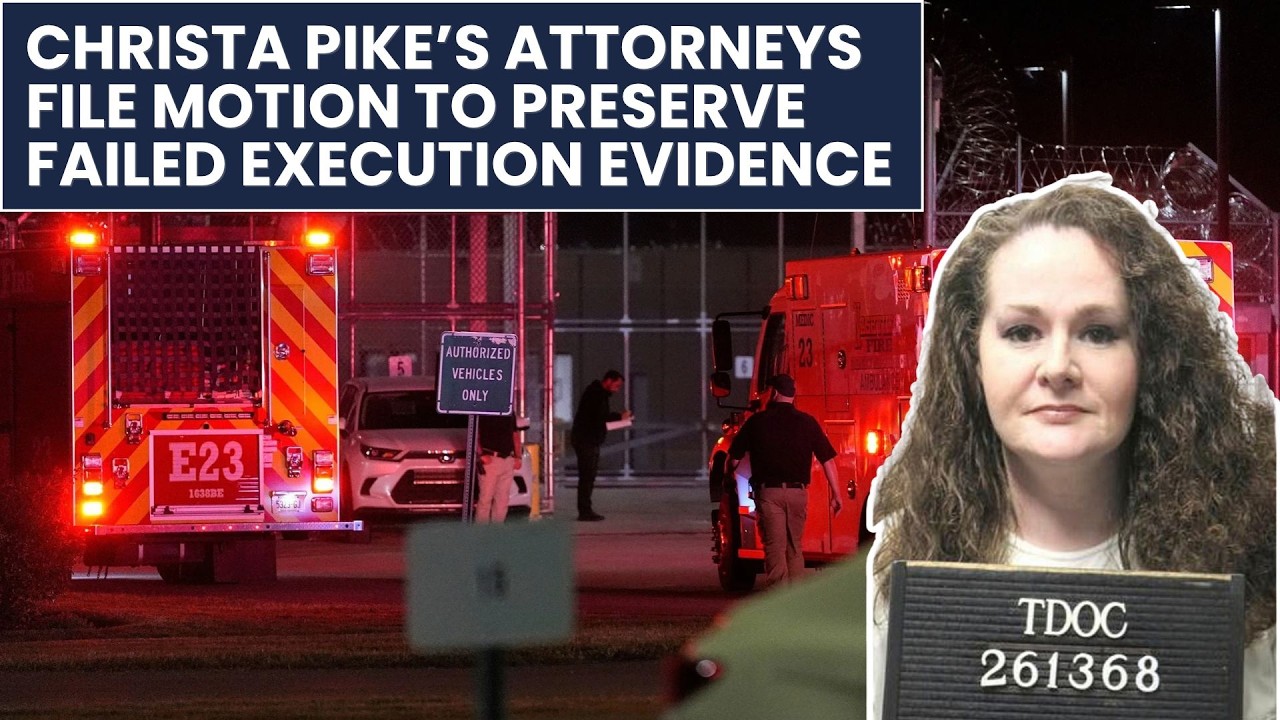
Furthermore, the defense’s emergency filings demanded immediate court orders requiring the Tennessee Department of Correction to preserve all physical evidence, medical logs, needle components, and chemical remnants from the chamber. Attorneys argued that this evidence is vital not only to hold state officials accountable for what they have characterized as state-sponsored “torture” under the Eighth Amendment, but also to prove that the state completely exhausted its legal and constitutional authority to execute her.
As Pike remains unconscious and connected to a mechanical ventilator in an undisclosed hospital under heavy armed guard, these emergency motions form the cornerstone of an unprecedented legal battle. With Governor Bill Lee enacting an indefinite pause on all remaining state executions and ordering an independent third-party investigation, the explosive details brought to light by her attorneys have ensured that the failure at Riverbend will face intense judicial scrutiny.


