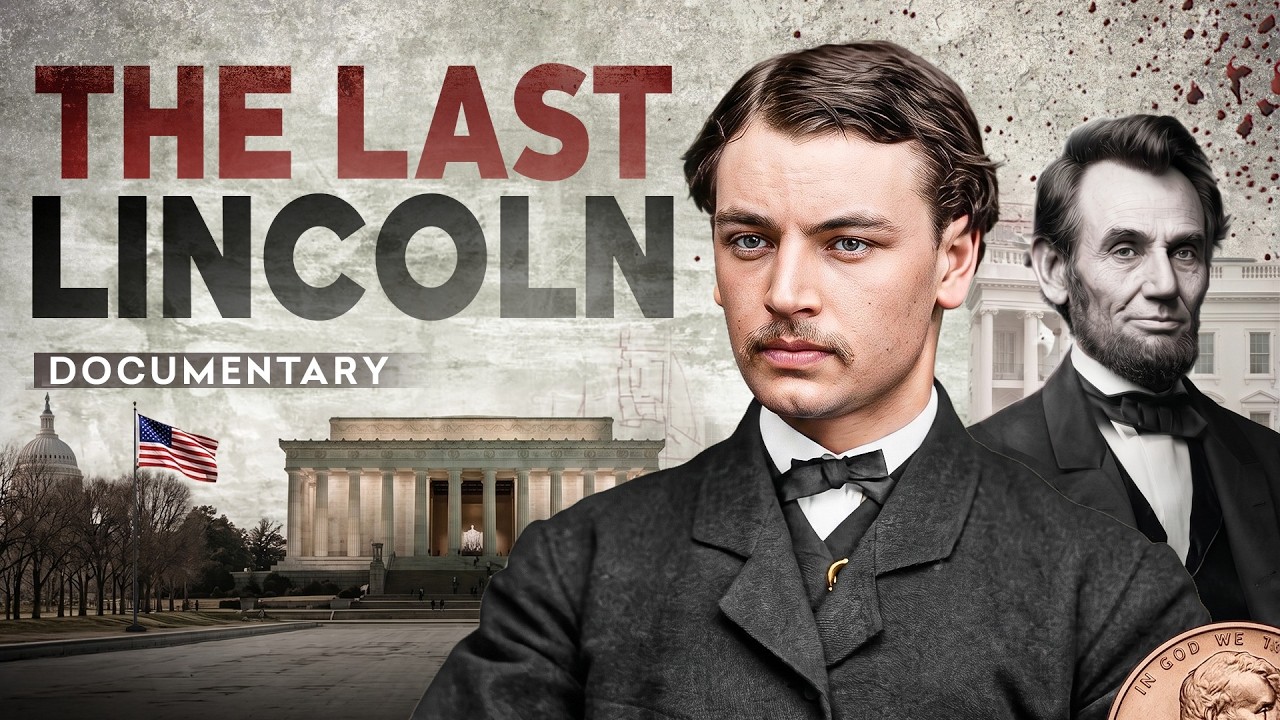
In 1909, Americans began carrying Abraham Lincoln in their pockets.
The United States Mint placed the murdered president’s profile on the one-cent coin to mark the hundredth anniversary of his birth.
It was the first time a real American president had appeared on a regular circulating United States coin. [United States Mint](https://www.usmint.gov/learn/history/timeline?utm_source=chatgpt.com)
Somewhere in America, a sixty-five-year-old businessman named Robert Todd Lincoln could have taken one of those new pennies into his hand and looked directly at the face of his father.
Everyone knew that face.
Schoolchildren knew it.
Politicians invoked it.
Veterans remembered it.
Statues were being planned for it.
The country was turning Abraham Lincoln from a dead president into something approaching a civic saint.
Robert had known the actual man.
And that was precisely the problem.
Because he had not known him nearly as well as he wished.
Robert Todd Lincoln was born in Springfield, Illinois, on August 1, 1843, the first child of Abraham and Mary Lincoln.
He was the only one of their four sons who would survive into adulthood. [National Park Service](https://home.nps.gov/liho/learn/historyculture/robertlincoln.htm?utm_source=chatgpt.com)
His father loved his children.
There is substantial evidence that Abraham Lincoln was affectionate and extraordinarily indulgent as a parent.
But Robert’s childhood differed sharply from those of younger Willie and Tad.
Abraham was building a legal and political career, and that meant long absences.
He rode the Illinois judicial circuit.
He traveled for cases.
He made political speeches.
He served a term in Congress.
Robert remembered those absences decades later with unusual sadness.
“My father’s life was of a kind,” he explained, “which gave me but little opportunity” to learn about him.
During Robert’s childhood and early youth, he said, Abraham was “almost constantly away from home, attending courts or making political speeches.”
Then, just as Robert became old enough to want to know the man behind those journeys, their paths separated again. [Mr. Lincoln’s White House](https://www.mrlincolnswhitehouse.org/residents-visitors/family/family-robert-todd-lincoln-1843-1926/?utm_source=chatgpt.com)
In 1859, sixteen-year-old Robert went east to prepare for college in New Hampshire.
Then he entered Harvard.
His father became president.
“Any great intimacy between us became impossible,” Robert later wrote.
During Abraham Lincoln’s presidency, he said, they scarcely had ten quiet minutes together because the president was continually consumed by work. [WHHA (en-US)](https://www.whitehousehistory.org/abraham-lincolns-white-house?utm_source=chatgpt.com)
That sentence may explain more about Robert Todd Lincoln than almost anything else he ever said.
He did not grow up fatherless.
Abraham Lincoln was present enough to shape him.
But intimacy kept arriving too late.
First the law took his father away.
Then politics.
Then Harvard separated Robert from Washington.
Then the Civil War swallowed almost every waking hour Abraham possessed.
And finally, when Robert was twenty-one and both men might have had decades ahead of them, an assassin ended the possibility forever.
Before that happened, Robert had one great conflict with his parents.
He wanted to join the Union Army.
By 1864, young men his age were dying by the thousands.
Robert had graduated from Harvard and knew exactly how it looked for the president’s healthy adult son to remain outside military service while other families sent their children into battle.
Mary Lincoln was terrified.
She had already buried two sons.
Eddie had died as a small child in Springfield.
Willie had died in the White House in 1862.
Mary could not tolerate the possibility of losing Robert too. [National Park Service](https://home.nps.gov/articles/000/robert-todd-lincoln-and-presidential-assassinations-not-formal-title.htm?utm_source=chatgpt.com)
Abraham understood both sides.
He reportedly observed that Robert was no more precious to them than other mothers’ sons were to their families.
Eventually the president found a compromise.
In January 1865, he wrote Ulysses S. Grant asking whether Robert could join Grant’s staff without displacing another officer.
Robert was commissioned a captain. [Shapell](https://www.shapell.org/manuscript/abraham-lincoln-sends-son-robert-todd-to-war/?utm_source=chatgpt.com)
It placed him in one of the most extraordinary locations in American history.
On April 9, 1865, Robert Todd Lincoln was with Grant’s army when Robert E. Lee surrendered at Appomattox Court House.
The great war his father had spent four years trying to end was effectively collapsing around him. [National Park Service](https://home.nps.gov/liho/learn/historyculture/robertlincoln.htm?utm_source=chatgpt.com)
Robert returned to Washington.
On April 14, he spent part of the day with his father.
The president was cheerful.
The war seemed almost over.
Abraham advised his son to finish his education and build a professional life after leaving the army. [Roger J. Norton](https://rogerjnorton.com/LincolnDiscussionSymposium/post-37156.html?utm_source=chatgpt.com)
That evening Abraham and Mary Lincoln went to Ford’s Theatre.
Robert did not join them.
John Wilkes Booth did.
The bullet entered Abraham Lincoln’s head shortly after 10 p.m.
Robert hurried to the Petersen boarding house across the street.
He was not present when Booth fired, despite later legends claiming otherwise.
But he was inside Petersen House during the terrible overnight vigil, and he was there when his father died the following morning. [National Park Service](https://home.nps.gov/articles/000/robert-todd-lincoln-and-presidential-assassinations-not-formal-title.htm?utm_source=chatgpt.com)
Robert was twenty-one.
The man he had spent years waiting to know better was suddenly the property of history.
And Robert’s role changed almost immediately.
He became, in effect, one of the custodians of Abraham Lincoln.
Not only his surviving son.
His gatekeeper.
His archivist.
His defender.
After the assassination, Robert arranged for his father’s papers to be taken from Washington and organized.
Eventually Abraham Lincoln’s former secretaries John Nicolay and John Hay used the collection while preparing their monumental biography.
Robert later deposited the papers with the Library of Congress and formally gave them to the nation in 1923—but required that they remain closed until twenty-one years after his own death. [The Library of Congress](https://www.loc.gov/collections/abraham-lincoln-papers/about-this-collection/?utm_source=chatgpt.com)
That restriction generated rumors.
What was Robert hiding?
Did Lincoln’s papers contain assassination secrets?
Cabinet betrayals?
Private scandal?
Nothing of that scale emerged when the collection finally opened in 1947.
But Robert’s protectiveness was real. [Research Guides](https://guides.loc.gov/manuscripts-illustrated-guide/presidency?utm_source=chatgpt.com)
He also disposed of much of his parents’ private correspondence, apparently believing some things belonged to the family rather than history. [Lincoln Library and Museum](https://presidentlincoln.illinois.gov/Blog/Posts/172/Artifacts-Documents/2023/1/Mary-Lincoln-in-Private/blog-post/?utm_source=chatgpt.com)
There is something almost heartbreaking about that impulse.
Robert had once complained that he lacked enough private time with his father.
After Abraham died, Robert spent decades deciding how much of that father the public was allowed to possess.
And the public wanted everything.
The assassination had transformed Lincoln.
Every anecdote became valuable.
Every scrap of handwriting became sacred.
Every person who had known him could sell a reminiscence.
Robert disliked much of that culture.
He had watched strangers gradually manufacture a Lincoln they had never met.
He alone among Abraham’s sons survived long enough to watch it happen.
Because the Lincoln household kept shrinking.
Eddie was already gone.
Willie had died in 1862.
Abraham was murdered in 1865.
Then Tad died in Chicago in 1871 at only eighteen.
Robert became the final surviving son. [National Park Service](https://home.nps.gov/liho/learn/historyculture/lincolnchronology.htm?utm_source=chatgpt.com)
Mary was devastated again.
By then mother and son had already developed a difficult relationship.
Robert was reserved, disciplined and increasingly conventional.
Mary could be impulsive, emotionally intense and financially unpredictable.
Her grief after Abraham’s murder never fully loosened its grip.
She worried obsessively about money despite having resources.
She purchased expensive goods.
She carried securities because she feared theft.
She developed intense fears about fire and personal danger. [National Park Service](https://www.nps.gov/liho/learn/historyculture/insanity.htm?utm_source=chatgpt.com)
By 1875 Robert believed something catastrophic might happen if he did nothing.
He consulted physicians and lawyers.
Then he initiated insanity proceedings against his mother.
The resulting episode has followed Robert’s name ever since.
Mary was given almost no advance warning.
Witnesses had been assembled against her.
The court declared her insane and sent her to Bellevue Place, a private sanitarium in Batavia, Illinois.
Robert gained control of aspects of her finances. [National Park Service](https://www.nps.gov/liho/learn/historyculture/insanity.htm?utm_source=chatgpt.com)
To Mary, it was betrayal.
To Robert, surviving evidence indicates, it was intervention.
He became emotional while testifying and apparently believed he was preventing a tragedy. [National Park Service](https://www.nps.gov/liho/learn/historyculture/insanity.htm?utm_source=chatgpt.com)
History has spent almost 150 years trying to force the episode into a simpler story.
Cruel son imprisons grieving mother.
Or responsible son saves unstable mother.
Neither version completely survives the records.
Mary’s behavior genuinely alarmed people.
The legal process also gave her shockingly little opportunity to defend herself by modern standards.
Within months she secured release to her sister’s care.
In 1876 a second jury declared her sane.
Her relationship with Robert never fully recovered. [National Park Service](https://www.nps.gov/liho/learn/historyculture/insanity.htm?utm_source=chatgpt.com)
Then Mary died in 1882.
Robert had now outlived his father, mother and all three brothers.
He was thirty-eight.
The Lincoln family millions of Americans imagined as frozen forever in photographs no longer existed.
But Robert kept moving.
He built a serious legal career in Chicago.
He married Mary Harlan in 1868.
They had three children.
He became a prominent lawyer and businessman.
President James Garfield appointed him Secretary of War in 1881, and Chester Arthur retained him after Garfield’s death. [National Park Service](https://home.nps.gov/liho/learn/historyculture/robertlincoln.htm?utm_source=chatgpt.com)
Then history repeated itself in a way so bizarre that Robert eventually acquired an absurd reputation as a human omen.
On July 2, 1881, Robert was at the Baltimore and Potomac Railroad Station in Washington when Charles Guiteau shot President Garfield.
Robert was not merely in the same city.
He was in the station, walking toward Garfield.
He rushed to the wounded president and helped summon medical assistance. [National Park Service](https://www.nps.gov/articles/000/july-2nd-1881-a-second-assassination.htm?utm_source=chatgpt.com)
Sixteen years earlier, he had watched doctors fail to save his father.
Now another president lay shot in front of him.
Garfield lingered for weeks before dying.
Twenty years later came another eerie connection.
In September 1901, Robert was traveling toward Buffalo to attend the Pan-American Exposition and meet President William McKinley.
Before Robert reached the president, Leon Czolgosz shot McKinley inside the Temple of Music.
Robert was not present at the shooting—the popular “Robert witnessed three presidential assassinations” story is false—but the coincidence was close enough to strengthen the legend that death somehow followed him. [National Park Service](https://www.nps.gov/articles/000/robert-todd-lincoln-and-presidential-assassinations-not-formal-title.htm?utm_source=chatgpt.com)
Robert himself apparently joked about the pattern.
But there was no curse.
Only terrible proximity.
And one coincidence was stranger still.
Years before Abraham Lincoln’s assassination, Robert had nearly fallen into the dangerous gap between a moving train and a station platform in Jersey City.
A stranger grabbed his coat and pulled him to safety.
The rescuer was Edwin Booth.
The famous actor.
And the older brother of John Wilkes Booth. [HISTORY CHANNEL ITALIA](https://www.history.com/articles/john-wilkes-booth-family?utm_source=chatgpt.com)
One Booth may have saved Robert Lincoln’s life.
Another Booth killed his father.
No novelist would risk writing something so neat.
Reality did.
Yet for all those macabre coincidences, the worst personal loss of Robert’s adulthood had nothing to do with assassins.
His only son, Abraham Lincoln II—called Jack—died in Europe in 1890 after complications following surgery.
He was sixteen years old. [National Park Service](https://www.nps.gov/articles/000/robert-todd-lincoln-and-presidential-assassinations-not-formal-title.htm?utm_source=chatgpt.com)
That death carried special dynastic weight.
Jack had been Abraham Lincoln’s only grandson.
The name appeared to have another male generation ahead of it.
Then it did not.
Robert still had two daughters, Mary and Jessie, but the direct male line carrying Lincoln’s surname through Abraham’s descendants was gone.
Once again Robert was left with the name.
The name opened doors for him.
And he knew it.
He served as Secretary of War.
He became minister to Great Britain from 1889 to 1893.
He eventually became president of the Pullman company.
Republicans periodically discussed him as a possible presidential or vice-presidential candidate. [National Park Service](https://home.nps.gov/liho/learn/historyculture/robertlincoln.htm?utm_source=chatgpt.com)
But according to his friend Nicholas Murray Butler, Robert himself understood how impossible it was to separate his achievements from his father.
Butler remembered him saying, in effect, that nobody wanted Robert Lincoln.
They wanted **Abraham Lincoln’s son**.
Secretary of War?
Abraham Lincoln’s son.
Minister to Britain?
Abraham Lincoln’s son.
Pullman president?
Abraham Lincoln’s son. [Biography](https://www.biography.com/history-culture/robert-todd-lincoln?utm_source=chatgpt.com)
Whether every word of Butler’s recollection captures Robert exactly, the sentiment fits the documentary record.
He had a successful career.
But comparison was unavoidable.
If he entered politics, people asked whether he would become his father.
If he avoided the presidency, they asked why.
If he spoke about Abraham, every sentence became valuable.
If he stayed silent, silence itself became mysterious.
Then came the penny.
On August 2, 1909, the United States Mint issued the Lincoln cent.
Abraham Lincoln became the first American president depicted on regular circulating U.S. coinage. [United States Mint](https://www.usmint.gov/learn/history/timeline?utm_source=chatgpt.com)
Robert was sixty-six.
His father had been dead forty-four years.
A private face had become currency.
Millions upon millions of identical Lincolns began passing across counters, entering cash drawers and collecting in children’s pockets.
Robert could no longer protect the image.
It belonged literally to everyone.
And the transformation was not finished.
Construction began on the Lincoln Memorial in Washington in 1914.
Robert watched its progress with intense interest.
National Park Service records say he frequently asked his driver to pass by the construction site and once obtained permission to enter while work was underway. [National Park Service](https://home.nps.gov/linc/learn/historyculture/other-notable-figures.htm?utm_source=chatgpt.com)
Then, on May 30, 1922, Robert Todd Lincoln returned to Washington.
He was seventy-eight.
More than fifty-seven years had passed since he stood inside Petersen House waiting for his father to die.
Now roughly 50,000 people gathered as the nation formally dedicated an enormous marble temple to Abraham Lincoln.
President Warren Harding was there.
Chief Justice and former president William Howard Taft was there.
Black educator Robert Russa Moton delivered the principal address, while the audience itself remained segregated. [National Park Service](https://www.nps.gov/linc/lincdedication.htm?utm_source=chatgpt.com)
And there in the crowd sat Robert.
The president’s last surviving son.
He did not speak.
When he reached his seat, the audience gave him an ovation.
Then Robert listened while other men explained his father to America. [National Park Service](https://home.nps.gov/linc/learn/historyculture/other-notable-figures.htm?utm_source=chatgpt.com)
The moment must have been extraordinary.
Robert had once struggled to find ten uninterrupted minutes with Abraham Lincoln.
Now he sat before a nineteen-foot marble version of him.
His father’s words were carved into stone.
His face was on the penny.
His name belonged to schools, streets and monuments.
The man Robert barely had enough time to know had become someone the nation believed it knew intimately.
Four years later, Robert died at Hildene, his Vermont estate.
It was July 26, 1926.
He was eighty-two, only days short of his eighty-third birthday. [National Park Service](https://home.nps.gov/liho/learn/historyculture/robertlincoln.htm?utm_source=chatgpt.com)
He was eventually buried at Arlington National Cemetery.
From there, Abraham Lincoln’s memorial stands within sight across the Potomac landscape. [National Park Service](https://home.nps.gov/linc/learn/historyculture/other-notable-figures.htm?utm_source=chatgpt.com)
It would be too dramatic—and historically wrong—to say the Lincoln name literally destroyed everyone Robert loved.
Disease killed his brothers.
An assassin killed his father.
Illness and trauma shaped his mother’s later years.
Surgical complications killed his son.
There was no family curse.
But Robert did spend his entire adult life surrounded by the consequences of being Abraham Lincoln’s surviving son.
His greatest family conflict became a public scandal.
His father’s papers became national treasures he felt obligated to guard.
His appointments were interpreted through his surname.
His private memories became historical evidence.
His father’s face eventually appeared on money carried by strangers.
And by old age, Robert could walk through Washington and encounter a marble version of the man with whom he had once wanted only a little more time.
Perhaps that is the most tragic part of Robert Todd Lincoln’s life.
He was not a failure.
Quite the opposite.
He graduated from Harvard.
Served in the Army.
Built a successful legal career.
Became Secretary of War.
Represented the United States in Britain.
Led one of the country’s best-known corporations.
Raised a family.
Protected a huge archive of documents historians still use today. [National Park Service](https://home.nps.gov/liho/learn/historyculture/robertlincoln.htm?utm_source=chatgpt.com)
Yet none of it could answer the question hidden inside his own recollection.
What would his relationship with Abraham Lincoln have become if the assassin had missed?
Robert was twenty-one.
Abraham was fifty-six.
They might have had thirty years.
They had hours instead.
So Robert spent the rest of his life doing something paradoxical.
Protecting the memory of a father he wished he had known better.
By the time Robert himself became an old man, America knew Abraham Lincoln everywhere.
On the penny.
In textbooks.
In photographs.
In speeches.
In marble.
Robert Todd Lincoln had spent decades watching the entire country grow closer to his father.
While knowing that his own chance to do the same had ended on April 15, 1865.


