THE WAR HERO WHO HID HIS FINAL BATTLE — THE PRIVATE STRUGGLE OF MAJOR RICHARD WINTERS
He led Easy Company through Normandy.
He fought through Holland.
He endured Bastogne.
He helped lead his men into the Bavarian Alps and toward Hitler’s famous mountain retreat.
But after surviving the bloodiest years of World War II, Major Richard “Dick” Winters faced a battle that he refused to let the world see.
For years, people noticed something had changed.
The man who had once stood for hours meeting veterans and shaking hands began appearing less often.
His movements became slower.
Walking became more difficult.
At public events, friends quietly stayed near him, helping him through crowds without drawing attention.
Fans wondered what was happening.
Few knew the truth.
Richard Winters had been privately battling Parkinson’s disease.
And just as he had done throughout his life, he refused to make the struggle about himself.
THE BOY FROM PENNSYLVANIA
Richard Davis Winters was born on January 21, 1918, in New Holland, Pennsylvania.
His family later moved to Ephrata and then Lancaster, where Winters grew up far from the battlefields that would eventually make his name famous.
He graduated from Lancaster Boys High School in 1937 and attended Franklin and Marshall College.
Nothing about his childhood suggested that he would one day become one of America’s most respected combat leaders.
Then came 1941.
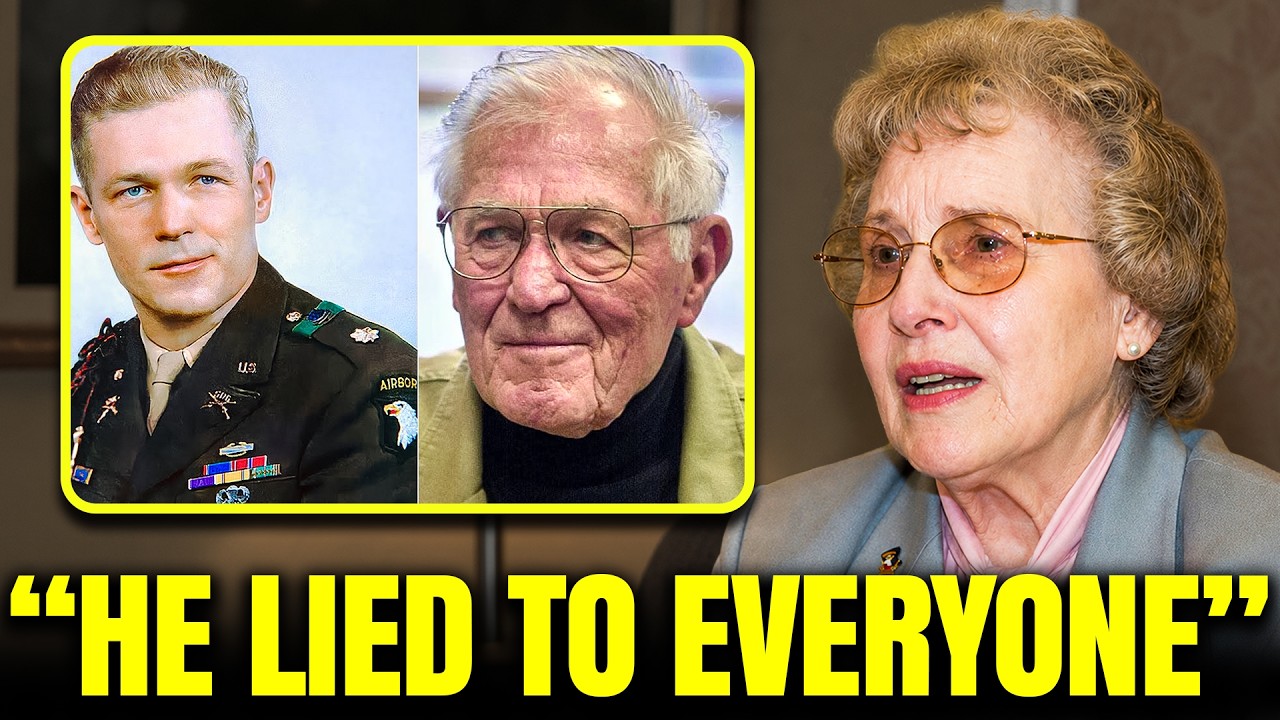
Before the United States entered World War II, Winters chose to volunteer for induction under the Selective Service System.
He wanted to complete his required service rather than wait for a future call-up that might disrupt his civilian career.
He did not enter the Army because he was chasing glory.
By his own account, he felt a sense of duty, but he had no particular desire to go to war.
Then Pearl Harbor changed everything.
ENTERING EASY COMPANY
Winters trained at Camp Croft in South Carolina before volunteering for the newly developing parachute infantry.
He was sent to Camp Toccoa, Georgia.
There, he became part of Company E, 2nd Battalion, 506th Parachute Infantry Regiment.
Easy Company.
The unit would eventually become one of the most famous American military formations of World War II.
But before the fame, there was training.
Hard training.
And there was Herbert Sobel.
Sobel was Easy Company’s original commanding officer, and relations between him and many of the enlisted men became increasingly strained.
Winters himself eventually found himself targeted by disciplinary action.
He demanded a court-martial to clear his name.
The punishment was ultimately thrown out.
The conflict became part of Easy Company’s early history and would later be dramatized in Band of Brothers.
But the real story was already teaching Winters an important lesson.
Leadership was not simply about giving orders.
It was about earning the trust of the people who had to follow them.
D-DAY CHANGED EVERYTHING
June 6, 1944.
D-Day.
Winters landed in Normandy and found himself thrust into command under chaotic circumstances.
Easy Company was tasked with attacking German artillery positions that were threatening American forces landing near Utah Beach.
At Brécourt Manor, Winters led a small group of paratroopers against a heavily defended German artillery position.
The assault succeeded.
The operation became one of the most studied examples of small-unit tactics from the Normandy campaign.
Winters was recommended for the Medal of Honor.
Instead, he received the Distinguished Service Cross, the second-highest American military decoration for combat valor.
Years later, after Band of Brothers had introduced his story to millions of people, Representative Tim Holden attempted to have the award upgraded to the Medal of Honor.
The effort stalled in Congress.
Winters never made the issue the center of his public life.
He simply moved on.
That silence would become one of the defining characteristics of the man.
FROM NORMANDY TO BASTOGNE
The fighting did not end at Brécourt Manor.
Winters and Easy Company continued through Operation Market Garden in Holland.
Then came the Battle of the Bulge.
Bastogne.
Winter.
Cold.
Exhaustion.
Constant danger.
The men were surrounded and subjected to brutal conditions.
Winters continued rising through the ranks.
The junior officer who had entered the war years earlier eventually became a major.
His decorations accumulated.
Combat Infantryman’s Badge.
Distinguished Service Cross.
Bronze Star.
Purple Heart.
French Croix de Guerre with Palm.
Yet the more recognition he received, the less interested he seemed in talking about himself.
His goal was surprisingly simple.
Survive.
Go home.
Build a quiet life.
THE EAGLE’S NEST
By the final stages of the European war, Easy Company had crossed enormous distances.
Eventually, Winters and his men reached the Bavarian Alps.
There stood Hitler’s famous mountain retreat, the Eagle’s Nest.
For many people, reaching that location became one of the symbolic endings of the European war.
For Winters, however, it was another chapter in a story he had never intended to become famous for.
The war ended.
And Richard Winters wanted to go home.
THE HERO WHO DIDN’T WANT TO BE ONE
Most people who survive extraordinary events eventually tell their stories.
Winters largely did not.
He returned to civilian life.
He worked with his close friend Captain Lewis Nixon at Nixon Nitration Works in New Jersey.
By 1950, he had become the company’s general manager.
He married Ethel Estoppey in 1948.
He continued his education through the GI Bill, attending Rutgers University and studying business and personnel management.
During the Korean War, he returned to military service for a period, training infantry soldiers and Army Ranger units.
Then he went back to civilian life again.
In 1972, he started his own animal-feed business.
Eventually, he and Ethel settled in Hershey, Pennsylvania.
Winters continued running his business until retiring in 1997 at age 79.
For decades, most people outside his family, close friends, and fellow veterans had little idea of what he had actually done during World War II.
He did not behave like a celebrity.
He behaved like a businessman.
A husband.
A neighbor.
An ordinary man who happened to have survived an extraordinary war.
THEN CAME BAND OF BROTHERS
Everything changed in the late 1980s.
At a 101st Airborne Division reunion in New Orleans in 1988, historian Stephen Ambrose encountered veterans of Easy Company while researching material for what would become a major historical work.
Winters remained relatively quiet.
But afterward, he began looking through the letters, notes, and memories he had kept from the war.
He realized that the story of Easy Company needed to be preserved.
On February 26, 1990, Winters began sharing his memories with Ambrose.
Those conversations helped form the foundation of Band of Brothers.
The book appeared in 1992.
For years, it remained primarily a favorite among military-history readers.
Then Hollywood arrived.
THE WORLD DISCOVERS DICK WINTERS
Tom Hanks and Steven Spielberg became involved in adapting Band of Brothers into an HBO miniseries.
Production began in 2000.
The first episode aired on September 9, 2001.
Two days later, America was transformed by the September 11 attacks.
Against that backdrop, Band of Brothers reached an enormous audience.
The series became one of the most respected television portrayals of American soldiers in World War II.
Damian Lewis portrayed Winters.
Suddenly, the quiet Pennsylvania businessman became famous around the world.
People wanted photographs.
They wanted autographs.
They wanted to shake his hand.
They wanted to hear him speak.
For perhaps the first time in his life, Richard Winters could not simply disappear into ordinary life.
But even then, he refused to change who he was.
“I WAS NOT A HERO”
One of the most memorable moments associated with Winters came when he was asked whether he considered himself a hero.
His answer became famous.
He recalled his grandson asking whether he had been a hero during the war.
Winters’ response was essentially that he was not a hero.
He had served in a company of heroes.
That sentence explained the man better than any medal ever could.
He did not deny what he had done.
He simply refused to place himself above the men who had fought beside him.
EVEN HIS STATUE WASN’T SUPPOSED TO BE ABOUT HIM
As Winters’ reputation grew, supporters wanted to create a monument honoring him in Normandy.
He agreed.
But he wanted one important condition.
The memorial should not simply celebrate Richard Winters.
It should honor the junior officers who fought and died during the Normandy invasion.
Even after becoming an international symbol of leadership, Winters continued trying to redirect attention toward others.
The message was consistent.
Leadership was not about the person standing at the front.
It was about the people standing behind him.
THEN PEOPLE STARTED NOTICING
By the middle of the 2000s, something changed.
People who had seen Winters regularly at reunions and speaking events began noticing that he moved more slowly.
He seemed less steady.
He appeared to tire more easily.
He attended fewer events.
At first, many people assumed it was simply age.
Winters was already in his eighties.
But something else was happening.
He had been fighting Parkinson’s disease.
And almost nobody knew.
THE BATTLE HE REFUSED TO SHARE
Parkinson’s disease can affect movement, balance, coordination, and the ability to perform ordinary physical tasks.
For Winters, the symptoms gradually became harder to hide.
Yet he reportedly wanted to keep the illness private.
He did not want people feeling sorry for him.
He did not want his public image to become that of an elderly former soldier struggling with disease.
And, according to longtime family friend William Jackson, Winters did not even want the surviving members of Easy Company to know how seriously ill he had become.
That decision reveals something remarkable about his character.
During World War II, his men had depended on him.
Decades later, he still felt responsible for them.
He did not want his former soldiers to see their commander as someone who needed their sympathy.
So he continued doing what he had always done.
He carried the burden himself.
Friends quietly helped him at public events.
They guided him through crowds.
They helped make sure he could walk safely.
And they tried to do it without making the assistance obvious.
To the audience, everything appeared normal.
That was exactly what Winters wanted.
HE NEVER STOPPED BEING THEIR COMMANDER
The irony is difficult to miss.
Richard Winters had survived enemy fire.
He had led men against German artillery.
He had endured Normandy.
Holland.
Bastogne.
The final campaign through Germany.
But the illness that eventually weakened his body was something he could not defeat with courage, tactics, or a command.
Still, his response remained the same.
Do not complain.
Do not ask for sympathy.
Keep moving.
Keep your responsibility.
Keep the attention on someone else.
For decades, that had been his philosophy.
And Parkinson’s did not change it.
HIS FINAL REQUEST
Richard Winters died on January 2, 2011, in New Enterprise, Pennsylvania.
He was 92.
But even at the end, he did not want his death to become a public spectacle.
He asked his family not to announce his death until after his funeral.
He wanted his family and close friends to say goodbye privately.
His funeral was held on January 8.
He was buried at Bergstrasse Evangelical Lutheran Church Cemetery in Ephrata, Pennsylvania, beside his parents.
His grave was simple.
There was no enormous monument celebrating the battles he had fought.
No long list of achievements.
No grand declaration of his place in military history.
Just a quiet grave for a man who had spent his entire life trying to avoid the spotlight.
THE WORLD FINALLY LEARNED THE TRUTH
More than a week after his death, longtime family friend William Jackson confirmed the news publicly.
He also revealed what many people had wondered about for years.
Winters had been living with Parkinson’s disease for several years.
Suddenly, all those photographs made sense.
The slower steps.
The fewer appearances.
The difficulty moving through crowds.
The quiet assistance from friends.
The absence from events where people had once expected to see him.
The mystery was finally explained.
And yet there was something almost fitting about the fact that Winters had kept it secret.
Because even at the end of his life, he did not want the story to be about himself.
THE MEN NEVER FORGOT
News of his death deeply affected the surviving members of Easy Company.
William Guarnere, known as “Wild Bill,” remembered Winters primarily for his leadership.
He remembered a commander who led from the front.
A man his soldiers trusted.
A man they believed would never order them to do something he was unwilling to do himself.
That trust had survived more than six decades.
The war had ended in 1945.
But the bond between those men never truly disappeared.
THE WOMAN BESIDE HIM
A little more than a year after Winters died, his wife Ethel also passed away.
She died on April 11, 2012, at the age of 89.
They had been married since 1948.
For more than sixty years, she had shared the quiet civilian life Winters had built after the war.
While millions eventually came to know Richard Winters through Band of Brothers, Ethel knew the man before he became a historical figure.
She knew the businessman.
The husband.
The father.
The private man.
The man who wanted nothing more than a peaceful life after surviving the war.
THE LASTING LEGACY
Today, Richard Winters is remembered as one of the most respected American combat leaders of World War II.
But his legacy is not simply about Brécourt Manor.
It is not just about Normandy.
It is not just about Bastogne or the Eagle’s Nest.
It is also about what happened after the guns fell silent.
He could have spent the rest of his life reminding people what he had accomplished.
Instead, he built a business.
He raised a family.
He lived quietly.
When fame eventually found him, he accepted it reluctantly.
When people called him a hero, he redirected the praise toward the men around him.
When a statue was proposed, he insisted that it honor others.
And when Parkinson’s disease began taking away his physical independence, he kept that battle private.
Even his death was meant to remain private until his family had said goodbye.
Perhaps that is why the story of Richard Winters continues to resonate.
The most revealing part of his life may not have been the moment he led men into battle.
It may have been what he did after the war was over.
He never needed the world to call him a hero.
He had already decided what mattered.
Serve your people.
Lead from the front.
Take responsibility.
And when the attention comes, give it away.
Richard Winters spent the first half of his life fighting a war that the world could see.
He spent the final years fighting one that almost nobody knew existed.
And in both battles, he chose the same weapon.
Quiet strength.


