The viral story about Eisenhower’s “classified 2AM files” combines authentic wartime tensions with dramatic details unsupported by credible evidence.
Dwight D. Eisenhower unquestionably managed forceful personalities, competing national priorities, severe logistics, and intense operational disagreements throughout northwest Europe.
George S. Patton was genuinely respected by German commanders, whose assessments often emphasized his speed, aggressiveness, and appetite for maneuver.
That reputation became operationally useful before Normandy, when Allied deception planners made Patton central to the fictitious First Army Group.
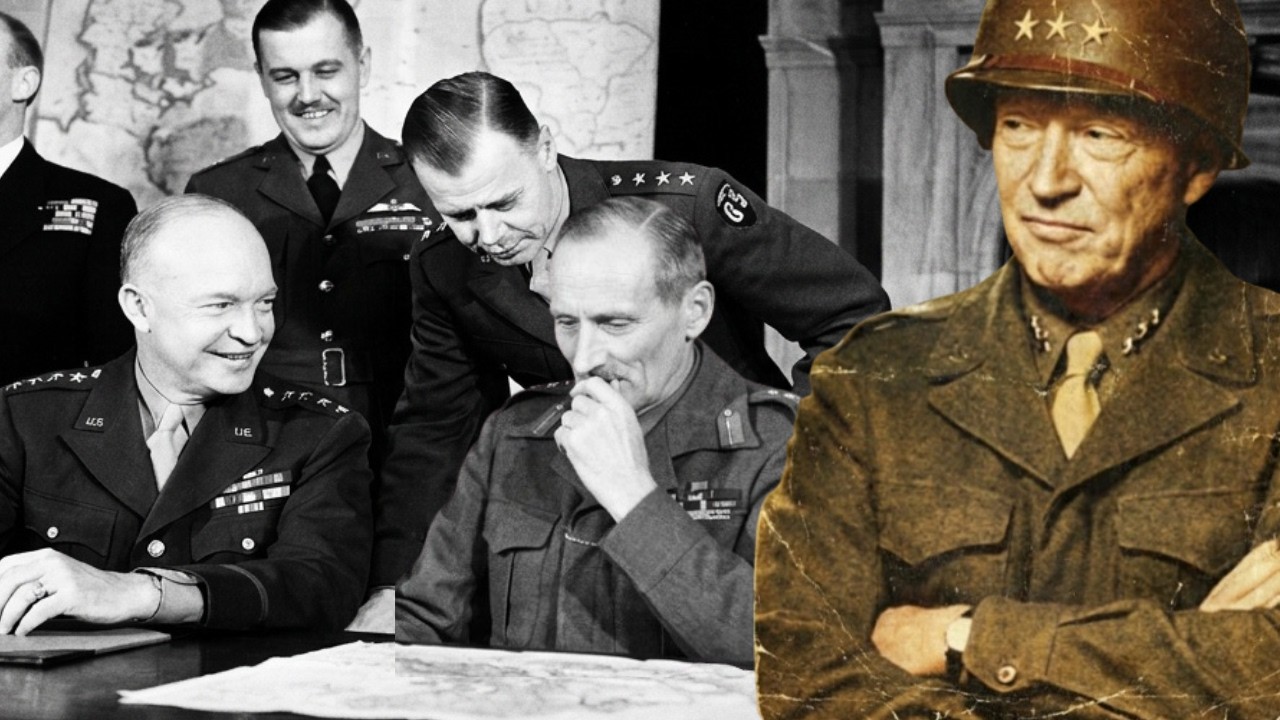
Operation Fortitude South exploited German expectations by presenting Patton as commander of forces supposedly preparing to strike Pas-de-Calais.
The U.S. Army later described German counterparts as regarding Patton among the Allies’ most daring and offensively minded commanders.
That documented respect provides the strongest factual ingredient behind the viral claim, but it does not validate everything surrounding it.
German intelligence and senior officers certainly studied Allied commanders, and Patton’s perceived aggressiveness mattered greatly to their strategic calculations.
However, admiration or fear of Patton does not establish any intercepted memorandum contrasting him with Bernard Montgomery in mocking language.
No reliable archival record identified in Eisenhower materials supports the alleged discovery of a memo proving Germans “laughed off” Montgomery.
That phrase reads more like modern engagement bait than translated wartime intelligence, especially because no document number or provenance appears.
Authentic wartime intelligence usually carries identifiable dates, distribution markings, source references, intelligence summaries, or archival catalog information for verification.
The viral caption supplies none of those essentials, instead substituting cinematic specificity about midnight discoveries, seizures, secrecy, and frightened commanders.
This absence matters because Eisenhower’s wartime papers are extensive, with correspondence, diaries, cables, operational plans, and intelligence documentation preserved.
The Eisenhower Presidential Library catalogs substantial material concerning Montgomery, Patton, Bradley, Ardennes operations, and Supreme Headquarters decision-making during 1944.
Those holdings demonstrate that serious command disagreements were recorded rather than automatically erased whenever they risked embarrassment or political controversy.
Eisenhower’s coalition command routinely generated sharp debates because American and British leaders differed over operational concentration, logistics, prestige, and timing.
Montgomery favored concentrated northern operations, while American commanders frequently argued for resources sustaining their own advances farther south.
Patton believed Third Army could exploit breakthroughs rapidly if supplied, a position reflected throughout official histories and memoir literature.
Yet Eisenhower’s problem was never reducible to choosing courageous Patton over an incompetent Montgomery caricature created for social media.
Montgomery had major victories, professional stature, and legitimate strategic arguments, even when Eisenhower rejected aspects of his preferred operational approach.
The relationship among Eisenhower, Montgomery, Bradley, and Patton was argumentative, political, professional, and sometimes personal, but not secretly binary.
Official histories emphasize supply constraints after the rapid Allied pursuit across France, especially transportation shortages, port limitations, and extended communications.
Those constraints shaped September 1944 operations, when fuel, ammunition, transport, and functioning supply routes determined what armies could attempt.
The U.S. Army’s logistical history describes supply limitations as dominating tactical planning for months after the dramatic pursuit from Normandy.
That evidence undermines simplistic stories claiming Montgomery advanced slowly because Germans dismissed his plans, while Patton embodied effective Allied warfare.
Operational tempo depended upon terrain, mission, enemy resistance, available supplies, command objectives, weather, bridge capacity, and broader coalition strategy.
Patton’s Third Army slowed considerably in Lorraine, demonstrating that bold leadership could not magically abolish logistics or hardened German resistance.
The official Army history “Breakout and Pursuit” documents Patton’s spectacular advance after activation of Third Army in August 1944.
His formations moved rapidly through France, exploiting German collapse after Normandy and creating an enduring image of American armored momentum.
That achievement was real, but later retellings exaggerate it into a narrative where every German commander supposedly feared Patton uniquely.
Some German officers praised him after the war, although retrospective testimony requires careful handling because memory and self-justification influence recollections.
Statements attributed to Jodl, Kesselring, Rundstedt, and others repeatedly appear in biographies and military histories praising Patton’s operational aggressiveness.
Those assessments help explain why Fortitude planners found Patton unusually valuable as the public face of a fictitious invasion force.
Fortitude’s success depended upon multiple deception channels, including double agents, false radio traffic, simulated formations, controlled indicators, and German assumptions.
Patton was not hidden because Eisenhower feared battlefield maps would expose Allied fractures; he was deliberately displayed as deception bait.
Before D-Day, his presence in southeastern England supported the impression that the decisive invasion would strike across the narrow Channel.
After Normandy landings began, German leaders anticipated a larger attack near Calais, delaying certain redeployments toward the actual battlefront.
That episode demonstrates German respect for Patton in a documented context far stronger than the viral caption’s invented-sounding midnight episode.
The claim about military police confiscating Patton’s unauthorized maps is problematic because it lacks recognizable archival grounding or chronology.
Patton certainly clashed with superiors, exceeded rhetorical boundaries, and cultivated operational ideas aggressively, sometimes creating headaches for Eisenhower and Bradley.
But map confiscation by military police would have been extraordinary, likely generating orders, diary entries, correspondence, testimony, or histories.
No such supporting trail accompanies the viral caption, and searchable authoritative sources do not corroborate this sensational allegation.
The added claim that every division ledger was sealed before journalists discovered a “deep command fracture” is similarly unsupported.
Military formations maintained war diaries, operations journals, after-action reports, intelligence summaries, personnel records, and numerous overlapping administrative paper trails.
Suppressing “every division ledger” would therefore require coordination across many headquarters and record systems, making the claim operationally implausible.
It misunderstands how wartime secrecy worked, because classified information was routinely controlled without staging wholesale documentary seizures by military police.
Sensitive plans, signals intelligence, deception operations, and command communications were protected under established security procedures, classification rules, and compartmentation.
The Allied secret involving Patton was Fortitude, whose success depended on Germans believing false information rather than journalists exposing rivalry.
Another warning sign is the promised “leaked audio recording” of Eisenhower’s confidential briefing, supposedly endangered by imminent removal.
That marketing formula resembles contemporary viral misinformation campaigns using urgency, secrecy, and disappearing evidence to discourage skeptical source checking.
Authentic historical audio normally has provenance: recording date, location, collection name, accession information, archive owner, transcript, and preservation history.
A credible publisher could identify the recording precisely, allowing researchers to compare voices, chronology, transcript language, and surrounding documentary evidence.
The caption instead asks audiences to follow a biography link before evidence supposedly disappears, a familiar mechanism for driving clicks.
Nothing about Eisenhower’s documented command style makes an undocumented midnight recording inherently impossible, but possibility is not historical evidence.
Historians distinguish between something conceivable and something demonstrated, particularly when a story introduces precise dialogue, timing, motives, and secret actions.
Here, the burden lies with whoever claims possession of the memo and recording, because those artifacts should be independently examinable.
Without them, the story remains an assertion built around real personalities, recognizable rivalries, and historically plausible atmospheric details.
That construction is persuasive because audiences already know Patton as aggressive, Montgomery as methodical, and Eisenhower as coalition manager.
Those familiar characterizations make invented connective tissue feel credible, even when the specific event cannot be located in reputable documentation.
Montgomery’s supposed “sluggish tactical blueprints” also flatten his actual record, which included careful preparation, overwhelming firepower, and several successful offensives.
His style often contrasted sharply with Patton’s, creating fertile ground for later comparisons between deliberate planning and rapid exploitation.
Yet German reactions to Montgomery were not uniformly contemptuous, and depicting generals literally laughing away his plans is unsupported.
German commanders had serious reasons to respect British operational capability after North Africa, Normandy, and the subsequent advance into Germany.
Montgomery commanded major Allied forces through difficult battles where success depended on coordination among infantry, armor, artillery, engineers, and airpower.
Criticism of Montgomery is legitimate historical debate, particularly concerning operational caution, personality, Market Garden, and disputes over Allied strategy.
But criticism should not be converted into fabricated enemy testimony merely because dramatic contrasts produce stronger online engagement.
Likewise, praising Patton does not require transforming him into a suppressed genius whose superiors repeatedly confiscated evidence of his superiority.
Eisenhower retained Patton in important commands despite controversies because he valued Patton’s battlefield abilities while also managing significant political liabilities.
The famous slapping incidents in Sicily damaged Patton’s standing and temporarily removed him from prominent operational command.
Nevertheless, Allied planners later exploited his reputation during Fortitude, demonstrating Eisenhower’s willingness to use Patton strategically even before combat return.
Third Army became operational in France on August 1, 1944, under Bradley’s Twelfth Army Group during the breakout phase.
Patton then drove forces across France with extraordinary speed, but his advance increasingly collided with shortages and resistance nearer Germany.
Eisenhower faced the fundamental coalition problem of allocating finite transportation and supplies among armies pursuing several potentially decisive objectives.
Montgomery argued for concentrated resources in the north, while Bradley and Patton resisted restrictions that slowed American operations elsewhere.
Eisenhower eventually supported priority for northern operations without permanently abandoning his broad-front concept, reflecting compromise rather than secret panic.
Official logistical histories describe these choices as constrained by transportation capacity and port development, not German opinions about individual commanders.
Antwerp’s capture did not immediately solve supply problems because approaches to the port remained contested until the Scheldt was cleared.
Meanwhile, truck routes stretched hundreds of miles from Normandy beaches, imposing severe maintenance costs and limiting sustainable operational tempo.
The Red Ball Express illustrates this challenge, moving enormous tonnage while consuming vehicles, fuel, drivers, and maintenance resources.
These realities explain pauses and changing priorities more convincingly than a secret memo supposedly ranking Patton and Montgomery for Eisenhower.
They also show why military history resists personality-only explanations, especially when logistics determined which bold plans were materially executable.
The Battle of the Bulge demonstrates Eisenhower’s approach to command disputes, because important disagreements were preserved extensively in archival correspondence.
The Eisenhower Library provides cables between Eisenhower and Montgomery from December 1944, alongside diaries, operational plans, and related records.
Those preserved documents reveal a headquarters that documented difficult decisions, not one routinely erasing every trace of senior-level disagreement.
Eisenhower could be angry with subordinates, and his private remarks sometimes became sharp, particularly during crises involving command authority.
Yet historical reconstruction depends upon surviving records precisely because many conflicts left correspondence, diaries, memoranda, and recollections from multiple participants.
A genuine 2 a.m. confiscation order touching Patton’s headquarters would therefore need more than anonymous social-media narration to become credible.
Researchers would ask who intercepted the German message, which intelligence channel delivered it, and how authentication was established.
They would ask whether the intercept came through Ultra, prisoner interrogation, captured documents, tactical signals intelligence, or another collection source.
They would also seek the original German text because loaded English wording can distort the tone of military assessments.
They would identify which “top German generals” authored, received, discussed, or endorsed the alleged comparison between Patton and Montgomery.
They would establish a date, since Patton’s operational role changed dramatically between Sicily, England, France, Lorraine, Ardennes, and Germany.
They would locate Patton’s supposed “unauthorized battle maps” and explain what made them unauthorized within his actual chain of command.
They would determine which military police unit executed the confiscation and under whose written or verbal authority it acted.
They would identify the “division ledgers,” explain their administrative meaning, and trace how numerous formations supposedly surrendered records simultaneously.
Finally, they would produce the audio’s archival lineage, recording technology, custody history, metadata, and expert authentication of Eisenhower’s voice.
The viral caption supplies none of this, making its extraordinary specificity a weakness rather than evidence supporting authenticity.
A common misinformation technique begins with verifiable history, then inserts undocumented drama between established facts and emotionally satisfying conclusions.
This story follows that pattern closely: Patton was feared, command rivalry existed, intelligence mattered, and Eisenhower guarded coalition unity.
The unsupported additions are the decisive memo, mocking German reaction, midnight seizure, sealed ledgers, imminent press exposure, and leaked audio.
Removing those additions leaves a fascinating genuine history that does not require conspiracy language to remain compelling or important.
German confidence in the Calais deception persisted because Allied deception planners understood enemy expectations and reinforced them through multiple channels.
Patton’s reputation functioned as one of those channels, showing that perception of commanders could influence strategic intelligence judgments.
Eisenhower’s strength, meanwhile, lay partly in balancing commanders whose operational preferences, personalities, and national constituencies frequently collided.
That balancing act generated resentment, especially when resources shifted between army groups or strategic priorities changed under logistical pressure.
Montgomery’s northern concentration proposals were not simply “sluggish blueprints,” and Patton’s southern thrusts were not unconstrained independent master plans.
Each operated inside a massive coalition system linking shipping, ports, railroads, trucks, air support, fuel, ammunition, replacements, and political objectives.
Even the word “relentless” needs qualification because Patton’s operations included pauses, difficult sieges, supply shortages, and costly resistance.
Lorraine offers the clearest corrective, where Third Army’s advance slowed amid weather, logistics, fortified terrain, and determined German defenses.
That campaign does not diminish Patton’s accomplishments; it shows that operational genius still functions within material and geographic constraints.
Similarly, Montgomery’s caution sometimes produced frustration, but caution can reflect logistics, enemy strength, operational sequencing, or casualty considerations.
Serious comparison requires examining specific campaigns rather than assigning permanent personality labels and treating them as universal explanations.
Eisenhower himself judged commanders according to broader coalition requirements, not simply which general produced the fastest armored movement.
His responsibility included maintaining Allied unity, synchronizing national forces, coordinating air and ground operations, and sustaining politically acceptable command relationships.
That institutional perspective helps explain why his decisions sometimes disappointed Patton, Montgomery, Bradley, or other powerful commanders simultaneously.
It also makes the viral scenario’s premise less convincing because Eisenhower already possessed legitimate mechanisms for settling operational disputes.
He could change missions, redirect supplies, modify boundaries, replace commanders, restrict public statements, and issue direct orders through established headquarters.
A panicked military-police raid on maps would be unnecessary unless supported by evidence of an exceptional security breach.
No reliable evidence currently establishes such a breach, seizure, or cover-up connected to the alleged German comparison.
The same skepticism applies to claims that reporters were moments from uncovering a command fracture requiring wholesale suppression.
Journalists knew Allied commanders disagreed, and wartime censorship already limited publication of sensitive operational information without erasing internal records.
Postwar memoirs then exposed many disagreements openly, ensuring the Patton-Montgomery-Eisenhower relationship became one of World War II’s most debated subjects.
If a sensational memo genuinely proved German ridicule of Montgomery, historians would expect it to surface within that extensive historiography.
Its absence cannot mathematically prove nonexistence, but it places a heavy evidentiary burden on anyone asserting the story confidently.
The responsible verdict is therefore not that every emotional premise is false, but that the specific narrative is unverified.
Several foundations are true: Germans respected Patton, Fortitude exploited his reputation, and Allied senior commanders disputed strategy and resources.
Several decisive embellishments remain unsupported: the intercepted comparison memo, 2 a.m. crisis, police confiscations, ledger sealing, and secret recording.
Calling the entire story “historically confirmed” would therefore mislead readers by conflating documented background with undocumented dramatic invention.
A better description is a fabricated or heavily embellished viral narrative assembled from genuine World War II ingredients.
Readers encountering the promised audio should demand original archival identification before treating any recording as authentic evidence of Eisenhower’s briefing.
Modern voice cloning and edited audio further increase the importance of provenance, although old recordings were also frequently miscaptioned.
Authenticity requires more than a voice sounding convincing; it requires demonstrable custody, contextual consistency, and documentary corroboration.
The strongest available evidence instead points toward ordinary, well-documented command friction inside an extraordinary multinational military organization.
Patton remained a formidable commander whose reputation affected German planning and Allied deception, particularly before and after Normandy.
Montgomery remained an influential field commander whose methods and strategic proposals were contested, sometimes sharply, by American counterparts.
Eisenhower remained the supreme coalition commander responsible for deciding among those competing views while confronting severe logistical constraints.
That real triangle contains enough rivalry, achievement, frustration, and strategic consequence without inventing confiscated maps or disappearing midnight recordings.
The historical lesson is consequently about evidence discipline: vivid specificity should increase scrutiny, not substitute for archival proof.
Until the memo, confiscation order, division records, and authenticated recording receive verifiable provenance, the viral story should be rejected.
Its most defensible core is narrow: German commanders respected Patton, and Allied leadership debates over strategy were genuine and consequential.
Everything beyond that core requires documentation, especially claims alleging covert suppression by Eisenhower’s headquarters to deceive the wartime press.
History becomes stronger when extraordinary stories survive source testing; this one, as presented, does not meet that standard.


