His explanation begins with a sentence that is difficult to forget.
He says he would not abandon Christa.
Not then.
Not even when the situation had become catastrophic.
Tadaryl Shipp was seventeen years old when the crime occurred.
Pike was eighteen.
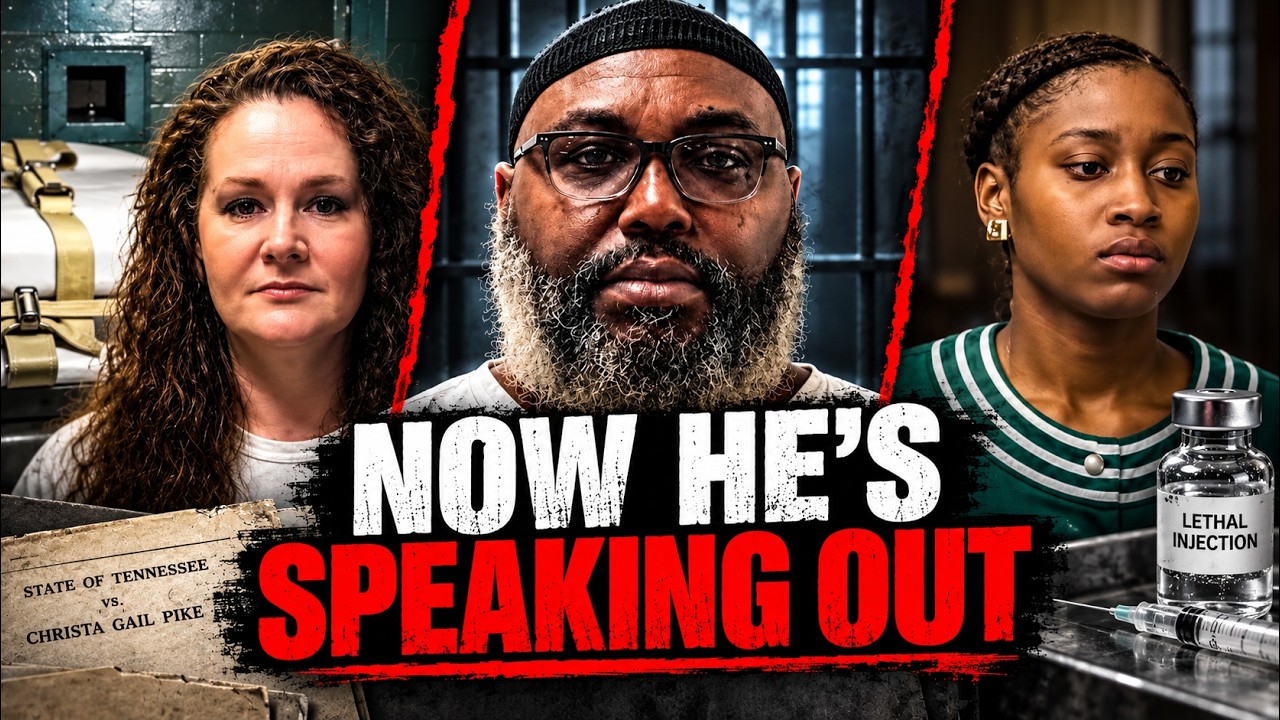
Both were convicted in connection with Colleen’s murder.
But the legal outcomes were dramatically different.
Pike received a death sentence.
Shipp received life in prison.
That one-year difference in age placed them on opposite sides of a critical constitutional boundary governing capital punishment.
Now, decades later, Shipp remains incarcerated while describing his relationship with Pike, his role in the night Colleen died, the moment he says he considered intervening, and why he still believes Pike should not be executed.
His words do not overturn the verdict against him.
They do not provide a new judicial finding.
They are the present-day recollections of a man convicted of first-degree murder and conspiracy to commit first-degree murder.
That distinction matters.
But his account offers a disturbing glimpse into how he now understands the choices that changed three young lives forever.
According to Shipp, his relationship with Pike began in an almost ordinary way.
They were both young and living at the Knoxville Job Corps.
Shipp says he arrived first after losing interest in conventional high school.
Pike arrived later.
One day, he noticed her sitting on some steps crying.
She did not want to be there.
He sat beside her.
He talked with her.
He encouraged her to give the program some time before deciding to leave.
From that conversation, he says, something developed quickly.
They began spending increasing amounts of time together.
They walked.
They talked.
They went places together.
Shipp remembers them becoming extremely close.
His description of the relationship is revealing.
He says Pike was “broken” in her way while he was “lost” in his.
He compares them to pieces of a puzzle.
At seventeen and eighteen, they apparently saw something familiar in each other’s instability.
But another part of Shipp’s life would later become inseparable from public discussion of the case.
Satanism.
Shipp does not deny it.
In the interview, he openly describes himself at the time as an active practicing Satanist.
He says his interest began years earlier after encountering material associated with Anton LaVey and The Satanic Bible.
What began as curiosity eventually became, according to Shipp, a major influence on his thinking and daily life.
When Pike became involved with him, he says she participated in some of those practices.
However, Shipp now makes an important distinction.
He portrays himself as considerably more invested in Satanism than Pike was.
That distinction matters because occult imagery became one of the most sensational elements surrounding Colleen’s murder.
After the killing, details associated with the crime created an almost inevitable media narrative.
Young defendants.
Satanic material.
Occult practices.
And a pentagram cut into Colleen’s body.
The case emerged during a period when American culture was already highly sensitive to claims involving Satanism and ritual violence.
Yet Shipp now rejects the idea that Satanism caused Colleen’s murder.
He acknowledges practicing it.
He acknowledges Pike participated with him.
But when asked whether Satanism was responsible for what happened, his answer is no.
That is Shipp’s claim today.
It is not a judicial finding about motive.
And his willingness to admit one disturbing part of his past does not automatically establish the accuracy of every explanation he offers about another.
More than thirty years have passed.
Memory changes.
Interpretations change.
Shipp has had decades to think about his seventeen-year-old self.
He has also faced the parole system, giving him obvious reasons to consider questions of remorse, responsibility and rehabilitation.
The established facts remain much harder than any retrospective explanation.
On January 12, 1995, nineteen-year-old Colleen Slemmer went into a secluded wooded area with Pike, Shipp and Shadolla Peterson.
Colleen was brutally attacked.
She was beaten and cut.
She was killed.
Pike was convicted of first-degree murder.
Shipp was also convicted of first-degree murder and conspiracy to commit first-degree murder.
Peterson reached a dramatically different legal outcome after cooperating with authorities and pleading guilty to being an accessory after the fact.
That record is essential when listening to Shipp.
At times during the interview, he describes events almost as though violence was escalating around him.
But his conviction does not describe him as a neutral spectator.
A jury found him criminally responsible for murder.
Shipp’s own account nevertheless contains a remarkable admission.
He says he expected some kind of confrontation between Pike and Colleen.
According to his version, he believed there might be an argument or fight.
He says he did not expect Colleen to die.
Then, he says, the situation escalated.
A confrontation became something more serious.
The violence continued.
At some point, Shipp says he realized it needed to stop.
That is one of the most consequential statements in his interview.
He does not say he remained completely unaware that something terrible was happening.
He does not claim the thought of intervention never entered his mind.
Instead, he acknowledges that it did.
He thought about stopping what was happening.
He had the intention.
Then he failed to act on it.
In his own telling, there was a point when his mind recognized that enough was enough.
But he stayed.
Even more disturbing is his description of what happened when Colleen apparently tried to get away.
Shipp says he had temporarily walked away from the immediate area.
When he returned, he encountered Colleen trying to leave.
He acknowledges directing her back.
He now calls that decision horrible.
It is one of the moments when his current narrative moves beyond passive language and acknowledges an affirmative action.
He knew, by his own account, that events had become extremely serious.
Yet instead of helping Colleen escape, he helped prevent her departure.
Why?
That question leads to perhaps the most unsettling part of the interview.
Shipp says he would not abandon Christa Pike.
He says he actually walked down the hill at one point.
He could have kept going.
He came back.
His explanation is emotional rather than legal.
He loved Pike.
He believed she had already been abandoned by people throughout her life.
He had seen behavior that he later came to interpret as evidence of severe trauma.
He describes Pike screaming and crying during sleep.
At the time, he says, he did not understand what he was witnessing.
Looking back, he interprets those episodes as night terrors.
He says he would hold her while they happened.
Later, he learned more about Pike’s history.
Her attorneys have argued that she experienced extreme childhood abuse, neglect and serious psychological problems.
Shipp says those experiences helped shape his teenage determination not to become another person who left her.
In another context, such loyalty might sound compassionate.
In this context, it becomes horrifying.
Because the person Shipp decided not to abandon was participating in the killing of another teenager.
His loyalty to Pike had consequences for Colleen.
He stayed.
Colleen died.
Shipp now acknowledges the contradiction.
As an adult, he describes his teenage reasoning as wrong and foolish.
He says he was seventeen and thinking like a child.
But age became far more than an explanation in this case.
It became the dividing line between life and death.
Shipp was seventeen.
Pike was eighteen.
Pike was eligible for capital punishment.
Shipp was not.
Both were convicted of murder, but Pike became the only defendant in Colleen’s killing sentenced to death.
Shipp received life imprisonment.
That disparity has followed the case ever since.
Pike’s lawyers have repeatedly pointed toward the difference when challenging the proportionality of her death sentence.
The argument is not that Shipp escaped punishment.
He did not.
He has spent decades incarcerated.
His conviction remains.
His life sentence remains.
In 2025, according to the transcript, Shipp went through Tennessee’s parole process.
Parole was denied.
The seriousness of Colleen’s murder was cited.
His next review was scheduled for 2031.
So describing Shipp as the defendant who “walked away with life” must be understood correctly.
He did not walk away from prison.
He remains there.
But life carries something death does not.
Possibility.
Shipp can seek parole.
He can speak about how he has changed.
A parole board can evaluate remorse, responsibility and rehabilitation.
Colleen cannot appear decades later and show the world who she became.
She was nineteen when she died.
That asymmetry hangs over every later development.
Shipp also remains deeply critical of how the third young person present, Shadolla Peterson, was treated.
Peterson cooperated with authorities and received a far less severe outcome.
In the interview, Shipp alleges that her role was greater than the legal result suggested.
At one point, he sarcastically says she deserved an Oscar for her performance.
But that statement must remain exactly what it is.
Shipp’s allegation.
It is not equivalent to a court finding that Peterson shared the same criminal responsibility attributed to Pike and Shipp.
That difference is particularly important in a case surrounded by decades of sensational retellings.
Shipp’s statements can illuminate what he believes.
They cannot retroactively rewrite another defendant’s adjudicated case.
His comments about Pike are similarly complicated.
Despite everything that happened, he says he does not believe she deserves execution.
He believes she deserved punishment.
He recognizes that she has been punished.
But when asked directly about death, his answer is no.
Shipp points toward Pike’s mental-health history.
He believes her problems existed long before Colleen’s murder.
He argues that she needed treatment and suggests that earlier intervention might have changed the direction of her life.
That possibility cannot be proved.
Shipp himself admits he is biased.
He loved Pike.
He remained beside her during the crime.
His own life was destroyed alongside hers.
More than thirty years later, his interpretation of the case remains inseparable from that emotional connection.
But the transcript then moves into an extraordinary modern development that changes the context of his comments.
According to the source, Tennessee attempted to execute Christa Pike on September 30, 2026.
The execution did not kill her.
The transcript describes a chaotic day that included last-minute litigation before the state proceeded with lethal injection.
Pike was supposed to die from pentobarbital.
According to the account, two doses were administered.
She survived.
Her attorneys subsequently alleged serious problems involving intravenous access.
They argued that the drug infiltrated tissue in Pike’s arms rather than entering her bloodstream as intended.
The transcript reports allegations of swelling, burning and blistering in her arms.
Pike was eventually transported from the prison by ambulance.
According to the latest update cited within the transcript, she remained hospitalized, unconscious and on a ventilator as of October 4.
Her long-term prognosis was described as uncertain.
Those medical details are particularly important to handle carefully.
The transcript itself repeatedly distinguishes between what Pike’s attorneys allege and what an independent investigation would still need to determine.
It warns against treating immediate speculation as established fact.
That caution is necessary.
What the source presents as established is already extraordinary enough.
Tennessee attempted to execute Pike.
The attempt failed.
She survived and required emergency hospitalization.
The state’s execution system subsequently came under intense scrutiny.
According to the transcript, Governor Bill Lee halted executions for the remainder of 2026 and ordered an independent review.
The Tennessee Department of Correction’s commissioner announced that he would step down.
The source also says the Pike incident followed another execution problem earlier in the year involving difficulties establishing IV access.
If those developments stand as described in the transcript, the legal landscape surrounding Pike’s sentence has changed dramatically.
But surviving an execution attempt does not automatically erase a death sentence.
The transcript explicitly makes that point.
Pike’s lawyers can challenge another attempt.
They can argue that the physical consequences of the first attempt alter the constitutional analysis.
They can raise questions about her medical condition.
Depending on her recovery, competency could potentially become relevant.
They can again seek clemency.
But none of those arguments automatically means the death sentence has disappeared.
And that uncertainty creates a remarkable parallel with Shipp.
More than thirty years ago, he received life.
Now Pike’s attorneys are again asking Tennessee to commute her sentence to life.
The punishment Shipp received.
The man who once refused to abandon Pike is now saying from prison that he never believed the state should kill her.
Yet focusing exclusively on Pike and Shipp risks repeating precisely what Colleen’s family has criticized for decades.
Colleen disappears.
Her mother, May Martinez, has repeatedly expressed frustration that public attention gravitates toward Pike.
Pike’s childhood.
Pike’s mental health.
Pike’s appeals.
Pike’s death sentence.
Pike’s execution.
Pike’s medical condition.
Meanwhile, Colleen becomes simply “the victim.”
But Colleen Slemmer was nineteen years old.
She had a life beyond the crime that made her name known.
Everything that followed exists because she never returned from those woods.
The trials exist because Colleen died.
The appeals exist because Colleen died.
The parole hearings exist because Colleen died.
The clemency arguments exist because Colleen died.
The execution controversy exists because Colleen died.
And Shipp’s interview exists because he was convicted for his role in what happened to her.
That reality becomes particularly important when Shipp discusses one of the most notorious details of the case.
After Colleen’s death, Pike took a fragment of her skull.
The detail became central to the public horror surrounding the prosecution.
Shipp says he did not initially realize what Pike had picked up.
That is his current account.
But his discussion of the fragment then takes a different direction.
He says it should be returned to Colleen’s family.
He says her mother should have the opportunity to bury her daughter whole.
And in discussing what happened, Shipp reportedly uses collective language.
“We.”
Not simply what Pike did.
What they did.
That shift matters because it contrasts sharply with moments in the interview when his language makes the violence sound like something unfolding around him.
At his most accountable, Shipp recognizes himself inside the event.
At other moments, he sounds more distant.
That tension makes the interview revealing.
It also makes it unreliable as a simple definitive history.
Shipp is simultaneously a convicted participant, a surviving witness, Pike’s former boyfriend, a prisoner who has sought parole and a middle-aged man trying to interpret decisions he made at seventeen.
Those identities cannot be separated from his account.
His conviction provides a fixed point against which his recollections must be measured.
First-degree murder.
Conspiracy to commit first-degree murder.
That is the legal reality.
The interview cannot erase it.
But it can show how Shipp now thinks about it.
He says he regrets what happened.
He acknowledges that he considered intervention.
He acknowledges failing to intervene.
He acknowledges bringing Colleen back when she tried to leave.
He acknowledges remaining because of Pike.
He acknowledges the horror of the crime.
Yet he also describes himself repeatedly through youth, confusion, emotional dependence and loyalty.
Does that represent genuine insight?
Does it minimize responsibility?
Can both be true simultaneously?
Those questions could matter again.
According to the transcript, Shipp’s next parole review is scheduled for 2031.
By then, more than three and a half decades will have passed since Colleen’s murder.
A parole board may eventually have to evaluate whether the seventeen-year-old convicted in 1995 has become a fundamentally different man.
His statements could help that argument.
They could also hurt it.
A board could hear remorse.
It could hear excuses.
It could hear psychological growth.
It could hear continued minimization.
It could hear all of those things at once.
Pike’s age creates an equally difficult question.
The law requires boundaries.
For capital punishment, age became one.
Shipp was seventeen.
Pike was eighteen.
Pike’s attorneys have argued that human maturity does not transform suddenly on an eighteenth birthday.
Modern constitutional law protects offenders who were under eighteen when they committed their crimes from execution.
Shipp fell on the protected side of that line.
Pike did not.
But reducing the sentencing difference entirely to age would also oversimplify the case.
Prosecutors presented evidence specific to Pike’s conduct.
Her jury heard evidence concerning the extraordinary brutality of Colleen’s murder and Pike’s actions surrounding it.
Age determined whether death was legally available for Shipp.
It does not, by itself, explain every reason the state sought and obtained death against Pike.
Both realities matter.
So does Pike’s history.
Her attorneys have argued that she suffered severe childhood sexual abuse, violence, neglect and serious mental-health problems.
Shipp’s recollections of her crying and screaming during sleep fit the broader portrait he now draws of a deeply troubled teenager.
But trauma does not erase Colleen.
Understanding why someone becomes violent is not equivalent to excusing violence.
A person can have been horribly victimized and later horribly victimize someone else.
Those truths can exist together.
That is part of what makes the Pike case resistant to simple moral categories.
Pike’s defense can present evidence of profound childhood suffering.
Colleen’s family can insist that the brutality inflicted upon their daughter remains the central fact.
Shipp can believe Pike should live.
The state can defend the sentence imposed by the jury.
And none of those positions can undo January 12, 1995.
The reported failed execution has now forced those old arguments into a new context.
Before September 30, arguments about another execution concerned what might happen.
According to the transcript, Tennessee actually attempted it.
If Pike recovers, any future effort could trigger new litigation involving the alleged injuries, IV problems, psychological consequences and the Eighth Amendment prohibition against cruel and unusual punishment.
If she suffers severe lasting cognitive impairment, competency could potentially become another issue.
But the transcript carefully notes that such an outcome had not yet been established.
Pike had not been declared permanently brain damaged.
She had not been declared incompetent.
Doctors had not yet provided a definitive long-term prognosis within the latest update cited by the source.
That uncertainty should not be filled with speculation.
Neither should questions surrounding the execution procedure.
The transcript reports that Pike’s attorneys believe pentobarbital infiltrated tissue because of IV problems.
It also notes that her lawyers had raised concerns beforehand about venous access and medical risk.
But determining precisely what happened requires investigation.
The source explicitly rejects unsupported theories about sabotage or intentional interference.
There is no need for conspiracy theories.
A failed execution followed by emergency hospitalization is serious enough.
And through all of this, Tadaryl Shipp remains in prison.
That fact complicates any headline suggesting that he simply escaped the consequences Pike faced.
He did escape death.
He did not escape punishment.
He has spent most of his life incarcerated.
His attempt at parole was denied.
He remains legally responsible for Colleen’s murder.
But he possesses something Pike has spent decades fighting to obtain.
A sentence measured in life rather than death.
That distinction becomes even more striking because Shipp still describes the same emotional impulse that shaped his actions as a teenager.
Do not abandon Christa.
In 1995, according to his own explanation, that impulse helped keep him beside Pike when he should have walked away, intervened or sought help.
Today, it appears differently.
He opposes her execution.
Thirty-one years have changed almost everything around that instinct.
But apparently not the instinct itself.
And that leaves one final person who cannot participate in the debate.
Colleen.
Shipp has had more than thirty years to reconsider himself.
Pike has had more than thirty years of appeals, litigation and arguments over punishment.
Lawyers have developed new evidence.
Medical experts have examined old questions.
Courts have revisited claims.
Governors have considered clemency.
Parole officials have examined Shipp.
Journalists have interviewed participants.
Audiences have debated Satanism, trauma, adolescence, culpability and capital punishment.
Colleen received none of those additional years.
She never got to become thirty.
Or forty.
Or fifty.
She never got to explain how her nineteen-year-old self differed from the woman she later became.
She never got a hearing where someone could decide she had changed.
That is the permanence at the center of this case.
A justice system can reconsider what should happen to the living.
It cannot reconsider what happened to the dead.
Perhaps that is why Shipp’s interview is simultaneously fascinating and deeply uncomfortable.
It gives a convicted participant a voice after three decades.
It allows him to explain his teenage reasoning.
It allows him to describe Pike’s suffering.
It allows him to express regret.
It allows him to oppose her execution.
But every additional explanation also demonstrates the opportunity Colleen lost.
Shipp is alive to reconsider his choices.
Pike, according to the latest status contained in the transcript, survived the state’s attempt to execute her.
Colleen Slemmer did not survive January 12, 1995.
Whatever happens next—to Pike’s medical condition, to Tennessee’s investigation, to her death sentence, or to Shipp when his next parole review arrives—that remains the one fact no court, governor, execution chamber or prison interview can ever change.


