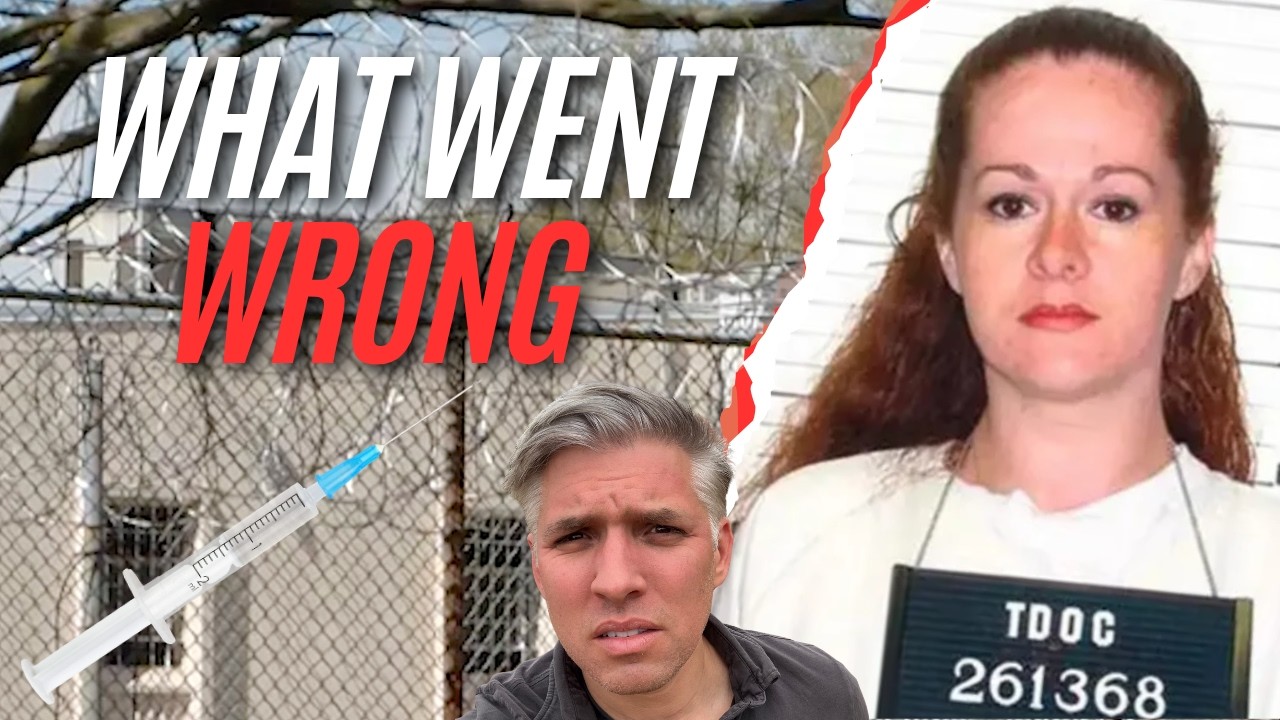
Nearly a week after Tennessee tried to execute Christa Pike, the most important fact remains brutally simple.
She still has not woken up.
Pike entered Riverbend Maximum Security Institution’s execution chamber on September 30 expecting to die from a massive dose of pentobarbital.
Tennessee administered the first set of lethal-injection drugs.
She survived.
The state administered its backup set.
She survived that too.
Then the protocol ran out of instructions.
Pike was taken from the prison in an ambulance and transported to a hospital where doctors suddenly faced the opposite task from the one Tennessee had just attempted.
They had to keep her alive.
Her attorney Stephen Ferrell said on October 5 that Pike had **not regained consciousness** since the failed execution.
She had been intubated and placed on a ventilator.
Her attorneys have described both arms as swollen, burned and blistered, injuries they believe resulted when pentobarbital leaked into surrounding tissue instead of remaining inside functioning veins.
No reliable public update has yet established that Pike has awakened.
No doctor has publicly guaranteed that she will recover.
And nobody outside her medical team can currently say whether she suffered permanent neurological damage.
That uncertainty has transformed what was supposed to be Tennessee’s first execution of a woman in more than two centuries into a crisis reaching far beyond one death-row prisoner.
The head of Tennessee’s prison system has resigned.
The governor has stopped all remaining executions for 2026.
An outside investigation is beginning.
Lawmakers are discussing alternative execution methods.
Pike’s lawyers are preserving evidence for what could become years of constitutional litigation.
And questions are now being asked about the professional history of the man who oversaw Tennessee’s corrections system when everything went wrong.
Frank Strada.
Strada became commissioner of the Tennessee Department of Correction in January 2023.
Before coming to Tennessee, he had spent years in Arizona’s corrections system, eventually serving in senior leadership positions.
That matters now because Arizona had its own recent history of troubled executions.
And some of the problems look uncomfortably familiar.
The central issue is intravenous access.
Lethal injection sounds mechanically simple.
Find a vein.
Insert the catheter.
Administer the chemical.
But in practice, establishing reliable IV access has repeatedly become one of the most failure-prone parts of American executions.
In May 2022, Arizona executed Clarence Dixon after execution personnel struggled for approximately twenty-five minutes to place IV lines in his arms.
Witnesses said Dixon appeared to grimace in pain.
Personnel eventually resorted to accessing a vein in his groin through what critics described as a “cutdown” procedure. [Death Penalty Information Center](https://deathpenaltyinfo.org/witnesses-report-problems-inserting-iv-in-arizonas-first-execution-in-eight-years?utm_source=chatgpt.com)
A month later came Frank Atwood.
Again, the execution team had difficulty establishing IV access.
Atwood reportedly assisted prison officials in locating a suitable vein.
Then in November 2022, Arizona executed Murray Hooper.
Again, the execution team struggled with IV placement and eventually used a femoral line. [Death Penalty Information Center](https://deathpenaltyinfo.org/as-lethal-injection-turns-forty-states-botch-a-record-number-of-executions?utm_source=chatgpt.com)
Strada was serving as a senior Arizona corrections official during that period.
That does **not** mean he personally inserted the needles.
It does not prove he ordered improper medical procedures.
And it would be inaccurate to assign him personal responsibility for every complication.
But critics of Tennessee’s execution system now argue that he arrived in Nashville already familiar with the operational reality that IV access can derail an execution.
That history is receiving new scrutiny because Tennessee encountered almost the same problem.
Twice.
The first warning came in May 2026.
Tennessee attempted to execute Tony Carruthers.
Execution staff spent more than an hour trying to establish satisfactory IV access.
They could not.
The execution was abandoned before the lethal drug was administered.
Then came Christa Pike.
Her attorneys had been warning the state for months that her veins presented a special problem.
They cited a history of difficult blood draws.
They cited small veins.
They cited thrombocytosis, a condition involving elevated platelet levels.
And they argued that Tennessee’s execution protocol did not contain sufficient safeguards for a prisoner whose vascular access could be unusually difficult.
Their predictions were specific.
They feared Pike would spend a prolonged period strapped to a gurney while execution personnel repeatedly searched for usable veins.
After September 30, Tennessee public defender Kelley Henry’s office said portions of those warnings had effectively come true. [https://www.wsmv.com](https://www.wsmv.com/2026/10/02/horrified-not-surprised-all-tennessee-public-defender-christa-pikes-failed-execution/?utm_source=chatgpt.com)
According to Pike’s attorneys, execution personnel made at least seven needle attempts.
One needle reportedly came out bent.
Pike herself allegedly tried to help the team identify places where a vein might be easier to access.
Eventually the execution team believed it had secured the necessary lines.
Then the pentobarbital began flowing.
Almost immediately, witnesses heard Pike complain.
Her arm hurt.
It burned.
At one point she reportedly said it felt as though her arm was going to burst.
Those comments have become central to the investigation.
Because they may indicate that the drug was not flowing where prison officials believed it was.
The current defense theory is IV infiltration or extravasation.
That occurs when a catheter fails to remain properly inside a vein and medication enters surrounding tissue.
With an ordinary hospital drug, infiltration can cause swelling and pain.
With highly concentrated pentobarbital solution, the consequences may be much more severe.
Pentobarbital formulations are alkaline.
If a large amount enters soft tissue instead of the bloodstream, it can irritate and damage that tissue.
Pike’s lawyers say that is consistent with what doctors later saw.
Swelling.
Burning.
Blistering.
Severe injuries to both arms. [Reuters](https://www.reuters.com/legal/government/tennessee-execution-survivor-christa-pike-ventilator-attorneys-say-2026-10-02/?utm_source=chatgpt.com)
It could also explain the most obvious mystery.
Why did she survive?
Tennessee’s written protocol provides for an initial administration of pentobarbital and a backup administration if the prisoner remains alive.
The state used both.
The Department of Correction said every authorized step had been completed.
But Pike continued breathing.
Tennessee’s protocol contained no third round and no alternative procedure for a prisoner who survived both administrations. [https://www.wsmv.com](https://www.wsmv.com/2026/10/01/christa-pikes-failed-execution-reveals-holes-tennessees-lethal-injection-protocol-heres-why-prison-staff-couldnt-have-been-prepared/?utm_source=chatgpt.com)
That means the protocol encountered a scenario it had not planned for.
Officials could not legally improvise another way to kill her.
They could not simply keep administering drugs indefinitely.
They could not switch immediately to electrocution.
They could not continue experimenting until something worked.
The execution stopped.
And Pike went to the hospital.
That absence of a contingency is now one of the most damaging facts for Tennessee officials.
The execution team reportedly trained according to the state’s protocol.
They rehearsed the steps.
They knew what to do if the first dose failed.
What they did **not** have was guidance for what to do if the second dose failed too.
Witness Catherine Sweeney summarized the problem afterward: the protocol simply did not contemplate what everyone in the room was watching happen.
A living prisoner after the final authorized dose. [https://www.wsmv.com](https://www.wsmv.com/2026/10/01/christa-pikes-failed-execution-reveals-holes-tennessees-lethal-injection-protocol-heres-why-prison-staff-couldnt-have-been-prepared/?utm_source=chatgpt.com)
This is where scrutiny of Frank Strada’s leadership becomes sharper.
Under Strada, Tennessee adopted its revised single-drug pentobarbital protocol after the state’s previous execution system had already experienced significant problems.
The 2025 protocol sets requirements for execution-team members and training.
But critics say its qualifications for IV personnel are vague.
One Tennessee defender argued that the standards were so broad that someone with very limited phlebotomy training could potentially meet them. [https://www.wsmv.com](https://www.wsmv.com/2026/10/02/horrified-not-surprised-all-tennessee-public-defender-christa-pikes-failed-execution/?utm_source=chatgpt.com)
That claim will now be tested against records.
Who exactly was on Pike’s IV team?
What were their credentials?
How many difficult IV placements had they handled?
Who supervised them?
Did anyone recognize infiltration before the second dose was given?
Did anyone question whether the lines remained patent?
Were the IV sites checked before administering the backup?
Those questions are no longer theoretical.
They could determine whether what happened to Pike was an unavoidable medical complication or a preventable execution failure.
And there is another reason Strada’s Arizona experience matters.
Arizona’s death-penalty system has repeatedly faced criticism for execution complications and secrecy.
The most notorious example occurred before Strada’s 2022 leadership period, in 2014, when Joseph Wood’s execution lasted almost two hours.
Witnesses reported hundreds of gasps and snorts before Wood finally died.
Arizona eventually acknowledged that officials had administered the drug combination repeatedly—fifteen separate times. [Death Penalty Information Center](https://deathpenaltyinfo.org/arizona-botches-execution-of-joseph-wood?utm_source=chatgpt.com)
That disaster led to years of litigation and a long pause in Arizona executions.
When Arizona finally resumed executions in 2022, IV difficulties again became prominent during the Dixon, Atwood and Hooper executions.
Those were the proceedings occurring during Strada’s senior tenure there. [Death Penalty Information Center](https://deathpenaltyinfo.org/as-lethal-injection-turns-forty-states-botch-a-record-number-of-executions?utm_source=chatgpt.com)
So when Tennessee experienced Carruthers in May and Pike in September, critics saw not merely isolated accidents but another chapter in a broader American pattern.
The procedures look controlled on paper.
The human vascular system does not always cooperate.
And once something goes wrong inside an execution chamber, the state may have fewer safe options than its protocol suggests.
Strada has defended the Tennessee staff.
When his resignation was announced, he said he believed employees had followed the state’s established protocol.
He nevertheless concluded that stepping down was appropriate while the investigation moved forward.
Governor Bill Lee accepted the resignation and appointed former U.S. Attorney Ed Stanton to conduct an independent review. [AP News](https://apnews.com/article/456e4c5e3e203be44744bcf839c11d4f?utm_source=chatgpt.com)
That wording creates an uncomfortable possibility.
If staff really did follow the protocol exactly, then perhaps the protocol itself failed.
That could be more serious than one employee making a mistake.
If an IV team violated procedure, Tennessee can rewrite training rules.
If one catheter was placed incorrectly, officials can blame a specific technical failure.
But if the state’s personnel did exactly what they were trained to do and still produced a critically injured, living prisoner, then the entire execution system comes under scrutiny.
That is why Governor Lee has halted executions for the rest of 2026.
The state cannot responsibly proceed while it does not know why the last attempt failed.
Tennessee lawmakers are already considering what comes after the review.
Republican legislative leaders have discussed expanding or changing available execution methods.
Some have suggested greater reliance on the electric chair.
Others want a broader review of what methods Tennessee should authorize.
The political reaction is therefore divided.
Death-penalty opponents see Pike’s case as evidence that executions cannot reliably be made humane.
Some death-penalty supporters see it as evidence that lethal injection, specifically, has become unreliable and should be replaced or supplemented. [AP News](https://apnews.com/article/0d859591659a62b4d9c4d8599d98315e?utm_source=chatgpt.com)
But none of that answers the immediate question.
What happens to Pike?
Right now, medicine comes before punishment.
Her attorney says she has not regained consciousness.
She previously gave medical power of attorney to another person, who is now making medical decisions on her behalf.
Her long-term condition is unknown.
Attorneys do not know whether she suffered brain damage from respiratory compromise, the drug itself or some combination of events during and after the execution.
They also do not know what she experienced while conscious.
That could become important if she wakes.
Pike is in a rare position.
Almost everyone who receives an execution-level dose of pentobarbital dies.
If Pike eventually becomes capable of communicating, she may be able to describe what happened from inside an attempted lethal injection.
She could say how long she remained aware.
What the burning felt like.
Whether she experienced breathlessness.
Whether she remembers the second dose.
Whether she could hear officials discussing the failure.
That testimony could become evidence in future litigation.
But her lawyers currently cannot ask those questions.
She remains unconscious. [AP News](https://apnews.com/article/615fbde1a6ab5b1d5f2c9ca97d4dce33?utm_source=chatgpt.com)
Her legal team has therefore focused on something else.
Preserving evidence.
They want Tennessee ordered to protect the needles.
The IV equipment.
Drug records.
Execution logs.
Electronic communications.
Information about pentobarbital preparation and storage.
Anything capable of reconstructing the procedure.
Because if Pike survives, the legal fight will almost certainly become much larger.
Her death sentence remains valid.
American law does not automatically erase a death sentence because an execution fails.
But another attempt would face an extraordinary Eighth Amendment challenge.
Pike’s attorneys can now point to actual injuries rather than hypothetical risks.
They can say the state knew her IV access was problematic.
They can say another Tennessee execution had already been abandoned months earlier because of IV difficulties.
They can say the execution team struggled with her veins anyway.
They can say two rounds of pentobarbital were administered.
And they can show that the result was not death but hospitalization, chemical injury and prolonged unconsciousness.
Whether that legally prohibits a future execution has not been decided.
But it makes the next case fundamentally different from the one Tennessee litigated before September 30.
There is also another family trapped inside this story.
Colleen Slemmer’s.
Pike was sentenced to death for the 1995 murder of the nineteen-year-old Job Corps student.
Slemmer’s mother, May Martinez, witnessed the failed execution.
She had waited more than thirty years believing September 30 would finally complete the sentence.
Instead, she watched Pike move, breathe and survive.
Martinez later said simply that she had not received justice for her daughter. [AP News](https://apnews.com/article/616827e89ef356d726bf8f0b7e5c7185?utm_source=chatgpt.com)
That makes the institutional failure consequential on both sides.
Pike’s lawyers say their client was subjected to prolonged and unnecessary suffering.
Slemmer’s family says Tennessee put them through the emotional ordeal of an execution without delivering the outcome the state had promised.
Nobody left Riverbend with closure.
And that is why Frank Strada’s resignation matters symbolically even before investigators assign responsibility.
Executions are among the most controlled acts a government performs.
Nothing is supposed to be improvised.
Every syringe is documented.
Every role is assigned.
Every minute is scheduled.
Every backup procedure is supposed to exist before the prisoner enters the chamber.
Yet Tennessee’s system reached a point where its written instructions effectively ended while the prisoner continued breathing.
That is not an ordinary complication.
It is a breakdown in the state’s final contingency.
The independent review led by Ed Stanton now has to determine where that breakdown began.
Was the IV team sufficiently qualified?
Were Pike’s veins properly assessed?
Was an alternative access method considered?
Did the lines fail after insertion?
Was infiltration detected?
Was the backup dose administered into a line already showing signs of failure?
Was the pentobarbital properly compounded, stored and prepared?
Did officials adequately account for Pike’s documented medical conditions?
And why did the protocol contain no meaningful instruction for the precise event that ultimately occurred?
Two full rounds.
One living prisoner.
Until those questions are answered, describing Pike’s case simply as “the drug didn’t work” is premature.
Pentobarbital is capable of killing.
The unanswered question is whether the drug reached Pike’s circulation in the way Tennessee intended.
Her burned and blistered arms may eventually provide part of that answer.
The remainder will come from records the state is now under enormous pressure to preserve.
Frank Strada leaves office insisting his staff followed the rules.
Pike’s attorneys are effectively asking the opposite question:
**What if following those rules was part of the problem?**
That question will define Tennessee’s investigation.
And as of the latest public information, the woman at the center of it cannot answer for herself.
Christa Pike is still alive.
She is still unconscious.
Her future medical condition is unknown.
Her death sentence remains legally intact.
Her next execution, if there ever is one, is nowhere near being scheduled.
And Tennessee is now confronting an uncomfortable truth that no execution protocol is supposed to expose:
The state prepared for Christa Pike to die.
It was far less prepared for her to survive.


