Christa Pike survived Tennessee’s attempt to execute her.
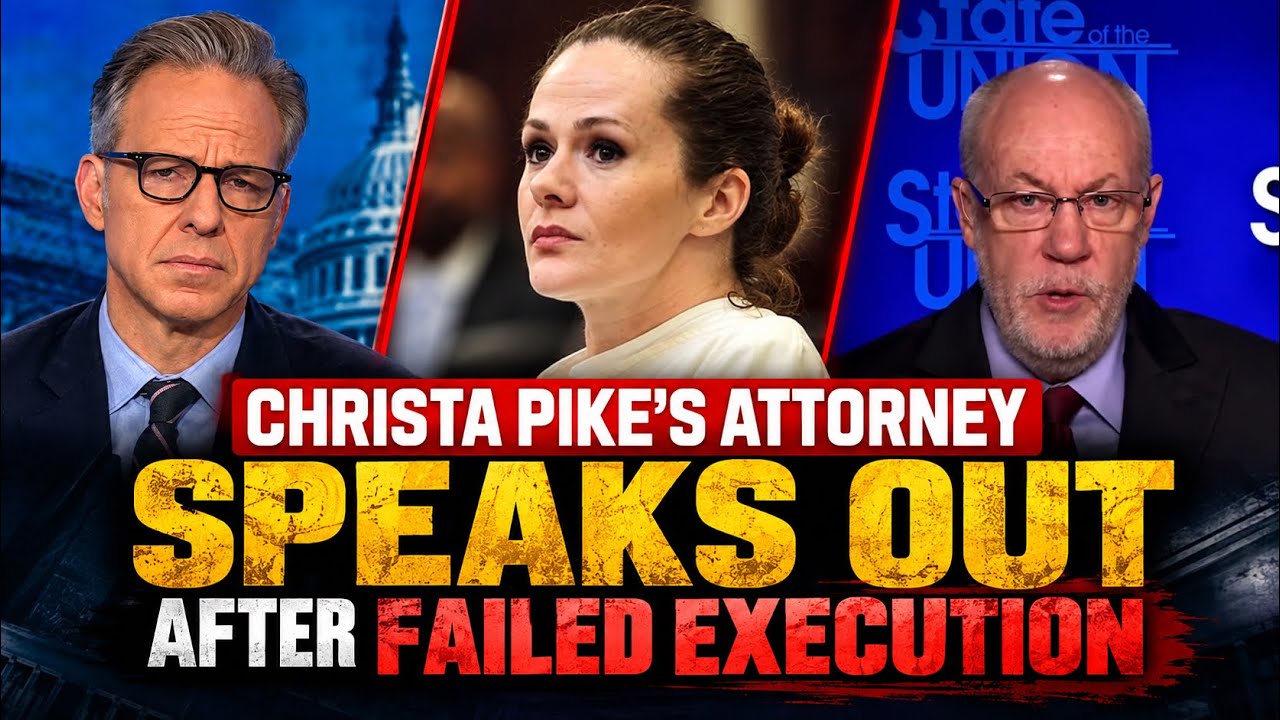
Now another question has replaced the one that dominated the night inside Riverbend Maximum Security Institution.
Will she recover?
According to the latest account provided, Pike remains hospitalized, critically ill and dependent on a ventilator.
Her attorney Steven Ferrell said her condition had not meaningfully changed.
There was still no clear prognosis.
And when asked whether Pike had regained consciousness or spoken since the failed execution, Ferrell said he was not aware that she had.
The hospital was also attempting to deal with the pentobarbital remaining in her body.
Doctors had not yet explained to Pike’s legal team how she survived the execution attempt.
That means the most dramatic medical questions remain unanswered.
What happened to the execution drugs?
How much entered her circulation?
What happened at the IV sites?
What occurred behind the curtain during the long period witnesses could hear Pike breathing but could not see her?
And what damage, if any, did the failed execution leave behind?
At this stage, the source does not provide those answers.
What it provides is something narrower and deeply consequential.
Christa Pike is alive.
She is critically ill.
She is on a ventilator.
And her long-term condition remains unknown.
Ferrell emphasized an important limitation during the interview.
Pike’s attorneys were not consulting directly with her treating doctors.
Information was reaching them through the person holding her medical power of attorney.
Ferrell therefore did not claim to know everything Pike’s medical team knew.
When asked whether doctors had successfully cleared the two reported doses of pentobarbital from her body, he said that process remained ongoing.
When asked whether doctors could explain why Pike survived, he said they had not provided such an explanation to the legal team.
That distinction matters.
The public now has several theories.
It does not yet have a definitive medical finding.
Previous reporting raised concerns about difficult IV access.
Pike complained during the execution that her arm felt as though the vein might burst.
She later described another location as throbbing.
Her lawyers have said the execution team used multiple needles while attempting to establish access.
Experts cited in earlier coverage raised the possibility that pentobarbital may have infiltrated surrounding tissue instead of entering circulation normally.
Questions were also raised about the condition of the execution drugs themselves.
But none of those possibilities is established as the cause in this new source.
The attorney’s update makes that uncertainty explicit.
Doctors had not explained to his team why Pike survived.
And Pike herself was apparently in no condition to provide an account.
Ferrell said he had not personally been allowed to see her.
She remained guarded.
He did not know everyone who might have visited.
That creates an extraordinary contrast with what happened only days earlier.
Tennessee had taken custody of Pike for the purpose of carrying out her death sentence.
Now Pike was in a hospital receiving treatment intended to preserve her life.
The execution failed.
The immediate duty changed.
Instead of carrying out the death sentence, medical personnel were now attempting to keep the condemned prisoner alive.
What happens if Pike survives remains unresolved.
Ferrell said Pike’s legal team had received no indication from either the governor’s office or the Tennessee Attorney General about whether the state would eventually seek another execution date.
Governor Bill Lee had already suspended Tennessee’s remaining executions for the rest of the year.
That provided an immediate pause.
It did not answer the long-term question.
Pike’s future also depends on something nobody can yet predict from the source.
Her recovery.
Ferrell acknowledged that even if Pike survives, she may not fully recover.
There could potentially be future questions about her physical condition or legal competence.
But those are possibilities.
The source does not establish brain damage.
It does not establish permanent neurological impairment.
It does not establish incompetence.
And it does not establish that Pike will remain dependent on a ventilator.
Her prognosis was simply unknown.
That uncertainty makes some of the commentary surrounding the case important to separate from confirmed developments.
The host of the program argued that he considered another attempt to execute Pike highly unlikely.
He raised Eighth Amendment concerns and suggested that if Pike survived with significant medical or cognitive impairment, another execution attempt would become even more difficult to imagine.
He repeatedly predicted that Tennessee would not put her through the process again.
But he also correctly identified those statements as his opinion.
No government decision cited in the source establishes that Pike will never face another execution attempt.
No court has eliminated her death sentence in the material provided.
And the Tennessee Attorney General’s office had not communicated its intentions to her lawyers.
For now, the future remains open.
Pike’s legal team is pushing for one outcome.
Commutation.
Ferrell argued that Governor Lee should reduce Pike’s death sentence to life imprisonment.
He said she had already spent more than 30 years incarcerated and had now endured an attempted execution that failed to kill her.
He characterized the process as torturous and argued that attempting another execution would not produce justice.
That is the position of Pike’s attorney.
It is advocacy on behalf of his client.
It is not yet the governor’s decision.
The distinction becomes particularly important because there is another family inside this story.
Colleen Slemmer’s.
Pike was sentenced to death for the 1995 murder of the 19-year-old.
Colleen’s mother, May Martinez, had waited decades for the sentence to reach its conclusion.
She was at the prison on the night Tennessee attempted to execute Pike.
Instead of finality, she received another extraordinary delay.
Ferrell was directly asked what justice could now mean for the victim’s family.
His response acknowledged something that no execution could change.
Nothing can bring Colleen back.
Nothing can undo what happened to her mother.
And the decades of appeals followed by an execution attempt that failed have extended the case far beyond anything the family could have anticipated.
Ferrell argued that Pike had already been severely punished and could remain severely punished under a life sentence.
But that remains the defense position.
For May Martinez, the issue described in the source also involves finality after more than 30 years of litigation.
The program’s host repeatedly emphasized that he did not consider Colleen or her mother an afterthought.
He also speculated about other issues involving the victim’s remains and what might happen if future civil litigation emerged.
Those portions of the discussion should be treated cautiously.
They are commentary about possible future events.
They are not established outcomes.
The confirmed medical update is already significant enough.
Pike remains on a ventilator.
She remains critically ill.
Her prognosis is unknown.
Ferrell is not aware that she has regained consciousness.
Doctors were still dealing with pentobarbital remaining in her body.
And Pike’s legal team had not been given a definitive medical explanation for her survival.
Those facts make the investigation into the failed execution even more important.
One area of scrutiny will almost certainly be the IV process.
Another will be the medication.
But perhaps the most important area is the period witnesses could not observe.
The curtain.
Media witnesses described the execution progressing abnormally.
They saw Pike continue moving and breathing.
They heard what they described as snoring.
They understood that another round of medication was attempted.
Then the curtain closed.
For roughly 50 minutes, they could hear activity without being able to see what was happening.
The host of the program repeatedly returned to that period.
What happened behind the curtain?
That is where speculation must stop and documentation must begin.
The investigation will need to determine what prison and medical personnel did during those minutes.
What was Pike’s medical condition?
What was happening at the IV sites?
Were the lines inspected?
Were new lines attempted?
Was medication still being administered?
What monitoring equipment was being used?
What did personnel observe?
When did officials determine that the execution could not be completed?
When did the responsibility shift from execution to emergency treatment?
And what steps were taken to preserve Pike’s life?
Those questions matter not only to Pike’s attorneys.
They matter to Tennessee’s credibility.
The source’s host, who approaches the case from a corrections perspective and expresses sympathy with Colleen Slemmer’s family, acknowledged that a failed process changes the transparency debate.
His argument was essentially institutional.
An execution system asks the public to trust that an extraordinary government power is being carried out correctly.
When multiple attempts fail, that trust becomes harder to sustain without additional information.
That does not mean every operational detail must automatically become public.
The host noted concerns involving execution-drug suppliers and other protected information.
But he argued that failures increase pressure for transparency because secrecy can begin to look like concealment when the process itself is no longer producing the expected result.
That may become one of the largest consequences of Pike’s case.
Not merely whether Tennessee attempts to execute her again.
But how much Tennessee will be required to reveal about the way it conducts executions.
Who places the IVs?
What qualifications do those individuals have?
How many attempts are permitted?
What happens after unsuccessful access?
How are execution drugs obtained?
How are they stored?
How are they tested?
What contingency procedure applies when a prisoner remains alive after the planned medication sequence?
And what are witnesses entitled to observe when something goes wrong?
Pike’s attorney also raised questions about Tennessee’s secrecy surrounding execution drugs.
He said that in an earlier case, lawyers sought information about the chemicals being used.
According to his account, a judge ordered disclosure of one item: the drugs’ expiration date.
The state then sought appellate intervention blocking that order.
In Pike’s case, Ferrell said the delay between the scheduled morning execution and the evening attempt created additional questions about the drugs.
He said the defense did not know enough about how the chemicals had been manufactured, compounded, stored or preserved.
He suggested those issues could potentially have contributed to the outcome.
Again, “could” matters.
The source does not establish that degraded or improperly stored pentobarbital caused Pike’s survival.
Ferrell himself acknowledged the absence of definitive answers when discussing IV placement and drug circulation.
His argument was for disclosure.
The records, in his view, are necessary precisely because the cause remains uncertain.
That is also why predictions about Pike’s future must remain separate from facts.
The host believes another execution attempt is extremely unlikely.
He predicts Pike could eventually receive a commutation if she survives.
He raises the possibility that future medical or mental impairment could become legally significant.
Those are plausible subjects for future litigation.
They are not present outcomes.
The same applies to political discussion surrounding alternative execution methods.
The source mentions gubernatorial candidate Marsha Blackburn and statements about using the electric chair, while noting that legal changes would be necessary.
That broader political debate does not establish what will happen specifically to Pike.
Her case now depends first on something far more immediate.
Whether she survives the aftermath.
The latest update ends without resolving that question.
A subsequent item cited by the host reportedly confirmed the same basic condition.
Pike remained unconscious.
She remained on a ventilator.
No clear prognosis had emerged.
That is where the evidence stops.
Everything after that must wait.
Whether she regains consciousness.
Whether she can breathe without mechanical assistance.
Whether she suffered permanent injury.
Whether her death sentence is commuted.
Whether Tennessee ever seeks another execution date.
Whether courts would permit another attempt.
Whether the state’s execution protocol survives the coming investigation.
None of those questions has been answered by this source.
For now, the image is stark enough.
Christa Pike entered Riverbend under a death warrant.
Tennessee attempted to carry out that warrant.
The execution failed.
Medical personnel then had to try to save the life the state had just attempted to end.
Now Pike lies critically ill on a ventilator while her attorneys, Tennessee officials, medical personnel and the public wait for an answer that no court can provide.
Will she recover?
Until doctors know more, the legal fight comes second.
Because before Tennessee can decide what it wants to do with Christa Pike next, it first has to learn what the failed execution has done to her.


