A sensational report claims the WNBA officially warned Caitlin Clark and Sophie Cunningham against joining a European basketball league.
The accompanying story describes an aggressive threat, a leaked letter, and an enormous federal lawsuit challenging the league’s authority.
It also claims Clark delivered a devastating five-word response that supposedly left the WNBA commissioner completely unable to react.
However, no credible evidence currently confirms that Clark and Cunningham have accepted contracts with any EuroLeague Women organization.
There is also no authenticated warning letter, identified European club, announced lawsuit, legal filing, or statement supporting the narrative.
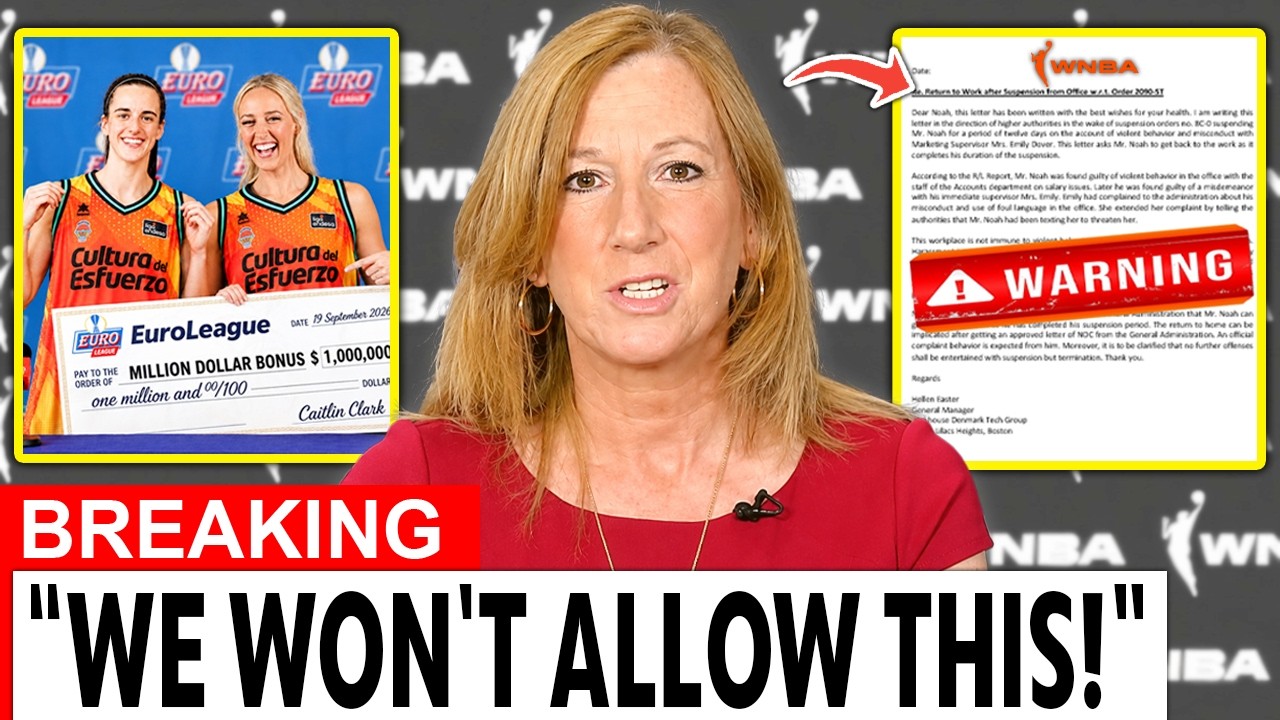
No official communication from the WNBA, Indiana Fever, EuroLeague Women, Clark, or Cunningham confirms the alleged confrontation.
That absence immediately changes the story from breaking sports news into an unsupported viral claim requiring careful examination.
A genuine move involving Clark would become one of the most significant international transactions in women’s basketball history.
Major American and European outlets would pursue confirmation from the players, their representatives, Indiana, and the interested overseas organization.
Reporters would identify contract terms, competition dates, insurance arrangements, travel requirements, and potential conflicts with existing obligations.
Instead, the viral narrative supplies almost none of those details while emphasizing corruption, violence, revenge, and supposed federal intervention.
The language creates enormous emotional stakes before providing the basic information needed to establish whether anything actually happened.
As of September 21, 2026, no verified announcement shows Clark or Cunningham preparing to abandon Indiana for Europe.
The available reporting instead places both guards firmly within the Fever’s competitive plans during a crucial late-season stretch.
Cunningham recently discussed WNBA leadership with NBA commissioner Adam Silver, emphasizing communication and stronger relationships between players and executives.
That documented conversation concerned league leadership, not an alleged attempt to escape through a secret European agreement.
Clark has also remained central to Indiana’s postseason ambitions following her successful return from international competition with Team USA.

Her partnership with record-setting scorer Kelsey Mitchell has transformed Indiana into one of basketball’s most dangerous offensive teams.
Nothing about those verified developments proves an imminent EuroLeague departure or an organized rebellion against the American league.
The headline nevertheless works because overseas basketball represents a realistic professional option for numerous WNBA players every offseason.
For decades, American stars have competed abroad to increase earnings, develop their games, and experience international basketball environments.
European clubs frequently offer competitive compensation, housing, transportation, and important roles within prestigious domestic and continental competitions.
Therefore, the underlying concept is plausible even though the specific Clark-Cunningham warning story currently lacks credible supporting evidence.
Plausibility, however, cannot replace confirmation when a report alleges threats, contractual interference, corruption, and a federal lawsuit.
The distinction between possibility and proof becomes especially important when recognizable people and organizations face potentially damaging accusations.
The WNBA does maintain rules affecting players who participate overseas, but those provisions do not create unlimited control.
The league’s prioritization system generally requires eligible veteran players to report for WNBA responsibilities before specified seasonal deadlines.
Players who remain with overseas clubs beyond applicable reporting dates can face suspension or other collectively negotiated consequences.
Reuters described prioritization as requiring veterans to place WNBA reporting obligations ahead of overlapping international club commitments.
That policy has generated legitimate criticism because international schedules sometimes collide with training camps and early regular-season activities.
Yet prioritization is fundamentally different from permanently forbidding athletes to sign lawful contracts during the WNBA offseason.
A player can generally compete internationally when schedules, existing contracts, insurance requirements, and reporting obligations remain properly coordinated.
The league’s power comes from its collective bargaining agreement and player contracts, not an unrestricted claim over private lives.
Those rules were negotiated between the WNBA and the Women’s National Basketball Players Association representing the league’s players.
The newest seven-year agreement became effective for 2026 and significantly increased salaries, benefits, and overall team compensation limits.
Average salaries rose toward $583,000, while maximum compensation reached approximately $1.4 million under the newly ratified framework.
Those increases were partly designed to reduce the financial pressure driving players toward demanding year-round overseas schedules.
The official WNBA announcement projected maximum salaries exceeding $2.4 million by 2032 under current league growth assumptions.
That context presents a complicated labor story, but it does not validate claims about a threatening Clark-Cunningham letter.
The supposed quotation, “We won’t allow this,” also appears without an identified speaker, recording, document, or verified transcript.
Readers are never told whether those words allegedly came from the commissioner, a team executive, attorney, or anonymous official.
This omission allows the accusation to sound authoritative while protecting its creator from providing any accountable evidentiary trail.
A genuine warning letter would include a sender, recipient, date, legal basis, contractual provisions, and requested corrective action.
It would likely reference specific clauses governing outside competition, injury protection, promotional duties, or conflicting professional commitments.
Lawyers assessing that document would examine whether the league acted within collectively bargained authority or exceeded contractual limitations.
The viral description offers none of that language, despite inviting readers to view a terrifying supposedly leaked communication.
Without the complete document and authenticated origin, an image described as leaked could easily be fabricated or manipulated.
Modern editing applications can reproduce letterheads, signatures, legal formatting, email interfaces, and official-looking documents within several minutes.
Artificial intelligence can also generate convincing corporate language that appears formal while containing meaningless or legally inaccurate assertions.
Therefore, screenshots should be compared against original files, metadata, confirmed senders, and statements from the named parties.
The federal lawsuit allegation demands the same scrutiny because real litigation produces searchable records, parties, claims, and docket numbers.
A lawsuit of the magnitude described would identify Clark and Cunningham as plaintiffs, defendants, witnesses, or represented interested parties.
It would state the responsible federal court, filing date, causes of action, requested relief, and legal representatives involved.
Possible sports disputes may concern antitrust principles, labor law, contractual interference, or collectively bargained employment restrictions.
However, describing a disagreement as “federal” does not automatically establish federal jurisdiction, criminal wrongdoing, or a viable legal claim.
Labor disputes involving unionized athletes also interact with collective bargaining procedures, grievance systems, arbitration clauses, and established precedent.
Those complexities make the promised instant lawsuit far less straightforward than the viral story’s cinematic presentation suggests.
No trustworthy reporting presently identifies such a filing connected with Clark, Cunningham, EuroLeague Women, or the WNBA.
The accusation that league officials “violently threatened” the players is even more serious and requires clear definition.
If “violently” describes physical intimidation, reporters would need witnesses, recordings, police reports, medical evidence, or direct testimony.
If the word merely intensifies an argumentative letter, it becomes misleading language designed to imply danger without establishing violence.
Either interpretation requires considerably more evidence than an anonymous caption promising revelations beneath a social-media link.
The claim also mischaracterizes EuroLeague by failing to identify whether it means EuroLeague Women or another European competition.
EuroLeague Women is FIBA Europe’s premier women’s club tournament, involving qualifying clubs from several national domestic leagues.
The commercial men’s EuroLeague is a different competition operating within a separate organizational and professional basketball structure.
An authentic contract report would name the women’s club offering employment rather than vaguely announcing a “EuroLeague move.”
Potential destinations could involve organizations from Turkey, Spain, France, Italy, Hungary, Poland, or other established basketball markets.
Each organization would present different salaries, schedules, coaches, rosters, competitive expectations, and domestic registration requirements.
Without naming one club, the alleged historic offer cannot be independently examined or compared with realistic market conditions.
Clark would also present unique commercial and insurance considerations because her visibility extends well beyond ordinary player compensation.
Her endorsements, signature products, media commitments, physical workload, and existing Fever obligations would influence any offseason decision.
Nike announced Clark’s signature basketball shoe for October 2026, expanding her already substantial global commercial profile.
That international profile could theoretically make European appearances attractive, but possibility remains different from a signed professional agreement.
Cunningham presents a different but still compelling international proposition because of her shooting, toughness, popularity, and outspoken personality.
Her defensive intensity and willingness to confront physical play have made her an important figure within Indiana’s identity.
European clubs regularly value experienced guards capable of spacing the floor, defending aggressively, and handling emotionally demanding environments.
Nevertheless, no confirmed joint contract currently links Cunningham and Clark to the same European club or continental campaign.
The “historic escape” language also assumes both players feel trapped, although neither has publicly announced such a position.
Cunningham has criticized league decisions and discussed leadership concerns, but disagreement does not automatically equal an intention to leave.
Clark has faced intense physical defense, controversial officiating, and relentless media narratives throughout her professional career.
She has still repeatedly focused public remarks upon competition, teammates, improvement, and Indiana’s pursuit of meaningful victories.
A credible departure report would require direct evidence that those frustrations outweighed her continuing commitments and ambitions in Indiana.
The headline instead assigns motives to both women before either player has publicly confirmed the underlying decision.
This approach transforms legitimate questions about athlete mobility into a predetermined story featuring heroic rebellion and institutional corruption.
There is a valuable issue beneath the exaggeration because professional athletes deserve reasonable freedom to maximize their careers.
Basketball careers remain relatively short, injuries can change earning potential instantly, and international opportunities may disappear unexpectedly.
Players understandably want flexibility to pursue financial security, competitive development, personal experiences, and worldwide brand expansion.
Leagues also possess legitimate interests involving player availability, broadcast commitments, competitive stability, safety, and contractual performance.
The central question becomes how those interests are balanced through fair negotiation rather than sensational threats or imaginary retaliation.
Collective bargaining exists precisely because individual athletes typically possess less institutional power than leagues and franchise ownership groups.
Through their union, players can negotiate common protections, compensation structures, grievance procedures, health benefits, and scheduling requirements.
If Clark or Cunningham believed league officials violated those protections, established union and contractual procedures would likely become relevant.
That process might involve private discussions, formal grievances, arbitration, negotiations, or eventually litigation under particular legal circumstances.
It would rarely begin with a mysterious five-word microphone response that instantly paralyzed an unnamed commissioner.
The supposed Clark response remains unverified, but its construction reveals how viral sports stories manufacture a satisfying protagonist moment.
First, powerful executives supposedly deliver an unfair ultimatum intended to frighten athletes into immediate obedience and silence.
Next, Clark remains calm while everyone else panics, reinforcing her image as emotionally disciplined and strategically fearless.
Finally, she speaks several devastating words that reverse the power relationship without requiring lengthy explanation or factual detail.
The likely invented response might resemble, “You Don’t Own Our Futures,” because that line neatly completes the desired confrontation.
It is a strong dramatic sentence, but no credible source confirms Clark actually delivered those five words.
Presenting invented dialogue inside quotation marks would falsely suggest a recording, transcript, witness, or authenticated written exchange exists.
Responsible reporting must clearly label reconstructed, hypothetical, satirical, or fictional dialogue rather than disguising it as direct speech.
Clark does not require fabricated quotations to appear powerful because her influence is already visible through measurable basketball outcomes.
Her passing changes defensive positioning, her shooting stretches coverage, and her popularity brings unprecedented attention to women’s basketball.
Cunningham likewise does not need an imaginary escape plot to demonstrate independence or challenge decisions she considers misguided.
Her willingness to speak publicly has already established a distinct voice within contemporary discussions surrounding WNBA leadership.
A truthful story can therefore remain favorable toward both players without manufacturing victimization, threats, or legal warfare.
It can ask whether prioritization remains appropriate as women’s basketball becomes increasingly global and financially competitive.
It can examine whether rapidly rising American salaries will reduce overseas participation among the league’s most marketable stars.
It can explore how EuroLeague Women clubs might pursue WNBA talent while avoiding conflicts between overlapping professional calendars.
It can also question whether players should receive greater individual flexibility when their health and commercial value are involved.
Those issues offer genuine tension because basketball’s international ecosystem is changing faster than traditional agreements can comfortably accommodate.
The WNBA’s growth now influences FIBA scheduling decisions, international merchandising, offseason competitions, and athlete workload management worldwide.
Reuters reported that future Women’s World Cups will avoid consecutive games while organizers address demanding global scheduling pressures.
That development demonstrates cooperation between institutions rather than evidence that the WNBA intends to isolate players from international basketball.
The league benefits when its stars become global figures, but it also wants them healthy and available domestically.
European organizations benefit from recognizable WNBA talent, yet they must manage national leagues and international tournament obligations.
Players stand between those systems, carrying physical risks while sponsors, broadcasters, clubs, and leagues pursue expanding audiences.
That is the real power struggle deserving investigation, even though the alleged Clark-Cunningham warning remains unsupported.
Fans should inspect any circulating letter for consistent logos, accurate executive titles, valid addresses, signatures, and contractual references.
They should reverse-search embedded images and determine whether screenshots first appeared on anonymous entertainment pages without named sourcing.
They should examine whether articles link to court records or merely repeat the same unsupported language across copied websites.
Multiple posts do not equal independent confirmation when every account traces its information back to one unidentified origin.
Viewers should also distrust clips using unrelated press-conference footage beneath narration describing events absent from the actual video.
A serious report should provide Clark’s complete comments, Cunningham’s complete comments, and the full league response within context.
It should identify representatives contacted for comment and explain whether they declined, disputed, or confirmed specific allegations.
Most importantly, it should distinguish documented contract rules from speculation about how those rules might affect hypothetical offers.
Current evidence supports the existence of prioritization requirements, rising salaries, global scheduling pressure, and expanding offseason opportunities.
It does not support a secret joint EuroLeague contract, an official threatening letter, or a massive federal lawsuit.
It also does not establish that Clark confronted league leadership with any five-word statement about leaving American basketball.
The most accurate five-word reality check is therefore: No EuroLeague Deal Was Confirmed.
That verdict may sound less explosive than a commissioner being publicly humiliated, but it respects the available evidence.
It also protects legitimate criticism from collapsing when audiences discover that the story’s central confrontation never occurred.
Clark supporters should demand strong reporting because unreliable stories can be weaponized against genuine concerns about her treatment.
Cunningham supporters should similarly distinguish her documented criticism from invented decisions that could misrepresent her professional intentions.
Fans can still debate whether both players would thrive overseas, attract enormous crowds, and elevate EuroLeague Women viewership.
They can calculate how a European club might build its offense around Clark’s range and Cunningham’s complementary shooting.
They can imagine packed arenas, international sponsorships, difficult travel, hostile road environments, and championship-level competitive pressure.
Those possibilities belong within clearly labeled analysis or speculation, not falsely presented leaked documents and fabricated legal claims.
If a real offer eventually emerges, credible confirmation will likely include the club’s identity and statements from player representatives.
If the WNBA objects, responsible coverage should quote the governing contract language and explain available dispute-resolution procedures.
If litigation genuinely follows, the court filing will provide names, allegations, legal theories, and requested remedies for examination.
Until those materials appear, the viral narrative should not be treated as an authenticated account of real events.
The strongest present story is not that Clark and Cunningham escaped, but that their leverage continues expanding significantly.
Clark’s market power gives her influence rarely possessed by a young player operating under a professional rookie contract.
Cunningham’s growing platform allows her to challenge league leadership while remaining an important competitive contributor for Indiana.
Together, they symbolize a broader generation of players increasingly conscious of branding, mobility, workload, and institutional accountability.
That evolution may eventually produce difficult confrontations over international opportunities, but this alleged confrontation remains unverified.
The basketball world should watch the actual negotiations, contracts, schedules, and public statements instead of manufactured warning letters.
Clark and Cunningham deserve coverage based upon their real choices, not decisions invented anonymously on their behalf.
The WNBA deserves scrutiny when its rules restrict players, but accusations of corruption require evidence rather than emotional adjectives.
EuroLeague Women deserves accurate identification instead of functioning as a vague setting for another fabricated celebrity escape narrative.
Fans deserve something equally important: the ability to celebrate compelling basketball without being manipulated by counterfeit breaking news.
For now, no commissioner has been publicly paralyzed, no verified warning has surfaced, and no federal lawsuit has appeared.
What remains is a meaningful debate about player freedom, global competition, contractual responsibility, and women’s basketball’s changing economics.
That debate may become increasingly intense as American compensation rises and international organizations pursue globally recognizable stars.
When verifiable developments arrive, they will be powerful enough without invented threats, leaked letters, or imaginary five-word confrontations.
Read the verified contract rules and confirmed player statements below before believing the alleged leaked WNBA warning. 👇


