A 14-year-old girl vanished from the streets of Blackpool after an evening with friends. A toddler disappeared beside a farmhouse on a Greek island. A 16-year-old schoolgirl took a taxi to a rain-soaked hillside and was never seen again. Another teenager secretly boarded a train to London, leaving behind almost everything that might explain his journey. And a three-year-old British girl disappeared from a holiday apartment in Portugal, triggering one of the world’s most widely publicized missing-child investigations.
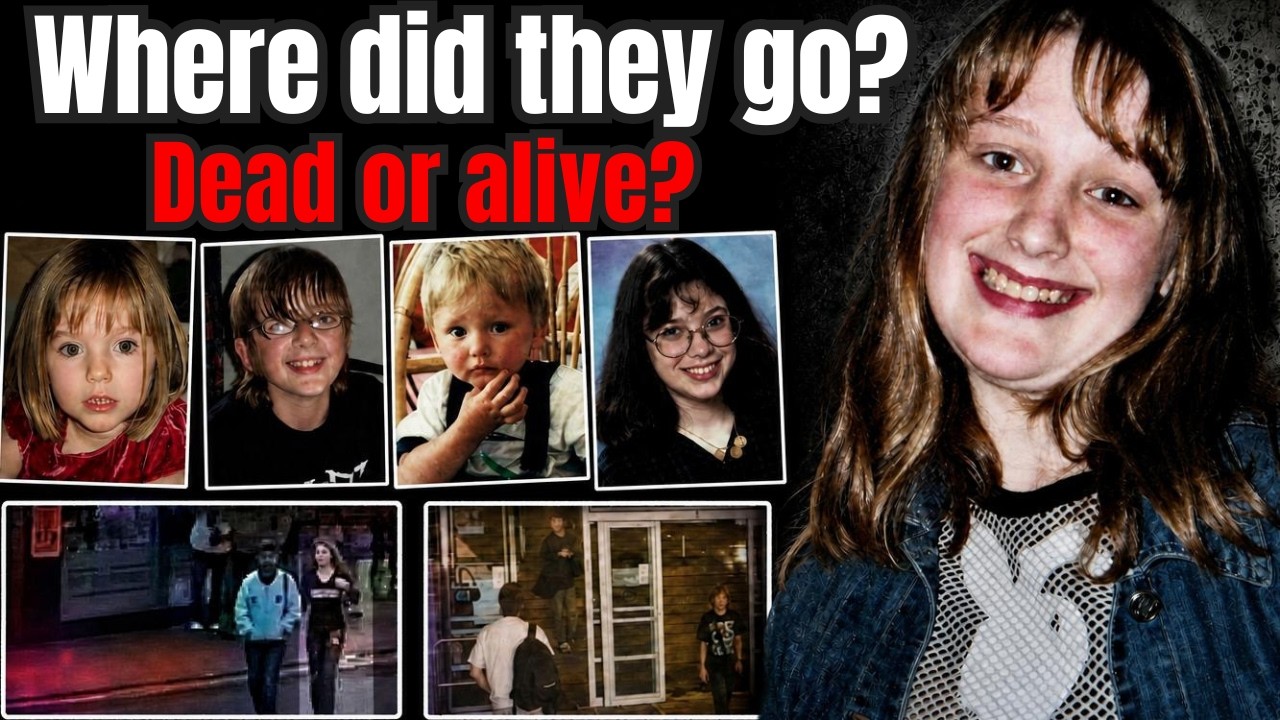
Five children. Five mysteries. Five families whose lives were transformed by a single day.
Their disappearances span more than three decades, from the early 1990s to 2007. Some cases have produced arrests, courtroom proceedings, and extensive forensic searches. Others have left investigators with little more than a final sighting and competing theories.
Yet they share one devastating feature: the absence of a definitive explanation.
The stories of Charlene Downes, Ben Needham, Ruth Wilson, Andrew Gosden, and Madeleine McCann reveal how missing-person investigations can be complicated by unreliable testimony, investigative mistakes, vulnerable circumstances, and the passage of time.
They also demonstrate why suspicion must never be confused with proof.
In several of these cases, investigators have identified possible explanations or questioned individuals. But no account should be presented as an established fact unless supported by reliable evidence and an appropriate legal finding.
Charlene Downes: The Blackpool Girl Who Vanished Into the Night
<text color=”secondary” size=”sm”>Blackpool, England — November 1, 2003</text>
Charlene Downes was just 14 when she disappeared from Blackpool town center.
Her last known evening began with an apparently ordinary encounter.
At approximately 6:45 p.m., her mother, Karen, saw Charlene and her sister Rebecca near Church Street.
Karen was distributing promotional leaflets for a restaurant.
Rebecca planned to return home, while Charlene said she intended to meet female friends.
After making a telephone call, Charlene waited until the girls arrived.
Her mother watched them leave together.
It was the last time Karen saw her daughter.
Charlene spent part of the evening with friends around Blackpool’s town center and North Pier.
According to the supplied account, one friend last saw her at approximately 11 p.m. near Talbot Road and Abingdon Street.
After that, the teenager disappeared.
No confirmed trace of her has ever been recovered.
A childhood marked by serious safeguarding concerns
Charlene was born in Coventry in March 1989.
Her family moved to Blackpool in 1999.
Behind her disappearance lay a disturbing history of concerns involving adults who had access to the family home.
The source describes repeated involvement by child-protection agencies and allegations that Charlene had been exposed to men with convictions for serious offenses.
Some incidents reportedly resulted in criminal investigations.
Others raised questions about whether the adults responsible for protecting her had adequately recognized the danger.
These details are relevant because investigators later examined whether Charlene had been exploited before she disappeared.
However, allegations involving specific individuals must be distinguished from proven criminal findings.
The family’s difficult history does not establish who was responsible for Charlene’s disappearance.
The takeaway investigation and the courtroom collapse
In 2006, police arrested two men in connection with Charlene’s suspected m.u.r.d.e.r.
The investigation focused partly on a Blackpool takeaway business.
Prosecutors alleged that Charlene had been k.i.l.l.e.d and that her remains had been disposed of.
The case attracted widespread attention because of sensational claims about what had happened to her body.
One especially disturbing allegation suggested that human remains had entered food sold by a takeaway.
That claim was never established as fact.
It should not be repeated as though forensic investigators proved it.
The prosecution relied in part on witness accounts and covertly recorded conversations.
But the recordings became a major source of controversy.
The transcript describes difficulties interpreting the audio and disagreements about how conversations had been transcribed.
The jury ultimately failed to reach a verdict.
A planned retrial did not proceed after serious problems emerged concerning surveillance evidence.
The two defendants were not convicted in connection with Charlene’s disappearance.
Subsequent scrutiny identified failures in the handling of evidence.
The outcome left Charlene’s family without a conviction and investigators without a confirmed account of what happened.
A disappearance still without resolution
Further investigative activity followed in later years.
In 2017, police arrested another man on suspicion of involvement in Charlene’s disappearance.
He was released without charge.
The source also refers to a £100,000 reward offered for information leading to a conviction or the recovery of Charlene’s body.
The case remains a stark example of the difficulty of pursuing criminal charges when physical evidence is missing and key witness accounts are disputed.
For Charlene’s family, the central questions remain unchanged.
Where did she go after leaving her friend that November night?
Who encountered her afterward?
And what evidence, if any, might finally explain her disappearance?
Ben Needham: The Toddler Who Disappeared Beside a Greek Farmhouse
<text color=”secondary” size=”sm”>Kos, Greece — July 24, 1991</text>
Ben Needham was only 20 months old when he vanished on the Greek island of Kos.
His family had connections to Sheffield, South Yorkshire, and had moved to the island during the summer of 1991.
Ben’s mother, Kerry, was working at a local hotel.
His grandparents were renovating a farmhouse in a rural area.
On July 24, Ben was playing around the property.
The source describes him exploring the surroundings and taking an interest in ordinary household and gardening tools.
Nothing about the day initially suggested that a tragedy was approaching.
Then Ben disappeared.
The moment the family realized something was wrong
At approximately 2:30 p.m., the adults realized Ben could not be found.
Initially, they considered ordinary explanations.
Perhaps he had wandered into a nearby building.
Perhaps another family member had taken him somewhere.
But as the minutes passed, those possibilities began to collapse.
Family members searched the farmhouse, nearby fields, and surrounding buildings.
They called his name.
No answer came.
Greek authorities eventually launched a substantial search involving police, military personnel, and emergency services.
Despite the effort, no confirmed trace of Ben was found.
The investigation and its early difficulties
The transcript describes concerns about the initial investigation.
It suggests that investigators spent time examining family members and possible accidental explanations before pursuing other lines of inquiry.
The family later criticized delays in checking transport routes and alerting relevant authorities.
These allegations became part of a wider debate over whether the earliest hours of the investigation had been handled effectively.
In missing-child cases, the initial response can be especially important.
Witness memories are freshest, potential physical evidence may still be available, and opportunities to identify movements can disappear quickly.
But it is not possible to determine from the transcript alone whether a particular early decision changed the outcome of Ben’s case.
The construction-equipment theory
Over the years, investigators considered several possible explanations.
One of the most prominent involved construction equipment operating near the farmhouse.
According to the source, information emerged suggesting that Ben might have been involved in an accidental incident with a digger.
The theory proposed that someone may have concealed what happened afterward.
Searches were undertaken in connection with this possibility.
A senior investigator later expressed the professional view that Ben had probably d.i.e.d in an accident near the farmhouse.
However, no definitive physical evidence establishing that scenario is provided in the transcript.
The theory should therefore be understood as an investigative assessment rather than a confirmed account.
Other possibilities, including abduction, have also been discussed.
None has produced a conclusive explanation.
A family left without answers
Ben’s disappearance has shaped his family’s lives for decades.
His mother and grandparents have participated in appeals and continued searching for information.
The absence of confirmed evidence has made closure especially difficult.
Even when investigators consider one explanation more likely than another, that assessment cannot replace knowing what actually happened.
Ben’s case remains haunting because the disappearance occurred in such an ordinary setting.
A toddler was playing near his family.
Within minutes, he was gone.
And decades later, the precise circumstances remain unknown.
Ruth Wilson: The Schoolgirl, the Blank Card, and the Rain on Box Hill
<text color=”secondary” size=”sm”>Surrey, England — November 27, 1995</text>
Ruth Wilson was 16 when she disappeared after traveling to Box Hill in Surrey.
Her final known movements have become one of the most discussed aspects of the case.
Unlike a disappearance involving an obvious struggle or sudden interruption, Ruth’s last day appeared to involve a series of deliberate decisions.
She did not follow her normal school routine.
Instead, she traveled into Dorking, visited local businesses, and arranged for flowers to be delivered to her stepmother.
Later, she took a taxi to Box Hill.
The weather was poor.
Rain was falling, and daylight was fading.
The taxi driver reportedly noticed something unusual when he dropped her off.
Rather than immediately walking away, Ruth appeared to remain near the roadside.
He thought she might have been waiting for someone.
That observation has fueled speculation ever since.
A quiet teenager with a love of music
Ruth was described as a dedicated student with a strong interest in music.
She played piano and electric guitar.
She also worked part-time in a music shop and participated in community activities.
According to the source, there were no obvious signs in the preceding days that she intended to disappear.
But her behavior on November 27 departed from her usual routine.
The transcript describes visits to Dorking Library and a florist before the journey to Box Hill.
Some times and details in the source are internally inconsistent, so they should not be treated as a verified minute-by-minute timeline.
The broader sequence, however, is central to the account.
Ruth traveled independently, arranged a future delivery, and then went to a secluded location.
The flowers that arrived after she vanished
One of the most memorable details is the bouquet Ruth reportedly ordered for her stepmother.
The flowers were scheduled to arrive on Wednesday, November 29, two days after her disappearance.
The accompanying card was blank.
The gesture has prompted numerous interpretations.
Some believe the flowers may have been intended as a farewell.
Others wonder whether they represented an apology, a private message, or an ordinary act whose significance has been exaggerated.
There is no verified evidence in the supplied material establishing Ruth’s intention.
The blank card is unusual, but it cannot reveal her state of mind with certainty.
Nor does arranging a delivery two days ahead prove that she knew she would never return.
That conclusion would go beyond the evidence.
A painful family discovery
The source also discusses the d.e.a.t.h of Ruth’s biological mother when Ruth was very young.
It claims that Ruth later discovered information about the circumstances that differed from what she had previously been told.
Commentators have suggested that the discovery may have affected her emotionally.
But the transcript itself acknowledges that no confirmed evidence directly links that family history to Ruth’s disappearance.
It would therefore be inappropriate to present it as the cause.
Personal circumstances can be relevant to an investigation without proving a particular explanation.
The search that found no definitive trace
Police launched searches around Box Hill after Ruth failed to return home.
The source describes the use of search teams, dogs, and aerial resources.
No confirmed physical trace of Ruth was recovered.
Reports later emerged about possible farewell notes and other items allegedly found in the area.
The transcript does not provide official forensic documentation establishing the provenance of all those items.
That limitation matters.
Without reliable confirmation, reported discoveries cannot safely be used to determine what happened.
Five theories, but no established answer
Ruth’s disappearance has generated several competing theories.
Some involve an accident on difficult terrain.
Others involve voluntary disappearance, a possible encounter with another person, or self-inflicted harm.
The source favors one interpretation but acknowledges that decisive evidence is absent.
It is important not to infer an outcome from family history or reported emotional distress alone.
Ruth has not been conclusively accounted for in the supplied material.
The strongest established fact is also the most painful: she was last known to have traveled to Box Hill, and she did not return.
The flowers arrived.
Ruth did not.
Andrew Gosden: The Boy Who Bought a One-Way Ticket to London
<text color=”secondary” size=”sm”>Doncaster and London, England — September 14, 2007</text>
Andrew Gosden was 14 when he disappeared after secretly traveling from Doncaster to London.
His case is particularly troubling because his movements were partially documented.
Investigators know that he left home, withdrew money, bought a train ticket, and arrived at King’s Cross Station.
What happened after that remains unknown.
A seemingly ordinary evening before an extraordinary decision
Andrew was described as intelligent, quiet, and interested in rock music.
He lived with his parents and sister in Doncaster.
According to the transcript, he spent time completing a jigsaw puzzle with his father the evening before he disappeared.
His family later described that night as ordinary.
There was no clear warning that he intended to travel to London alone.
The following morning, however, Andrew did not attend school.
Instead, he withdrew £200 from his bank account.
He returned home, changed clothes, and collected several belongings, including his portable gaming console.
Then he headed to Doncaster railway station.
The ticket decision that still raises questions
Andrew purchased a one-way ticket to London.
The ticket seller reportedly offered him a return ticket for a very small additional cost.
He declined.
That decision has been interpreted in different ways.
Some believe it suggests he did not plan to return.
Others note that a teenager traveling alone might simply have misunderstood his options or made an impulsive choice.
A one-way ticket does not prove an intention to disappear permanently.
Other details complicate the picture.
The source states that Andrew left additional money at home.
He also did not take certain practical belongings, including a charger for his gaming device.
Those omissions have been used to question whether he intended to remain away for an extended period.
But they do not establish what he planned.
The final confirmed CCTV footage
Andrew traveled by train to London King’s Cross.
At approximately 11:25 a.m., CCTV captured him leaving the station.
That footage became the last confirmed sighting described in the source.
Afterward, his movements remain unknown.
The transcript also describes a school communication error that delayed his parents learning about his absence.
When the family realized he was missing, they contacted police.
Investigators later established that he had traveled to London.
But by then, opportunities to recover further surveillance footage may have been lost.
A digital trail that led nowhere
Andrew’s disappearance occurred at a time when mobile phones and online communication were becoming increasingly common.
Yet he reportedly left almost no digital footprint.
He did not have a mobile phone with him.
The source describes investigations into computer use and gaming accounts that produced no confirmed evidence of an online arrangement.
Sony reportedly examined information associated with his PlayStation Portable without finding evidence of relevant online activity.
The absence of a digital trail made it difficult to establish whether Andrew had arranged to meet someone.
But it does not prove that no such meeting was planned.
He could have communicated offline, acted independently, or encountered someone after arriving in London.
Concert theories and unconfirmed sightings
One theory suggested Andrew traveled to London to attend a music event.
A photograph reportedly showed someone resembling him at a concert.
However, the identification was never confirmed.
Other theories involved a voluntary departure, an unexpected encounter, or criminal involvement.
None has been conclusively established.
The case demonstrates how a relatively clear travel timeline can still leave investigators without an explanation.
The 2021 arrests and the later police decision
In December 2021, two men were arrested in connection with Andrew’s disappearance.
Investigators examined electronic devices and pursued the relevant allegations.
In September 2023, both men were released without charge.
According to the transcript, South Yorkshire Police stated that they were satisfied the individuals were not involved in Andrew’s disappearance.
That outcome is important.
An arrest is not proof of guilt.
The men should not be portrayed as responsible for Andrew’s disappearance when the investigation did not establish their involvement.
Andrew’s family has continued appealing for information and sharing age-progressed images.
The central mystery remains what happened after he walked out of King’s Cross Station.
Madeleine McCann: The Holiday Disappearance That Captured the World
<text color=”secondary” size=”sm”>Praia da Luz, Portugal — May 3, 2007</text>
Madeleine McCann was three years old when she disappeared from a holiday apartment in Portugal.
She was approaching her fourth birthday.
Her parents, Kate and Gerry McCann, were staying in Praia da Luz with their children and a group of friends.
The family occupied a ground-floor apartment at the Ocean Club resort.
On the evening of May 3, Madeleine and her younger twin siblings were left asleep while the adults ate at a nearby restaurant.
The parents and their companions made periodic checks on the children.
During the evening, Madeleine was discovered missing.
Her disappearance triggered an international investigation and extraordinary media attention.
The apartment and the questions about supervision
The source describes the restaurant as being relatively close to the apartment, although the walking route was longer than the direct distance.
The apartment’s patio doors were reportedly left unlocked to allow the adults to check on the children.
The transcript strongly criticizes the decision to leave young children unattended.
That criticism reflects the commentator’s judgment.
But the distinction between parental supervision and criminal responsibility is essential.
The fact that children were left alone does not establish who caused Madeleine’s disappearance.
Her parents have continued searching for answers.
The investigation must be assessed on evidence concerning what happened to Madeleine, not on assumptions drawn solely from the family’s decisions that evening.
Early witness sightings and investigative uncertainty
One early lead involved a witness who reported seeing a man carrying a child near the resort.
Investigators initially examined the possible significance of the sighting.
Later developments changed how certain witness accounts were interpreted.
The transcript also describes scrutiny of people living near the resort and individuals seen in the surrounding area.
Some were investigated and subsequently eliminated as suspects.
These changes illustrate a recurring problem in major missing-person investigations.
Early witness reports may seem highly significant.
But their meaning can change when investigators establish additional facts.
A sighting that initially appears suspicious may eventually have an innocent explanation.
The burglary and abduction theories
Investigators considered whether Madeleine had been taken during a planned abduction or an opportunistic crime.
The source describes reports of burglaries in the surrounding area before her disappearance.
Some theories suggested that an intruder might have entered the apartment.
Others proposed that someone had previously observed the family’s routine.
Investigators also considered whether Madeleine could have left the apartment independently.
No single theory described in the transcript has been conclusively established.
The case generated numerous searches, reconstructions, and appeals.
But the central evidential gap remained.
There was no confirmed account of what happened after Madeleine disappeared from the apartment.
Christian Brückner and the German investigation
In 2020, German investigators publicly identified Christian Brückner as a suspect.
German prosecutors expressed their belief that Madeleine was d.e.a.d and that Brückner was responsible.
The transcript describes his criminal history, connections to Portugal, and investigative interest in his movements around the time of the disappearance.
It also discusses searches of areas in Portugal and alleged statements attributed to him.
However, those matters must be treated carefully.
Brückner has not been convicted of involvement in Madeleine McCann’s disappearance, and the supplied source states that he has not been charged in that case.
He denies involvement.
The transcript also refers to his release from prison in September 2025 after serving a sentence in an unrelated case.
His status as a suspect does not establish that he abducted or k.i.l.l.e.d Madeleine.
Nor do prosecutors’ public statements substitute for proof tested in court.
The unanswered questions
The investigation has continued for years across national borders.
British, Portuguese, and German authorities have all been involved in different aspects of the case.
Despite the enormous publicity, Madeleine’s fate remains unresolved in the supplied account.
Her family has faced years of speculation, scrutiny, and false leads.
The central question remains whether investigators can obtain evidence sufficient to establish what happened and identify anyone responsible.
Until that occurs, theories must remain theories.
Five Cases, Five Different Investigative Challenges
Although these disappearances are often grouped together, they present very different evidential problems.
Charlene Downes’s case involved serious safeguarding concerns, disputed witness accounts, and a criminal prosecution that ended without convictions.
Ben Needham’s case involved a toddler disappearing in a rural setting, with investigators later considering an accidental explanation.
Ruth Wilson’s disappearance centered on a teenager’s unusual final movements, a delayed flower delivery, and the absence of confirmed physical evidence.
Andrew Gosden’s case contained a documented train journey but almost no reliable information about what happened afterward.
Madeleine McCann’s disappearance generated an international investigation, extensive media coverage, and a publicly identified suspect who denies involvement.
The differences matter.
There is no single explanation that can be applied to every missing-child case.
An absence of remains does not automatically prove abduction.
An unusual decision does not prove that someone intended to disappear.
A witness account does not become reliable simply because it is dramatic.
And a police suspect is not necessarily a proven perpetrator.
Each case must be evaluated on its own evidence.
Why Missing-Child Mysteries Can Remain Unsolved for Decades
Time creates enormous obstacles in missing-person investigations.
Witness memories fade.
Physical evidence may be lost or degraded.
Businesses close, buildings change, and surveillance footage disappears.
People who might once have supplied information may become impossible to locate.
At the same time, public attention can generate large numbers of tips.
Some are useful.
Others are mistaken, speculative, or deliberately misleading.
The internet has made these cases more visible, but it has also enabled unsupported allegations to spread rapidly.
In Charlene Downes’s case, sensational claims about her remains became part of the public narrative despite the absence of proof.
In Ruth Wilson’s case, speculation about private family history risks turning uncertainty into an unsupported conclusion.
In Andrew Gosden’s case, unconfirmed sightings and theories about his intentions can overshadow the limited facts investigators actually know.
And in Madeleine McCann’s case, public suspicion has repeatedly moved faster than the evidence available in court.
The responsibility of reporting on these cases is therefore substantial.
Accurate coverage should distinguish confirmed facts, witness recollections, police assessments, courtroom allegations, and speculation.
It should also recognize that the missing children are real people, not simply subjects of an intriguing mystery.
The Families Who Continue Living With Uncertainty
For the families, the passage of time does not necessarily make the questions easier.
A parent may spend years wondering whether a missing child is alive.
A sibling may grow older while the missing person remains frozen at the age they disappeared.
Ordinary dates become reminders of what was lost.
Birthdays, anniversaries, holidays, and family gatherings can all carry the same unanswered question.
Where are they?
In these five cases, the families have faced different experiences with police investigations, media attention, and public speculation.
Some have pursued new searches.
Others have continued public appeals.
Several have had to confront theories that their loved one d.i.e.d without ever receiving definitive evidence.
The uncertainty itself becomes part of the tragedy.
A criminal conviction, a confirmed recovery, or a reliable account of events can provide answers.
But none should be invented merely to make a story feel complete.
The Questions That Remain
Charlene Downes disappeared from Blackpool in 2003, and the account provided identifies no conviction or confirmed recovery.
Ben Needham vanished on Kos in 1991, with an accidental explanation considered plausible but not definitively established.
Ruth Wilson was last known to have traveled to Box Hill in 1995, leaving behind a sequence of actions that remain open to interpretation.
Andrew Gosden arrived in London in 2007, walked out of King’s Cross Station, and disappeared from the confirmed record.
Madeleine McCann vanished from a Portuguese holiday apartment in 2007, and investigators have yet to establish her fate through a concluded criminal case.
The mysteries are different, but the consequences are painfully similar.
Families have been left waiting for information that may never come.
Investigators have pursued leads that sometimes appeared promising before ending in disappointment.
And the public has repeatedly confronted the limits of what can be known from incomplete evidence.
The most haunting aspect of these five cases is not the dramatic theories surrounding them. It is the ordinary moment at which each child’s known story suddenly stops—and the fact that, after so many years, no one has been able to provide the missing ending.


