A sensational headline claims Indiana Fever assistant coach Briann January violently attacked Caitlin Clark during a live basketball broadcast.
The story alleges Clark physically retaliated before frightened producers abruptly terminated coverage and Indiana immediately banned January.
However, no credible report, team statement, disciplinary notice, or verified recording currently supports that extraordinary version of events.
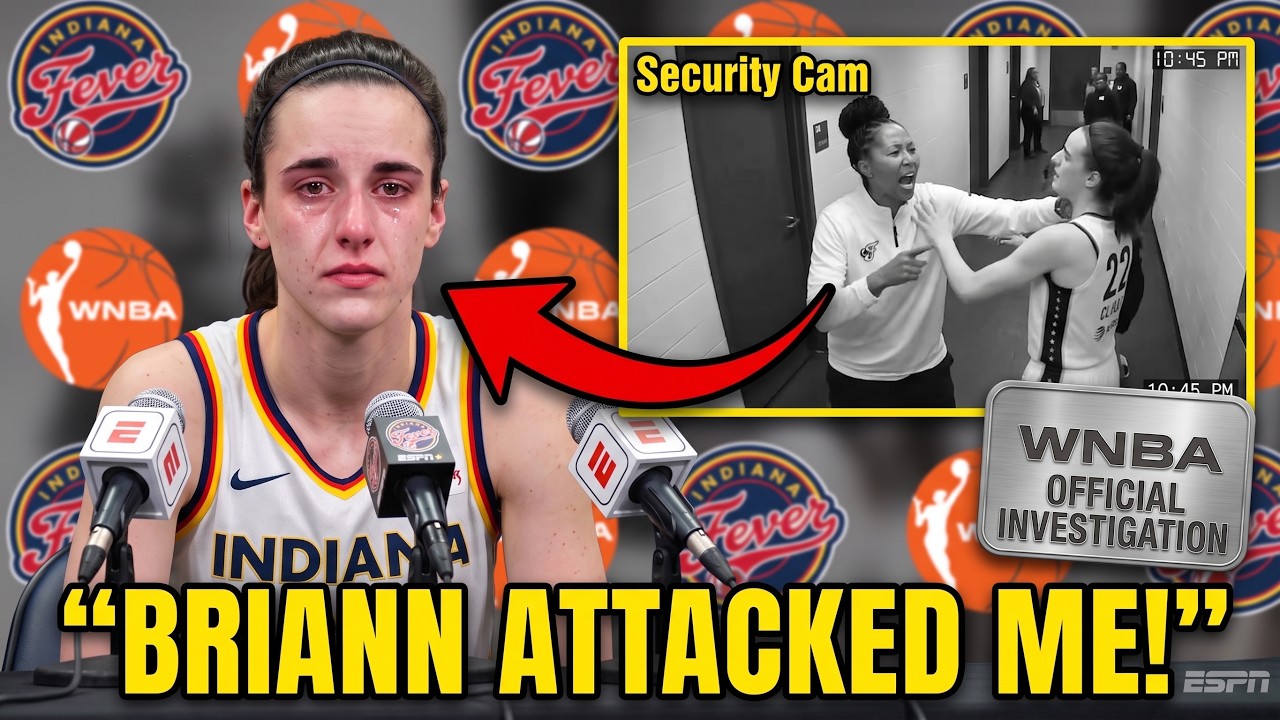
There is no confirmed assault, no documented retaliation, no broadcast shutdown, and no official Fever ban involving January.
The available evidence instead points toward an older sideline incident being dramatically misrepresented through misleading narration and captions.
That real incident occurred during Indiana’s July 2025 victory over the Connecticut Sun at Boston’s TD Garden.
Clark became furious with an official while referees reviewed possession following a contested play during the third quarter.
Television footage showed Clark directing strong language toward the referee and attempting to continue the heated confrontation.
January stepped between the situation and pulled Clark backward toward the Fever bench before emotions escalated further.
That physical contact was visible, but the surrounding context identified it as de-escalation rather than an attack.
Contemporary reporting described January as restraining Clark while the star guard angrily challenged the game officials.
The official did not assess Clark a technical foul during that confrontation, despite her obvious frustration.
Indiana eventually won 85–77, while Clark contributed 14 points, eight rebounds, and seven assists.
Clark later aggravated a groin injury during the same game, creating an additional storyline around her availability.
Nothing within the verified report described January punching, striking, choking, or intentionally injuring Indiana’s star player.
Nothing indicated Clark attacked January in response or used a terrifying physical technique against the assistant coach.
Nothing showed producers cutting the feed because an unprecedented violent confrontation had suddenly paralyzed the broadcast.
Instead, the televised sequence remained part of normal game coverage and circulated widely across sports media afterward.
The viral story apparently removes the referee dispute and presents January’s restraining movement without its essential surrounding context.
Once that context disappears, an arm around Clark can be falsely framed as aggression rather than intervention.
A dramatic voice-over can then assign imaginary motives, dialogue, fear, and consequences absent from the original broadcast.
This editing method is effective because viewers recognize Clark and observe genuine physical movement happening on screen.
They may not know when the clip was recorded, what happened beforehand, or why January approached Clark.
The narration supplies those missing details, encouraging audiences to accept invention as an explanation for authentic footage.
Yet visible contact alone cannot establish assault because intent, context, necessity, force, and surrounding conduct all matter.
Coaches frequently guide players away from officials to prevent technical fouls, ejections, fines, or damaging suspensions.
They may place hands around shoulders, waists, or arms when verbal instructions cannot interrupt an emotional confrontation.
Those actions can appear forceful because professional athletes continue moving while coaches attempt to redirect them quickly.
The relevant question is whether January was trying to harm Clark or prevent the situation from worsening.
Every credible description of the 2025 sequence supports intervention rather than an intentional attack against her player.
The story’s use of “lost control” therefore reverses the most reasonable interpretation of January’s behavior.
January appeared to be the person restoring control while Clark remained understandably angry about officiating.
That does not make Clark wrong for expressing frustration or January wrong for managing the immediate consequences.
Both responses can exist together within a high-pressure professional environment where split-second decisions carry substantial costs.
Clark wanted the referee to hear her objection, while January wanted Clark protected from unnecessary disciplinary punishment.
That is ordinary competitive tension, not evidence of a violent breakdown between coach and superstar.
January’s professional role provides additional context that the viral headline almost completely ignores.
She returned to Indiana as an assistant coach in April 2025 after an accomplished fourteen-season WNBA playing career.
Before coaching Indiana, she worked with Stephanie White’s Connecticut Sun staff and the Motor City Cruise.
White publicly praised January’s toughness, communication, work ethic, and basketball intelligence when welcoming her back.
January was expected to improve Indiana’s defense while helping players understand the demands of championship-level professional basketball.
She was not an unknown outsider suddenly appearing near Clark during a chaotic live broadcast.
She was a Fever assistant fulfilling the responsibility of managing players, officials, emotions, and sideline discipline.
January also carries deep connections with Indiana from her highly successful playing career with the franchise.
The Fever selected her sixth overall during the 2009 WNBA Draft after her collegiate career at Arizona State.
She spent nine seasons playing for Indiana and became one of the league’s most respected perimeter defenders.
January earned six WNBA All-Defensive selections and helped Indiana capture the franchise’s 2012 championship.
Her Fever career placed her near the organization’s historical leaders in games, assists, steals, and three-point production.
That history does not make her incapable of wrongdoing, but it raises the evidentiary standard for career-destroying accusations.
A credible report claiming Indiana banned such a prominent former player would require direct confirmation and detailed explanation.
The Fever would likely issue an announcement describing the employment change, effective date, and organizational response.
Basketball reporters would contact January, Clark, White, general manager Amber Cox, and league representatives for comment.
The WNBA might investigate if any coach physically attacked a player during an officially televised league event.
Law enforcement could become relevant if the alleged violence met criminal standards or produced physical injury.
None of those predictable developments currently accompanies the headline, despite its claim of unprecedented public violence.
Instead, Indiana’s official digital material continued associating January with team practices and media appearances during 2026.
The Fever website recently referenced practice availability featuring Lexie Hull, Raven Johnson, and Briann January together.
That current team material conflicts directly with claims that January was permanently banned from the organization.
An individual excluded from Fever facilities would not ordinarily appear within recent official practice-media programming.
No subsequent team release identifies a suspension, firing, investigation, arena restriction, or separation concerning January.
The viral headline’s word “live” adds urgency while obscuring when the source footage was originally recorded.
Recycled sports clips are often presented as breaking developments after resurfacing months or years later.
Removing score graphics, dates, opponents, and original commentary makes an older sequence easier to misrepresent as current.
Viewers should examine uniforms, arena markings, scoreboard designs, broadcast logos, and surrounding players before accepting recirculated footage.
The Clark-January clip can be traced to the 2025 Indiana-Connecticut game rather than a newly reported 2026 attack.
That timeline alone dismantles the suggestion that a fresh violent clash suddenly paralyzed Indiana’s current campaign.
It also exposes how the story converts protective coaching into personal betrayal through selective framing.
The headline promises an “uncensored” version, implying broadcasters concealed evidence too dangerous for normal television audiences.
However, the original sideline exchange appeared publicly during game coverage and was subsequently discussed by multiple sports outlets.
Footage visible on television cannot logically become forbidden simply because a later page attaches a different explanation.
The word “uncensored” functions primarily as a curiosity trigger rather than a verifiable description of missing content.
Similarly, claiming producers panicked and cut the feed attempts to explain why no complete violent confrontation can be found.
Modern professional games are recorded simultaneously by league systems, broadcasters, teams, photographers, journalists, and spectators.
A genuine attack involving Clark would produce numerous independent recordings from different positions inside the arena.
Fans would post cellphone video, while reporters seated courtside would publish eyewitness accounts within minutes.
The Fever and WNBA could not plausibly erase every angle from an incident unfolding before thousands of attendees.
The absence of such evidence weighs against the claim instead of proving a successful institutional cover-up.
The alleged Clark retaliation presents another serious problem because it accuses a real athlete of violent conduct.
No reliable source identifies any kick, punch, shove, hold, strike, or self-defense maneuver performed against January.
The story asks viewers what terrifying move Clark used without first demonstrating that she used any move whatsoever.
That question presupposes the invented event and encourages audiences to speculate about violence as though it were established fact.
It also misrepresents Clark’s visible reaction during the actual footage, which remained directed toward the officiating dispute.
January’s intervention prevented further escalation, and Clark did not appear to turn against her assistant coach.
An athlete can resist being pulled away momentarily without intending to attack the person restraining her.
Momentum, emotion, and focus upon another individual can make the movement appear sharper than its real purpose.
Slow motion, zooming, repetition, and alarming sound effects can further exaggerate an ordinary sideline interaction.
A clenched hand may reflect frustration with officiating rather than preparation to strike a nearby coach.
A sudden turn may follow the referee’s movement rather than indicate aggression toward January.
Responsible analysis must consider the uninterrupted sequence instead of selecting one visually ambiguous frame.
The word “retaliated” is especially misleading because retaliation requires an initial wrong and intentional responsive action.
The verified clip does not establish that January wronged Clark or that Clark sought revenge against her.
It shows a coach separating a player from an official during an emotionally volatile competitive moment.
That interpretation matches common professional basketball behavior and the descriptions published when the incident originally occurred.
The alleged instant ban also misunderstands how professional organizations handle serious employee misconduct.
Indiana would normally gather footage, interview witnesses, consult human resources, review contracts, and coordinate legal advice.
A temporary administrative leave might occur during investigation, depending upon the allegations and available evidence.
A permanent termination or facility ban would follow organizational procedures rather than an unexplained instantaneous decision.
If the attack happened during a televised game, officials and arena security might document the incident immediately.
No credible documentation currently indicates any of those processes occurred concerning January and Clark.
There is also no reason to assume January and Clark possess a hostile professional relationship.
January’s defensive expertise provides practical value to Clark, who faces aggressive coverage and difficult perimeter matchups.
She can teach screen navigation, physical positioning, communication, anticipation, and strategies for handling relentless defensive pressure.
Clark’s exceptional offensive vision offers January a detailed perspective on how elite creators exploit defensive weaknesses.
That coach-player exchange can strengthen Indiana even when their sideline communication becomes forceful during stressful moments.
January’s decision to protect Clark from a possible technical foul fits that mentorship relationship more naturally than assault.
Coaches sometimes become unpopular momentarily because they prevent players from continuing arguments those players deeply believe matter.
The player may remain angry, but the intervention protects both individual availability and collective competitive interests.
Technical fouls accumulate, and additional punishment can affect close games, future eligibility, and financial consequences.
Preventing unnecessary discipline therefore represents part of responsible coaching rather than evidence of disrespect.
Clark’s intensity makes such intervention particularly important because she communicates visibly and passionately with officials.
Her emotion fuels competitive greatness, but it also creates moments requiring teammates or coaches to redirect attention.
That balance does not diminish Clark; it reflects the realities surrounding every highly competitive professional athlete.
Michael Jordan, Diana Taurasi, Kobe Bryant, and numerous celebrated stars required coaches capable of managing fierce emotions.
Strong coaching relationships often include direct physical guidance, raised voices, disagreements, and immediate return to competition.
Viewers should not automatically translate intensity between women into instability, hatred, or violent personal conflict.
Men’s basketball frequently treats comparable scenes as leadership, passion, accountability, or ordinary competitive heat.
Women receive disproportionate speculation about relationships whenever cameras capture frustration, shouting, or stern sideline contact.
The January-Clark narrative reflects that double standard by turning intervention into an allegedly career-ending attack.
A more useful discussion would examine why officiating repeatedly becomes central to Indiana’s emotional game environment.
Clark experiences significant physical pressure because opponents try disrupting her rhythm, balance, and decision-making through contact.
Officials must distinguish legal defense from holding, displacement, landing-space violations, and unnecessary off-ball aggression.
Clark must communicate concerns without accumulating technical fouls capable of hurting Indiana’s competitive position.
Coaches must advocate effectively while preventing frustration from consuming possessions or distracting the broader rotation.
January’s intervention occurred precisely within that complicated responsibility, where protection sometimes means ending an argument.
The 2025 game also contained a genuine injury concern when Clark later left after aggravating her groin.
That verified development was more consequential than the invented conflict because it affected her health and availability.
However, injury reporting lacks the immediate interpersonal villain provided by a fabricated assistant-coach attack.
Viral stories often replace complex physical and tactical issues with simplified betrayal because betrayal generates stronger reactions.
January becomes the villain, Clark becomes the threatened superstar, and management becomes the decisive rescuer.
That structure gives audiences an emotionally satisfying storyline while erasing the referee dispute that explains the footage.
It also uses January’s physical strength and defensive reputation to make the false assault allegation seem visually plausible.
Her former identity as an elite defender becomes twisted into evidence that she supposedly attacked her own player.
In reality, defensive experience likely helped January control the movement without allowing Clark to reach the official again.
She understood body positioning, leverage, and the urgency of preventing a disciplinary confrontation from escalating.
That is not a terrifying secret; it is a logical explanation grounded in her professional responsibilities.
January’s continued presence within Fever material provides the clearest practical test of the claimed ban.
A person permanently barred from the organization would disappear from practices, media sessions, games, and official staff references.
Recent Fever pages still connect January with current team content, indicating the franchise recognizes her coaching role.
Sports media also continued describing her as an Indiana assistant and possible future WNBA head-coaching candidate.
Industry analysis has praised her experience and identified her among promising coaches capable of leading professional teams.
Those reports would require substantial correction if Indiana had banned her after attacking its most famous player.
No such correction, investigation, or updated employment report currently appears within credible coverage.
The silence of reputable sources is significant because the alleged event would be impossible for basketball media to ignore.
Clark remains the WNBA’s most visible player, making any public attack against her an immediate national story.
Television networks, newspapers, wire services, and local Indianapolis reporters would compete to confirm every available detail.
January’s background as a Fever champion and assistant would make the story even more historically consequential.
Yet exact searches primarily surface social posts repeating the allegation without documents, witnesses, or accountable reporting.
That pattern strongly suggests viral recycling rather than suppressed breaking news about genuine workplace violence.
Readers should examine whether posts identify the game, date, quarter, venue, opponent, and original broadcast network.
They should search those details independently rather than following captions promising prohibited or deleted footage.
They should compare the complete sequence against edited versions featuring altered audio, narration, or misleading subtitles.
They should also check whether the official team roster and recent media content still include the supposedly banned person.
Any authentic disciplinary action should eventually produce reporting from sources with direct access to Indiana’s organization.
Anonymous pages should not receive greater credibility merely because their language appears urgent, angry, or highly specific.
Specific adjectives are not evidence, and capitalization cannot transform speculation into a documented professional consequence.
The phrase “ugliest physical altercation in basketball history” is also unsupportable against basketball’s extensively recorded history.
The verified footage shows no mass fight, serious injury, criminal response, or game abandonment related to January.
Historic basketball altercations have involved punches, bench-clearing confrontations, suspensions, and documented injuries across multiple leagues.
Comparing January’s restraint of Clark against those incidents exposes the headline’s reliance upon extreme exaggeration.
The claim that the event paralyzed the broadcast fails for the same reason: the game continued normally afterward.
Indiana completed the contest, secured victory, and addressed Clark’s later injury rather than an assistant-coach assault.
January did not require removal by security, and Clark did not appear to demand her immediate dismissal.
No broadcast team announced that coverage had stopped because player safety was threatened by a Fever coach.
The real scene lasted briefly before attention returned toward basketball and the ongoing replay review.
That timing matters because sensational edits often loop short interactions until they seem much longer and more dangerous.
Repeated footage can create the impression of sustained violence when the original movement lasted only several seconds.
Music and narration then fill temporal gaps, manufacturing fear that the live broadcast itself never communicated.
A factual description should remain proportionate to what the complete unedited video actually demonstrates.
January placed herself between Clark and escalating disciplinary danger, guiding the player backward toward the bench.
Clark continued expressing frustration, but she did not launch a verified physical counterattack against January.
The official continued working, the game resumed, and Indiana later completed an eight-point victory.
Those facts describe a tense sideline management moment rather than an organizational emergency.
The strongest five-word verdict is therefore: January Restrained Clark, Not Attacked.
That conclusion does not require pretending every coaching interaction was gentle or perfectly handled.
It recognizes that forceful redirection can look uncomfortable while remaining appropriate within a rapidly escalating sports confrontation.
If Clark ever objects publicly to January’s method, her complete words should become part of responsible coverage.
If Indiana disciplines January, the official action and credible reporting should replace current uncertainty immediately.
If additional unedited footage shows something materially different, analysts should examine it within complete temporal context.
Until then, accusing January of violence and Clark of retaliation remains unsupported by reliable evidence.
Clark deserves protection from invented stories portraying her as either helpless victim or secretly violent aggressor.
January deserves evaluation based upon her actual coaching, conduct, and documented communication with Indiana’s players.
Fever supporters deserve coverage explaining competitive problems instead of repeatedly manufacturing personal war inside the organization.
The WNBA deserves criticism when officials or institutions fail, but criticism becomes weaker when attached to fabricated events.
Indiana’s real questions concern playoff execution, defensive consistency, health, rotations, and leadership under increasing pressure.
January’s knowledge may help address those issues because defense and communication defined her successful playing career.
Clark’s leadership remains essential because her offensive creation and emotional energy shape Indiana’s identity every night.
Their roles are more naturally complementary than the viral headline’s violent confrontation would have audiences believe.
An assistant coach capable of calming Clark without suppressing her competitive edge provides meaningful organizational value.
A superstar willing to accept temporary redirection while continuing to demand accountability strengthens the entire Fever roster.
Those dynamics can occasionally appear messy because elite competition rarely produces polished emotions during every difficult possession.
Messiness should invite context and analysis, not automatic claims of assault, retaliation, and permanent banishment.
The original footage already supplies enough tension without assigning actions that neither participant has confirmed.
Clark was furious, January intervened, Indiana avoided a technical escalation, and the game continued.
That is the verified sports story behind the dramatic clip now circulating under a misleading headline.
Viewers seeking an uncensored version should watch the complete 2025 game sequence with original commentary and scoreboard context.
Doing so reveals why January approached Clark and why separating them from officials protected Indiana competitively.
It also demonstrates how quickly truthful footage can become misinformation when captions rewrite motives and consequences.
No trustworthy evidence currently proves January attacked Clark, Clark retaliated, or Indiana banned its assistant coach.
The viral story should therefore be labeled an unsupported reinterpretation of an older televised sideline incident.
Watch the complete verified footage below before believing claims about violence, retaliation, or January’s supposed Fever ban. 👇


