BREAKING: CHRISTA PIKE OFF VENTILATOR, CONSCIOUS AND SPEAKING AFTER FAILED EXECUTION — BUT THE QUESTIONS BEHIND THE CURTAIN ARE ONLY BEGINNING
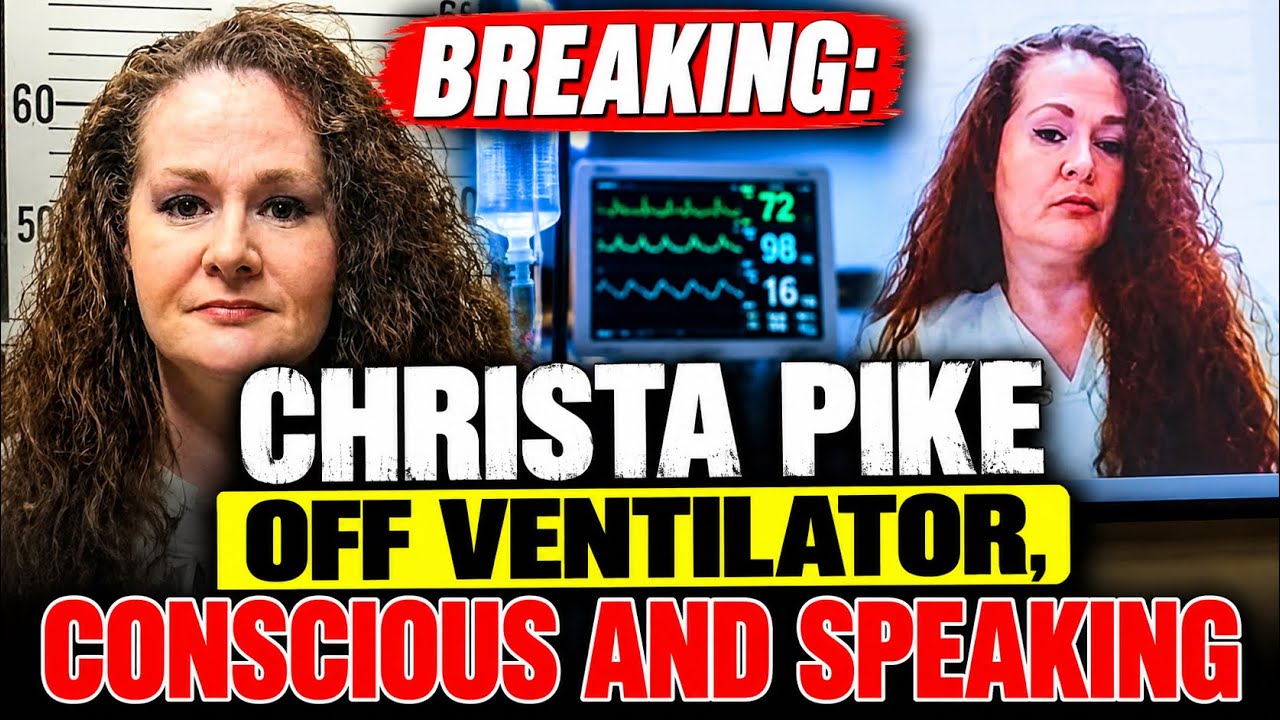
Six days after Tennessee’s failed execution attempt, Christa Pike has regained consciousness, is speaking, and is now breathing without a mechanical ventilator, marking the most significant medical improvement since she survived the administration of two doses of the execution drug on September 30.
According to the latest update from her attorneys and medical expert Dr. Joel Zeit, Pike has recovered sufficiently to come off the ventilator and communicate, although she remains in intensive care and could still face serious complications.
Zeit, a professor of anesthesiology and surgery who has served as a medical expert for Pike’s legal team, told the Associated Press that Pike is off mechanical ventilation and able to speak, while cautioning that doctors may need weeks or even months before they understand the full extent of her recovery.
That distinction is crucial because being conscious and breathing independently does not mean Pike has recovered completely, and her prognosis remains uncertain as physicians continue monitoring her condition.
Only days earlier, Pike remained unconscious and mechanically ventilated after being transported by ambulance from Riverbend Maximum Security Institution following the failed execution.
The execution attempt involved two administrations of pentobarbital, according to the report, after which Pike eventually became unconscious while witnesses reported hearing rhythmic breathing or snoring from behind the execution chamber curtain.
Her attorneys subsequently reported that she remained unconscious and dependent on mechanical ventilation, while concerns grew over the condition of her arms following the procedure.
Now, however, Pike is awake, communicating, and breathing without the ventilator, creating an entirely different medical and legal situation from the one Tennessee faced immediately after the failed execution.
Her arms remain a major concern.
According to statements from her attorneys, Pike suffered severe injuries during the execution attempt, with earlier descriptions including swelling, burns, and blistering around the affected area.
The latest update continues to emphasize the seriousness of those injuries, but there is still no public medical report establishing whether the damage to her nerves, muscles, blood vessels, or surrounding tissue will be temporary or permanent.
Pike also reportedly remains handcuffed and shackled to her hospital bed while receiving treatment.
The most important unanswered medical question may be what happened to the intravenous line during the execution.
Dr. Zeit suggested that Pike’s injuries are consistent with infiltration or extravasation, meaning the medication may have escaped the vein and entered surrounding tissue rather than circulating through her bloodstream as intended.
Pentobarbital can cause significant tissue injury when it escapes from a vein, according to the medical expert cited in the report, potentially providing an explanation for both the severe arm injuries and questions surrounding the failed execution.
But that explanation has not been established as the official cause.
The independent investigation ordered by Tennessee has not publicly determined exactly what happened behind the execution chamber curtain, leaving investigators with a series of questions that could become central to the legal battle.
Was the intravenous line functioning properly?
When did the medication begin entering the surrounding tissue, if it did?
How much of the drug actually entered Pike’s bloodstream?
What happened after the first administration?
What happened after the second?
And why did Pike survive?
Those questions could become even more significant now that Pike is conscious enough to potentially describe what she remembers.
During the execution, witnesses reportedly heard Pike complain about pain in her arm and ask whether what she was experiencing was supposed to happen.
She was reportedly still responsive after the first administration before the second round followed, after which she eventually appeared to lose consciousness.
If Pike can remember those moments, investigators and her attorneys may eventually have an eyewitness account from inside the execution chamber that could be compared with the state’s records, medical evidence, and testimony from those involved.
For the first time since September 30, Pike may be capable of answering questions such as when the burning began, what the IV attempts felt like, what happened after the first dose, what happened after the second dose, and what she remembers immediately before losing consciousness.
There has been no public statement from Pike herself describing those events.
That could change as her medical condition continues to improve.
Meanwhile, Tennessee’s independent investigation and Pike’s legal challenge are moving forward at the same time.
Her attorneys are seeking preservation of evidence connected to the failed execution, including drug lot information, records, and other materials that could help establish what happened inside the execution chamber.
A court proceeding scheduled for October 7 is expected to address the evidence-preservation effort.
That proceeding could become an important early step in determining what physical and digital evidence remains available for examination, particularly as Pike’s attorneys prepare constitutional arguments surrounding the execution attempt.
The investigation also comes amid scrutiny of Tennessee’s execution procedures.
The transcript reports that Tennessee Department of Correction Commissioner Frank Strada stepped down following revelations involving deposition records and questions about whether safety protocols identified in a previous review had been properly implemented.
Those claims remain part of the broader dispute surrounding the failed execution and should be distinguished from findings that have yet to be established by the independent investigation.
The state now faces an unusual situation.
Pike remains a death-row prisoner, but the state’s attempt to carry out the sentence did not result in her death.
At the same time, the governor has paused executions through the end of the year while the state investigates what went wrong.
That means the immediate question is no longer simply whether Tennessee can carry out another execution.
It is whether the state can explain why the first attempt failed, what medical consequences resulted, and what legal consequences may follow.
Pike’s lawyers are expected to argue that subjecting her to another execution attempt after what she endured could raise serious constitutional concerns, including arguments under the Eighth Amendment.
The transcript also notes that some officials and lawmakers have discussed alternative execution methods, including the electric chair, while others have raised questions about other methods.
Those proposals, however, do not answer the central problem created by the failed September 30 procedure.
Before Tennessee can determine what happens next, investigators must establish as much as possible about what happened during the attempt itself.
The medical evidence may be especially important.
Pike’s current ability to speak is encouraging in one specific respect: it means she may eventually be able to provide information about her own experience.
But doctors still do not know whether she has suffered permanent neurological, vascular, muscular, or organ damage.
There has been no public diagnosis establishing permanent brain damage, cognitive impairment, or memory loss.
Her ability to regain consciousness and communicate is certainly a major improvement, but it does not answer every question about possible long-term effects.
Dr. Zeit has warned that it could take weeks or months before doctors understand what Pike’s ultimate recovery will look like.
For now, the clearest picture is this: Christa Pike is conscious, speaking, breathing without mechanical ventilation, and still receiving critical medical care in the ICU.
She is not considered fully recovered.
Her arm injuries remain serious.
Her prognosis remains uncertain.
The precise reason two administrations of the execution drug failed to kill her remains unresolved.
And perhaps most importantly, investigators still need to determine what happened behind the execution chamber curtain.
That is where the next chapter may begin.
Because if Pike becomes medically stable enough to speak in detail about what she experienced, her memories could become one more piece of evidence in a case already surrounded by medical questions, legal challenges, an independent investigation, and a state execution system now facing intense scrutiny.
For the moment, Tennessee has paused executions.
Pike remains hospitalized.
Her attorneys are preserving evidence.
Investigators are examining the failed procedure.
And after surviving the execution that was supposed to end her life, Christa Pike is now awake and able to speak about what happened.
What she remembers may ultimately become one of the most important unanswered questions of all.


