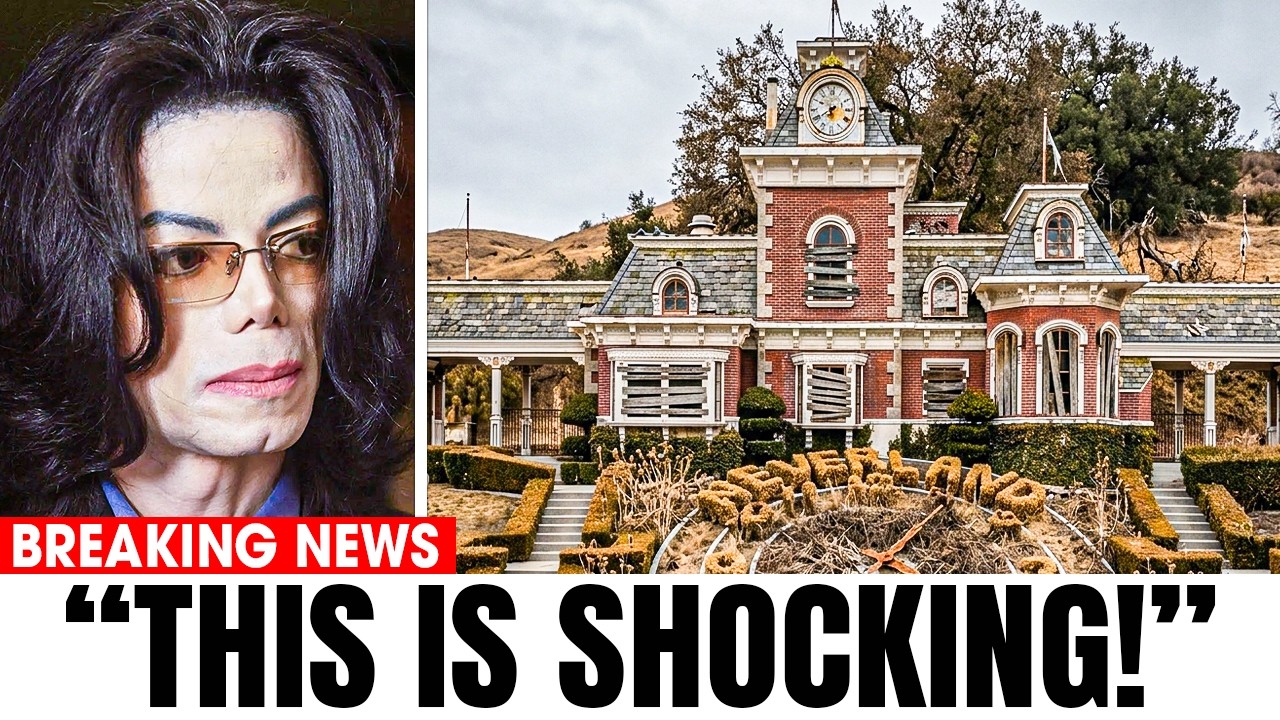
For seventeen years, the viral story says, the gates remained shut.
Nothing moved.
Nobody entered.
Michael Jackson’s abandoned kingdom supposedly sat frozen exactly as he had left it.
Then, in 2026, workers finally unlocked Neverland Ranch.
They pushed through rooms untouched since the King of Pop’s death.
They opened doors the public had supposedly never seen.
And what waited inside left everyone pale.
It is an irresistible story.
It is also not what actually happened.
Neverland was never sealed for seventeen years.
Its interiors were photographed and filmed in 2009.
Its grounds were maintained.
Its ownership changed.
It was marketed for sale.
Film crews eventually returned.
And parts of the famous property were restored decades after Michael Jackson stopped living there.
The real story is stranger precisely because Neverland was not a perfectly preserved time capsule.
It was a place slowly stripped of the fantasy that once defined it.
Michael Jackson purchased the sprawling Santa Barbara County property in 1988 and transformed it into Neverland Valley Ranch.
The estate covered roughly 2,700 acres near Los Olivos, California.
Its centerpiece was a large Tudor- and French-country-influenced residence surrounded by gardens, guest structures, a theater, railroad facilities and eventually the amusement attractions that became internationally famous.
Jackson named the property after the world of Peter Pan.
Then he tried to build that world physically.
There were trains.
A station.
Carnival rides.
Animals.
Statues.
Gardens.
A movie theater.
Children who visited could enter an environment almost deliberately disconnected from ordinary adult life.
For years, photographs of those attractions became more recognizable than photographs of the actual residence.
Neverland stopped looking like a house.
It became mythology.
That mythology made what happened later feel even more haunting.
After Jackson’s 2005 trial, in which he was acquitted, he largely stopped living at Neverland.
The place remained associated with him, but the relationship had changed.
By 2008, financial problems threatened the property with foreclosure, and Colony Capital became involved in a joint venture connected to the ranch.
When Jackson died on June 25, 2009, he was not living at Neverland.
And almost immediately, cameras went inside.
AP footage recorded on July 2, 2009 shows the gates opening and reporters being taken through the estate.
They filmed the kitchen.
The living spaces.
The staircase.
Jackson’s bedroom.
The master bathroom.
The grounds.
The train station.
The security systems.
And a small concealed room accessible through a cedar-lined closet.
TIME published photographs from essentially the same period.
Those pictures destroy the idea that nobody saw inside until 2026.
They also reveal something more emotionally powerful.
Much of Michael Jackson was already gone.
The master bedroom was largely empty.
Some sections showed wear.
Furniture and personal possessions had been removed.
The spectacular Neverland known from television no longer existed in its original form.
One room, however, immediately drew attention.
Behind Jackson’s closet was a secured space protected by multiple locks.
TIME described it as a room where Jackson stored valuable possessions.
The image later became perfect material for internet mythology.
A “secret room.”
A locked chamber.
A hidden vault.
But the room itself was documented publicly in 2009.
It was not discovered seventeen years later.
That detail shows how the modern Neverland legends are built.
Start with something real.
There was a locked room.
Remove the date.
Remove the context.
Then reintroduce it years later as a shocking discovery.
Suddenly an old AP tour becomes:
“They finally opened Michael Jackson’s secret room.”
The same transformation happened with the estate itself.
Neverland did spend years closed to ordinary public tourism.
It was never converted into a Graceland-style attraction.
But “closed to the public” does not mean “untouched.”
Those are completely different things.
The property remained private.
Staff maintained parts of it.
Real-estate professionals entered it.
Photographers documented it.
Potential purchasers evaluated it.
Later, film crews received permission to work there.
By 2015, the ranch had been placed on the market with an asking price reportedly around $100 million.
Its name had reverted to Sycamore Valley Ranch.
Over time, the asking price fell dramatically.
Eventually, billionaire investor Ron Burkle purchased the property in 2020 for approximately $22 million—a fraction of that original listing price.
Burkle was not buying a sealed museum.
He was buying an enormous private estate with a complicated history.
And by then, the Neverland amusement world had already changed considerably.
Many of the rides associated with Jackson had been removed years earlier.
Animals were gone.
Personal memorabilia had been dispersed.
The estate photographed for sale looked more like an exceptionally large luxury property than the surreal amusement kingdom seen during Jackson’s lifetime.
That is perhaps the first genuinely unsettling thing about looking inside Neverland after Michael Jackson.
Not that investigators supposedly found something horrifying.
That so much of the world he created had simply vanished.
A place designed around permanent childhood turned out to be temporary.
The trains remained recognizable.
The buildings survived.
The landscape survived.
But Neverland itself depended on Michael Jackson being there.
Without him, the fantasy became architecture.
Then came another transformation.
Years later, the production behind the Michael Jackson biopic returned to the actual property.
Public film permits confirmed production activity at the Neverland address in 2024, including both interior and exterior filming.
Reports also documented rehabilitation work around buildings and amusement-related structures as the estate became active again for production.
That is where many recent “Neverland reopened” stories appear to originate.
There really were crews.
There really was activity.
There really was restoration.
And the actual Neverland grounds really were used during production of Michael.
People reported that filmmakers worked with the current ownership to recreate aspects of the property for the movie.
From there, viral storytelling did the rest.
“Film crew returns to Neverland.”
became:
“Neverland finally opened.”
Then:
“Neverland finally opened after seventeen years.”
Then:
“Workers turned pale after seeing what Michael left inside.”
The final sentence is the one for which there is no verified discovery.
No newly opened chamber filled with shocking evidence has been credibly reported.
No forgotten vault has rewritten Jackson’s history.
No newly discovered secret collection has been authenticated as the reason crews returned.
The known recent activity is connected largely to maintenance, ownership and filmmaking.
But the estate does contain strange details.
And some of them were documented long before 2026.
The bedroom security system was unusual.
AP footage from 2009 showed multiple locks and electronic security equipment around Jackson’s private sleeping area.
The secured room behind the closet was real.
The train system was real.
The private cinema was real.
The statues of children throughout the grounds were real.
The elaborate landscaping was real.
The ice-cream cart given to Jackson by Elizabeth Taylor was photographed there.
TIME’s 2009 tour even noted that approximately forty of the child statues had been restored ahead of the intense media attention following Jackson’s death.
None of this was hidden.
What made it haunting was context.
Walk through the estate without crowds, music or rides operating and Neverland becomes something very different.
A giant kitchen with nobody eating.
A railway station without passengers.
Gardens built for spectacle without the person who commissioned them.
A bedroom stripped nearly bare.
Security locks guarding rooms containing little of the life that once made them important.
The photographs taken after Jackson’s death conveyed abandonment more effectively than any invented horror reveal could.
Neverland had been built as an escape.
By 2009, it looked like somewhere its creator had already escaped from.
Architectural Digest’s account of the ranch offers another view.
Writer Paul Theroux described entering an estate filled with amusement structures, statues, gardens, portraits, decorations and objects that created the impression of an elaborate stage set.
The interior was less like a conventional celebrity mansion than the private environment of someone constructing an alternate world around himself.
And that may explain why people remain fascinated with “what is inside.”
Neverland has always invited psychological interpretation.
Every locked door seems symbolic.
Every childlike object becomes evidence in somebody’s theory.
Every abandoned ride looks meaningful.
Every room appears to promise an answer to Michael Jackson himself.
But houses rarely provide answers that simple.
Neverland contains contradictory histories.
For fans, it can represent imagination, generosity and a performer trying to create the childhood environment he felt he had missed.
For critics and accusers, the ranch is inseparable from allegations surrounding Jackson.
Jackson denied sexual-abuse allegations during his lifetime and was acquitted of criminal charges in the 2005 trial.
Later accusations and civil litigation have continued after his death, while his estate has denied those claims.
That contested history is one reason any “secret Neverland discovery” spreads so rapidly.
Different audiences expect the building to confirm what they already believe.
Some expect hidden evidence of innocence.
Others expect hidden evidence of wrongdoing.
Others simply want lost Michael Jackson memorabilia.
The property cannot satisfy all of those expectations.
What it can do is preserve fragments.
A doorway.
A staircase.
A train platform.
An empty room.
A security panel.
A tree.
A road through thousands of acres of California countryside.
And sometimes those fragments are more revealing than imagined discoveries.
One of the most striking truths about Neverland after Jackson left is how quickly physical fantasy can be dismantled.
Carnival rides that seemed permanent could be removed.
Animals could be relocated.
Furniture could disappear.
Personal collections could be sold or stored elsewhere.
A $100 million asking price could eventually become a $22 million sale.
A private universe could become simply real estate.
That is the transformation people are actually seeing when old Neverland footage is compared with newer images.
It is not an untouched vault being opened.
It is a property repeatedly rewritten by whoever controls it.
First it was a private ranch.
Then Jackson transformed it into Neverland.
After he left, much of that identity was reduced.
It became Sycamore Valley Ranch again.
Then filmmakers partially resurrected Neverland for the camera.
That latest transformation is especially strange.
A fantasy Jackson built in real life became a set recreating Jackson’s life.
The real Neverland was being asked to impersonate its own past.
For crews working there, that must have created surreal visual moments.
Buildings restored.
Old landmarks recognizable again.
The landscape appearing closer to the place millions remembered from archival footage.
But restoration should not be confused with archaeological discovery.
The workers were not opening Tutankhamun’s tomb.
They were working on a privately owned California estate that had been entered, photographed, marketed and maintained repeatedly since Jackson’s death.
Even the phrase “17 years later” is misleading for another reason.
Jackson effectively left Neverland in 2005, not 2009.
By the time he died, he had already been away from the ranch for years.
So if someone wants to measure Neverland’s abandonment from the moment Jackson ceased treating it as home, the timeline begins earlier than the viral title suggests.
If they measure from his death, then they must confront the fact that journalists toured it almost immediately afterward.
Either way, the dramatic sealed-for-seventeen-years premise collapses.
What remains is still a remarkable story.
Michael Jackson spent millions turning 2,700 acres of California into perhaps the most famous private entertainment estate on Earth.
He placed a railway through it.
Built entertainment spaces.
Filled the landscape with fantasy.
Then he left.
Years later, reporters walked through an almost empty bedroom.
Another decade passed.
The property was sold for far less than its once-anticipated value.
Then Hollywood returned and began reconstructing pieces of the world for a movie about the man who created it.
There is something almost circular about that.
Neverland was originally Michael Jackson’s attempt to transform reality into fantasy.
Now reality is transforming Neverland back into a version of that fantasy for the screen.
And that is why recent footage can look so startling.
People expect ruins.
Instead, they sometimes see restoration.
People expect an abandoned amusement park.
They see manicured grounds.
People expect Michael’s possessions waiting exactly where he left them.
Most were gone long ago.
People expect one forbidden door containing the explanation for everything.
The famous “secret room” had already been photographed in 2009.
The biggest revelation is therefore not what somebody discovered after seventeen years.
It is what wasn’t there anymore.
The Michael Jackson who built Neverland had already been removed from the property piece by piece.
His furniture.
His collections.
His animals.
Many of the rides.
His daily routines.
His family life there.
His presence.
What survived was the shell of his imagined world.
That shell proved durable enough that filmmakers could resurrect it.
But it was never frozen in time.
So when a video claims:
“After 17 years, they finally opened Michael Jackson’s Neverland Ranch—and everyone turned pale when they saw what was inside…”
the documented story points somewhere else.
The gates had opened before.
The cameras had already entered.
The bedroom had already been filmed.
The locked room had already been photographed.
The estate had already been marketed.
It had already changed ownership.
And the most recent dramatic activity came from filmmakers rebuilding pieces of the past rather than investigators discovering something buried within it.
Yet Neverland still has the power to make people stare.
Not because of a newly discovered secret.
Because nearly everything visible there reminds us how completely one person tried to build an entire world—and how quickly even that world began disappearing once he was gone.
Seventeen years later, the most haunting thing inside Neverland is not what was finally uncovered.
It is how much of Neverland had already vanished.


