For decades, one of the strangest stories circulating among military collectors has sounded like the plot of a wartime thriller.
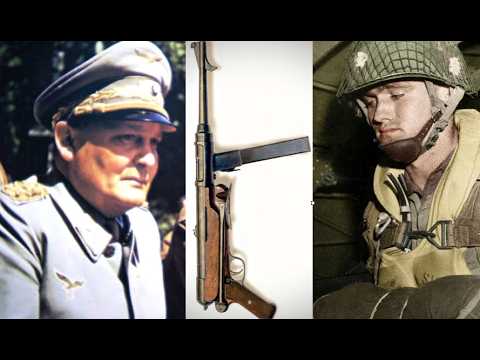
In 1943, according to the legend, Allied commandos parachuted deep inside Nazi Germany with an extraordinary mission.
Their target was Hermann Göring.
Head of the Luftwaffe.
Reichsmarschall.
One of the most powerful men in Hitler’s regime.
The commandos were supposedly sent to Göring’s enormous Carinhall estate northeast of Berlin.
They expected limited security.
Instead, they encountered heavily armed German troops.
A firefight erupted.
Most of the raiding force was apparently lost.
But during the chaos, an American major reportedly slipped inside Göring’s residence.
There, hanging on a wall, he saw a weapon he had never encountered before.
He removed it.
Put it in his pack.
Then fought his way out with a handful of survivors.
The assassination failed.
Göring lived.
But the major escaped with the weapon.
He carried it for the remainder of the war.
Then brought it home to the United States in 1945.
If true, the weapon would be more than a rare firearm.
It would be physical evidence of a secret Allied assassination mission deep inside the Third Reich.
There is just one problem.
The gun appears to be real.
The raid probably was not.
And the deeper the story is examined, the more difficult it becomes to explain how such an operation could have happened at all.
At the center of the mystery is an extraordinarily rare German submachine gun commonly identified as the MP36.
The famous MP40 needs little introduction.
Compact, recognizable and chambered in 9mm, it became one of the iconic German weapons of the Second World War.
Its predecessor, the MP38, was more expensive and manufactured to a higher standard.
Both became closely associated with German troops, particularly leaders, armored crews and airborne forces.
But before them came something much more obscure.
The MP36.
According to the source, it differed substantially from the later MP38 and MP40 despite sharing obvious design features.
It incorporated wooden furniture.
It was manufactured from machined steel.
It offered select-fire capability.
Its magazine catch differed from the familiar button arrangement of the later weapons.
Its magazine housing projected forward at approximately 30 degrees.
Its front sight was an unprotected, drift-adjustable design.
Even its bolt contained differences.
And underneath the wooden foregrip appeared the marking “EMP36.”
The source interprets the designation as connected with Erma Werke, the German manufacturer associated with the development lineage that eventually produced the MP38 and MP40.
No dedicated MP36 magazine is known to have survived, according to the narrative, although the weapon can reportedly accept MP40 magazines.
One surviving example in the United States carries serial number 014.
Another reported example in a military museum in Prague carries serial number 001.
That suggests at least a very small production or prototype sequence.
The American gun is described as having an unusually high-quality finish.
Not simply an experimental shop gun.
Potentially a presentation weapon.
And according to the legend attached to it, the man who received it was Hermann Göring.
On the surface, the connection is not absurd.
German airborne forces fell under the Luftwaffe.
Göring headed the Luftwaffe.
A prototype compact automatic weapon intended for airborne use could plausibly have attracted attention within that organization.
A high-quality example being presented to Göring therefore fits the broad historical context better than the commando story that supposedly explains how it later reached America.
That second part begins in 1943.
The account cited in the source reportedly appeared in a 1998 Small Arms Review article titled “The MP36, the Missing Link.”
According to that version, volunteers were assembled for a top-secret assassination mission.
The target was Göring.
The location was Carinhall, his vast estate roughly 40 miles northeast of Berlin.
Allied intelligence supposedly believed Göring would be present and security relatively light.
The raiding party parachuted into the region at night.
Then the intelligence proved catastrophically wrong.
Carinhall was heavily defended.
The commandos encountered what the story describes as Göring’s elite troops.
Fighting erupted.
During the battle, an American major penetrated the residence while searching for Göring.
He found the strange machine pistol hanging inside.
Believing intelligence personnel might want to examine it, he removed the weapon and put it into his pack.
The raid was collapsing around him.
So the major abandoned the search for Göring and concentrated on escaping.
According to the legend, only a small fraction of the original Allied team survived.
Somehow they returned to friendly territory.
The major retained the MP36.
At the end of the war, he carried it back to America as a souvenir.
It is a spectacular provenance story.
Perhaps too spectacular.
Because once the source begins testing the operational details, basic questions become difficult to answer.
The first is obvious.
How did the commandos get there?
Carinhall was not in occupied France.
It was not close to an Allied frontier.
It was deep inside Germany, northeast of Berlin.
An aircraft carrying a parachute force would have to penetrate hostile airspace, reach the target region, release the team and—unless the aircraft itself was considered expendable—return to Britain.
The source examines the C-47 Skytrain first.
The C-47 was extensively used for airborne operations.
It was exactly the type of aircraft one might imagine dropping American paratroopers.
But range becomes a problem.
The source estimates a round-trip distance from eastern England to the Carinhall region at approximately 1,150 to 1,250 miles depending on the airfield.
A heavily loaded C-47’s practical range, it argues, could fall around 1,026 to 1,180 miles.
Even before considering navigation, weather, evasive routing or combat conditions, the margins become uncomfortable.
Then comes survivability.
This is 1943.
The Allies did not yet possess the overwhelming air dominance over Germany they would enjoy later.
A C-47 was not a high-speed combat aircraft.
It was a slow transport.
Unpressurized.
Essentially defenseless against serious interception.
Flying deep into Germany meant exposure to radar detection, antiaircraft fire and Luftwaffe fighters.
A lone transport crossing hundreds of miles of hostile territory at night was not physically impossible.
But an assassination plan requiring that aircraft to reach an area near Berlin undetected, deliver a substantial raiding force and then escape demands far more evidence than the legend provides.
Could another aircraft have done it?
The source considers bombers.
B-17s and B-24s were not designed as paratroop transports.
Men could theoretically exit through modified openings or bomb bays, but deploying an assault team that way would be awkward and dangerous.
German aircraft had dropped individual agents into Britain and Ireland.
But inserting one clandestine operative is very different from deploying a combat unit expected to assault a fortified estate.
British bombers such as the Lancaster present similar problems.
Technically, personnel could be carried and dropped.
That does not make the aircraft an efficient platform for inserting a large commando force.
Then there were aircraft actually used for airborne operations.
The Halifax.
The Short Stirling.
A Stirling could carry roughly ten fully equipped paratroopers in the configuration discussed by the source.
But now another problem appears.
Numbers.
How many men would be required to attack Carinhall?
The estate was not an isolated country house with two guards at a gate.
The source describes it as a large, heavily forested complex protected by roughly 200 armed men associated with the Hermann Göring formation.
Göring himself also had personal security.
An assault force large enough to fight through that defense would require more than a handful of men.
And more men meant more aircraft.
More aircraft meant a larger radar signature.
More chances of interception.
More complicated navigation.
More parachute drops.
More opportunities for the entire operation to be detected before anyone reached Göring.
A force of ten men from a Stirling would be tiny.
Even approximately 18 to 22 men from a C-47 would be badly outnumbered if the defenders numbered anything close to the figure cited by the source.
That does not mean small assassination teams were ineffective during the Second World War.
Quite the opposite.
But their success generally depended on avoiding exactly this kind of battle.
The assassination of Reinhard Heydrich provides the obvious comparison.
In 1942, Czechoslovak agents Jozef Gabčík and Jan Kubiš were parachuted into occupied territory.
They did not assault a massive fortified headquarters with dozens of commandos.
They entered an existing resistance environment.
Then attacked Heydrich while he traveled through Prague.
The kill mechanism was focused.
Ambush the target when he was vulnerable.
Avoid fighting the entire security structure protecting him.
Heydrich was mortally wounded.
The aftermath was horrific, and the assassins and many of their supporters were eventually killed.
But operationally, the method made sense.
Small team.
Specific target.
Known movement pattern.
Short engagement.
Another comparison in the source is Operation Foxley.
That was the British SOE proposal to assassinate Adolf Hitler.
Again, the concept was not to parachute a miniature army onto the Berghof and fight the SS.
The proposed team was tiny.
The plan relied on infiltration, disguise, observation and ambush.
One concept involved shooting Hitler with a scoped rifle during his routine walk near his mountain residence.
A backup concept involved attacking his vehicle.
The principle was the same.
Do not attack the fortress.
Attack the man when he leaves it.
That is exactly why the alleged Carinhall raid feels operationally strange.
If Allied intelligence possessed enough information to know Göring would be at Carinhall, why choose the most difficult possible moment to kill him?
Why attack the estate itself?
Why fight his guards?
Why send American paratroopers into a location from which escape would be extraordinarily difficult?
Why not target Göring while traveling between the estate and his nearby airfield?
That would still have been extremely dangerous.
But it resembles known clandestine assassination planning far more closely than a frontal raid.
And even that alternative requires something the source says there is no evidence the Allies possessed.
An insider.
To ambush Göring’s vehicle, agents would need reliable knowledge of his movements.
When would he leave?
Which route?
Which vehicle?
How large an escort?
Would plans change?
Without someone close enough to Göring’s headquarters to provide timely information, the assassins might spend days waiting in hostile territory while German security searched the area.
The source says no known mole of that kind has emerged.
That does not prove no clandestine planning ever existed.
Secret wartime operations can leave incomplete records.
But extraordinary claims require something more substantial than an object with a dramatic ownership story.
Then there is extraction.
Suppose the commandos somehow reached Carinhall.
Suppose they penetrated the estate.
Suppose they killed Göring.
What happened next?
They were still northeast of Berlin.
Deep inside Nazi Germany.
No friendly front line was nearby.
The source notes the absence of a resistance infrastructure comparable with the networks available in occupied countries such as France or Czechoslovakia.
How would a surviving American assault force move hundreds of miles back to Allied territory?
Would another aircraft land?
Would they march?
Use German vehicles?
Reach a coast?
Wait for pickup?
The legend apparently provides no convincing operational answer.
Captured German aircraft offer another possibility.
Perhaps the Allies could have used a Ju 52 to reduce suspicion.
Captured Axis aircraft certainly existed.
But the source points out that the Ju 52 introduces its own range limitations.
More importantly, it notes the lack of evidence that such an aircraft was used for this supposed mission.
Each attempt to solve one problem creates another.
Use a C-47?
Range and detection.
Use bombers?
Poor airborne deployment platform.
Use a Stirling?
Insufficient assault force unless multiple aircraft participate.
Use captured German aircraft?
Range, logistics and no documentary evidence.
Use a tiny team?
Then why assault a heavily defended estate?
Use a large team?
Then covert insertion becomes vastly more difficult.
Assume they somehow succeed?
How do they escape?
The legend survives because it begins with the artifact rather than the operation.
Here is the gun.
The gun is extraordinarily rare.
It may have belonged to Göring.
It ended up in America.
Therefore the story attached to it feels as though it must explain those facts.
But provenance does not work backward that easily.
A real object can acquire a false story.
In fact, rare objects often attract better stories precisely because their origins are obscure.
The more unusual the artifact, the stronger the temptation to fill missing years with adventure.
And this MP36 is unusual enough to sustain an extraordinary legend.
According to the source, the American example carries serial number 014.
Its quality suggests prototype or presentation status.
Another known example reportedly carries serial 001.
The weapon therefore represents an extremely rare stage in the evolution that ultimately produced the MP38 and MP40.
None of that requires Allied commandos to have attacked Carinhall.
So if the assassination raid probably did not happen, how did the MP36 reach the United States?
Here the source changes from criticism to speculation.
And that distinction is crucial.
The narrator proposes an alternative explanation.
He explicitly says he cannot prove it.
The theory begins in 1945.
By then, the Red Army was approaching from the east.
Göring had Carinhall emptied.
His immense collections—art, personal property, weapons and other possessions—were moved away from the estate.
According to the source, much of this material traveled by train toward Berchtesgaden, where Göring maintained another residence near Hitler’s Bavarian complex.
Some art treasures were hidden in a bunker beneath a Luftwaffe facility.
Other property, including weapons, allegedly remained aboard railway cars.
Then American forces arrived.
Berchtesgaden fell in early May 1945.
The source states that troops of the 101st Airborne Division subsequently took over garrison responsibilities in the area.
That is where the narrator sees a much simpler path for the MP36.
No 1943 parachute raid.
No secret assassination mission.
No firefight at Carinhall.
No impossible escape across Germany.
Instead:
Göring owned the weapon.
Göring evacuated his possessions from Carinhall.
The weapon traveled with his collection.
American troops captured the collection in Bavaria.
An American airborne officer acquired the gun as a souvenir.
The gun later reached the United States.
Then, somewhere along the way, the mundane story of looting or souvenir-taking became something much more heroic.
According to the narrator’s theory, the owner—or somebody later in the chain of provenance—may have created the Carinhall story.
Perhaps the kernel of truth was simply this:
The weapon really had belonged to Göring.
And an American paratrooper really had taken it.
Everything between those two facts could then have grown with each retelling.
Eventually:
The paratrooper became part of a secret team.
The souvenir became intelligence material.
Berchtesgaden became Carinhall.
May 1945 became 1943.
Taking a weapon from captured property became removing it from Göring’s wall during a firefight.
And a war trophy became evidence of an assassination mission.
It is an elegant theory.
It is also only a theory.
The source admits that directly.
There is no proof presented that the American MP36 was aboard Göring’s train.
There is no identified 101st Airborne officer conclusively shown taking it.
There is no chain of custody establishing the proposed journey from Carinhall to Berchtesgaden to the United States.
The theory is persuasive primarily because it requires fewer extraordinary events.
That is not the same as proving it.
What can be separated with greater confidence inside the source are three different questions.
First:
Is the MP36 itself real?
The source says yes.
It describes surviving examples and specific mechanical characteristics.
Second:
Was the American example connected with Göring?
The source considers that plausible, particularly because of its high-quality presentation-like construction and Göring’s relationship with the Luftwaffe and German airborne forces.
But the file does not provide an unbroken documentary provenance proving that ownership.
Third:
Did American commandos obtain it during a 1943 assassination raid on Carinhall?
That is where the story becomes extremely difficult to sustain.
No mission records are presented.
No operational order.
No aircraft logs.
No identified raid commander.
No casualty list.
No extraction plan.
No intelligence file.
No German report describing a major firefight at Göring’s estate.
Instead, the story depends heavily on the gun’s later provenance tale.
That is not enough to establish an operation of this scale.
Especially because such an operation would have involved multiple layers of planning.
Aircraft.
Aircrew.
Parachute personnel.
Intelligence.
Weapons.
Briefing.
Navigation.
Communications.
Casualties.
Recovery.
Debriefing.
An attack deep inside Germany that ended in a firefight with Göring’s guards would have generated many potential documentary traces.
Could records have been classified?
Certainly.
Could records have been destroyed?
Certainly.
But “still classified” can also become an extremely convenient explanation whenever evidence for a dramatic wartime story is missing.
Absence of evidence is not automatically evidence of absence.
But absence becomes more meaningful when the alleged event should have created substantial evidence and none is presented.
That is why this story is more interesting as an examination of military mythology than as an assassination adventure.
World War II produced countless genuine operations that sound fictional.
Agents parachuted into occupied Europe.
Resistance networks moved weapons beneath German surveillance.
Commandos attacked ports.
Saboteurs destroyed infrastructure.
British planners seriously considered killing Hitler.
Czechoslovak agents assassinated Heydrich.
American airborne troops fought across Europe.
None of those realities makes every dramatic wartime legend true.
Sometimes the genuine history is precisely what allows the false story to survive.
Listeners know secret missions happened.
They know agents parachuted at night.
They know Allied intelligence targeted senior Nazi officials.
They know American paratroopers reached Berchtesgaden.
They know soldiers brought home captured German weapons.
Combine those real elements and an invented story can sound historically authentic.
The MP36 legend contains all the right ingredients.
A secret mission.
A Nazi leader.
Elite guards.
A nighttime parachute drop.
A desperate firefight.
A lone American major.
A mysterious weapon.
A handful of survivors.
A classified operation.
A trophy hidden for decades.
It sounds right because every piece resembles something that genuinely occurred somewhere during the war.
The problem comes when those pieces are assembled into one operation.
Then the logistics begin fighting the legend.
Distance.
Aircraft range.
Air defenses.
Force size.
Carinhall’s security.
Lack of resistance support.
No clear extraction route.
No identified insider.
No surviving operational documentation presented by the source.
The story becomes less convincing with every practical question.
Meanwhile, the alternative requires almost nothing unusual.
By 1945, Göring’s world was collapsing.
His possessions were being moved.
American troops entered the region where some of those possessions ended up.
War trophies changed hands constantly.
A rare gun could disappear into a duffel bag far more easily than a secret airborne assault force could disappear from the historical record.
That does not make the Berchtesgaden theory true.
It makes it economical.
And history often rewards the explanation requiring the fewest unsupported miracles.
The final irony is that the legend may actually distract from what makes the MP36 genuinely fascinating.
The weapon does not need a fictional firefight to matter.
If the source’s technical description is accurate, it is an exceptionally rare transitional German submachine gun.
Its design sits between earlier concepts and the weapons that became synonymous with German forces during the Second World War.
The American example reportedly carries serial number 014.
The Prague example reportedly carries serial number 001.
If those numbers reflect an actual production sequence, at least 14 may once have existed.
Today, according to the source, only two are known.
That alone makes the weapon historically significant.
Its estimated value is given as approximately $40,000 or potentially much more.
But monetary value is almost secondary.
The MP36 represents an obscure branch in German small-arms development.
A weapon nearly erased by the far more famous MP38 and MP40 that followed it.
And attached to one surviving example is a story so dramatic that it has threatened to become more famous than the gun itself.
Perhaps that is the real lesson of the MP36.
Objects do not speak.
People speak for them.
A firearm can tell historians things through metallurgy, machining, serial numbers, markings and design.
But it cannot explain who owned it.
It cannot say where it hung in 1943.
It cannot identify the soldier who picked it up.
It cannot prove that a firefight occurred around it.
Those claims require records.
Witnesses.
Documentation.
Provenance.
Without them, a genuine artifact can become the foundation for a completely imaginary adventure.
The MP36 does not prove that Allied commandos parachuted into Germany to kill Hermann Göring.
Based on the source’s analysis, the alleged operation presents severe logistical and evidentiary problems.
But neither does debunking that legend solve the gun’s provenance.
The mystery simply changes.
Instead of asking:
How did an American major steal Göring’s machine gun during a secret 1943 assassination raid?
The better question becomes:
Who actually picked up serial number 014—and where?
Maybe the answer lies in Berchtesgaden in May 1945.
Maybe it lies somewhere else entirely.
Until stronger documentary evidence appears, the most responsible conclusion is also the least cinematic.
The MP36 is real.
The story attached to it is disputed.
And the true journey of one of the rarest German submachine guns of the Second World War may still be hiding behind a legend that was simply too good not to repeat.


