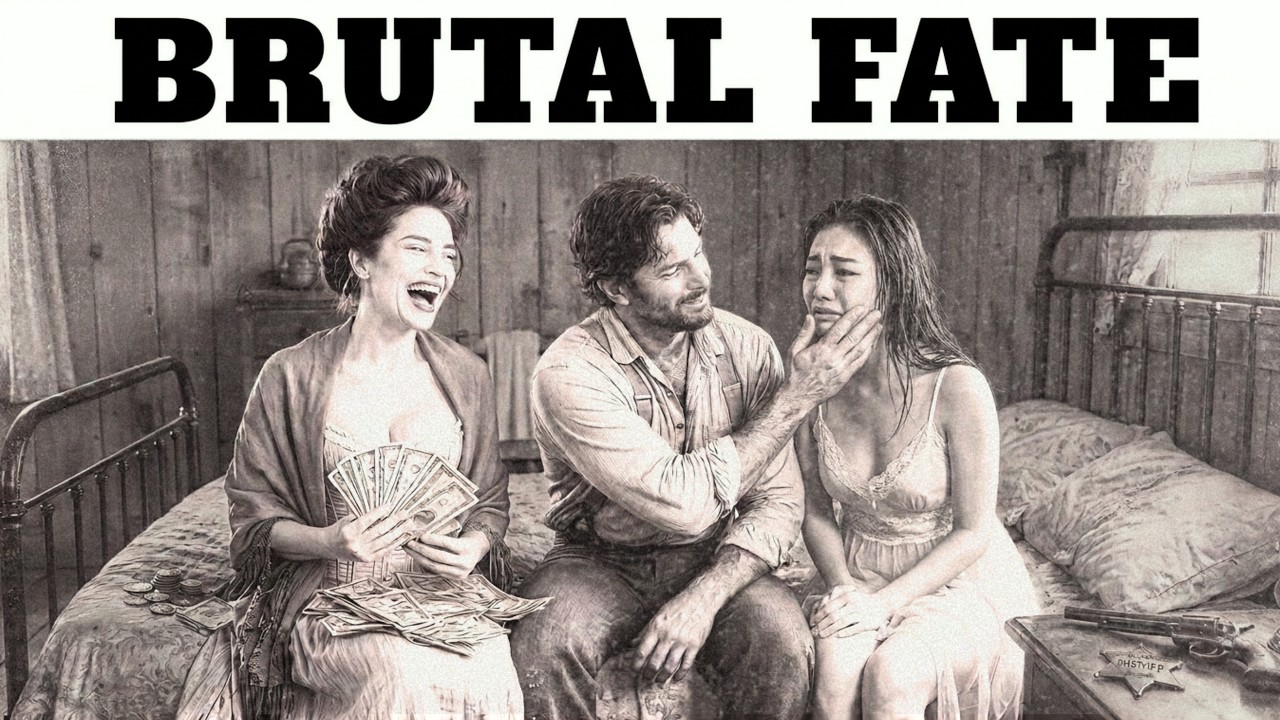
The story usually gets reduced to one sentence.
Chinese women were brought to the American West and sold as wives.
It sounds simple.
It was not.
Between the California Gold Rush and the exclusion era that followed, the lives of Chinese women in the West were shaped by several systems operating at once.
Poverty in southern China.
Family-arranged marriages.
Migration brokers.
Debt.
Domestic servitude.
Concubinage.
Commercial sex.
Human trafficking.
American immigration law.
Racial restrictions on marriage.
And a frontier society containing enormous numbers of Chinese men but extraordinarily few Chinese women.
Sometimes a woman crossed the Pacific knowing she was going to marry a man selected by relatives.
Sometimes she had never seen his face.
Sometimes she expected employment and was offered marriage as part of the promise.
Sometimes the promise was a lie.
Sometimes her family believed they were placing her into domestic service.
Sometimes a broker sold her again after arrival.
And sometimes American officials looked at a completely legitimate wife and assumed she was secretly a prostitute.
That distinction is the key to understanding the real history.
Here are twenty-five brutal truths about Chinese women, marriage and trafficking in the American West.
25. “SOLD AS A WIFE” COULD DESCRIBE COMPLETELY DIFFERENT REALITIES.
The phrase sounds precise.
Historically, it is dangerously vague.
A family-arranged marriage was not automatically trafficking.
A woman traveling to join a husband was not necessarily coerced.
A girl transferred into domestic service was not automatically a bride.
And a woman working in prostitution was not automatically doing so involuntarily.
At the same time, all of those categories could overlap.
The National Park Service notes that impoverished Chinese families sometimes transferred girls into service, concubinage or wealthier households with the expectation that the arrangement could improve their prospects.
Unscrupulous procurers could then alter the agreement entirely and sell the girl into domestic servitude or commercial sex.
The brutal part is that the woman herself might be the last person told what arrangement had actually been made.
24. SOME FAMILIES REALLY DID SELL THEIR DAUGHTERS.
This fact should neither be romanticized nor used to stereotype an entire culture.
Extreme poverty mattered.
In nineteenth-century China, a struggling household might place a daughter into another family as a servant, concubine or dependent.
The arrangement could involve payment.
Sometimes parents believed their daughter would be fed more reliably or eventually receive better marriage prospects.
Liang May Seen’s history, preserved by the National Park Service, describes this broader system.
Her procurer ultimately sold her into a San Francisco brothel instead of delivering the safer future that had been implied.
A transaction that began inside a poor family could become international trafficking once brokers entered the chain.
23. A PROMISE OF MARRIAGE COULD BE BAIT.
One of the most disturbing documented examples came later in the exclusion era.
Jeung Gwai Ying left China after a broker told her she could find work in America and perhaps marry a prosperous Chinese merchant.
The offer was attractive.
She was young.
Her family was poor.
America appeared to provide an escape.
After she passed immigration inspection, the man controlling her journey took her papers.
Then he sold her into prostitution in San Francisco.
That sequence reveals why historians must distinguish a marriage proposal from a marriage.
Sometimes “a husband in America” was not the destination.
It was the advertisement.
22. A GIRL COULD BE EXPECTED TO TAKE HER SISTER’S PLACE AS A BRIDE.
Tye Leung’s story sounds like frontier melodrama.
It is documented.
In 1899, her family arranged for her older sister to marry a much older man in Montana.
The sister refused.
She ran away with another man.
The family had already made the arrangement.
Their solution was to send young Tye instead.
Sources differ on whether she was twelve or fourteen.
Tye resisted and escaped to San Francisco’s Presbyterian Mission rather than accept the substitution.
She later became a translator helping other Chinese women escape exploitation.
The girl once expected to become a replacement bride eventually helped other women challenge the system that had tried to decide her future.
21. SOME WOMEN DID NOT MEET THEIR HUSBANDS UNTIL THEY REACHED THE AMERICAN WEST.
In Butte, Montana, historian Rose Hum Lee later interviewed first-generation Chinese women about their marriages.
Many marriages had been arranged through relatives.
One woman’s aunt selected a merchant in Butte who was too occupied with his business to return to China looking for a wife.
The ceremony occurred while the groom was absent.
The bride traveled across the Pacific.
When she finally arrived, a relative pointed toward a man smoking a large cigar.
That was her husband.
No dating.
No courtship in the modern sense.
Marriage came first.
Recognition came afterward.
20. A PROXY MARRIAGE COULD BE COMPLETELY LEGITIMATE AND STILL LEAVE A WOMAN WITH ALMOST NO INFORMATION ABOUT THE MAN SHE WAS JOINING.
Arranged marriage did not necessarily mean the woman had been purchased into slavery.
But it could place enormous risk on her.
Distance magnified that risk.
The husband might live in Montana.
California.
Idaho.
Nevada.
The bride’s family could know him primarily through kinship networks, business reputation or intermediaries.
Once she crossed the Pacific, reversing the decision was extraordinarily difficult.
Travel was expensive.
Immigration law was restrictive.
English might be unfamiliar.
Her entire American social world could consist of the husband and people connected to him.
A marriage negotiated across thousands of miles could therefore be consensual at the family level while leaving the bride with very little personal power.
19. THE HUSBAND’S OCCUPATION COULD DETERMINE WHETHER HIS WIFE WAS EVEN ALLOWED INTO AMERICA.
After Chinese exclusion hardened, class became extraordinarily important.
Chinese laborers faced severe restrictions.
Merchants belonged to an exempt category.
A merchant who could prove his legal status could sometimes leave the United States, return, and bring a wife and children.
The National Archives preserves extensive merchant files because officials demanded evidence of business ownership and family relationships.
That created a grotesque situation.
Two Chinese men could both be legally married.
One happened to own a qualifying business.
The other worked with his hands.
One might bring his wife.
The other might remain separated from his for years.
Marriage rights became partly a function of class.
18. FOR MANY LABORERS, AMERICA EFFECTIVELY SAID: YOU CAN WORK HERE, BUT YOUR WIFE CANNOT EASILY JOIN YOU.
This helped create the famous “bachelor society” of western Chinatowns.
It was not simply a cultural preference.
In Montana, official historical material notes that by the late nineteenth century merchants could bring wives under circumstances unavailable to ordinary laborers.
The gender imbalance became extreme.
There were roughly fourteen Chinese men for every Chinese woman in Montana in 1870.
By 1880, the ratio was about twenty to one.
By 1900, more than forty to one.
Then American observers looked at overwhelmingly male Chinese communities and said:
They do not form American families.
Government policy had helped prevent those families from forming.
17. THE PAGE ACT TURNED BEING A CHINESE WOMAN INTO EVIDENCE AGAINST YOU.
The Page Act of 1875 officially targeted involuntary labor, criminals and women brought for prostitution.
In practice, its enforcement focused heavily on Asian women, particularly Chinese women.
Immigration officials were given broad authority to determine whether a woman was arriving for “immoral purposes.”
The National Park Service concludes that the law functioned as an enormous barrier to Chinese female immigration.
A law supposedly aimed at trafficking therefore produced a remarkable result.
Actual victims could be excluded.
Legitimate wives could be excluded.
Ordinary women seeking opportunity could be excluded.
Their gender and ethnicity themselves became suspicious.
16. IMMIGRATION OFFICIALS COULD ASSUME A WIFE WAS REALLY A PROSTITUTE UNTIL SHE PROVED OTHERWISE.
This was not merely a social stereotype.
It influenced federal administration.
The National Archives preserves an 1895 statement from a customs official suggesting Chinese women could be presumed to have been brought for immoral purposes under the disguise of being wives or children.
Think about what that meant for a newly married woman.
She might possess a husband.
A marriage arrangement.
Family testimony.
Travel documents.
Yet the government could begin from the position that all of it was fraudulent.
Marriage did not automatically prove respectability.
For Chinese women, officials sometimes required respectability to prove marriage.
15. AN ACTUAL WIFE COULD BE CALLED AN “ALLEGED WIFE” FOR YEARS.
Quok Shee arrived at Angel Island in 1916 as the wife of Chinese merchant Chew Hoy Quong.
Federal officials consistently referred to her as his “alleged wife.”
They interrogated husband and wife separately.
They compared tiny details.
Officials suspected the relationship might be a front for prostitution.
Quok Shee remained detained for almost two years while appeals and investigations continued.
Whatever the ultimate complexities of her case, the bureaucratic language reveals the presumption.
The marriage did not belong to the couple until the government believed it.
14. SOME WOMEN CARRIED PAPERS ESSENTIALLY PROVING THEY WERE RESPECTABLE WIVES.
Mrs. Wo Hop lived in Butte, Montana.
Even her first name has disappeared from the historical record.
What survives is documentation emphasizing that she was married, supported by her husband and married to a merchant rather than a laborer.
Those facts protected her legal position.
The document is extraordinary precisely because it looks so ordinary.
A married woman carried paperwork demonstrating that she was the correct kind of Chinese woman.
A wife.
Dependent.
Respectable.
Attached to a commercially acceptable husband.
Without those characteristics, deportation could become a real threat.
13. THE SHORTAGE OF WOMEN MADE MARRIAGE ITSELF MORE VALUABLE.
When one sex vastly outnumbers the other, intimate relationships become part of an economy whether anyone wants them to or not.
Chinese communities in the United States remained overwhelmingly male for decades.
National Archives research notes that the population was more than ninety percent male between approximately 1860 and 1910.
That created demand.
For wives.
For prostitutes.
For domestic partners.
For servants.
For women who could help establish multigenerational households.
Scarcity did not mean every woman was sold.
It meant that legal access to Chinese women became unusually valuable.
That value attracted both legitimate marriage networks and criminal ones.
12. EXCLUSION CREATED A BLACK MARKET IN FAMILY IDENTITY.
When legal immigration becomes nearly impossible, legal identities acquire monetary value.
The 1906 San Francisco earthquake destroyed important public records.
Afterward, some Chinese residents claimed additional family relationships that could be used to bring other people into the country.
Slots identifying someone as a legal son or relative could be transferred or sold.
The people entering this way became known as “paper sons,” although women also navigated fabricated family identities.
The system was created in response to exclusion.
Then its existence convinced officials that every Chinese family claim deserved suspicion.
Fraud produced interrogation.
Interrogation encouraged more sophisticated fraud.
Legitimate families were trapped between both.
11. TRAFFICKERS LEARNED TO USE MARRIAGE LAW AS A SMUGGLING TOOL.
Criminal networks understood that wives of merchants and U.S.-born Chinese men had immigration advantages.
So false marriages became useful.
National Archives research documents trafficking organizations arranging sham marriages to Chinese merchants or American-born Chinese men.
Once admitted, some women were forced into prostitution rather than living as wives.
This is one reason federal officials became suspicious.
But it also created a terrible feedback loop.
Traffickers abused the wife category.
Officials responded by distrusting wives.
Real wives then suffered because traffickers had learned how to imitate them.
10. A WOMAN’S IMMIGRATION PAPERS COULD BECOME AN INSTRUMENT OF CONTROL.
Jeung Gwai Ying’s trafficker took possession of her documents after she arrived.
That mattered enormously.
A Chinese immigrant living under exclusion laws needed proof of legal identity.
Without papers, a woman could be vulnerable not only to her trafficker but also to immigration enforcement.
Her captor did not need chains around her wrists.
He could control her through language.
Money.
Documents.
Threats.
And the knowledge that the American government might treat her as an illegal immigrant rather than a victim.
The law surrounding her became part of the cage.
9. DEBT COULD FUNCTION LIKE OWNERSHIP.
Passage across the Pacific cost money.
Clothing cost money.
Food cost money.
Brokers charged fees.
Traffickers could convert all of those expenses into a supposed debt.
Then the debt justified continued labor.
A woman might be told she had to work until the transportation price was repaid.
But the person keeping the books also controlled the charges.
Debt therefore had the appearance of a contract while functioning like captivity.
This was particularly dangerous for women who had little English and no independent access to the bookkeeping supposedly proving how much they owed.
8. WOMEN COULD BE SOLD MORE THAN ONCE.
The idea of one man purchasing one woman and permanently turning her into his wife is too simple.
Women could move through several transactions.
Tien Fuh Wu’s father, facing gambling debts, sold her when she was a young girl.
She reached San Francisco using false papers and worked as a child servant—a mui tsai—inside a brothel.
She was later sold again to another woman who abused her badly before authorities intervened.
Her story shows why “sold as wives” can conceal the actual horror.
A child might be sold without becoming anyone’s wife at all.
Her market category could change according to what the next buyer wanted.
7. WOMEN COULD BE RESOLD AT ENORMOUS MARKUPS.
Trafficking was profitable precisely because women became commodities.
National Archives records from the later “Broken Blossoms” investigation describe testimony that one trafficked woman had been purchased in Hong Kong for roughly $200 and resold in the United States for about $5,000.
The exact figures belong to the later exclusion period, but the economic principle had existed much earlier.
A person’s price could increase simply by moving her across the Pacific and successfully passing American immigration controls.
The border did not necessarily destroy the market.
Sometimes it increased the value of the merchandise.
6. THE TRAFFICKING NETWORK DID NOT END IN SAN FRANCISCO.
San Francisco was often the gateway.
Women could then be moved deeper into the West.
Mining camps throughout California and the interior West contained Chinese female populations that were tiny compared with the number of men.
Some women were classified as prostitutes.
Others married merchants, laborers or local residents.
The National Archives notes that by 1880 the recorded number of Chinese women in prostitution in San Francisco had dropped partly because women had been moved to other California cities and western states.
The trafficking geography therefore followed the mining economy.
Men moved toward gold.
Businesses followed men.
Women could be moved as part of that commercial migration.
5. POLLY BEMIS WAS SOLD—BUT THE FAMOUS “POKER GAME” VERSION SHOULD BE TREATED WITH CAUTION.
Polly Bemis became one of Idaho’s best-known Chinese pioneers.
Her story accumulated mythology.
The Idaho State Historical Society says the broad outline is supported: her struggling family sold her, smugglers transported her to Portland, and she was subsequently sold to a man in Warren, Idaho.
She later developed a relationship with saloon owner Charlie Bemis and married him in 1894.
But colorful claims that she was simply won in a poker game have long been repeated beyond what the documentary evidence can firmly establish.
The distinction matters.
The real story was already extraordinary.
It did not need a saloon legend added to it.
4. MARRYING LATER DOES NOT MAKE THE ORIGINAL SALE CONSENSUAL.
Stories like Polly Bemis can easily be rewritten as frontier romance.
A Chinese woman is brought west.
She meets a man.
Eventually they marry.
Happy ending.
But a later marriage cannot retroactively transform trafficking or sale into consent.
Human beings adapt to terrible circumstances.
They form friendships.
They choose partners.
They create families.
Those later choices belong to them.
They do not erase what happened before.
This distinction is essential when reading Old West biographies, because later white writers often turned coercive beginnings into romantic adventure.
3. SOME WOMEN RAN AWAY FROM ARRANGED MARRIAGES BECAUSE THEY WANTED TO CHOOSE THEIR OWN HUSBANDS.
The Mission Home in San Francisco did not shelter only women escaping brothels.
National Park Service history notes that some women sought refuge from arranged or abusive marriages.
Some prostitutes entered the home while trying to marry men they had chosen themselves.
Others temporarily sought protection while negotiating difficult family relationships.
This complicates the idea that Chinese women were simply passive victims.
They resisted.
They negotiated.
They fled.
They used courts.
They used missions.
They found allies.
They sometimes rejected both family and trafficker expectations.
2. EVEN THE PEOPLE WHO RESCUED WOMEN OFTEN WANTED TO DECIDE WHAT A “GOOD WOMAN” SHOULD BECOME.
The Presbyterian Mission Home saved women from genuine exploitation.
Its staff offered shelter, education, legal assistance and protection.
Women such as Liang May Seen escaped abusive situations through its doors.
But the institution was also Christian and reformist.
Missionaries encouraged conversion.
They taught Victorian domestic ideals.
They frequently prepared women for Christian marriage or religious service.
NPS historians emphasize that some residents rejected those expectations and did not convert.
So a woman might escape one system controlling her life only to enter another institution with strong ideas about what her future should look like.
The difference was enormous—one offered protection rather than ownership—but complete autonomy was still difficult to find.
1. THE BRUTALEST TRUTH: AMERICA USED THE REAL TRAFFICKING OF SOME CHINESE WOMEN AS A REASON TO KEEP ALMOST ALL CHINESE WOMEN OUT.
This is the contradiction beneath the entire story.
Trafficking existed.
Forced prostitution existed.
Girls were sold.
Women were deceived with promises of work and marriage.
Those abuses were real.
The United States could have responded by targeting traffickers.
Protecting victims.
Creating legal migration pathways.
Prosecuting coercion.
Instead, the Page Act gave officials enormous power to stop Asian women at the border.
Chinese women increasingly had to prove they were not prostitutes before they could enter.
The result was devastating.
Wives remained in China.
Husbands remained in America.
Children grew up separated from fathers.
Western Chinese communities became overwhelmingly male.
Then Americans pointed at those same communities and argued that Chinese people did not form normal families.
The government had helped prevent family life—
then used the absence of family life against the people it had separated.
American marriage law tightened the trap further.
By 1869, several western states already banned marriages between whites and Chinese or other people classified under racist Asian categories.
Nevada adopted such a ban in 1861.
California expanded its anti-miscegenation restrictions to Chinese people in 1880.
Montana later prohibited Chinese residents from marrying outside their race from 1909 until 1953.
Consider the combined effect.
Chinese men were prevented from easily bringing wives from China.
Chinese women trying to enter America were presumed sexually suspicious.
Interracial marriage could be illegal.
Naturalization was racially restricted.
Then society condemned western Chinatowns for containing too many unmarried men.
That was not merely hypocrisy.
It was policy creating a social condition and then treating that condition as racial evidence.
And through all of this, Chinese women continued arriving when they could.
Some entered arranged marriages and built stable families.
Butte historian Rose Hum Lee later found large first-generation Chinese families with multiple children and strong kinship networks.
Leung Shee became the wife of San Diego merchant Tom Ah Quin and raised twelve children there.
Others escaped arrangements they rejected.
Tye Leung refused to become a substitute bride, eventually entered federal service at Angel Island and became the first Chinese woman known to vote in the United States.
Some former prostitutes married men they chose.
Some remained unmarried.
Some disappeared from the documentary record completely.
And some women remained trapped.
That is why the phrase “Chinese women sold as wives” must be handled carefully.
It contains truth.
But only part of it.
There were girls sold by desperate families.
There were women promised husbands who instead encountered traffickers.
There were proxy brides who voluntarily entered arranged marriages but did not meet their husbands until America.
There were women passed from owner to owner.
There were women using marriage categories to evade racist immigration laws.
There were traffickers using those same categories to exploit them.
There were real wives whom American officials treated as prostitutes.
There were prostitutes who later became wives.
There were wives who fled marriages.
There were daughters who refused to become brides at all.
The frontier did not create one Chinese female experience.
It created a brutal collision between private family customs, global poverty, American racism and an immigration system obsessed with deciding which Asian women were morally acceptable.
And perhaps the darkest irony is this:
The American government claimed it was protecting Chinese women from being sold.
Yet the laws it created made legal female migration so difficult that the ability to cross the border became more valuable—
and therefore more profitable for the very brokers and traffickers those laws were supposed to destroy.
The woman standing at the center of that system could be questioned by her parents.
Her broker.
Her husband.
Her owner.
Her missionary.
Her immigration inspector.
Her judge.
Almost everyone was allowed to ask what kind of woman she was.
The hardest thing was allowing her to answer for herself.


