Ethel Kennedy and Her 11 Children: The Tragedies That Haunted the Kennedy Family for 56 Years
In June 1968, Ethel Kennedy was pregnant with her eleventh child, traveling beside her husband, Robert F. Kennedy, as he pursued the presidency. Ten children waited at home, and a political victory seemed to bring the family closer to a future filled with promise. Then, in a matter of minutes, everything changed.
On the night of June 4, Robert Kennedy won the California Democratic primary, strengthening his campaign for the Democratic presidential nomination. Ethel stood beside him at the Ambassador Hotel in Los Angeles, where supporters celebrated a victory that appeared to bring the White House within reach.
Shortly after midnight on June 5, Kennedy was shot while walking through a hotel kitchen pantry. As panic spread, Ethel pushed through the crowd and knelt beside her husband, stroking his face and pleading for people to give him room to breathe.
Among the most heartbreaking details was the experience of their twelve-year-old son, David, who watched the chaotic news coverage from a hotel room before an adult could explain what had happened. Less than a day earlier, his father had rescued him from dangerous surf at a Malibu beach house.
Robert Kennedy was rushed to Good Samaritan Hospital, where surgeons fought to save his life. Ethel remained at his bedside with family members throughout the night. At 1:44 a.m. on June 6, 1968, Kennedy died at just 42 years old.
Ethel was 40, suddenly widowed with ten children ranging in age from infancy to sixteen, and three months pregnant with another. The woman who had helped build one of America’s most recognizable political families now faced the impossible task of raising eleven children without the husband who had been at the center of their lives.
Ethel Skakel had been born in Chicago on April 11, 1928, into a wealthy, energetic, and deeply Catholic family. Her father made his fortune in the coal business, and she grew up riding horses, playing sports, and competing with her siblings.
At Manhattanville College, Ethel became close to Jean Kennedy, who introduced her to her older brother Bobby during a ski trip to Canada. The two shared a competitive spirit, a love of sports, and a strong Catholic faith. They married on June 17, 1950, in Greenwich, Connecticut.
Their first child, Kathleen, arrived in 1951. Ten more children followed over the next seventeen years: Joseph, Robert Jr., David, Courtney, Michael, Kerry, Christopher, Max, Douglas, and Rory. Their home at Hickory Hill in McLean, Virginia, became famous for its noise, animals, impromptu games, and stream of political leaders, celebrities, and friends.
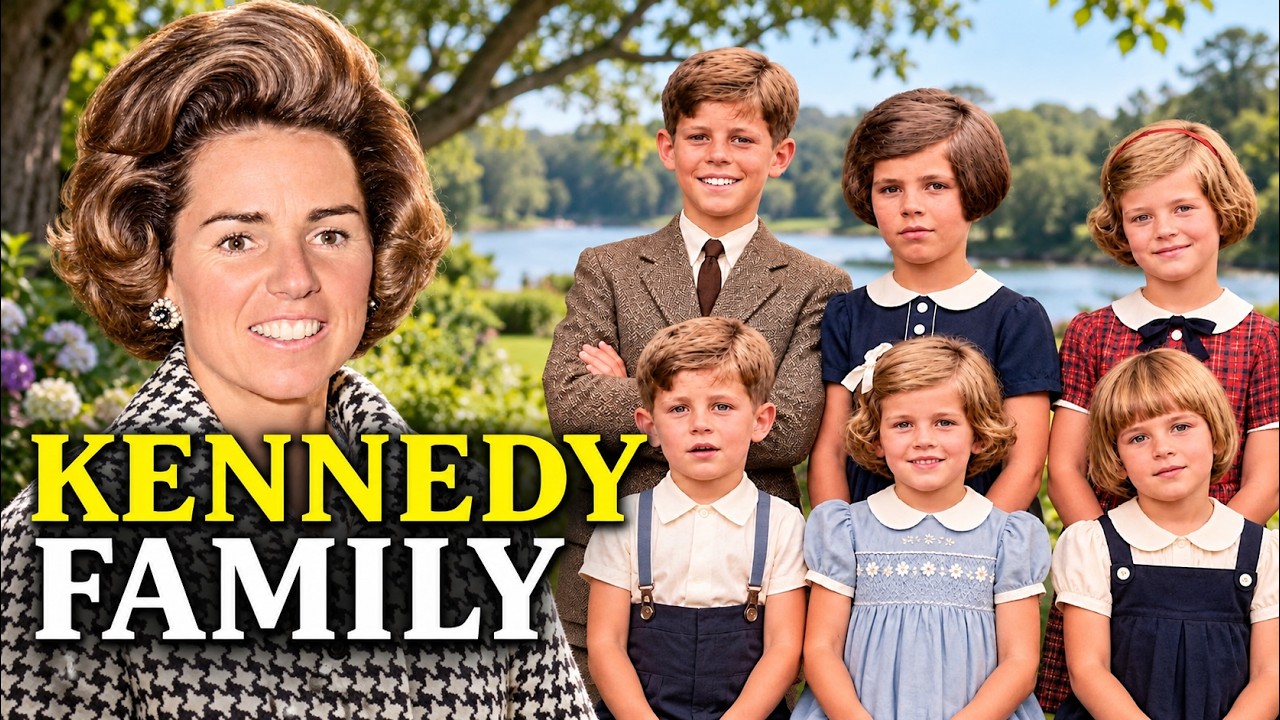
Visitors remembered children racing through the house, dogs and horses roaming the grounds, and guests sometimes finding themselves pulled into touch football games or even pushed into the swimming pool. For Ethel and Bobby, family life was busy, chaotic, and full of energy.
But Ethel had already experienced devastating loss. In 1955, her parents died when their private plane crashed over Oklahoma. Her brother George Jr. later died in another plane crash in 1966. She had also watched her husband endure profound grief after his brother President John F. Kennedy was assassinated in Dallas in November 1963.
When Robert Kennedy entered the Senate and later launched his presidential campaign, Ethel became a constant presence beside him. His assassination abruptly ended that life. Six months after his death, on December 12, 1968, she gave birth to Rory Elizabeth Katherine, a daughter who would never meet her father.
Ethel refused to remarry. She remained at Hickory Hill, determined to preserve the lively family environment she and Bobby had created. Yet the children carried their grief in different ways, and some struggled for years to escape its effects.
The first major crisis involving one of the older children came in August 1973, when Joseph Kennedy II was driving a Jeep on Nantucket Island. His brother David and several young women were passengers when the vehicle overturned during what accounts described as reckless driving.
Pam Kelley, who was dating David, suffered a severe spinal injury that left her paralyzed from the waist down. David also sustained a back injury that later contributed to his use of powerful painkillers. Joe was charged with reckless driving and fined $100, a penalty many considered inadequate given the consequences of the crash.
Joe eventually built a career in public service. In 1979, he founded Citizens Energy, an organization that helped provide heating assistance to low-income families. He later served in Congress for twelve years, representing Massachusetts, but controversies surrounding his personal life would also draw public attention.
For David, however, the consequences of the Nantucket accident were only part of a much longer struggle. He had watched his father’s assassination on television as a child, and his grief followed him into adolescence. His use of drugs deepened after the accident, and repeated attempts at treatment failed to provide lasting relief.
On April 25, 1984, David was found dead in his room at a hotel in Palm Beach, Florida. Authorities determined that he had died from an accidental drug overdose. He was only 28.
For Ethel, losing David meant burying a child whose pain had been visible for years but had never fully subsided. The death also intensified concern for another son, Robert F. Kennedy Jr., who had struggled with drugs after his father’s assassination.
Robert Jr. was arrested in 1983 after heroin was found in his possession following a medical emergency aboard a flight that landed in South Dakota. He pleaded guilty and received probation and community service. That obligation introduced him to environmental advocacy, eventually leading him to work with Riverkeeper and become a prominent environmental lawyer.
His professional life developed into a long career in environmental activism. His personal life, however, brought another devastating loss. After divorcing his first wife, he married Mary Richardson in 1994, and they had four children together.
Their marriage later broke down, and Robert Jr. filed for divorce in 2010. On May 16, 2012, Mary was found dead at the family’s home in Bedford, New York. Her death was ruled a suicide. She was 52, leaving four children behind.
Another of Ethel’s sons, Michael Kennedy, appeared to have found stability through family life, business, and charitable work. He married Victoria Gifford in 1981 and became involved in Citizens Energy, later helping manage his uncle Ted Kennedy’s Senate reelection campaign.
In 1997, reports emerged alleging an inappropriate relationship between Michael and a teenage girl who had worked as a babysitter for his family. The allegations triggered a public scandal and damaged his marriage. Prosecutors investigated, but no charges were filed.
On December 31, 1997, Michael was skiing in Aspen, Colorado, during a family holiday. He was reportedly skiing backward while trying to catch a football when he struck a tree. He suffered fatal head injuries and died at 39. His death made him the second of Ethel’s sons to die young.
The Kennedy family barely had time to recover before another tragedy interrupted a celebration. In July 1999, Ethel’s youngest daughter, Rory, was preparing to marry filmmaker Mark Bailey at the family compound in Hyannis Port.
John F. Kennedy Jr., the son of the assassinated president, planned to attend with his wife, Carolyn Bessette Kennedy, and her sister, Lauren. On July 16, John piloted a small plane from New Jersey toward Massachusetts. The aircraft disappeared over the Atlantic near Martha’s Vineyard, killing all three people aboard.
Rory’s wedding was postponed as the family waited for news. The gathering that had been planned as a joyful celebration became a place of mourning. Rory and Bailey married later that year in a quieter ceremony.
Ethel’s children pursued different paths, but public attention continued to follow the family. Kerry Kennedy became a human rights advocate and led the organization established in her father’s memory. Kathleen Kennedy Townsend entered politics and served as lieutenant governor of Maryland. Christopher Kennedy worked in business and later ran unsuccessfully for governor of Illinois.
Courtney Kennedy Hill, meanwhile, faced a deeply personal tragedy in 2019. Her daughter, Saoirse Kennedy Hill, had spoken publicly as a teenager about depression and the importance of discussing mental health. On August 1, 2019, Saoirse was found unresponsive at the Kennedy family compound in Hyannis Port. Authorities later ruled her death an accidental overdose. She was 22.
Less than a year later, tragedy struck another branch of the family. Maeve Kennedy McKean, a public health and human rights professional, was staying with her family at her mother’s home on the Chesapeake Bay in April 2020.
On April 2, Maeve and her eight-year-old son, Gideon, entered a canoe after a ball rolled into the water. Strong winds carried them away from shore, and they were unable to return. Their overturned canoe was later discovered. Maeve’s body was recovered on April 6, and Gideon’s was found two days later.
Maeve was 40. Gideon was eight. Kathleen Kennedy Townsend had lost both her daughter and grandson in a single accident, while Maeve’s two younger children were left without their mother.
The family also remained divided over the assassination that had changed their lives. Sirhan Sirhan, convicted of killing Robert Kennedy, was sentenced to death in 1969, but his sentence was later changed to life imprisonment after California briefly abolished capital punishment.
In 2021, a parole board recommended his release, prompting disagreement among Kennedy family members. Robert Jr. and Douglas supported release, while several siblings opposed it. Ethel issued a rare public statement saying that Sirhan should not be paroled. In January 2022, California Governor Gavin Newsom rejected the recommendation.
Political differences would later create another family rift. Robert F. Kennedy Jr. announced his presidential campaign in 2023, eventually leaving the Democratic primary to run as an independent. In August 2024, he suspended his campaign and endorsed Donald Trump, a decision that drew public criticism from several of his siblings, who said they believed it conflicted with the values associated with their father.
Robert Jr. maintained that he was pursuing causes he believed important. In February 2025, he was confirmed as U.S. Secretary of Health and Human Services, placing him at the center of national debates over vaccines and public health.
Ethel did not live to see that chapter. In her later years, she largely withdrew from politics, focusing on her children, grandchildren, and the Robert F. Kennedy Human Rights organization. She sold Hickory Hill in 2009 after more than half a century of family life there.
In 2012, her daughter Rory released a documentary titled Ethel, offering a rare look at her mother’s life, marriage, and grief. Ethel spoke affectionately about Bobby but rarely dwelled on the night he died. Her focus remained on the family they had built together.
In November 2014, President Barack Obama awarded Ethel the Presidential Medal of Freedom in recognition of her work for human rights and justice. She continued to attend Mass and take part in family life, surrounded by generations of children and grandchildren.
In early October 2024, Ethel suffered a stroke. She died on October 10 at the age of 96, fifty-six years after her husband. Her funeral took place at Our Lady of Victory Church in Centerville, Massachusetts, with family members and President Joe Biden among those attending.
She had outlived her husband, two of her sons, a granddaughter, a great-grandson, and numerous other relatives. Yet she had also lived to see her family grow into a vast network of grandchildren and great-grandchildren, many of whom knew Robert Kennedy only through photographs and stories.
Nine of Ethel’s eleven children were still alive at the time of her death. They carried forward different parts of their father’s legacy through politics, journalism, business, environmental advocacy, filmmaking, and human rights work. Their lives were not free of controversy or conflict, but each had been shaped by the same extraordinary family history.
For nearly six decades, Ethel Kennedy lived with the consequences of a single night in a Los Angeles hotel. The assassination of Robert Kennedy did not simply end a presidential campaign; it changed the childhoods of eleven children and set a family on a long, uneven path through grief and recovery.
The photograph of Ethel sitting beside her husband’s coffin aboard the funeral train remains a powerful image of that loss. She was forty years old, pregnant, and suddenly responsible for ten children. Along the tracks, crowds gathered to say goodbye to a man many believed might change the country.
Ethel lived another fifty-six years. She could not protect her family from every tragedy, nor could she prevent the struggles that followed them into adulthood. But she continued to gather her children around her, preserve her husband’s memory, and support causes connected to the values they had shared.
Her story was not one of unbroken strength or a family untouched by failure. It was the story of a woman who endured extraordinary loss and continued to build a life around the people who remained.
Robert Kennedy never met the daughter born after his death, and he never saw the grandchildren and great-grandchildren who would carry his name into another generation. But through Ethel, his family continued long after the night that changed everything.


