Cinderella’s Dark Origins: The Ancient Myths, Restless Spirits, and Bloody Secrets Behind the Fairy Tale
Cinderella is one of the most beloved fairy tales in the world, a story of a mistreated young woman who rises from a life of hardship to become a princess. With her magical transformation, sparkling slippers, and romantic ending, the familiar version promises that kindness will eventually triumph over cruelty. But the story’s history is far more complicated, filled with ancient legends, supernatural guardians, brutal punishments, and historical figures whose lives were darker than fiction.
Long before a fairy godmother waved her wand or a pumpkin became a golden carriage, stories resembling Cinderella circulated across different cultures. Some featured magical animals, others relied on the spirits of deceased mothers, and some contained disturbing acts of violence. Together, these variations reveal how a simple tale of transformation evolved through centuries of changing beliefs about family, beauty, justice, and power.
The version most familiar to Western audiences comes from French author Charles Perrault’s 1697 collection, Histoires ou contes du temps passé. In his telling, Cinderella suffers under the control of a cruel stepmother and two vain stepsisters. Despite their mistreatment, she remains gentle and patient, completing their chores while dreaming of a life beyond the ashes of the hearth.
Her opportunity arrives when the king’s son hosts a grand ball. Unable to attend, Cinderella weeps until her fairy godmother appears and transforms a pumpkin into a carriage, mice into horses, and a rat into a coachman. Her ragged clothing becomes a magnificent gown, and glass slippers complete the transformation. But the magic comes with one condition: everything will return to its original form at midnight.
At the ball, the prince becomes captivated by the mysterious young woman. Cinderella escapes when the clock strikes twelve, leaving behind one glass slipper. The prince searches the kingdom for its owner, and when the slipper finally fits Cinderella, her hidden identity is revealed. She marries the prince and, in Perrault’s version, forgives her stepsisters, even helping them find suitable husbands.
Yet the glass slipper itself has become the subject of debate. A popular theory suggests that Perrault’s glass may have resulted from confusion between the French words verre, meaning glass, and vair, referring to a type of fur. The theory remains disputed, and there is no definitive proof that a mistranslation created the famous slipper. Regardless of its origin, the glass shoe became one of the tale’s most recognizable symbols: delicate, extraordinary, and capable of identifying one woman among an entire kingdom.
Cinderella’s story, however, reaches far beyond seventeenth-century France. One of its earliest recorded relatives appears in an account of an Egyptian legend written by the Greek historian Strabo around the beginning of the first century AD. The heroine, Rhodopis, was a Greek woman living in Egypt who was associated with a remarkable sandal incident.
According to Strabo, an eagle seized one of Rhodopis’s sandals while she was bathing and carried it to Memphis. The bird dropped the sandal into the lap of the king, who was struck by its unusual beauty and the extraordinary circumstances of its arrival. He sent men throughout the country to find the woman who wore it. When Rhodopis was discovered, she was brought to Memphis and became the king’s wife.
The story bears a striking resemblance to Cinderella’s lost slipper, although its setting and details differ considerably. An eagle replaces the fairy godmother, and the king’s search replaces the prince’s romantic pursuit. The divine significance of the bird may also reflect Egyptian religious symbolism, where falcons and other birds of prey were associated with Horus and royal authority.
Rhodopis may have been based on a real historical woman. Herodotus, writing centuries before Strabo, described a Greek courtesan of that name who lived in Egypt and acquired considerable wealth. However, he did not record the sandal story or a marriage to a pharaoh. The romantic episode therefore belongs to the realm of legend rather than established biography, blending a potentially historical figure with a tale of extraordinary fortune.
A different version emerged in China. Known as the story of Ye Xian, it appeared in a ninth-century collection attributed to Duan Chengshi and contains many familiar Cinderella elements, but its supernatural helper is not a fairy godmother. Instead, it is a magical fish connected to the heroine’s deceased mother.
Ye Xian loses her mother and later her father, leaving her vulnerable to a cruel stepmother and stepsister. Forced into exhausting labor and dressed in rags, she finds comfort in a beautiful golden fish that lives in a nearby body of water. She feeds it and treats it as a companion, unaware that it possesses supernatural significance.
When the stepmother discovers the friendship, she kills the fish and eats it. Ye Xian is devastated until a mysterious spirit reveals that the fish’s bones can grant her wishes. She preserves them and eventually uses their power to obtain beautiful clothing and golden slippers for a festival.
At the celebration, Ye Xian attracts attention but flees when her stepsister suspects her identity. She loses one of her slippers, which passes through several hands before reaching a king. Fascinated by its delicate size, he searches for the woman who can wear it. Eventually, Ye Xian is discovered, and her extraordinary story leads to her marriage to the king.
The similarities are unmistakable: a mistreated young woman, supernatural assistance, a special pair of shoes, a hurried escape, and a royal search. Yet Ye Xian’s story carries a different emotional weight because the magical fish connects her to her mother’s memory. The help she receives is not merely an unexpected gift; it preserves a bond between a daughter and the family she has lost.
That connection becomes especially important in European versions collected by the Brothers Grimm. Their Cinderella, known as Aschenputtel, does not receive a fairy godmother or a pumpkin carriage. Instead, she plants a hazel tree on her mother’s grave, watering it with her tears. Birds associated with the tree help her obtain what she needs and assist her during her struggle to attend the royal festivities.
The mother’s influence continues beyond death, transforming grief into a source of protection. Such imagery resembles older beliefs in ancestral spirits, although the presence of a grave, tree, or helpful animal does not prove that the tale directly preserves a particular pre-Christian ritual. Rather, it illustrates how folklore repeatedly gives supernatural form to the enduring emotional relationship between the living and the dead.
The Grimm version is also much harsher than Perrault’s. When the prince searches for the woman whose foot fits the slipper, the stepsisters attempt to force themselves into it. One cuts off her toes, while the other cuts away part of her heel. Their mother encourages the deception, hoping that one of her daughters will become queen.
The trick fails when birds expose the blood on their feet. At Cinderella’s wedding, those same birds punish the stepsisters by pecking out their eyes. The ending transforms the story from a gentle celebration of forgiveness into a warning about vanity, deception, and the consequences of cruelty.
An even darker European relative appears in Giambattista Basile’s The Pentamerone, published posthumously between 1634 and 1636. Its Cinderella-like tale, commonly known as The Cat Cinderella, follows a young woman named Zezolla, who is encouraged by her governess to murder her stepmother.
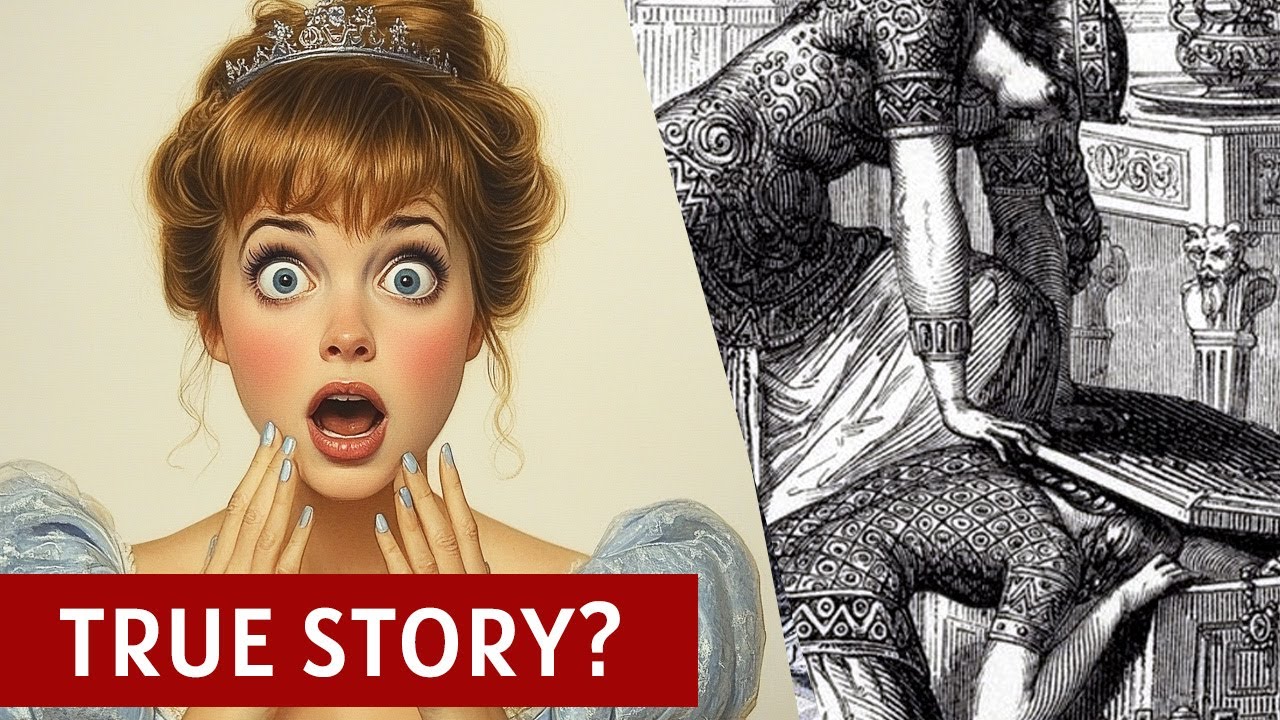
Zezolla kills the woman by slamming the lid of a heavy chest onto her neck. She then persuades her father to marry the governess, only to discover that her new stepmother has six daughters of her own. The young heroine is subsequently pushed into servitude and treated with contempt.
Eventually, supernatural assistance allows Zezolla to attend royal festivities, where the king becomes captivated by her. As in other versions, a lost slipper leads him to the woman he wishes to marry. But unlike Perrault’s patient heroine, Basile’s protagonist begins her journey through a deliberate act of murder, making the story’s transformation far more morally complicated.
The tale has sometimes been compared with the life of Fredegund, a sixth-century Frankish queen whose rise to power was accompanied by brutal political struggles. Fredegund became associated with accusations of murder and intrigue, including the killing of Queen Galswintha, whose death helped fuel a bitter conflict between rival royal families.
Historical accounts also describe violent acts within the Merovingian royal household, and some details resemble scenes found in later folklore. However, a direct connection between Fredegund and Basile’s fictional heroine has not been established. The similarities are intriguing, but they do not prove that The Cat Cinderella was based on the queen’s life.
Across these variations, Cinderella’s central transformation remains remarkably consistent. A young woman is deprived of status and security, receives assistance from an unexpected source, and eventually finds a way to escape the conditions imposed upon her. What changes is the meaning of that assistance. It may come from a fairy, a magical fish, birds in a sacred tree, or a mysterious force that seems to reach beyond death.
The story also reveals the changing ideals of the societies that retold it. In some versions, beauty and tiny feet help determine a woman’s future. In others, obedience and patience are rewarded, while deception brings painful consequences. Some endings celebrate forgiveness; others insist upon revenge.
Cinderella has survived because it can absorb these different fears and hopes without losing its essential shape. Beneath the glass slipper and royal wedding lies a much older human concern: how someone trapped by circumstances might find a path toward freedom.
The familiar fairy tale may promise that goodness will eventually be rewarded, but its darker ancestors remind us that transformation is rarely simple. Sometimes it begins with grief, sometimes with injustice, and sometimes with acts that leave lasting scars. Cinderella’s journey is not just a passage from rags to riches. It is a story continually reshaped by the cultures that tell it, carrying their ideas about family, power, suffering, and the possibility of a different life.


