On November 22, 1963, Harry S. Truman was seventy-nine years old, living in retirement in Independence, Missouri, when news arrived that President John F. Kennedy had been shot in Dallas, Texas. Nearly eleven years had passed since Truman left the White House, but he understood better than almost anyone what the sudden death of an American president could mean for the country.
He had experienced that moment himself.
On April 12, 1945, Truman had been vice president for less than three months when Franklin D. Roosevelt died unexpectedly. Within hours, he became president of a nation fighting a global war, confronting extraordinary military decisions, and preparing to shape the international order that would emerge after victory.
Eighteen years later, Truman was no longer responsible for making those decisions. He was a former president, an elder statesman, and a man who had spent much of his retirement reflecting on the responsibilities of the office he once held.
Yet the news from Dallas reached him with unmistakable force.
When reporters asked for his reaction, Truman did not deliver an elaborate speech about American democracy or international politics. He spoke in the direct, unpolished language that had defined his public career.
He said he was shocked and hurt. He described Kennedy as a good man and an able president. Then he condemned the person responsible for the shooting in characteristically blunt terms.
It was a brief statement, but it carried considerable historical weight.
Only three years earlier, Truman had publicly questioned whether Kennedy possessed the experience necessary to become president. He had expressed serious reservations about the Kennedy family, particularly the influence of John’s father, Joseph P. Kennedy Sr. He had preferred other Democratic candidates and had not concealed his doubts about the young senator from Massachusetts.
Now the former president was mourning the man whose candidacy he had once opposed.
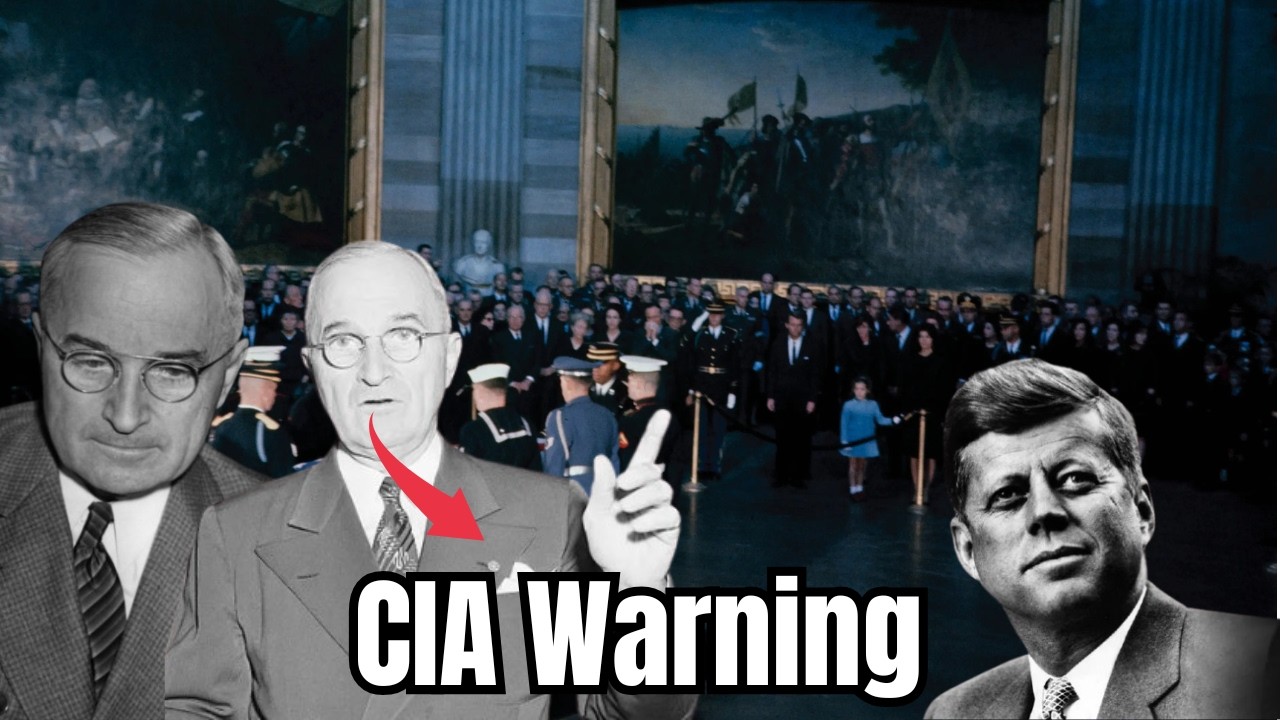
And exactly one month after the assassination, an even more remarkable document appeared under Truman’s name in The Washington Post.
Its subject was the Central Intelligence Agency.
Truman had signed the legislation establishing the CIA in 1947. But in December 1963, he publicly warned that the agency had expanded beyond the intelligence responsibilities he believed it was supposed to perform.
The timing was extraordinary.
The article appeared during a period of national grief, political uncertainty, and growing questions about the assassination.
Its later interpretation would become deeply controversial.
Some readers regarded Truman’s warning as evidence that the former president was alarmed by the power of an intelligence organization he had helped create. Others suggested that the article’s publication so soon after Kennedy’s death carried implications about the assassination itself.
The surviving record supports a more careful conclusion.
Truman did publicly express grief over Kennedy’s death. He did attend the funeral. He did raise concerns about the CIA’s operational activities in an article published one month later.
But the article did not accuse the CIA of assassinating Kennedy, and its timing alone cannot establish such a connection.
The deeper story is one of political rivalry transformed into respect, personal grief shaped by presidential experience, and a former president’s continuing concern about the institutions of American government.
To understand Truman’s reaction, it is necessary to return to the 1960 presidential campaign, when the relationship between the two men was anything but comfortable.
Harry Truman had been born on May 8, 1884, in Lamar, Missouri. He grew up in the state and developed a political identity rooted in local Democratic Party organizations, military service, and a practical understanding of government.
He served in World War I, entered Missouri politics, and eventually became a United States senator.
In 1944, he was selected as Franklin Roosevelt’s running mate.
Roosevelt’s death the following April placed Truman in the presidency at one of the most consequential moments in modern history.
He oversaw the final months of World War II, authorized the use of atomic bombs against Japan, confronted the emerging Soviet challenge, and helped establish the institutions that would define American foreign policy during the Cold War.
His administration supported the Marshall Plan, the creation of NATO, and the policy of containing Soviet expansion.
He also made difficult domestic decisions, including the desegregation of the armed forces.
By the time he left office in January 1953, Truman had experienced intense political criticism, military conflict, and the burdens of presidential responsibility.
His presidency was followed by Dwight D. Eisenhower’s administration.
Truman returned to Independence with his wife, Bess, and resumed a life that was considerably more modest than the lifestyles associated with many later political figures.
He wrote his memoirs, corresponded with friends and political leaders, and remained active in Democratic Party affairs.
The Harry S. Truman Presidential Library opened in Independence in 1957, providing a permanent home for the documents and history of his administration.
Truman became closely associated with the library and regularly participated in its activities.
He also maintained his famous morning walks, which reinforced his public image as an unusually accessible former president.
But retirement did not mean political silence.
Truman continued offering opinions about national affairs.
He remained fiercely loyal to the Democratic Party and frequently expressed his views with the bluntness that had made him famous.
When the 1960 presidential campaign began, he took a particular interest in the Democratic nomination.
John F. Kennedy was emerging as one of the party’s most prominent contenders.
Born in 1917, Kennedy was thirty-three years younger than Truman.
He had served in the Navy during World War II, represented Massachusetts in the House of Representatives, and entered the Senate in 1953.
His youth, public speaking ability, and political organization made him an increasingly formidable candidate.
But Truman had reservations.
He believed the presidency required substantial experience.
Kennedy was only forty-three years old during the election year.
Although the Constitution permitted someone of that age to serve, Truman questioned whether the senator was prepared for the enormous responsibilities of the office.
His concerns were not limited to age.
Truman also distrusted Joseph P. Kennedy Sr., the candidate’s wealthy and politically influential father.
The elder Kennedy had served as American ambassador to the United Kingdom during the Roosevelt administration.
His controversial political positions and earlier attitudes toward European affairs had damaged his reputation among many Democrats.
Truman was particularly troubled by the elder Kennedy’s associations and political influence.
He feared that the family’s wealth and organization might exercise excessive control over the nomination process.
His criticism sometimes took the form of sharp humor.
One remark attributed to Truman captured his concern about Joseph Kennedy’s influence by contrasting the Pope with the candidate’s father, whom he called Pop.
The comment reflected Truman’s belief that the central political issue was not Kennedy’s Catholic faith but the influence of his powerful family.
Religion was nevertheless a major issue in the 1960 election.
Kennedy was seeking to become the first Roman Catholic elected president of the United States.
Some voters questioned whether a Catholic president could remain independent of religious authority.
Kennedy repeatedly emphasized the separation of church and state.
Truman’s reservations, however, were more closely associated with experience and family influence.
He preferred other potential Democratic nominees, including Senator Stuart Symington of Missouri and Senate Majority Leader Lyndon B. Johnson of Texas.
Both had substantial political experience.
Truman believed the party had alternatives who were better prepared for the presidency.
As Kennedy’s campaign gained momentum, Truman’s public criticism became an increasingly sensitive matter.
The Democratic Party needed unity if it hoped to defeat the Republican nominee, Vice President Richard Nixon.
Kennedy’s supporters were concerned that opposition from a former Democratic president could weaken the campaign.
The dispute became especially visible before the Democratic National Convention.
Truman questioned whether Kennedy should receive the nomination and suggested that the party needed a candidate with greater experience.
Kennedy responded by defending his qualifications.
He had served in Congress for years, participated in national security debates, and developed a substantial record in public office.
The disagreement reflected more than personal tension.
It represented a generational division within the Democratic Party.
Truman belonged to the political world of Roosevelt, World War II, and the early Cold War.
Kennedy represented a younger generation promising energy, modernization, and a new approach to leadership.
The party ultimately chose Kennedy.
At the Democratic National Convention in Los Angeles in July 1960, Kennedy secured the presidential nomination.
He selected Lyndon Johnson as his running mate.
The choice helped unite important factions of the party, including Southern Democrats and supporters of Johnson’s leadership experience.
Truman accepted the convention’s decision.
His loyalty to the Democratic Party remained stronger than his personal reservations about Kennedy.
That transition became visible during a meeting in Independence on August 20, 1960.
Kennedy visited Truman at the presidential library.
The occasion brought together the former president who had questioned his candidacy and the nominee who now needed Democratic unity.
Reporters naturally wanted to know whether Truman had changed his mind.
Had he withdrawn his criticism of Kennedy’s youth and experience?
Truman avoided an elaborate explanation.
He indicated that the Democratic National Convention had settled the matter.
The party had chosen its candidate.
For Truman, that decision was sufficient.
His response did not require him to deny that he had previously preferred someone else.
It allowed him to support Kennedy without pretending that the earlier disagreement had never existed.
The moment was characteristic of Truman’s political style.
He could argue forcefully during a nomination contest and then accept the party’s collective decision.
Once Kennedy became the nominee, Truman worked to help him win.
He campaigned during the general election, traveling across several states and speaking on behalf of the Democratic ticket.
His participation mattered because he retained influence among older Democrats and voters who remembered his presidency.
Truman did not possess Kennedy’s youthful appeal or television-friendly image.
His strengths were different.
He spoke with the authority of someone who had occupied the presidency during war and international crisis.
He understood the concerns of working-class voters and traditional Democratic constituencies.
His endorsement helped communicate that Kennedy had the support of the party’s established leadership.
The campaign remained intensely competitive.
Nixon was an experienced national figure who had served as Eisenhower’s vice president for eight years.
He possessed extensive foreign policy knowledge and was familiar to American voters.
Kennedy emphasized the need for renewed national leadership.
The candidates debated on television, introducing a new dimension to presidential campaigning.
Their contest became one of the closest elections in modern American history.
Kennedy won in November 1960.
The result placed the forty-three-year-old senator on the path to becoming the youngest person elected to the presidency.
Truman congratulated him.
Their relationship, which had begun with serious disagreement, gradually became more cordial.
The transition was especially visible after Kennedy’s inauguration in January 1961.
Truman returned to the White House as a guest of the new president.
For a former president, such a visit carried considerable symbolic meaning.
The Oval Office was a place Truman knew intimately.
He had occupied it during the final stages of World War II, the Berlin blockade, the Korean War, and numerous domestic controversies.
Now it belonged to a much younger man.
Kennedy welcomed him with respect.
The two presidents represented different eras, but they shared an understanding of the office’s responsibilities.
Truman knew that a president could be criticized by people who did not possess the information available inside the White House.
He also understood how quickly events could force decisions with enormous consequences.
Kennedy was beginning to discover those realities.
During his presidency, Kennedy faced the Bay of Pigs invasion, the Berlin crisis, the Cuban Missile Crisis, and growing tensions over civil rights.
He also pursued a major domestic legislative agenda and spoke about the need for a new generation of American leadership.
Truman observed these developments from retirement.
The two men were not intimate friends.
They did not share the same political temperament.
But their relationship had moved beyond the sharp divisions of the nomination campaign.
Truman respected the presidency as an institution.
Once Kennedy held the office, Truman regarded him as the legitimate leader of the country.
That respect shaped his response when the news from Dallas arrived.
On November 22, 1963, Kennedy traveled through downtown Dallas in an open presidential limousine.
He was accompanied by First Lady Jacqueline Kennedy, Texas Governor John Connally, and Connally’s wife, Nellie.
The presidential motorcade moved through Dealey Plaza shortly after noon.
Shots were fired.
Kennedy was struck and gravely wounded.
Governor Connally was also injured.
The limousine rushed toward Parkland Memorial Hospital.
Doctors attempted emergency treatment, but Kennedy’s wounds were fatal.
He was pronounced dead at 1 p.m. Central Standard Time.
The announcement shocked the nation.
Television networks interrupted their regular programming.
Radio stations broadcast emergency reports.
Government officials struggled to understand what had happened.
Americans gathered around televisions, telephones, and radios as information emerged.
For Truman, the news carried an additional personal dimension.
He had once experienced the sudden death of a sitting president from the perspective of the man required to assume power.
In April 1945, Roosevelt’s death had transformed Truman’s life within hours.
He had been vice president for only eighty-two days.
He was not fully informed about every major military and intelligence project underway.
Yet he immediately inherited responsibility for the American war effort and the future of international security.
The transition was constitutionally clear but personally overwhelming.
When Kennedy was assassinated, Lyndon Johnson faced a similarly sudden transfer of responsibility.
Johnson was sworn in aboard Air Force One at Dallas Love Field, with Jacqueline Kennedy standing nearby.
The ceremony provided constitutional continuity during a moment of national trauma.
Truman understood the significance of that continuity.
He knew that the government could not suspend its responsibilities while the country mourned.
A president had died.
Another president had to govern.
That institutional reality did not diminish the human tragedy.
When reporters reached Truman, his words conveyed immediate shock.
He said that Kennedy had been a good man and an able president.
He praised the work Kennedy had done.
Then he condemned the person responsible for the attack.
His language was direct and unmistakably personal.
Truman was not known for elaborate expressions of sentiment.
He preferred plain speech.
He often described people and events in terms that ordinary Americans could understand.
His reaction to Kennedy’s death followed that pattern.
He did not attempt to construct a grand historical interpretation in the immediate aftermath.
He expressed sorrow.
He acknowledged Kennedy’s service.
And he condemned the violence that had ended his life.
The contrast with the 1960 campaign was striking.
Three years earlier, Truman had questioned Kennedy’s readiness for the presidency.
Now he described him as capable and effective.
The change did not necessarily mean Truman had reversed every earlier judgment.
Rather, it reflected the difference between evaluating a candidate and assessing a president who had served during extraordinary circumstances.
Kennedy had confronted crises that required difficult decisions.
He had survived the political consequences of the Bay of Pigs.
He had faced Khrushchev during the Berlin crisis.
He had managed the Cuban Missile Crisis without allowing the confrontation to escalate into nuclear war.
Truman could recognize those achievements even if he disagreed with particular policies.
His public tribute reflected that recognition.
It also reflected the shock of seeing a relatively young president killed in office.
Kennedy was forty-six years old.
Truman was seventy-nine.
The former president had lived through decades of political conflict and international upheaval.
He had seen friends and colleagues die.
But the assassination of a sitting president was a different kind of event.
It represented an attack on an individual and a profound disruption of the national political order.
Truman had devoted much of his career to defending constitutional government.
The murder of a president therefore carried significance beyond personal grief.
The country was confronting the vulnerability of its highest office.
The days following the assassination were marked by mourning and uncertainty.
The federal government organized funeral ceremonies.
Foreign leaders prepared to travel to Washington.
Americans watched the solemn procession of events through television coverage.
Kennedy’s body was returned to the capital.
He lay in repose at the White House before being taken to the Capitol Rotunda.
The funeral arrangements drew on traditions associated with earlier presidential deaths.
The ceremony emphasized national continuity, public service, and the dignity of the presidency.
Truman traveled to Washington during the mourning period.
His presence represented more than a courtesy to the Kennedy family.
As a former president, he embodied an earlier chapter of American leadership.
He had served under Roosevelt, inherited the presidency during wartime, and governed through the beginning of the Cold War.
His attendance connected Kennedy’s funeral to the longer history of the American presidency.
The ceremonies brought together political figures who had often disagreed during ordinary times.
Republicans and Democrats stood alongside foreign leaders and members of the military.
Their presence reflected the understanding that the assassination transcended partisan politics.
Kennedy’s funeral took place on November 25, 1963.
The procession through Washington became one of the most memorable public events of the twentieth century.
Jacqueline Kennedy walked with members of the Kennedy family.
Military personnel accompanied the procession.
The president’s flag-draped coffin was carried with solemn ceremony.
At St. Matthew’s Cathedral, mourners gathered for the funeral Mass.
The procession continued to Arlington National Cemetery, where Kennedy was buried.
Television images of the ceremonies became permanently associated with the national memory of the assassination.
Truman’s participation reflected his respect for the office and for the man who had held it.
The former president had also been in contact with Lyndon Johnson during the immediate transition.
Their relationship was shaped by years of Democratic politics.
Johnson had served in Congress during Truman’s presidency and later became a powerful Senate leader.
The two men understood the importance of maintaining government stability after Kennedy’s death.
For Johnson, the first days of his presidency were exceptionally difficult.
He had to reassure the country, manage the transition, and begin establishing his authority.
He also had to decide how to handle Kennedy’s unfinished legislative and foreign policy agenda.
Former presidents could provide a degree of reassurance during such moments.
Their experience gave them an understanding of the pressures Johnson now faced.
Truman’s presence was therefore part of a broader effort to demonstrate continuity.
But the most controversial part of the story emerged after the funeral.
On December 22, 1963, The Washington Post published an article under Truman’s name titled Limit CIA Role to Intelligence.
The timing immediately invites attention.
Exactly one month had passed since Kennedy’s assassination.
The article did not focus on the murder.
It addressed the development and responsibilities of the Central Intelligence Agency.
Truman had signed the National Security Act of 1947, which established the CIA.
The agency was created as part of a broader reorganization of American national security institutions after World War II.
The legislation also established the National Security Council and reorganized the military departments.
The United States was entering a new era of international rivalry.
American leaders believed they needed better coordination of intelligence gathered by military, diplomatic, and other government organizations.
The CIA was intended to provide national-level intelligence support.
But the agency’s responsibilities evolved rapidly.
During the early Cold War, it became involved in covert political and paramilitary operations.
Some of those activities sought to influence foreign elections.
Others involved support for opposition movements or efforts to overthrow governments.
The agency’s expanding operational role raised difficult questions about democratic oversight, presidential authority, and the boundaries of intelligence work.
Truman’s December 1963 article expressed concern about that development.
He argued that the CIA had moved beyond the functions he believed it should perform.
He was troubled by the possibility that an intelligence organization could become involved in shaping or carrying out foreign policy rather than simply supplying information to elected officials.
His criticism was significant because it came from the president who had signed the agency into existence.
Truman was not an outsider unfamiliar with national security.
He had governed during the early Cold War and understood the importance of intelligence.
His objection was not to the collection and analysis of information.
It was to the expansion of covert operational authority.
The distinction mattered.
Intelligence gathering is intended to inform government decisions.
Covert operations can directly influence events abroad.
Those activities may involve political intervention, clandestine support for foreign groups, and actions that are not publicly acknowledged.
Truman feared that the agency’s involvement in such activities could distort the relationship between intelligence and policymaking.
He wanted the CIA’s role reconsidered.
The article called attention to the danger of allowing an organization created for intelligence purposes to become an operational instrument with significant influence over foreign policy.
The warning was consistent with concerns Truman had expressed about the development of national security institutions.
It also reflected broader debates about covert action during the Cold War.
By 1963, the CIA had participated in major operations in Iran, Guatemala, Cuba, and other countries.
Some had achieved their immediate objectives.
Others had produced controversy or failure.
The Bay of Pigs was the most prominent recent example.
The invasion had been planned by the CIA and approved by Kennedy’s administration.
Its collapse exposed weaknesses in intelligence estimates, operational planning, and the relationship between the agency and the White House.
The disaster contributed to changes in CIA leadership.
Allen Dulles resigned as director later in 1961.
The episode also intensified questions about how intelligence agencies should advise presidents and how covert operations should be controlled.
Truman’s article appeared within that historical context.
His concerns were therefore not inexplicable or dependent on the assassination.
They addressed problems that had been developing for years.
Nevertheless, the publication date gave the article an enduring aura of mystery.
It appeared exactly one month after Kennedy’s death.
That coincidence encouraged later readers to search for a connection.
Some suggested that Truman was indirectly warning about the CIA’s possible involvement in the assassination.
Others argued that the article reflected his fear that intelligence organizations had become too powerful.
But the document itself does not make an accusation about Kennedy’s death.
It does not identify the CIA as responsible.
It does not present evidence linking the agency to the shooting in Dallas.
And it does not explicitly connect the assassination with Truman’s proposed reforms.
Those limitations are essential.
A document’s timing may raise historical questions.
It cannot substitute for evidence about the author’s intentions.
The article can be examined as a warning about the expansion of covert intelligence operations without turning it into proof of an assassination conspiracy.
There is also a complication concerning its preparation.
A later declassified CIA memorandum discussed the role of David Noyes, a former Truman associate who assisted with writing and public communications.
According to the account described in the source transcript, the memorandum suggested that Noyes had played an important role in drafting the article.
It also raised questions about how directly Truman reviewed the final text before publication.
That issue complicates attempts to treat every sentence as an unambiguous expression of Truman’s private thoughts.
The article was published under his name.
It reflected a position publicly associated with him.
But questions about the drafting process mean that historians should distinguish between the published text and assumptions about the former president’s precise involvement in composing it.
The existence of editorial assistance would not, by itself, invalidate the article.
Presidents and former presidents frequently work with aides, speechwriters, and advisers.
But the extent of Truman’s participation matters when researchers attempt to infer hidden intentions from the document’s wording or timing.
If an article was drafted with assistance, its publication date and precise language may reflect decisions made by more than one person.
That possibility makes speculative interpretations even less secure.
The article’s limited immediate circulation has also attracted attention.
According to the supplied account, it appeared in an early edition of The Washington Post but was not carried in later editions that day.
It was also syndicated through other publications.
The transcript describes relatively limited attention from major newspapers and broadcasters.
That publication history is relevant, but it does not establish deliberate suppression.
Newspapers frequently change content between editions for reasons involving space, deadlines, editorial priorities, and developing news.
To conclude that the article was intentionally buried would require evidence of an organized effort to prevent its circulation.
The source does not provide such evidence.
What remains significant is that the article existed and expressed a serious concern about the CIA’s role.
Its later rediscovery brought renewed attention to Truman’s views on intelligence and covert operations.
The controversy also illustrates how historical documents can acquire meanings that extend beyond their original context.
A former president criticizes an intelligence agency.
The criticism appears shortly after an assassination.
Decades later, readers interpret the timing through debates about the assassination.
The resulting narrative can become more dramatic than the underlying evidence permits.
But the original article remains important without any speculative connection.
It raises fundamental questions about the responsibilities of intelligence agencies in a constitutional democracy.
Who should determine foreign policy?
What authority should intelligence organizations possess?
How should covert operations be supervised?
What happens when agencies responsible for providing information become involved in actions that may influence the policies they are supposed to assess?
Those questions were important in 1963.
They remain important today.
Truman’s position reflected the experience of a president who had helped build the national security structure of the postwar United States.
He understood why intelligence coordination was necessary.
He had also lived long enough to see the institution evolve in directions that troubled him.
That concern was part of his broader political legacy.
The article should not be reduced to an unexplained clue in the Kennedy assassination.
It was a substantive intervention in a debate about the proper limits of intelligence power.
The relationship between Truman and Kennedy adds another dimension to the story.
Their political disagreement in 1960 had been public and sometimes sharp.
Truman questioned Kennedy’s experience.
He distrusted the influence of Joseph Kennedy.
He preferred other Democratic candidates.
But once Kennedy received the nomination, Truman supported him.
After Kennedy became president, the former president treated him with respect.
When Kennedy was assassinated, Truman expressed genuine sorrow.
That progression reveals an important feature of Truman’s political character.
He could distinguish between personal preference, party loyalty, and respect for constitutional office.
He did not have to pretend that his earlier criticism had been mistaken in every respect.
He could acknowledge that Kennedy had become president and had carried out the responsibilities of the office.
His tribute after the assassination reflected that distinction.
Truman’s experience as Roosevelt’s successor also shaped his understanding of the moment.
He knew that presidential death created two simultaneous realities.
One was personal tragedy.
A family had lost a husband, father, and son.
A nation had lost a leader.
The other was institutional necessity.
The presidency had to continue.
Government officials had to make decisions.
Foreign governments needed assurance that American authority remained intact.
The constitutional transfer of power was therefore not merely a ceremonial formality.
It was essential to national stability.
Truman had lived through that transition in 1945.
Johnson lived through it in 1963.
The circumstances differed, but the burden of sudden succession was familiar.
Truman’s support for Johnson during the mourning period reflected his understanding of that burden.
It also reflected the informal relationships among former and sitting presidents.
Historians have sometimes described those relationships as a presidents’ club.
The term refers to the network of men who have held the nation’s highest office and who possess experiences that few others can fully understand.
They may disagree politically.
They may have competed bitterly.
But they share knowledge of the presidency’s pressures.
Truman’s relationship with Kennedy demonstrated how such bonds could develop despite earlier conflict.
The two men were not close personal friends.
But they respected the office and recognized the responsibilities attached to it.
The assassination transformed their relationship into a final act of remembrance.
Truman’s words were not lengthy.
They did not require elaborate historical comparisons.
He called Kennedy a good man and an able president.
For someone who had questioned Kennedy’s qualifications only three years earlier, that acknowledgment was meaningful.
It recognized that Kennedy had earned respect through service.
It also demonstrated Truman’s ability to place national tragedy above partisan disagreement.
The CIA article, meanwhile, revealed that the former president remained concerned about the direction of American government.
He had helped establish institutions intended to protect national security.
He now feared that some of those institutions had expanded beyond their proper responsibilities.
The warning was not necessarily connected to Kennedy’s assassination.
But it reflected the same underlying concern for constitutional authority that shaped Truman’s reaction to the president’s death.
Truman believed that elected leaders had to remain responsible for government policy.
Intelligence agencies could provide information and expertise.
They should not become independent centers of political authority.
That principle was consistent with his experience as commander in chief.
During World War II and the early Cold War, Truman had confronted military and intelligence officials whose advice carried enormous weight.
He understood the importance of expertise.
But he also understood that responsibility ultimately belonged to the president.
The CIA’s expansion into covert operations complicated that relationship.
If intelligence organizations planned and executed foreign interventions, they could become deeply involved in policy outcomes.
Their operational interests might influence the information and recommendations presented to elected leaders.
Truman considered that development troubling.
His December 1963 warning therefore addressed a genuine constitutional and administrative issue.
It was not merely an expression of personal dissatisfaction with an agency.
It concerned the structure of democratic government.
The timing of the article remains historically interesting.
But the content is important on its own terms.
A former president who had created the CIA publicly questioned whether the agency had departed from its intended role.
That was an extraordinary intervention.
It deserves attention without unsupported claims about hidden assassination knowledge.
The assassination itself became the subject of multiple investigations and decades of public controversy.
Lee Harvey Oswald was arrested and accused of killing Kennedy.
Two days later, Oswald was shot and killed by Jack Ruby while in police custody.
The Warren Commission concluded in 1964 that Oswald had acted alone.
Later investigations and research challenged or reconsidered aspects of the official findings.
The House Select Committee on Assassinations concluded in 1979 that Kennedy was probably assassinated as a result of a conspiracy, although important elements of its acoustic evidence were subsequently disputed.
The historical debate remains complicated.
But Truman’s CIA article does not resolve it.
The article contains no direct accusation concerning the assassination.
Its existence cannot establish who organized or carried out the shooting.
Using it as proof would require an inference that the document itself does not support.
That distinction is particularly important because dramatic historical narratives often rely on coincidence.
A date matches.
A document appears.
A public figure makes an ambiguous statement.
Those facts can be assembled into a compelling story.
But compelling chronology is not the same as demonstrated causation.
Historical responsibility requires evidence.
The strongest account of Truman’s response to Kennedy’s assassination therefore remains grounded in his documented words and actions.
He learned of the shooting while living in retirement.
He expressed shock and sorrow.
He praised Kennedy’s character and performance as president.
He condemned the violence.
He traveled to Washington during the mourning period.
He participated in the national farewell.
And one month later, an article published under his name warned about the expanding operational role of the CIA.
Those events are significant without embellishment.
They reveal a former president responding to tragedy while remaining engaged with the institutions he had helped shape.
They also reveal the evolution of his judgment about Kennedy.
In 1960, Truman had viewed the senator as too inexperienced.
By November 1963, Kennedy had faced some of the most dangerous international crises of the Cold War.
His presidency had been brief, but it had been consequential.
Truman recognized that record.
His tribute did not erase their earlier disagreements.
It placed them within the larger perspective of national service.
The two men belonged to different generations.
Truman’s political career emerged from the Democratic organizations of Missouri and the New Deal era.
Kennedy’s career reflected the postwar transformation of American politics, with television, public image, and a younger electorate becoming increasingly important.
Truman spoke in blunt, practical language.
Kennedy often used carefully structured rhetoric and literary references.
Truman had risen from modest circumstances.
Kennedy came from one of America’s wealthiest political families.
Their differences were substantial.
Yet both understood that the presidency demanded decisions with consequences far beyond personal reputation.
Truman had faced the end of World War II, the beginning of the Cold War, and the Korean conflict.
Kennedy had confronted the Bay of Pigs, Berlin, and the Cuban Missile Crisis.
Both had experienced the limits of American power.
Both had learned that intelligence and military advice could be incomplete.
And both had been forced to make decisions under extraordinary pressure.
Those shared experiences help explain why Truman could respect Kennedy despite his earlier doubts.
The assassination also confronted Truman with the fragility of political leadership.
A president might command the armed forces, influence international diplomacy, and occupy the most powerful office in the country.
Yet he remained physically vulnerable.
The attack in Dallas demonstrated that vulnerability in the most devastating way.
Truman’s reaction combined anger at the violence with sorrow for the man who had died.
His condemnation of the attacker reflected a lifelong belief that political disputes should be resolved through constitutional processes rather than assassination.
He had spent his career participating in elections, party contests, legislative debates, and executive decisions.
He could be combative.
He could be sharply critical.
But those conflicts existed within a system of lawful political competition.
The murder of a president represented a rejection of that system.
For Truman, the attack was therefore both a personal tragedy and an assault on the nation’s political institutions.
His attendance at the funeral affirmed the importance of continuity.
His respect for Johnson affirmed the legitimacy of constitutional succession.
And his later criticism of the CIA reflected his continuing belief that government institutions required clear limits and accountability.
Those themes were connected through Truman’s understanding of public responsibility.
They do not require an unsupported conspiracy interpretation.
The former president remained active in retirement for several more years.
He continued writing, corresponding, and receiving visitors in Independence.
His health gradually declined as he aged.
He died on December 26, 1972, at the age of eighty-eight.
By then, the United States had experienced enormous political changes.
The Vietnam War had transformed public attitudes toward government.
The civil rights movement had reshaped American society.
The Cold War continued.
And questions about the power of intelligence agencies remained subjects of public concern.
Truman did not live to see all the later investigations into CIA activities.
But his December 1963 article became part of the historical record examined by researchers studying the growth of American intelligence institutions.
Its significance increased as more information about covert operations became publicly available.
The article also became a recurring reference in discussions of Kennedy’s assassination.
That later use illustrates how a document can acquire a second life.
A warning written in the context of intelligence reform becomes associated with a national tragedy because of its publication date.
The association attracts attention.
But the document’s meaning still depends on what it actually says.
Truman’s warning concerned the CIA’s proper responsibilities.
It did not identify the agency as responsible for Kennedy’s death.
The distinction should remain clear.
The most revealing part of Truman’s response may ultimately be the distance between his position in 1960 and his words in November 1963.
He had doubted Kennedy’s readiness.
He had questioned the family’s political influence.
He had supported other candidates.
But he accepted the Democratic nomination, campaigned for Kennedy, and later treated him as a legitimate and capable president.
When Kennedy died, Truman did not revisit the old disagreements.
He did not remind reporters that he had once considered the young senator inexperienced.
He acknowledged the loss.
That response reflected political maturity as well as personal grief.
Truman had spent decades in public life.
He understood that elections produce winners and losers.
He also understood that the responsibilities of government continue after campaigns end.
Kennedy’s assassination was not an occasion for political score-settling.
It was a moment for national mourning.
The former president’s public words were simple because the essential facts required no elaborate explanation.
A president had been killed.
The country was grieving.
The violence was indefensible.
And the man who had died deserved recognition for his service.
The later CIA warning added a different dimension to Truman’s legacy.
It demonstrated that his concern for the presidency extended beyond the individual who occupied the office.
He believed the president needed institutions capable of providing reliable information without assuming inappropriate policy-making authority.
That belief was rooted in his own experience.
He had created the CIA as part of a national security system designed to help elected leaders govern during an increasingly dangerous international era.
By 1963, he feared that the agency’s operational activities had complicated its original mission.
His warning was therefore a reflection on the consequences of his own presidency.
It showed a former leader reconsidering the development of an institution he had helped establish.
That willingness to criticize his own legacy is historically significant.
It also complicates simplistic portrayals of Truman as either an unquestioning defender of intelligence agencies or a figure secretly revealing knowledge about Kennedy’s assassination.
The documentary record supports neither extreme.
It shows a former president concerned about institutional accountability.
It shows a man who understood the value of intelligence but questioned the expansion of covert operations.
And it shows someone who continued to engage with national policy long after leaving office.
More than six decades after Kennedy’s assassination, Truman’s immediate reaction remains striking for its lack of theatricality.
He did not deliver a lengthy address.
He did not attempt to explain the entire meaning of the tragedy.
He said he was shocked and hurt.
He called Kennedy a good man and an able president.
He condemned the attacker.
Those words were consistent with the plainspoken style that had defined his career.
But they also represented the final transformation of a complicated political relationship.
The former president who had questioned Kennedy’s candidacy now honored his service.
The elder Democrat who had preferred other nominees now mourned the leader his party had chosen.
And the man who had once inherited the presidency after Roosevelt’s death understood the terrible responsibility suddenly placed upon Lyndon Johnson.
The CIA article published one month later remains an important historical document.
Its warning about the expansion of intelligence operations deserves serious examination.
Its timing deserves accurate description.
The questions surrounding its drafting deserve acknowledgment.
But it should not be presented as evidence of a connection to Kennedy’s assassination that Truman did not explicitly make.
The distinction between documented history and speculative interpretation is essential to understanding the period.
The events of November and December 1963 were extraordinary enough without inventing hidden conclusions.
An American president was assassinated.
A former president publicly expressed grief.
The nation witnessed a solemn transfer of power.
And the man who had established the CIA questioned the direction that agency had taken.
Each event carries its own historical significance.
Together, they reveal a period in which American political institutions were confronting grief, uncertainty, and the responsibilities of power.
Truman’s response was shaped by everything he had experienced before that moment: his sudden succession to Roosevelt, his years in the White House, his conflicts with political opponents, and his belief that the presidency must remain stronger than the ambitions of any individual or agency.
When Kennedy was killed, Truman recognized the loss of a national leader.
When he questioned the CIA, he was addressing the proper boundaries of government power.
Those were different responses to different problems, even though they occurred within the same extraordinary month.
The lasting story is not that Truman secretly explained Kennedy’s assassination.
It is that a former president who had once doubted Kennedy’s qualifications came to respect his service, mourned his death, and continued warning Americans about the institutions that exercised power in their name.
His words after Dallas were brief.
His concerns about government were enduring.
And the contrast between them remains a revealing portrait of Harry S. Truman: a man capable of sharp political disagreement, genuine respect for an opponent, and an unwavering belief that the American presidency belonged to the constitutional system rather than to any one individual.
On November 22, 1963, the former president in Independence, Missouri, was no longer making the nation’s decisions.
But he understood the magnitude of what had happened.
A younger president had been killed.
A family had been devastated.
A country had entered mourning.
And another man had suddenly inherited the responsibilities Truman himself had once received without warning.
For Harry Truman, who had lived through war, political conflict, and the sudden death of Franklin Roosevelt, the news from Dallas was both painfully familiar and profoundly shocking.
He responded as he had so often responded throughout his life: without elaborate language, without unnecessary ceremony, and without concealing his anger at an act of violence.
He was shocked.
He was hurt.
And despite everything that had divided them during the 1960 campaign, he believed John F. Kennedy had served his country well.
That was Truman’s documented public verdict on the president whose life ended in Dallas.
The warning about the CIA that followed belongs to the larger history of American intelligence and presidential authority.
The two episodes should be understood together as part of Truman’s final years of public engagement, but not confused with evidence of a hidden connection that the surviving documents do not establish.
What remains is a powerful historical contrast: the blunt words of grief from a former president, followed by a warning about the limits of government institutions from the man who had helped create them.
Both reveal Truman’s enduring concern for the American presidency.
And both explain why his response to Kennedy’s assassination continues to attract attention long after the nation first heard the terrible news from Dallas.


