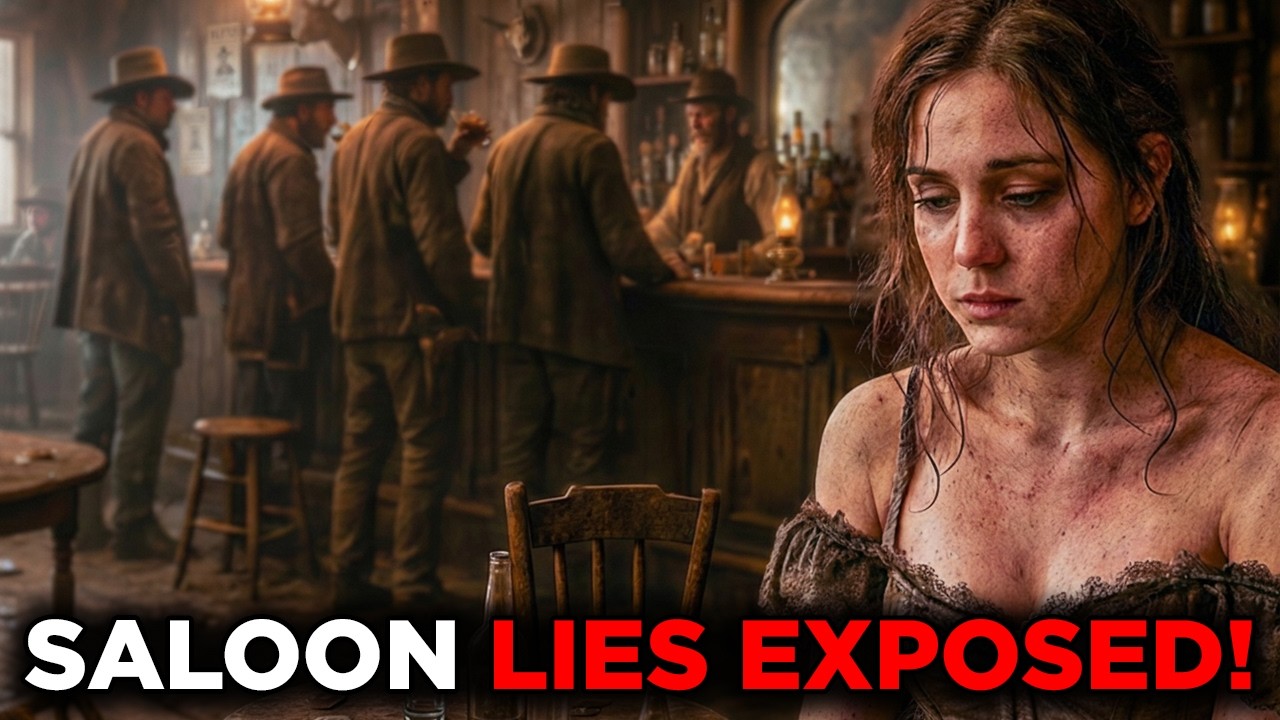
Picture the doors opening.
A stranger steps inside.
The piano stops.
Card players slowly turn their heads.
A bartender freezes with a glass in his hand.
Somebody reaches toward a revolver.
It is one of the most recognizable scenes in the entire Western genre.
It is also one of the cleanest versions of a place that was rarely clean at all.
The real frontier saloon was not simply a stage for gunfighters.
It was a crowded commercial room filled with smoke, mud, sweat, tobacco spit, gambling, cheap liquor, questionable medicine, arguments, loneliness, and men who had sometimes gone days or weeks without bathing.
Some saloons were impressive establishments with mirrors, chandeliers, billiard tables, food, and expensive fixtures.
Others were tents.
Shacks.
Sod structures.
Rooms thrown together almost overnight because the miners, railroad workers, or cattlemen had arrived before permanent buildings did.
Hollywood remembered the adventure.
History remembers the smell.
The First Saloon Might Have Been a Tent
Boomtowns could grow faster than anyone could build them.
A strike was announced.
A railroad camp appeared.
A cattle trail shifted.
Hundreds of men suddenly needed food, beds, liquor, entertainment, and somewhere to spend money.
Entrepreneurs responded immediately.
A saloon did not need to begin as a grand wooden building.
In a new camp it might start under canvas.
Or inside a rough shack assembled from scrap lumber.
In areas where timber was scarce, even sod or improvised materials could be used.
Only after money began flowing did owners invest in more permanent structures.
The famous false-front building became one of the frontier’s defining architectural tricks.
A tall wooden façade made a modest one-story establishment appear larger and more prosperous from the street.
It was commercial theater before the customer had even walked inside.
In a town built on speculation, looking permanent could be almost as valuable as actually being permanent.
Then You Smelled It
This is something cinema cannot reproduce.
A frontier saloon could assault the nose before anything else.
Tobacco smoke.
Cigar smoke.
Kerosene.
Sweat.
Wet wool.
Leather.
Spilled beer.
Cheap liquor.
Mud.
Horses outside.
And the accumulated smell of men who did not bathe according to modern schedules.
Water was work.
It had to be hauled.
Heated.
Carried.
In dry settlements, it could also be expensive.
A full bath was therefore not always an everyday ritual.
Add dozens of bodies to a poorly ventilated room and the atmosphere becomes easier to imagine.
Hollywood gives us amber light.
Reality gave the amber light a smell.
The Floor Was Not Supposed to Shine
One of the most persistent movie inventions is the spotless saloon floor.
Real establishments had to deal with constant mess.
Men walked in from unpaved streets.
Mud dried on boots.
Beer spilled.
Food dropped.
Chewing tobacco created another problem entirely.
Sawdust was an inexpensive solution.
Spread across wooden floorboards, it absorbed liquid and made the room easier to sweep.
At closing time, workers could remove the dirty layer and replace it.
That did not make the floor sanitary.
It made filth manageable.
The difference matters.
By late evening, the material under a customer’s boots could contain a mixture he probably preferred not to examine closely.
Tobacco Made Everything Worse
Chewing tobacco was widespread.
So were spittoons.
A respectable saloon might place brass cuspidors around the room.
A poorer one might use buckets or less elaborate containers.
The trouble was aim.
Drinking did not improve it.
Spit hit the floor.
Walls.
Furniture.
Whatever happened to be nearby.
Sawdust helped absorb what missed the container.
The romantic Western soundtrack gives us a piano.
A more accurate soundtrack would include coughing, chairs scraping, billiard balls, cards being shuffled, dice rattling, boots crunching through sawdust, and the metallic sound of tobacco juice striking a spittoon.
Even the Bar Could Be Filthy
Imagine hundreds of hands touching the same surface.
Coins sliding across it.
Beer foam dripping onto it.
Men leaning against it in dusty clothing.
Glasses constantly being placed and removed.
Modern commercial sanitation standards did not exist.
Neither did modern dishwashing equipment.
Cleaning practices varied widely from establishment to establishment.
Some proprietors undoubtedly maintained relatively respectable rooms.
Others did only enough to keep business moving.
That variation is important.
The nineteenth-century West contained polished urban saloons and crude mining dives simultaneously.
There was no single universal saloon.
But there were plenty where modern customers would not want to inspect the glassware too carefully.
Disease Was a Bigger Frontier Enemy Than the Gunfighter
The American West was not only violent.
It was unhealthy.
Tuberculosis.
Smallpox.
Cholera.
Typhoid.
Respiratory infections.
Wound infections.
Diseases killed enormous numbers of nineteenth-century Americans.
Crowded indoor spaces obviously helped respiratory illness spread.
Poor sanitation increased other risks.
A saloon brought travelers together in close quarters.
Men arrived from cattle trails.
Mining camps.
Railroad towns.
Military posts.
Distant cities.
They shared air, objects, rooms, and sometimes drinking vessels in a world that had not yet developed modern public-health infrastructure.
The popular Western focuses on the bullet because a shooting is visually dramatic.
Disease killed without providing a good movie scene.
Smoke Filled the Air
Cigars and pipes were common.
Kerosene lamps added their own fumes.
Cooking and heating stoves could further affect air quality.
Ventilation depended heavily on the building.
In summer, doors and windows helped.
In winter, especially on the Plains or in mountain settlements, owners had another problem.
Open the building and freeze the customers.
Close it and trap the smoke.
A crowded saloon in cold weather could therefore become an enclosed cloud of tobacco, lamp smoke, body heat, and alcohol fumes.
That may explain why a customer stepping outside probably noticed the fresh air almost immediately.
The Famous Batwing Doors Need Context
Those swinging half-doors existed.
But Hollywood turned them into something universal.
They were not practical as the only exterior barrier in places with freezing winters, dust storms, heavy rain, or security concerns.
Many establishments used solid exterior doors.
Swinging doors might appear inside, during warm weather, or in locations where climate allowed them to make sense.
The reason is obvious once the movie image is stripped away.
Nobody trying to heat a saloon in a Wyoming winter would rely solely on two waist-high slatted panels.
The iconic entrance survived because it looks fantastic on camera.
Practical architecture had different priorities.
The Whiskey Could Be Terrible
Hollywood whiskey is beautifully colored and conveniently smooth.
Cheap nineteenth-century spirits could be another experience entirely.
Quality varied dramatically.
Real aged whiskey cost money.
Transportation cost money.
Storage cost money.
In rough settlements, customers with little money often bought cheap liquor.
Adulteration was also a genuine problem in the nineteenth-century alcohol trade.
Coloring, dilution, artificial flavoring, and deceptive labeling existed in an era before modern food regulation.
Frontier folklore later produced elaborate recipes supposedly used to create fake whiskey.
Burnt sugar.
Tobacco.
Pepper.
Turpentine.
Gunpowder.
Various chemicals.
Some such claims are difficult to verify as routine practice and should not be treated as the standard recipe behind every saloon counter.
But the broader danger was real.
A customer had far less certainty about what was actually inside a cheap bottle.
“Rotgut” Was More Than a Joke
Cheap, harsh alcohol acquired memorable names.
Rotgut.
Tanglefoot.
Coffin varnish.
Tarantula juice.
The terminology itself tells us how drinkers thought about quality.
People knew some liquor was terrible.
They drank it anyway.
That was partly because intoxication was the point.
A miner finishing a brutal shift was not necessarily evaluating oak aging and flavor notes.
He wanted something strong.
Fast.
Affordable.
A saloonkeeper who could provide that had a market.
Whether the customer’s stomach agreed the next morning was another question.
Beer Was Not Always Cold
Another Hollywood assumption comes from the modern refrigerator.
Before reliable refrigeration and large-scale ice distribution, beer temperature depended on storage conditions.
A Kansas summer did not naturally produce an icy mug.
Beer could be warm.
It could spoil.
It could become flat or sour.
Ice existed, of course, and prosperous establishments might have access to icehouses or shipments.
By the late nineteenth century, industrial brewing and improved rail transport transformed the market.
But the earlier frontier customer did not automatically receive the frosted glass modern advertising taught us to expect.
Sometimes beer was simply whatever temperature the room was.
The Saloon Was Not Always Full of Drunks
This is another important correction.
A saloon was often one of the few public rooms in town.
That changed its role completely.
Men came for coffee.
Business.
News.
Cards.
Warmth.
Food.
Conversation.
Someone waiting for a stage might spend hours there.
A rancher might negotiate a deal.
A salesman might meet customers.
A local political discussion might happen near the stove.
A stranger could learn who mattered in town simply by sitting quietly and listening.
The saloon was part bar, part lounge, part informal office, and part information exchange.
Liquor kept the business profitable.
But human contact kept people coming back.
Gambling Could Matter More Than Drinking
Poker owns the cinematic saloon.
Historically, gamblers played many games.
Faro was enormously popular.
So was chuck-a-luck.
Billiards attracted wagers.
Dice games pulled money from working men.
Professional gamblers could earn livelihoods moving from table to table and town to town.
There were honest dealers.
There were also cheats.
Marked cards.
Altered decks.
Weighted dice.
Rigged dealing equipment.
Mechanical holdout devices eventually became sophisticated enough to conceal cards on a gambler’s body.
The game could therefore be more dangerous financially than the whiskey.
A cowboy might work for weeks and lose the wages in one night.
No gunfight required.
Getting Caught Cheating Was Dangerous
The mythic Western card game ends when someone calls another player a cheat.
Reality could indeed become violent.
Money carried enormous emotional weight for men who had earned it through months of physical labor.
Discovering that someone had deliberately stolen those wages through a rigged game could trigger immediate retaliation.
But the massive room-wide bar fight beloved by filmmakers is less representative than smaller, personal confrontations.
Real violence was often fast.
Two men.
An insult.
A debt.
A gambling accusation.
Then fists, a knife, or a gun.
That could be more frightening than a choreographed movie brawl because it was less theatrical and more final.
Many Towns Restricted Firearms
This fact undermines perhaps the biggest saloon fantasy.
Not every customer walked around town permanently armed.
Western municipalities often imposed weapon restrictions.
Towns such as Dodge City and Tombstone had rules affecting firearm carrying.
Visitors might be expected to surrender or store guns depending on local law and circumstance.
Why?
Because town leaders understood basic economics.
Armed intoxicated men were dangerous.
Broken mirrors cost money.
Dead customers stopped spending.
Gunfire frightened families and investors.
Business owners wanted excitement.
They did not necessarily want homicide.
The frontier could therefore be heavily armed outside town while surprisingly regulated inside it.
Saloon Girls Were Not One Category
Hollywood often divides women in saloons into two types.
The innocent singer.
The prostitute.
Historical reality was more complicated.
Women could work as dancers, entertainers, waitresses, drink solicitors, musicians, or sex workers.
Some roles overlapped.
Others did not.
A woman might earn commissions by encouraging customers to purchase drinks.
Her job was commercial.
Talk to the lonely rancher.
Dance with him.
Keep him spending.
Move to the next customer.
That labor could be exhausting, dangerous, and socially stigmatized.
But it could also provide women with income unavailable in many other occupations.
Reducing every saloon woman to prostitution erases that economic reality.
Prostitution Was Still Part of the Frontier Economy
That distinction does not mean prostitution was absent.
Vice districts frequently grew around mining, railroad, military, and cattle settlements dominated by single men.
Brothels and saloons might operate near one another.
Sometimes business interests overlapped.
Gambling, alcohol, lodging, entertainment, and prostitution formed parts of the same nighttime economy.
The experience for women inside that system varied from relative independence to severe exploitation.
Once again, the real West resists the simple movie category.
Respectability Had Boundaries
The saloon might function as the public living room of the town.
But it was not equally public for everyone.
Gender expectations mattered.
Race mattered.
Class mattered.
Local custom mattered.
A middle-class white woman concerned about reputation could avoid the saloon entirely unless circumstances required entering.
Chinese immigrants, Native Americans, Black residents, Mexican residents, soldiers, and other groups encountered different levels of exclusion depending on town, period, and establishment.
It would be inaccurate to say every saloon universally barred every minority group.
The West was too geographically and socially diverse for that.
But segregation and racial discrimination were absolutely part of western life.
The supposedly free frontier still had boundaries.
Black Westerners Built Their Own Social Spaces
Black cowboys and other African American workers were significant participants in western expansion.
Yet discrimination could follow them into town.
Where white-owned businesses excluded Black customers, separate institutions developed.
That included bars, restaurants, lodging houses, churches, clubs, and other gathering places.
The romantic claim that the frontier erased racial hierarchy therefore does not survive close examination.
Opportunity existed.
So did prejudice.
Both can be true at the same time.
The Shared Glass Is a Reminder of Another World
Imagine a bartender pouring drink after drink.
Glasses are rinsed quickly.
Perhaps not thoroughly.
Another customer takes one.
The modern mind immediately sees contamination.
Nineteenth-century customers did not possess modern microbiology.
Scientists were proving germ theory, but translating scientific discovery into everyday commercial sanitation took decades.
The same applies to shared towels, public spittoons, crowded sleeping quarters, and limited handwashing.
The saloon itself was not uniquely dirty by nineteenth-century standards.
That may be the more disturbing point.
Much of society was operating under conditions modern health inspectors would shut down immediately.
Toothache Could Become Its Own Nightmare
Dental medicine existed, particularly in larger cities.
But access on the frontier varied enormously.
A severe tooth infection could become debilitating.
Improvised extraction by someone with tools and nerve was not impossible in remote places.
Pain relief could mean alcohol or available narcotic medicine.
That kind of everyday suffering rarely appears in Western films because it destroys the heroic illusion.
The gunslinger with perfect white teeth is another Hollywood artifact.
Real mouths aged hard.
So did real bodies.
Pests Came With the People
Flies followed food and waste.
Lice followed people.
Bedbugs followed beds.
Rodents followed grain and garbage.
Cockroaches thrived where conditions allowed.
A frontier settlement created an ecological opportunity for pests almost as quickly as it created an economic opportunity for saloonkeepers.
Hotels, boarding houses, saloons, kitchens, barns, and outhouses were close together.
Garbage removal systems were primitive.
That meant the West was alive in ways filmmakers generally prefer not to visualize.
The Outhouse Was Part of Saloon Life Too
Drink enough beer and eventually everyone needs the same thing.
Indoor plumbing was not standard in frontier settlements.
Customers used outhouses.
Chamber pots.
Back lots.
More improvised arrangements in the roughest camps.
Sanitation depended on geography and infrastructure.
In successful cities, conditions improved.
In temporary camps, very little separated drinking, waste disposal, horses, kitchens, and sleeping quarters except a few walls.
The Western saloon set always looks spacious.
The actual built environment could be crowded and unpleasant.
Yet People Loved These Places
This is where the story becomes more interesting than simply saying saloons were filthy.
People kept going back.
Why?
Because outside might be worse.
Imagine living alone in a crude cabin.
No electric light.
No radio.
No television.
No telephone in the early years.
No central heating.
No family nearby.
Night falls.
It is freezing.
Then one building down the street glows through its windows.
Inside is a hot stove.
Coffee.
Food.
News.
Cards.
Other human beings.
Maybe music.
Maybe laughter.
For the price of one drink, you could belong somewhere for an evening.
That explains the saloon far better than whiskey alone.
Loneliness Was One of the Saloon’s Biggest Products
Frontier populations could be heavily male.
Mining camps especially drew transient workers.
Cattle towns filled seasonally with young men who had spent months surrounded by livestock and a small crew.
Railroad camps shifted constantly.
Isolation was part of the job.
The saloon sold relief from it.
That relief could be alcohol.
But it could also be conversation.
A dance.
A card game.
Someone remembering your name.
A newspaper from somewhere far away.
The saloon was commercially successful because humans are social.
That part of the business has changed very little.
The Dirt Was Only Half the Truth
Yes, the room could smell terrible.
Yes, sawdust absorbed things no modern customer wants underfoot.
Yes, hygiene was primitive.
Yes, liquor quality could be questionable.
Yes, vice existed.
But calling the saloon merely a filthy den misses why it mattered historically.
It was dirty because the frontier itself was dirty.
Infrastructure came late.
Clean water came late.
Paved roads came late.
Sewers came late.
Public buildings came late.
Sometimes the saloon arrived first.
That gave it enormous importance.
Hollywood Cleaned the Room Because It Needed a Stage
A movie Western needs visibility.
The audience must see the hero.
The villain.
The bartender.
The cards.
The gun.
So filmmakers created spacious interiors.
Clear air.
Good lighting.
A polished floor.
A piano.
Customers positioned perfectly for confrontation.
The result works beautifully as cinema.
It works badly as documentary history.
The real saloon was crowded.
Noisy.
Smoky.
Commercial.
Unequal.
Often regulated.
Sometimes dangerous.
Frequently filthy.
And much more important to the functioning of a frontier town than a simple drinking establishment.
The Dirty Truth
The dirt is not really the shocking part.
The shocking part is how normal it was.
Nobody walked inside thinking:
This is historically disgusting.
This was simply life.
A man wiped his hands.
Shared the towel.
Drank from a questionable glass.
Stepped around the spittoon.
Ate food sitting on a counter.
Played cards beside a coughing stranger.
Used the outhouse.
Returned to the stove.
Ordered another drink.
Then went back into a town without modern plumbing, refrigeration, antibiotics, sanitation codes, or reliable medical care.
The saloon was not some uniquely filthy island inside a clean frontier.
It was the frontier concentrated into one room.
The smoke.
The money.
The disease.
The gambling.
The loneliness.
The prejudice.
The opportunity.
The violence.
The warmth.
The companionship.
All of it existed together.
That is why the real Wild West saloon is more fascinating than Hollywood’s version.
Hollywood gave us swinging doors and heroic gunfights.
History gives us something less glamorous and much more human:
A dirty room full of people trying to escape an even harder world outside.


