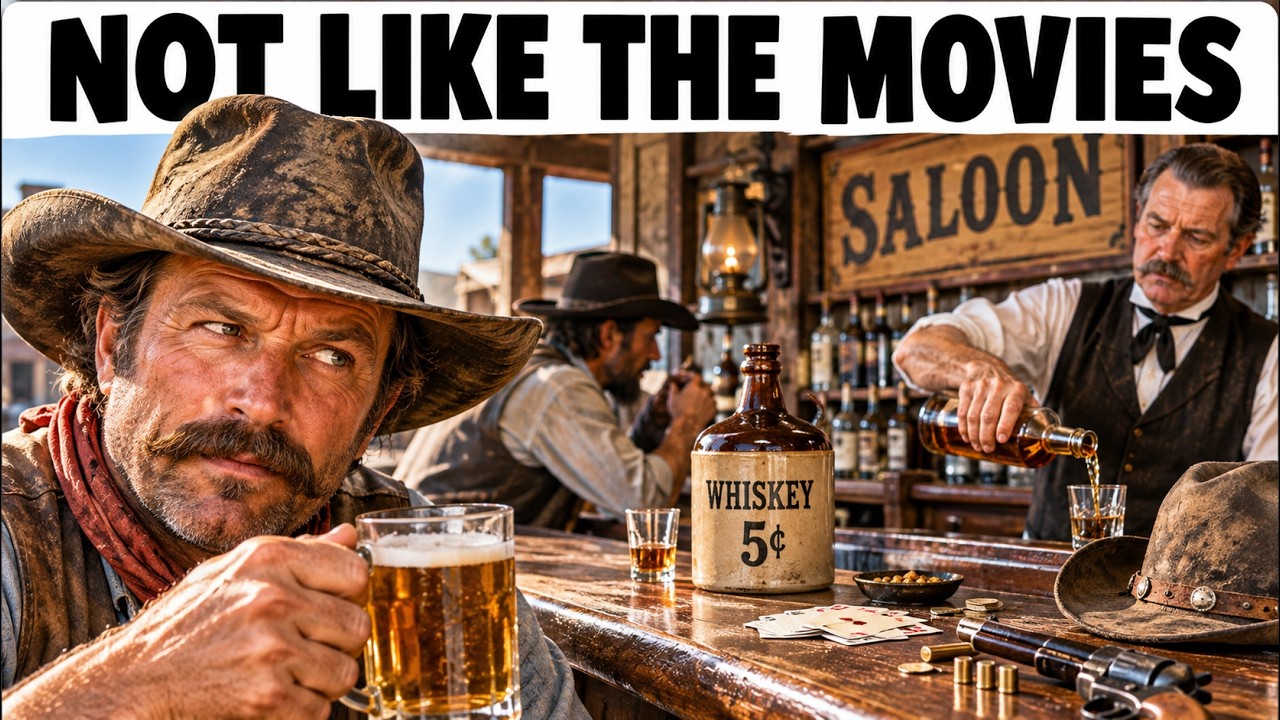
Hollywood taught generations of viewers to recognize a Wild West saloon in seconds.
Swinging batwing doors.
A perfectly tuned piano.
A bartender polishing the same clean glass.
Poker players with revolvers hanging openly from their belts.
A bottle of whiskey on every table.
Then somebody says the wrong thing.
Everyone freezes.
Two men reach for their guns.
That image is so familiar it feels historical.
Much of it is not.
The real frontier saloon could be warmer, dirtier, more commercial, more regulated, and much stranger.
Depending on the town, it might function as a gambling hall, restaurant, hotel lobby, business office, temporary courtroom, political headquarters, informal bank, message center, meeting hall, and pharmacy at the same time.
Whiskey mattered.
But the room mattered more.
The source behind this list emphasizes exactly that point: a saloon was often one of the only heated, brightly lit, socially active public spaces available in a frontier settlement.
Here are twenty-five things you could actually encounter inside one.
25. Sawdust Under Your Boots
The polished pine floors of movie saloons are one of the easiest myths to break.
Many real bars scattered sawdust across wooden floors.
Why?
Because saloons were filthy.
Mud came in on boots.
Beer spilled.
Tobacco juice missed the spittoons.
Food hit the floor.
Men tracked in dust, manure, and whatever else lay in the street outside.
Sawdust absorbed moisture and made the mess easier to sweep out.
In rough establishments, it could become part of the identity of the place itself.
The transcript describes the smell as a mixture of pine, alcohol, tobacco, and unwashed bodies.
That is probably closer to the sensory reality than anything shown in a classic Western.
24. A Brass Footrail Instead of Barstools
Many nineteenth-century bars were built for standing.
A customer leaned against the counter, planted one foot on a brass rail, and stayed there.
The rail was practical.
It shifted body weight.
Made prolonged standing more comfortable.
And in an expensive saloon, polished brass also advertised status.
A frontier businessman could walk into a room and immediately tell whether the owner had invested serious money in fixtures.
Luxury did not always mean marble.
Sometimes it meant a bright strip of brass shipped hundreds of miles by rail and wagon.
23. Spittoons Everywhere
Chewing tobacco and cigars were part of everyday male life.
That required places to spit.
Hence the cuspidor.
Brass spittoons could sit along the bar and beside gaming tables.
Cheaper establishments made do with less elegant containers.
The problem was not providing them.
The problem was getting customers to hit them.
That is another reason sawdust mattered.
A saloon filled with chewing-tobacco users would have been visually and physically much dirtier than most films suggest.
The constant sound of spit striking metal may have been as ordinary as cards shuffling.
22. A Shared Towel
One of the least glamorous details in the transcript is also one of the easiest to imagine.
A communal cloth towel might hang near the bar.
Customers used it to wipe beer foam from mustaches or dry their hands.
Then someone else used it.
Then someone else.
Modern viewers immediately think about bacteria.
Nineteenth-century customers generally did not understand disease transmission in the same way.
Germ theory was still transforming medicine and public sanitation.
A clean towel could therefore be a luxury rather than something taken for granted.
The source paints the shared towel as one of the clearest reminders that frontier hygiene belonged to an entirely different world.
21. “Free Lunch” That Was Not Really Free
One of the smartest saloon business models was food.
Buy a drink.
Eat from the lunch spread.
Ham.
Cheese.
Bread.
Pickles.
Eggs.
Sausage.
Pretzels.
The meal encouraged drinking.
That is the essential economic logic.
A saloon could afford to give away cheap food because a customer eating salty items was likely to purchase more beer.
The phrase “there is no such thing as a free lunch” later became a famous economic expression.
Whether every saloon operated this exact system is another matter, but the free-lunch tradition was absolutely part of American saloon culture.
20. Beer That Was Often Warmer Than You Expect
Modern beer culture depends on refrigeration.
Much of the nineteenth-century frontier did not have it.
That meant temperature depended heavily on season, storage, location, and access to ice.
Beer traveling long distances could deteriorate.
Warm weather made everything worse.
Then industrial ice production, improved rail transport, and major brewing companies changed drinking habits.
By the late nineteenth century, cold lager could become a selling point in prosperous towns.
But the frosted mug in a dusty 1860s cattle camp?
That is much more Hollywood than history.
19. Beer Carried Home in a Pail
The modern glass growler had a humbler predecessor.
Customers could bring containers to be filled with draft beer.
Workers might pool money and send someone to the saloon.
A child could be sent.
A laborer could bring beer back to coworkers.
The phrase “rushing the growler” became associated with the practice.
The source describes tin pails being used for take-away beer long before packaged six-packs existed.
It is a wonderfully ordinary historical detail.
The frontier drank alcohol outside the saloon too.
And sometimes the delivery system was simply a bucket.
18. Coffee
Western films often make it seem as if every person entering a saloon immediately ordered whiskey.
Real establishments served other drinks.
Coffee mattered especially because a saloon functioned as a daytime gathering place.
A rancher might negotiate.
A freight agent might wait for news.
A politician might talk business.
A traveler might simply want warmth.
Not every man wanted to be intoxicated at ten in the morning.
Keeping a coffee pot on the stove made commercial sense.
The saloon was often closer to a combination bar and community lounge than a nonstop drunken riot.
17. A Pot-Bellied Stove
In a Wyoming or Dakota winter, alcohol was not enough.
Heat kept customers inside.
The pot-bellied stove therefore became one of the most important fixtures in cold-climate saloons.
Men dried wet clothing around it.
Talked.
Played cards.
Waited out storms.
A customer living in a poorly insulated shack might spend hours inside simply because the saloon was warmer.
The stove could also support coffee and food preparation.
In practical terms, one glowing iron stove might do more to fill a saloon than any bottle on the shelf.
16. An Extremely Expensive Billiard Table
A billiard table was not casual furniture.
Slate tables were heavy.
Precision mattered.
Transporting one into a remote western settlement could require rail shipment, wagons, crates, and skilled assembly.
That made the table a status symbol.
It also made money.
Men played.
Spectators wagered.
Games could occupy customers for hours.
The soundscape of a prosperous saloon therefore included more than piano music.
It included billiard balls striking one another and quiet side bets forming around the table.
A good billiard table told customers the establishment expected to remain in business.
15. Chuck-a-Luck
Poker dominates Western cinema.
But gambling variety was much broader.
Chuck-a-luck used three dice placed inside a wire cage.
Players bet on numbers.
The operator rotated the cage.
The game was fast and easy to understand.
That made it ideal for casual gamblers.
No complicated strategy.
No need to learn poker etiquette.
Just wager and watch.
The house still had an advantage.
Its metallic rattle may have been one of the more distinctive sounds inside gambling saloons.
14. Bad Liquor
This is where saloon mythology becomes especially exaggerated.
Cheap frontier whiskey could indeed be rough.
Alcohol might be diluted, colored, flavored, or otherwise adulterated.
Counterfeit liquor existed.
Poor storage existed.
Dishonest operators existed.
The transcript lists sensational additives including tobacco, chili, turpentine, ammonia, gunpowder, and even strychnine.
Those colorful recipes should be treated cautiously.
They appear frequently in frontier lore, but not every dramatic “rotgut” recipe can be assumed to represent routine saloon practice.
What is safer to say is that regulation was weak, quality varied enormously, and consumers had fewer protections against adulterated liquor than modern drinkers do.
The danger was real.
The exact recipe was not universal.
13. A Giant Mirror Behind the Bar
Large mirrors became iconic saloon décor for good reason.
They were expensive.
Fragile.
Hard to transport.
An intact mirror announced wealth.
It also had a practical advantage.
A customer standing with his back to the room could see movement behind him.
A bartender could monitor tables while serving drinks.
That security function makes sense in any crowded establishment, not only in a violent frontier town.
One object could therefore serve three purposes at once.
Decoration.
Status.
Situational awareness.
Hollywood actually got this one fairly right.
12. Faro — Not Poker — as the Major Money Game
Faro deserves far more screen time than it receives.
It was enormously popular.
Players bet on cards displayed on a layout while a dealer drew from a dealing box.
The game moved quickly.
It was easy to follow.
And famous frontier figures worked around it.
Wyatt Earp dealt faro.
Doc Holliday dealt faro.
Bat Masterson was connected to faro gaming.
The transcript also emphasizes the game’s reputation for cheating.
Manipulated dealing boxes and dishonest dealers could alter outcomes.
That made a game that appeared straightforward much more dangerous financially than players realized.
The true saloon economy was built at least as much around gambling as liquor.
11. A Heavy Wooden Club Behind the Bar
The bartender needed something to manage violence.
Not every dispute justified gunfire.
In fact, firing a pistol inside your own business was a terrible commercial strategy.
A heavy wooden mallet associated with barrel work could double as an improvised weapon.
The transcript calls particular attention to the bung starter.
Whether every bartender kept one specifically for fighting should not be universalized.
But the larger reality is obvious.
Bartenders and saloon employees often had to control drunk customers physically.
Before professional security staff became common, the bartender himself could be the bouncer.
And blunt force was far less destructive than bullets.
10. Places to Leave Your Gun
This is one of Hollywood’s biggest distortions.
Many famous western towns regulated weapons.
Dodge City.
Wichita.
Tombstone.
Other communities had ordinances restricting gun carrying in populated areas.
Exactly how firearms were checked varied by town and establishment.
The transcript describes saloons using racks or systems where customers surrendered weapons.
It would be too broad to imagine every saloon maintaining a neat numbered gun-check counter.
But the central historical point is strong.
An armed man walking into town could be expected to disarm.
Town leaders understood that alcohol plus gambling plus pistols was bad for business.
The West had gun control because people in the West understood guns.
9. Patent Medicines and Narcotic Remedies
Before modern drug regulation, medicine could look very different.
Laudanum contained opium and alcohol.
Other products contained cocaine, morphine, large amounts of alcohol, or secret proprietary ingredients.
Patent medicines promised extraordinary results.
Pain.
Insomnia.
Coughs.
Nerves.
Digestive complaints.
Almost everything had a bottle claiming to cure it.
The transcript presents saloons as one place where such substances could circulate.
The larger historical point is solid even if availability varied from saloon to saloon.
Americans could obtain substances now heavily controlled with far fewer restrictions before the twentieth-century regulatory system emerged.
8. Women Paid to Sell Drinks
The “saloon girl” was not one occupation.
Some women worked in prostitution.
Some danced.
Some served drinks.
Some were entertainers.
Some worked on commission encouraging customers to buy more alcohol.
The transcript describes “percentage girls,” whose earnings were linked to sales.
That business model turns one of Hollywood’s romantic figures into something more recognizable.
A salesperson.
Her job was to keep the customer inside.
Keep him entertained.
Keep him spending.
Sex might be part of that environment in some establishments.
It should not automatically be assumed in every case.
7. Often No Piano at All
The piano may be the most persistent saloon cliché.
And some saloons absolutely had one.
But a good piano was expensive.
Heavy.
Sensitive to climate.
Difficult to transport.
Remote camps were therefore more likely to rely on smaller instruments.
Fiddles.
Harmonicas.
Banjo.
Singing.
Or no formal music at all.
Prosperous establishments could afford pianists sometimes called “professors.”
A rough mining shack probably could not.
The transcript correctly emphasizes that musical equipment depended heavily on wealth and location.
The piano belongs more naturally to a successful urban saloon than to every dirt-road drinking shack in the West.
6. A Bartender Who Functioned Like an Information Network
The bartender saw everyone.
That created power.
Travelers.
Ranchers.
Lawmen.
Gamblers.
Salesmen.
Miners.
Politicians.
Outlaws.
Everyone eventually passed through the room.
The source expands this idea dramatically, describing the bartender as banker, postmaster, referee, information broker, and keeper of valuables.
Not every saloon performed every one of those functions.
But frontier businesses frequently overlapped because small towns lacked specialized institutions.
A trusted saloonkeeper could hold valuables.
Receive messages.
Extend credit.
Know who had arrived.
Know who was leaving.
Know who owed money.
That knowledge could be as valuable as cash.
5. Terrible Sanitation
Indoor plumbing could be nonexistent.
Outhouses were common.
Chamber pots existed.
Water for washing could be limited.
The transcript makes the environment intentionally disgusting: smoke, sweat, tobacco spit, spilled alcohol, shared towels, heat, and inadequate waste disposal.
That theatrical description should not be applied identically to every establishment.
A luxury San Francisco saloon and a crude mining-camp bar were different worlds.
But frontier sanitation standards were generally far below modern expectations.
Hollywood removes the smell.
History did not.
4. Solid Exterior Doors
Those famous swinging batwing doors did exist.
But they were not the only doors keeping out the outside world.
Full exterior doors were necessary against cold, dust, rain, and theft.
Batwing-style doors could function as interior doors or warm-weather barriers.
The idea of a Wyoming saloon protected from a blizzard solely by two waist-high swinging panels is obviously impractical.
The transcript uses this to expose how movie set design became accepted as historical memory.
Hollywood needed an entrance through which the audience could see the hero arrive.
Real saloon owners needed to keep the weather outside.
3. Cheating Devices Hidden Under Clothing
Professional cheating was sophisticated.
Marked cards.
Altered decks.
Mirrors.
Manipulated dice.
Mechanical devices.
The transcript highlights the holdout machine, a concealed apparatus designed to move hidden cards into or out of a gambler’s hand.
Some late nineteenth-century cheating technology was remarkably elaborate.
Getting caught could also be dangerous.
A gambler exposed as cheating was not simply breaking the rules of a game.
He had taken money directly from men sitting within arm’s reach.
Possibly armed men.
Even without a gunfight, public discovery could lead to beating, expulsion, arrest, or worse.
The gambling table was one of the places where trust and violence sat closest together.
2. Erotic Artwork
Paintings and prints of women decorated some higher-end drinking establishments.
That did not mean every saloon had an expensive reclining nude above the bar.
The transcript itself recognizes the economic distinction.
Large oil paintings belonged to prosperous houses.
Cheaper establishments might have inexpensive prints.
Others had bare walls.
The broader point is useful:
Saloon décor communicated class.
Mirrors.
Lighting.
Paintings.
Furniture.
Brass.
Glassware.
Everything told a customer whether he had walked into a palace or a dive.
The West had luxury bars too.
1. Water
The source saves clean water for its final surprise.
In desert settlements, water absolutely could be expensive.
Towns in Arizona, Nevada, and California sometimes relied on wells, hauled water, or infrastructure developed only after settlement had already expanded.
That made reliable clean water valuable.
But the transcript’s broad claim that water was commonly more expensive than whiskey across the West, or that people drank liquor because it was routinely safer than water, goes beyond what its evidence establishes.
The reality varied enormously by location.
A desert mining camp with poor wells faced one problem.
A river town faced another.
A city with municipal waterworks faced another.
Still, the underlying irony survives.
A saloon could possess barrels of alcohol while struggling to secure adequate clean water for washing, cooking, animals, and customers.
That says something profound about how quickly boomtowns were built.
Commerce often arrived before infrastructure.
What Hollywood Really Got Wrong
The biggest saloon myth is not the batwing door.
Not the piano.
Not even the guns.
It is the idea that a saloon existed primarily for drinking.
The real institution often filled an enormous social vacuum.
A man entered because the room had heat.
Light.
News.
Games.
People.
Food.
Mail.
Information.
Coffee.
A stove.
Business contacts.
Entertainment.
And yes, alcohol.
Imagine spending weeks working alone on a ranch.
Or underground in a mining camp.
Or moving cattle hundreds of miles.
Then imagine arriving in a town after sunset.
Almost every building is dark.
One room is glowing.
You hear conversation through the wall.
Dice rattling.
Billiard balls clicking.
Cards hitting felt.
Someone laughing.
A stove is burning.
Coffee is hot.
Food is sitting on a counter.
That is the real power of the saloon.
It was not simply somewhere to become drunk.
It was somewhere to stop being alone.
The Saloon Could Also Become a Political Room
Public life sometimes spilled into drinking establishments.
Meetings happened there.
Campaign conversations happened there.
Deals were negotiated there.
Temporary public proceedings could use commercial rooms when dedicated civic buildings did not exist.
The transcript dramatically says elections, courts, and even occasional religious gatherings could take place inside saloon spaces.
The exact practice differed widely by town.
But the principle is important.
Frontier institutions were improvised.
If the largest available room belonged to a saloonkeeper, then civic life sometimes entered the saloon.
The American West built governments while towns were still physically being built.
It Was Dirtier Than Hollywood
Think again about that classic movie set.
Perfectly clean glass.
Clean clothing.
Clear air.
Beautiful wood.
Freshly painted walls.
Now replace it.
Smoke hangs beneath the ceiling.
The floor absorbs spit and beer.
Men stand close together in clothing worn for days.
A stove heats the entire mixture.
Spittoons need emptying.
Alcohol smells sour.
Outhouses sit outside.
The shared towel stopped being white hours ago.
That sensory reality may explain why old photographs seem so distant from Western movies.
A camera records shapes.
It cannot record smell.
Cinema later filled that gap with romance.
It Was Also More Regulated Than Hollywood
One of the stranger truths about frontier saloons is that business owners often wanted order.
A dead customer did not buy another drink.
A bullet through the mirror cost money.
A destroyed table cost money.
A gunfight frightened respectable customers.
Local governments also wanted revenue.
Disarming visitors could therefore protect commerce as much as public safety.
That is why armed cowboys everywhere inside a bar is such a misleading picture.
The people actually running these towns had powerful reasons to stop drunken gunfire before it started.
Gambling Was Probably More Important Than the Whiskey Bottle
A prosperous gaming table generated continual income.
Faro.
Chuck-a-luck.
Poker.
Billiards.
Other games.
Spectators drank while watching.
Players drank while losing.
The house profited from both.
The opening claim in the transcript uses Tombstone’s Oriental Saloon to dramatize how gambling could generate far more money than ordinary drink sales.
Whether a specific night exceeded a cowboy’s annual wages depends on the actual receipts being referenced.
But the central commercial reality holds.
Western saloons were entertainment businesses.
Alcohol was only one revenue stream.
The Most Accurate Saloon Is Contradictory
Elegant and filthy.
Regulated and violent.
Social and exploitative.
Warm and unhealthy.
Community center and gambling trap.
Place of business and place of escape.
That contradiction explains why the saloon became such a permanent part of American mythology.
It was not simply a bar transplanted onto the frontier.
It was a concentrated version of the frontier itself.
Money moved through it.
Information moved through it.
People disappeared into it.
Fortunes were won.
Paychecks vanished.
Friendships formed.
Deals were made.
Arguments started.
And every class distinction in town could be seen by looking around the room.
Did it have a mirror?
A piano?
A billiard table?
Brass fixtures?
Real glassware?
Cold beer?
Or was it simply boards, bottles, a stove, buckets, sawdust, and men looking for somewhere to sit?
That difference mattered.
Hollywood gave nearly every town the same saloon because audiences needed to recognize the set.
History gave every town the saloon it could afford.
And that real room — smoky, commercial, warm, loud, regulated, dirty, social, and full of things far stranger than a swinging door — is much more interesting than the one Hollywood built.


