Spain’s Deadly High Speed Train Collision Sparks Claims of a Secret Assassination, but Investigators Face a Different Disturbing Reality
At least 68 people were reported dead after two high-speed trains collided near Urda, Spain, on October 28, 2026.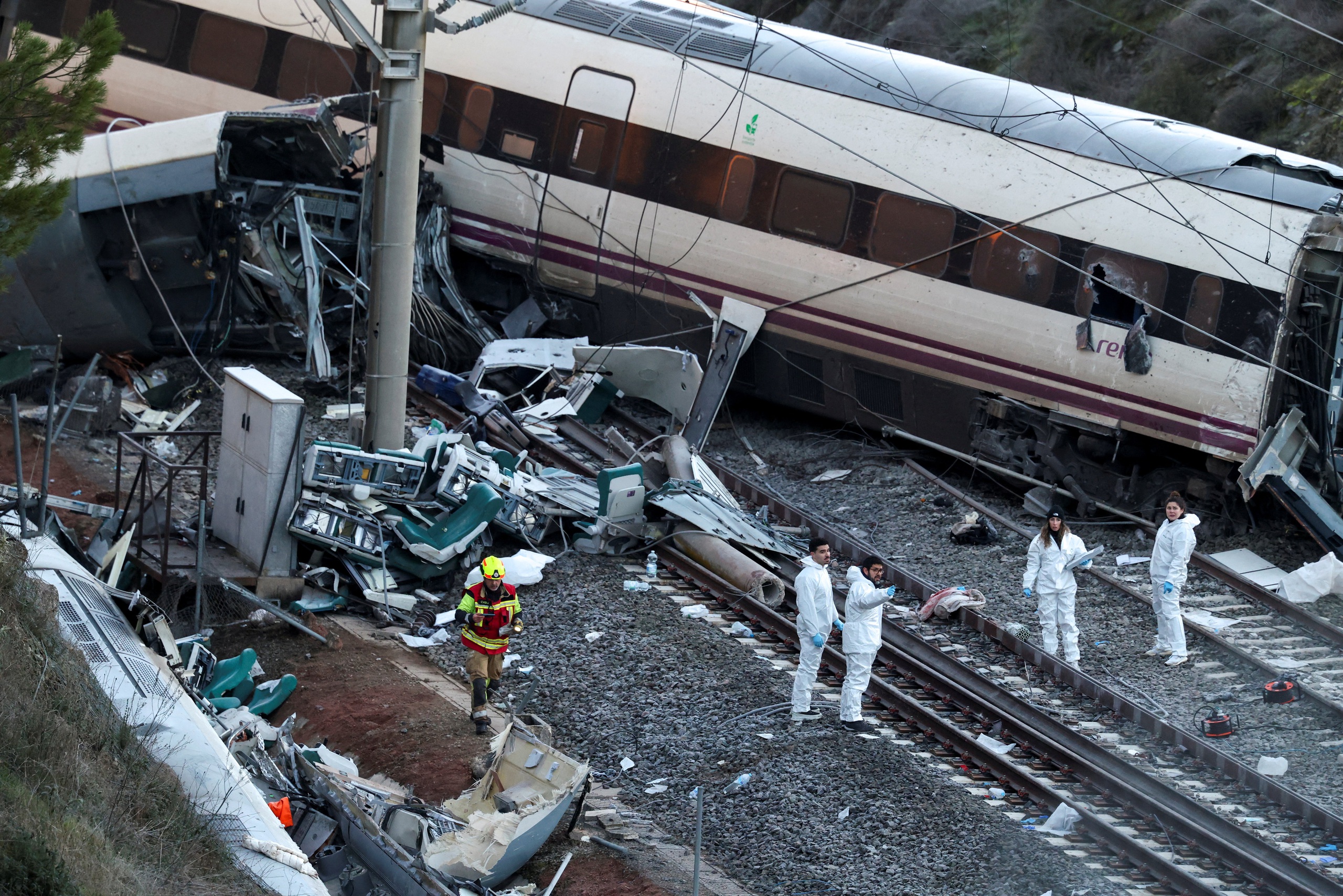
The catastrophe raised urgent questions about railway signaling, traffic-control decisions, and whether safety systems could have prevented the collision.
But allegations of a government assassination order, a billionaire whistleblower, and a $100 million dossier have not been supported by authenticated evidence.
The Morning a Journey Became a National Tragedy
URDA, SPAIN — OCTOBER 28, 2026. Hundreds of passengers boarded high-speed trains expecting a routine journey between Madrid and Seville.
Instead, two trains collided near the Toledo town of Urda, leaving wrecked carriages, devastated families, and an urgent national investigation.
Emergency responders confronted a scene of destruction as rescuers searched damaged vehicles for survivors and recovered victims from the wreckage.
By later reporting that day, authorities had confirmed at least 68 deaths, with rescue operations and casualty assessments still continuing.
The tragedy immediately raised questions about how a modern high-speed railway could permit such a devastating collision between passenger services.
Initial reports pointed toward a signaling disruption and possible mistakes in the instructions governing train movements.
Yet a far more sensational explanation began circulating, accusing powerful officials of deliberately arranging a mass-casualty assassination.
No verified evidence establishes that the crash was an assassination attempt or that a billionaire carrying secret financial documents was aboard.
The Two Trains Involved
The collision involved a Renfe AVE train and an Iryo service traveling along the Madrid–Seville high-speed railway corridor.
The Renfe service was identified as train 2080, while the Iryo train was operating as service 6076.
Approximately 544 people were traveling aboard the two trains, according to passenger figures reported by Spanish authorities.
The Renfe service carried 397 passengers, while the Iryo train carried 147 people, including an infant.
Those figures underline the potential consequences of a failure in the systems responsible for separating trains on busy railway lines.
High-speed operations depend upon accurate signaling, reliable communication, and carefully controlled authorization for each train to proceed.
When those protections become unavailable or ineffective, even a brief misunderstanding can create a dangerous situation.
The investigation must determine how the two services came into conflict despite the railway’s established safety procedures.
The Collision Was Not Head-On
The sensational narrative describes two trains deliberately locked onto a collision course at approximately 300 kilometers per hour.
However, contemporary reporting described a rear-end collision rather than a head-on impact.
The Iryo train had stopped on the tracks when the Renfe service approached from behind and struck its rear carriages.
The impact caused several carriages to derail, with some falling down an embankment beside the railway.
This distinction matters because collision geometry determines the sequence of events investigators must reconstruct.
A head-on collision between opposing trains presents different operational questions from a rear-end collision involving services traveling in the same direction.
The trains’ maximum operating capabilities also do not establish their actual speeds at the moment of impact.
Investigators must rely upon recorded technical data rather than assume that either train was traveling at 300 kilometers per hour.
The Signaling Failure Before the Disaster
Reporting indicated that railway infrastructure operator Adif received notice of a signaling problem at approximately 8:30 that morning.
The disruption reportedly affected the LZB system, which continuously supervises train movements and can activate automatic braking under certain conditions.
Trains in the affected area were temporarily stopped while railway personnel responded to the problem.
Traffic was subsequently authorized to resume under alternative operating procedures.
However, the Iryo train remained stationary for reasons that were not immediately established.
The Renfe service reportedly received authorization to continue along the same railway corridor.
At approximately 8:54 a.m., the approaching Renfe train collided with the stopped Iryo service.
The short interval between the reported signaling problem and the collision became a central focus of the investigation.
The Authorization That Demands Answers
According to early reporting, the Renfe driver proceeded after receiving instructions permitting the train to continue.
The railway operator maintained that its driver had followed the authorization provided through the traffic-control system.
That account raised questions about what information controllers possessed regarding the stationary Iryo train.
Investigators must determine whether the control center correctly identified the occupied track section before allowing another train to proceed.
They must also establish which safety procedures applied after the normal signaling system became unavailable.
A mistaken authorization could involve incomplete information, procedural error, or failures in the wider traffic-management system.
Such possibilities require detailed examination rather than immediate conclusions about criminal intent.
The distinction between an operational mistake and deliberate murder remains essential to understanding the tragedy.
The Alleged Billionaire Whistleblower
The circulating conspiracy narrative claims that a billionaire was carrying evidence of a $100 million infrastructure fraud operation.
It further alleges that Spanish ministers deliberately arranged the collision to prevent that person from testifying.
No authenticated evidence identifies the supposed whistleblower or establishes that such an individual was traveling aboard either train.
The story also provides no verified court proceedings, financial records, or communications supporting the alleged assassination motive.
A credible criminal investigation would require proof of a specific target, an identifiable conspiracy, and intentional actions causing the collision.
The existence of a devastating accident cannot independently establish those elements.
Without corroboration, the billionaire story remains an unsupported allegation.
The victims and their families deserve conclusions based upon reliable evidence rather than invented identities and speculative motives.
The Myth of Military Black Boxes
Another dramatic claim refers to leaked military black boxes supposedly proving that officials deliberately engineered the collision.
High-speed passenger trains contain operational recording systems that can preserve information relevant to accident investigations.
Those systems may record speed, braking behavior, equipment warnings, and other technical details.
Investigators can compare such information with signaling records and communications between train drivers and railway controllers.
However, ordinary railway event recorders should not be confused with unspecified military devices.
No authenticated leaked recordings have established that ministers ordered the collision.
A genuine technical record would require verification of its origin, completeness, timestamps, and interpretation.
The existence of recorded data does not make every claim attributed to that data reliable.
The Supposed Three-Hundred-Kilometer Fireball
The sensational account describes a massive explosion that incinerated hundreds of passengers and destroyed the alleged financial evidence.
Verified reporting established a violent collision, derailed carriages, fatalities, and extensive damage.
It did not establish the claimed deliberate fireball or the supposed destruction of a billionaire’s dossier.
A train’s advertised maximum speed is not proof of its speed during a particular accident.
Nor does severe structural damage automatically establish an explosion.
Investigators must distinguish damage caused by impact forces from evidence of fire, fuel ignition, or other separate events.
Those distinctions depend upon forensic examination rather than dramatic language.
The reported destruction was catastrophic without requiring an unverified explosion to explain its severity.
Why Railway Protection Systems Matter
Modern high-speed railways use multiple layers of protection to maintain safe separation between trains.
These systems can include continuous train supervision, trackside signals, traffic-control procedures, and automatic braking.
The objective is to prevent an individual equipment failure or operational mistake from becoming a fatal accident.
When normal supervision becomes unavailable, alternative procedures must preserve an acceptable level of safety.
The Urda collision raises questions about whether those backup protections operated as intended.
Investigators must examine the transition between normal and alternative signaling arrangements.
They must also establish what information was available to drivers and controllers during the disruption.
Understanding those interactions will be essential to identifying preventable failures.
The Human Decisions Behind Automated Systems
Sophisticated railway technology still depends upon people making decisions during unusual operating conditions.
Controllers must interpret information, coordinate movements, and communicate instructions accurately.
Drivers must follow authorized procedures while responding to signals and changing circumstances.
If technical systems provide incomplete information, the risk of misunderstanding may increase.
A human error can therefore emerge from a wider combination of organizational and technical weaknesses.
Investigators must examine those conditions before assigning responsibility.
An incorrect instruction would be a serious finding, but it would not automatically demonstrate deliberate violence.
Criminal intent requires evidence that an individual knowingly acted to cause harm.
The Victims Behind the Headlines
Every passenger aboard the trains had a personal reason for making the journey.
Some were traveling for work, while others were returning home or visiting relatives.
The collision interrupted those ordinary plans with consequences that families will carry long after the wreckage is cleared.
Survivors faced injuries, uncertainty, and the immediate challenge of escaping damaged carriages.
Relatives waited for information as emergency personnel identified victims and coordinated medical assistance.
The emotional consequences may extend far beyond the first day of the disaster.
These human experiences deserve attention independent of speculation about political motives.
Sensational conspiracy narratives risk reducing real victims to supporting characters in an unverified story.
The Rescue Operation
Emergency services mobilized rapidly after the collision was reported.
Firefighters, medical personnel, police, and civil protection teams worked to reach passengers and secure the damaged railway area.
Rescuers faced hazards involving unstable carriages, damaged infrastructure, and difficult access to parts of the wreckage.
Authorities also established facilities to assist injured passengers and coordinate support for affected families.
Railway traffic between Madrid and Andalusia was suspended while emergency operations continued.
The scale of the response reflected the seriousness of the collision.
Rescue teams needed reliable information about passenger numbers and the condition of the damaged vehicles.
Their immediate priority was saving lives rather than determining the political implications of the disaster.
The Earlier Adamuz Tragedy
The Urda collision followed another deadly Spanish railway disaster earlier in 2026.
On January 18, an Iryo train derailed near Adamuz in Córdoba province.
Its derailed carriages entered the path of a Renfe service traveling in the opposite direction.
That collision killed dozens of people and prompted an investigation into the circumstances surrounding the derailment.
The earlier disaster raised questions about railway infrastructure, maintenance, and safety oversight.
However, its reported sequence differed from the events near Urda.
The Adamuz accident involved a derailment followed by a collision, while Urda involved a train striking another that had stopped.
Both events warrant scrutiny without assuming they resulted from the same cause.
The Financial Cover-Up Allegation
The conspiracy narrative claims that the collision concealed a $100 million fraud scheme involving railway infrastructure.
Large transportation projects involve substantial public expenditure, making financial transparency and independent auditing legitimate public concerns.
However, concern about possible corruption does not establish a connection between financial wrongdoing and this particular accident.
No authenticated bank records have been presented proving that the collision was arranged to suppress evidence.
The story also fails to identify a verified criminal case involving the alleged dossier.
A genuine financial investigation would require documents showing transactions, responsible individuals, and a demonstrable connection to the collision.
Without that evidence, the allegation remains speculative.
The seriousness of the accusation makes independent verification indispensable.
Did the Ministry Collapse Financially?
Another claim states that the disaster instantly bankrupted Spain’s transport ministry.
No credible evidence establishes that such a bankruptcy occurred.
Government ministries operate through public budgets and administrative systems that differ from those of private companies.
Major accidents can generate compensation claims, infrastructure costs, investigations, and political consequences.
Those costs may be significant, but they do not establish immediate institutional bankruptcy.
The financial consequences of the collision would require proper accounting over time.
Claims of an overnight collapse should therefore be treated as unsupported.
The public can demand financial accountability without accepting an invented bankruptcy narrative.
What an Assassination Investigation Would Require
A deliberate mass-murder theory would require evidence of planning, intent, and actions designed to cause the collision.
Investigators would need to identify the alleged target and establish that the person was aboard one of the trains.
They would also need reliable communications or other corroborating evidence linking specific individuals to a criminal plan.
Technical records would have to demonstrate deliberate manipulation rather than accidental or procedural failure.
The evidence would need to withstand independent examination.
Anonymous claims about secret orders cannot meet that standard on their own.
Even proof of negligence would not automatically establish murder.
The distinction matters because the legal and factual consequences of those findings are profoundly different.
Why Conspiracy Narratives Gain Attention
Large disasters create uncertainty while investigators gather evidence and authorities assess casualties.
During that period, incomplete information can leave important questions unanswered.
Conspiracy narratives often fill those gaps with dramatic explanations involving hidden motives and powerful institutions.
Such stories can appear persuasive because they offer certainty before the evidence is complete.
They may also exploit legitimate concerns about government transparency and institutional responsibility.
However, a compelling story is not proof of a coordinated criminal act.
Responsible investigation begins with verifiable evidence and remains open to findings that contradict initial assumptions.
The purpose is to discover what happened, not to confirm a predetermined narrative.
The Need for Independent Investigation
Investigators must reconstruct the precise movements of both trains before the collision.
They should examine signaling failures, traffic-control instructions, train recordings, and communications between operating personnel.
Maintenance histories and emergency procedures may also reveal relevant weaknesses.
The investigation must establish which protective systems were functioning and why the approaching train was not stopped.
Where evidence suggests unlawful conduct, appropriate authorities can examine potential criminal responsibility.
However, preliminary technical findings should not be confused with completed judicial conclusions.
Transparency will be essential to maintaining public confidence.
Families deserve explanations that can be supported by documents, testimony, and independently assessed technical evidence.
What Was Known on October 28
By October 28, verified reporting established that two high-speed passenger trains had collided near Urda in Toledo province.
The collision involved Renfe and Iryo services traveling along the Madrid–Seville corridor.
One train reportedly struck the rear of another that had stopped following a signaling disruption.
Authorities confirmed substantial loss of life, with later reports placing the death toll at least 68.
Investigators were examining possible failures involving traffic-control authorization and railway safety systems.
The final technical cause had not been established.
No authenticated evidence supported the claims of a billionaire assassination target, military black-box revelations, or deliberate government sabotage.
The alleged financial conspiracy and ministry bankruptcy also remained unsubstantiated.
The Final Truth Behind the Alleged Execution Plot
Spain’s deadly railway collision exposed urgent questions about the reliability of high-speed train protection systems and traffic-control procedures.
The reported sequence involved a Renfe train striking a stationary Iryo service after a disruption to railway signaling.
Available reporting does not support the claim that two trains were deliberately forced into a head-on collision at 300 kilometers per hour.
No verified evidence establishes that a billionaire whistleblower carrying a $100 million dossier was the intended target.
The alleged military black-box leak has not been authenticated, and no credible findings demonstrate a government order to cause the collision.
Claims that hundreds were deliberately incinerated in a planned explosion are not supported by the reported accident sequence.
The assertion that the disaster instantly bankrupted Spain’s transport ministry also lacks verified financial evidence.
Investigators must determine whether signaling failures, operational decisions, or weaknesses in backup procedures contributed to the tragedy.
Any finding of negligence or criminal wrongdoing must be supported by evidence rather than inferred from the severity of the consequences.
The victims deserve an investigation that identifies responsibility, explains the failure of protective systems, and recommends measures to prevent another disaster.
The most important unanswered question is why a passenger train was permitted to approach a track section already occupied by another service.
What changes to railway supervision and traffic-control procedures would most effectively prevent a similar failure during future signaling disruptions?
And how can authorities provide transparent updates without allowing preliminary information to become distorted into unsupported accusations of deliberate mass murder?
The tragedy’s lasting significance will depend upon the evidence investigators establish and the concrete safety improvements made in response.


