Catherine Howard’s Final Burial: What Tudor Records Reveal About the Queen Executed by Henry VIII
Catherine Howard’s death remains one of the most disturbing episodes in the history of the Tudor monarchy, not simply because a young queen was beheaded, but because the circumstances of her burial reflected the extraordinary power of a king who could transform a royal marriage into a death sentence.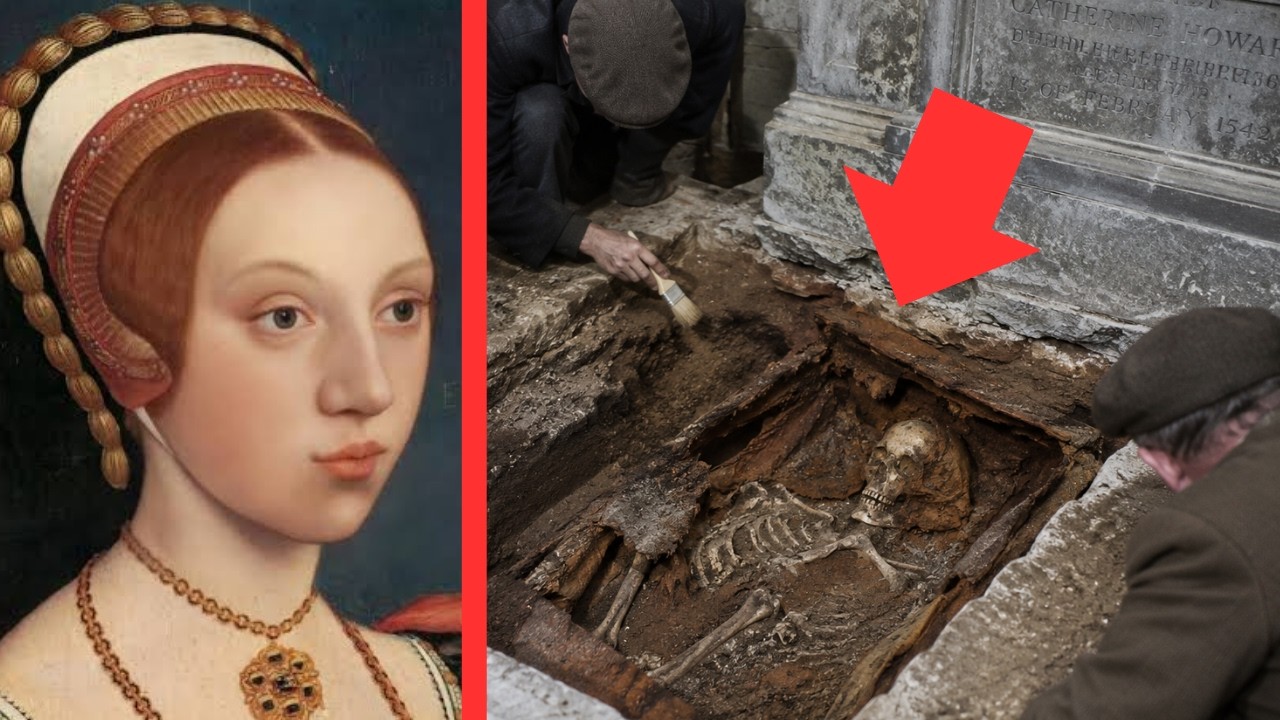
In February 1542, Catherine was still a young woman when she was executed at the Tower of London on the orders of Henry VIII. She had once occupied the most privileged position available to a woman in England. Within a short period, however, her title, security, and future had disappeared.
Her final resting place was not a grand royal tomb or an elaborate monument. Instead, her remains were buried in the Chapel Royal of St Peter ad Vincula, inside the Tower complex, alongside other people whose lives had ended through the Tudor state’s machinery of punishment.
The historical record supports a stark conclusion: Catherine received no elaborate royal funeral, and her burial was carried out without the ceremony that might ordinarily have accompanied a queen’s death. Yet some of the most dramatic claims circulating about her remains require closer examination. The suggestion that she was deliberately thrown into a pit of lime, denied every basic burial dignity, or completely erased from archaeological history goes beyond what surviving evidence can securely establish.
The distinction matters. Catherine’s story is already tragic without adding details that cannot be verified. The real history reveals how vulnerable even a queen could become when royal favor turned into political danger.
According to Historic Royal Palaces, Catherine was taken to the Tower on February 10, 1542. Three days later, at approximately nine o’clock in the morning, she was executed on Tower Green. She may have been as young as eighteen. The same institution identifies the Chapel of St Peter ad Vincula as her burial place, alongside that of her cousin Anne Boleyn and other executed figures from Tudor history.
Her death marked the end of a brief and disastrous queenship. Her burial marked the beginning of a different kind of disappearance, one shaped by the practices of sixteenth-century punishment, the changing architecture of the Tower, and the difficulty of identifying individual remains centuries later.
Catherine had not been born to expect the English throne. She belonged to a junior branch of the powerful Howard family, whose influence gave her access to the royal court but did not make her independent of its political dangers.
The precise year of her birth remains uncertain. Surviving evidence places it between 1518 and 1524, with many historians favoring a date around 1523 or 1524. That uncertainty is one reason responsible accounts generally describe her as a teenager or young woman rather than presenting her exact age as indisputable.
Henry VIII was more than thirty years older than Catherine when she became his fifth wife in 1540. The king had already experienced years of marital conflict, dynastic anxiety, and political upheaval. Catherine’s youth and charm initially appeared to offer him a new beginning.
But the relationship unfolded inside a court where personal intimacy and political survival were inseparable. A queen’s reputation could affect the succession, the standing of noble families, and the security of people associated with her.
Catherine’s past became the foundation of a devastating investigation. Questions arose about her relationships before her marriage and her conduct after becoming queen. Thomas Culpeper and Francis Dereham were prosecuted in connection with the scandal. Both men were executed, while Catherine and her attendant Jane Boleyn, Lady Rochford, were condemned under a bill of attainder.
The legal and political process moved with extraordinary speed. Catherine was deprived of her queenship in November 1541, and Parliament’s actions helped establish the basis for her eventual execution. Her fate was no longer simply a private marital disaster. It had become an issue of royal authority and state security.
Modern readers often encounter the story through a simple moral question: was Catherine an unfaithful traitor, or was she a young woman destroyed by a ruthless king?
The surviving record makes that question more complicated than either label suggests. Her earlier relationships, the circumstances in which she entered court life, and the standards imposed upon women of the royal household all require careful historical interpretation. The evidence does not justify reducing her entire life to a single accusation.
What is clear is that Henry’s authority left Catherine with little ability to control the public account of her fall. Once the crown turned against her, the machinery that had elevated her could no longer protect her.
On February 13, 1542, Catherine was taken to Tower Green. Historic Royal Palaces records that she was so weak she needed support to reach the scaffold. She reportedly acknowledged the justice of her sentence before the executioner struck. Such a statement must be understood within the circumstances of a condemned prisoner facing the king’s authority, rather than treated as an uncomplicated expression of freely chosen guilt.
The execution itself was swift. The consequences were permanent.
Catherine’s remains were buried on the same day in the Chapel of St Peter ad Vincula, without a formal funeral. The chapel served the Tower community and became the resting place of several people executed within its walls, including Anne Boleyn, who had been beheaded in 1536.
That shared burial place is significant. Catherine had been queen of England, yet after her execution she was interred in the same chapel associated with other condemned people whose lives had ended under the Tudor state.
There is no evidence that she received a lavish royal tomb or a public memorial comparable to those afforded to monarchs who died in favor. Her burial reflected her sudden political disgrace.
But the claim that Catherine’s body was simply dumped into raw earth, denied even a wooden coffin, must be treated cautiously. The available institutional account confirms a rapid burial without a funeral. It does not establish every detail of the container used, the precise depth of the grave, or whether lime was placed around her remains.
Those distinctions may appear small beside the violence of her execution, but they separate documented history from speculation.
The same caution applies to the idea that her body was deliberately placed in a chemical pit intended to destroy every trace of her identity. No reliable evidence presented by the principal historical institution responsible for the Tower establishes such a plan.
The Chapel of St Peter ad Vincula underwent substantial alterations over the centuries. Burials accumulated beneath its floors, and later building work disturbed the remains of people who had been interred there. The chapel’s changing structure would eventually make the precise locations of individual graves increasingly difficult to establish.
The absence of a prominent memorial during Catherine’s lifetime did not mean that her burial place had vanished immediately. Rather, the building continued to serve as a place of worship and burial while the Tower itself changed around it.
Centuries later, restoration work brought the chapel’s buried history back into view. In 1876, the chapel underwent a major restoration. Human remains were uncovered in the chancel, and the disturbed remains were reburied beneath a marble pavement bearing names and heraldic symbols associated with prominent historical figures.
Historic Royal Palaces explains that the remains uncovered during the restoration were reburied beneath the pavement, where memorial inscriptions now mark the resting places associated with people including Anne Boleyn and Catherine Howard.
The restoration did not amount to a modern forensic identification of every individual skeleton. That distinction is crucial when evaluating claims that nineteenth-century excavators either found Catherine’s bones or failed to locate a single identifiable fragment.
Historical investigators worked with the records, architectural evidence, and archaeological methods available to them. Their task was complicated by repeated burials, disturbed graves, and centuries of alterations to the chapel.
A grave’s location could be inferred from historical descriptions, but that did not necessarily mean every set of remains could be identified with scientific certainty. Names engraved into a memorial pavement should not automatically be interpreted as proof that a complete, individually identifiable skeleton lies directly beneath each inscription.
Nor does the absence of a modern forensic identification establish that a person’s remains had completely dissolved.
Human bones can survive for centuries under suitable conditions, but their preservation depends on soil chemistry, moisture, temperature, burial practices, disturbance, and many other factors. Bones may fragment, become mixed with other remains, or be displaced during later construction.
Lime is also not a simple historical eraser. Different materials described as lime behave differently, and their effects depend on the conditions in which they are used. It is therefore misleading to claim that Catherine’s body must have disappeared because she was supposedly buried in a lime pit when that specific burial detail has not been established.
The archaeological history of the Tower is more complicated than a single dramatic explanation. It includes layers of construction, repeated use of sacred spaces, and the reinterment of human remains after restoration.
More recent excavations have reinforced that complexity. Historic Royal Palaces reported in 2019 that trial excavations near the chapel uncovered burials and other archaeological evidence relating to the Tower’s development. Subsequent research has continued to reveal how the chapel and its surrounding structures changed over many centuries.
In 2025, Historic Royal Palaces described a major excavation outside the chapel that uncovered remains belonging to more than twenty individuals, along with evidence that changed historians’ understanding of the site’s earlier buildings. The work demonstrated how much of the Tower’s buried history remains difficult to reconstruct, even with modern archaeological techniques.
These discoveries do not prove that Catherine’s grave was destroyed, nor do they establish that her remains were lost beyond recognition because of a deliberate effort to erase her. They instead show why archaeological claims must be grounded in specific evidence.
The chapel’s history also complicates the idea that its burial ground was reserved exclusively for disgraced royal prisoners. It served as the parish church for people who lived and worked inside the Tower. Over the centuries, many individuals were buried there, including people whose names never entered the historical record.
Consequently, the presence of remains beneath the chapel does not automatically connect them to a famous execution. Identification requires more than a location and a compelling story.
Catherine’s burial nevertheless reveals something important about Tudor power. Her body was not granted the ceremonial treatment that might have accompanied a queen who died peacefully while still enjoying royal favor. The speed of the burial and the absence of an elaborate funeral reflected the political circumstances surrounding her execution.
In Tudor England, punishment could reach beyond death. Public execution communicated the consequences of challenging royal authority, while the treatment of a condemned person’s remains could reflect the loss of status that followed disgrace.
Yet Catherine was not completely erased from history. Her name survived in chronicles, political records, later histories, and the continuing memory of the Tower. Her burial place is recognized by the institution that manages the historic site, and visitors can learn about her fate alongside that of Anne Boleyn and other executed figures.
That survival creates an irony. The monarchy could deprive Catherine of her title and life, and her burial could remain poorly documented for centuries, but the story could not be permanently suppressed.
The modern fascination with Catherine often concentrates on the most gruesome details: the axe, the missing head, the supposed lime pit, and the possibility that her remains disappeared without a trace. Those details produce an arresting narrative, but they can also obscure the larger historical reality.
Catherine was a young woman caught in a system where the king’s personal decisions carried the force of state policy. Her fall was shaped by gender, court politics, the importance of the succession, and the enormous imbalance of power between a monarch and his wife.
It is possible to recognize the severity of her fate without assuming that every allegation about her burial is true. Indeed, the more disturbing aspect of her story may be how quickly her position changed from royal privilege to complete dependence on the authorities who condemned her.
The question of whether Catherine was a traitor or a victim cannot be answered simply by examining her grave. It requires attention to the circumstances of her life, the evidence behind the charges against her, and the political system that determined her fate.
Likewise, the question of whether her body was buried in lime or without a wooden coffin cannot be settled through dramatic repetition. It requires reliable documentary evidence or archaeological findings that specifically support those claims.
At present, the strongest evidence establishes that Catherine was executed at the Tower on February 13, 1542, and buried that day in the Chapel of St Peter ad Vincula without a formal funeral. Later restoration disturbed remains within the chapel, and the site’s complicated burial history makes individual identifications difficult.
What the evidence does not establish is that Catherine was deliberately placed in a lime pit as part of a secret effort to destroy her remains, or that nineteenth-century excavators conclusively proved every trace of her skeleton had vanished.
The difference between those statements matters because history is not made more powerful by treating uncertainty as proof.
Catherine Howard’s final burial remains a sobering symbol of how completely royal favor could turn into disgrace in Henry VIII’s England. A young woman who had once stood beside the king ended her life condemned by his government and buried without the ceremony associated with her former rank.
Her remains may not be identifiable with the certainty modern readers would prefer. Her precise grave may not be recoverable as an individual archaeological deposit. But the historical record has not erased her.
The chapel still stands, carrying the memory of people who lived and died within the Tower’s walls. Its stones and buried layers preserve fragments of a past that archaeologists continue to investigate.
Catherine’s story therefore ends not with proof of a secret lime pit, but with a more defensible and enduring question: what does it mean when a monarchy can strip a queen of her title, condemn her to death, and leave her burial with so little ceremony that later generations must reconstruct the circumstances from incomplete records?
The answer lies in the extraordinary power of the Tudor crown—and in the responsibility of modern historians to distinguish the brutality the evidence reveals from the darker legends that grew around it.
Catherine Howard was executed at eighteen or thereabouts, depending on her uncertain birth year. She was buried in the Tower chapel, and her death became part of the history of Henry VIII’s reign. The details of her final resting place remain constrained by the limitations of the surviving evidence.
That is disturbing enough.
Her story does not need an unproven grave of lime or a claim that every bone vanished to remind us how precarious life could be at the Tudor court. The documented facts already reveal a young queen whose extraordinary elevation ended in swift execution, an unceremonious burial, and centuries of uncertainty about the physical remains she left behind.


