Jack and the Beanstalk’s Dark Origins: The 5,000-Year-Old Mystery Hidden Behind the Fairy Tale
For generations, Jack and the Beanstalk has been remembered as a familiar children’s story about a poor boy, a handful of magic beans, and a terrifying giant living in a castle above the clouds. But beneath its simple adventure lies a much older mystery, one that may connect the tale to ancient beliefs, prehistoric migrations, and humanity’s oldest traditions of storytelling.
The version most people know begins with a widow and her only son, Jack, who live in poverty with almost nothing left to their names. When their last remaining possession, a cow, must be sold to provide food, Jack encounters a stranger who offers him something extraordinary in exchange: a handful of supposedly magical beans.
Jack accepts the bargain, returning home with beans instead of money. His mother is furious and throws them out of the window. Yet during the night, something astonishing happens. A gigantic beanstalk rises from the earth, twisting upward until its towering branches disappear into the clouds.
Driven by curiosity, Jack begins to climb. Far above the world he knows, he discovers a strange castle inhabited by a giant and his wife. The giant’s wife initially warns him that her husband eats boys for breakfast, but she takes pity on the hungry child and offers him food. When her husband returns, she hides Jack from his enormous, dangerous presence.
The giant soon announces his hunger with the familiar rhyme, “Fee, fi fo fum, I smell the blood of an Englishman.” Although he suspects that someone may be nearby, he eventually settles down and falls asleep.
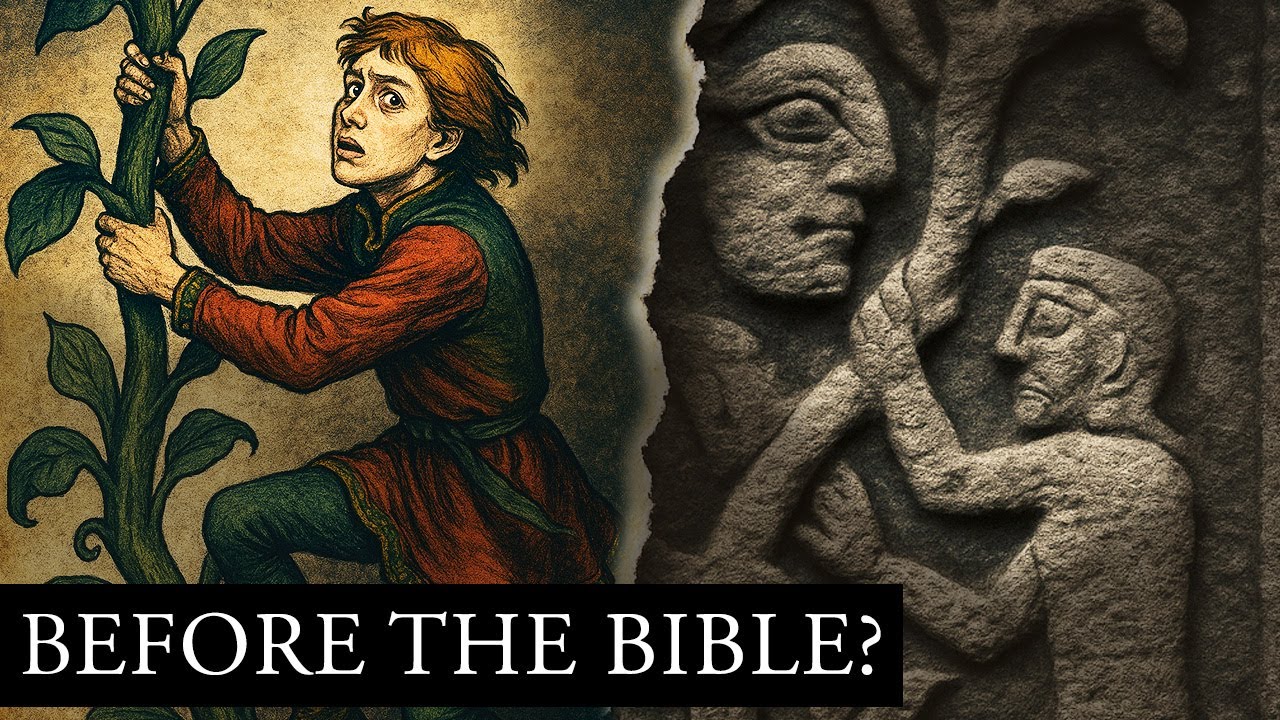
Jack seizes his opportunity. He steals a bag of gold and escapes down the beanstalk, bringing wealth to his struggling household. But his adventure does not end there. He returns to the castle twice more, eventually taking a hen that lays golden eggs and a magical harp that sings by itself.
The final theft proves far more dangerous. The harp cries out for help, awakening the giant, who pursues Jack down the towering stalk. Reaching the ground, Jack calls for his mother to bring an axe. Together, they cut through the enormous plant until it collapses, sending the giant plunging to his death.
Jack and his mother live happily ever after, or so the familiar story concludes. Yet the history of this tale is considerably more complicated than its traditional ending suggests.
The version most widely recognized today is closely associated with folklorist Joseph Jacobs, who published Jack and the Beanstalk in his collection English Fairy Tales in 1890. Jacobs drew on an oral version he had heard from a storyteller identified as Mrs. Hunt, helping preserve a story that had circulated long before its appearance in his book.
However, the tale was already known in print much earlier. In 1734, a London booklet titled Jack Sprigins and the Enchanted Bean appeared as a parody of the familiar adventure. Its very existence provides an important clue: readers must already have recognized the story well enough for its central ideas to become the subject of public humor.
A more traditional printed version followed in 1807, associated with Benjamin Tabart and titled The History of Jack and the Beanstalk. This version gave Jack a more explicitly moral purpose. A fairy revealed that the giant had murdered Jack’s father and stolen his wealth, transforming the boy’s actions from questionable theft into an attempt to recover what rightfully belonged to his family.
That change reflected a broader tendency to reshape traditional stories into clearer moral lessons. Jack became less of a mischievous opportunist and more of a righteous avenger. In Jacobs’s version, however, the hero remains morally ambiguous, relying on cunning, luck, and theft rather than an elaborate justification for his actions.
This distinction matters because folklore rarely remains unchanged. Stories evolve as they pass between generations, absorbing new values and interpretations along the way. The Jack remembered today may therefore be the product of centuries of storytelling rather than the creation of any single author.
Even the giant’s famous rhyme has a history of its own. A version of the phrase appears in Shakespeare’s King Lear, written around the beginning of the seventeenth century, suggesting that the expression was already familiar to audiences of the period. Its appearance in the play indicates that the language of giants and monstrous hunger had a place in English storytelling before Jacobs recorded his version.
In the nineteenth century, a Scottish antiquarian proposed that the rhyme might have Gaelic origins, offering a possible interpretation related to food and hunger. That theory remains speculative rather than an established explanation of the phrase’s origin, but it illustrates how scholars have searched for older traditions beneath the familiar words.
The giant himself invites even bigger questions. Giants appear throughout the mythologies of the world, often as powerful beings who inhabit territories beyond the reach of ordinary people. In the Bible, David defeats Goliath with a sling and a stone. In Homer’s Odyssey, Odysseus blinds the Cyclops Polyphemus after the giant imprisons him and devours his companions. Norse mythology describes the jötnar, powerful beings who stand in opposition to the gods.
These stories differ considerably, but they share a recurring image: a vulnerable or comparatively small figure confronting a powerful being whose strength appears overwhelming. In many traditions, the encounter takes place in a remote or forbidden realm, where the ordinary rules of human society no longer apply.
Jack follows a similar pattern. He enters a world that does not belong to him, encounters its powerful guardian, takes valuable objects, and escapes by destroying the path that connects the two realms. Viewed from this perspective, Jack is not simply a brave boy defeating a monster. He is also an intruder whose success depends on taking what another being possesses.
Some modern interpretations have therefore questioned whether the story can be read as an account of conquest, with Jack representing an outsider who enters another world, appropriates its wealth, and destroys its protector. This is an interpretive possibility, not an established historical explanation of the tale, but it highlights the unsettling ambiguity beneath its traditional happy ending.
The most extraordinary claim about Jack’s origins emerged from research published in 2016. Folklorists Sara Graça da Silva and Jamshid J. Tehrani examined the relationships between traditional tales using methods inspired by evolutionary biology. Rather than tracing the physical ancestry of living organisms, their approach used similarities between stories to investigate how narratives may have developed and spread across generations.
Their research considered a broader family of folktales, including the tale type classified as ATU 328, known as “The Boy Who Stole the Ogre’s Treasure.” Stories in this category feature a young protagonist who confronts a monstrous guardian and steals valuable objects from a dangerous or extraordinary realm.
Related versions appear in different parts of the world, including European traditions and stories from regions farther east. Although the details vary, the recurring structure suggests that some narrative patterns have traveled across cultures and survived considerable changes in language and society.
The researchers’ analysis suggested that certain fairy tales may have roots extending thousands of years into prehistory. The widely discussed possibility that a tale type related to Jack and the Beanstalk could reach back more than 5,000 years has made the story particularly fascinating to historians and folklore enthusiasts.
However, this does not mean that researchers discovered a written version of Jack’s adventure from the Stone Age. Nor does it establish that every detail of the familiar English story existed in its present form thousands of years ago. The proposed age concerns the ancestry of a related narrative tradition, reconstructed through similarities among surviving tales, and such estimates depend on the methods and assumptions used.
The research has nevertheless raised an intriguing possibility: some of the stories told to children today may preserve fragments of narrative traditions that originated among prehistoric communities.
One proposed connection leads to the Proto-Indo-Europeans, a prehistoric population associated with the development of the ancestral language from which many later languages emerged, including Greek, Latin, Sanskrit, Celtic, and Germanic languages. Their communities are generally associated with the Pontic-Caspian steppe, although details of their origins and movements remain subjects of scholarly investigation.
These populations lived thousands of years before the earliest surviving written versions of Jack’s story. They left no known written account of a boy climbing a magical plant to steal treasure from a giant. Any connection between their storytelling traditions and the modern fairy tale must therefore be reconstructed indirectly.
Archaeological evidence provides information about their material lives, including burial mounds, pottery, ornaments, and weapons. Oral storytelling, however, leaves no comparable physical record. A narrative can survive for generations without leaving an identifiable trace, making it difficult to determine precisely when a particular plot first emerged.
If a story resembling Jack’s adventure really did circulate among prehistoric communities, its survival would be remarkable. It would mean that a basic narrative pattern had traveled through migrations, changing languages, and centuries of cultural transformation before eventually appearing in English collections of fairy tales.
Jack’s adventure also resembles several well-known myths about entering a forbidden realm and taking something powerful from its guardian. One of the clearest comparisons is the Greek story of Prometheus, the Titan who steals fire from the gods and gives it to humanity.
Fire represents far more than a useful tool in the Prometheus myth. It becomes a symbol of knowledge, warmth, technology, and the possibility of civilization. By crossing a boundary that the gods intended to enforce, Prometheus changes the lives of human beings, although he suffers terrible punishment for his defiance.
Jack’s stolen treasures are different, but the underlying structure invites comparison. He enters a world beyond ordinary human experience and returns with objects that provide wealth, abundance, and wonder. His golden eggs promise an ongoing supply of riches, while the magical harp represents music and enchantment.
Other mythological traditions contain related patterns. In Norse mythology, Odin obtains the mead of poetry, a supernatural drink associated with poetic inspiration and wisdom. In the Mesopotamian Epic of Gilgamesh, the hero’s encounter with the guardian Humbaba takes him into a forbidden forest, where the cutting of sacred cedar trees connects the adventure to questions of divine authority and human ambition.
These are not necessarily direct ancestors of Jack and the Beanstalk. Similar motifs can arise independently, and parallels alone cannot prove that one story developed from another. Nevertheless, the comparisons demonstrate how widely human storytelling has explored the dangers and rewards of crossing boundaries to obtain something extraordinary.
The beanstalk itself adds another layer of symbolism. Its sudden growth creates a bridge between the familiar ground below and an inaccessible world above. In numerous religious and mythological traditions, trees, mountains, ladders, and other vertical structures connect different levels of existence.
Norse cosmology features Yggdrasil, the great tree linking different worlds. Greek mythology places the gods on Mount Olympus, whose heights and clouds distinguish their realm from ordinary human life. Other traditions describe sacred trees or cosmic structures connecting heaven, earth, and the underworld.
Jack’s beanstalk can be read as a fairy-tale version of this familiar image: a passage between worlds that would otherwise remain separate. Yet the story does not explain what the stalk represents, and any connection to ancient cosmology remains an interpretation rather than a proven origin.
An even darker reading emerges when the magic beans are considered in the context of ancient beliefs about life and death. In Greek tradition, some followers of the philosopher Pythagoras reportedly regarded beans as sacred or avoided them for religious reasons. Later accounts describe beliefs connecting beans with the souls of the dead, although the exact meaning and origins of these traditions remain debated.
These beliefs have encouraged modern interpreters to view Jack’s bargain as something more significant than a foolish exchange. He gives away the family’s last cow, an animal associated with nourishment and survival, and receives seeds that produce an extraordinary passage into another realm.
The symbolism is compelling, but there is no direct evidence that the original storytellers intended the beans to represent death or the beanstalk to serve as a path to the afterlife. The interpretation belongs to a broader effort to understand fairy tales through the religious and symbolic traditions of the ancient world.
Still, the journey invites comparison with stories about souls traveling between realms. In some mythologies, the dead descend into an underworld. In others, the heavens, sacred trees, or elevated landscapes provide routes to supernatural territories. The direction of travel varies, but the central idea remains recognizable: ordinary existence is separated from another realm by a boundary that must somehow be crossed.
Jack climbs toward the sky, encounters a guardian, and returns carrying extraordinary objects. The giant might be understood as a monster, an enemy, or, in a symbolic reading, a protector of a world that humans are not meant to enter. The treasures might represent prosperity, knowledge, or the rewards of a dangerous journey.
None of these interpretations can be established as the definitive meaning of the fairy tale. Jack and the Beanstalk has existed in changing forms, and its surviving evidence does not reveal a single original message hidden beneath every version.
Perhaps that uncertainty is part of the story’s enduring appeal. A simple adventure about a poor boy and a giant can accommodate questions about greed, courage, injustice, conquest, and the limits of human ambition. It can be enjoyed as a magical escape while also inviting readers to consider why stories about forbidden worlds and stolen treasures appear in so many cultures.
The familiar ending offers a reassuring conclusion: Jack defeats the giant, saves his family from poverty, and lives happily ever after. Yet the events leading to that ending remain morally complicated. Jack is rewarded for entering someone else’s home, taking its wealth, and destroying the route by which its owner might follow him.
That tension has helped keep the story alive. Jack is neither an unquestionable hero nor simply a villain. He is a clever, opportunistic character whose actions produce a satisfying victory while leaving uncomfortable questions behind.
Whether the tale’s oldest narrative ancestors date back 5,000 years or its similarities to ancient myths reflect recurring patterns in human imagination, Jack and the Beanstalk reaches far beyond its familiar image of a boy climbing into the clouds.
Its history reminds us that fairy tales are rarely as simple as they appear. They travel through generations, change as societies change, and gather new meanings along the way. Beneath the magic beans and the golden treasures lies a story about crossing forbidden boundaries, confronting overwhelming power, and returning with something that changes the world below.
And perhaps that is the real mystery of Jack and the Beanstalk: not that we can prove it began in the prehistoric past, but that a story with roots so difficult to trace can still capture our imagination today.


