On a quiet day inside a military operating room in Korea, a young company clerk walked through the doors carrying a piece of paper. The surgeons continued working, unaware that the words he was about to read would become one of the most unforgettable moments in television history.
Lieutenant Colonel Henry Blake’s plane had been shot down over the Sea of Japan. There were no survivors.
The announcement stunned the characters and devastated millions of viewers watching at home.
More than half a century later, that scene from MASH* remains one of television’s most powerful portrayals of the human cost of war.
When the series premiered on CBS on September 17, 1972, nobody expected it to become one of the most celebrated programs in American television history.
Inspired by the 1970 film and set during the Korean War, MASH* followed the doctors, nurses, and military personnel of the fictional 4077th Mobile Army Surgical Hospital.
Its unusual combination of comedy, drama, political commentary, and emotional storytelling distinguished it from conventional sitcoms.
The series initially struggled in the ratings, but its audience gradually grew.
By the time the finale aired on February 28, 1983, MASH* had become a television institution. Its concluding episode, Goodbye, Farewell and Amen, attracted approximately 106 million viewers in the United States.
The show ran for eleven seasons, even though the Korean War itself lasted approximately three years.
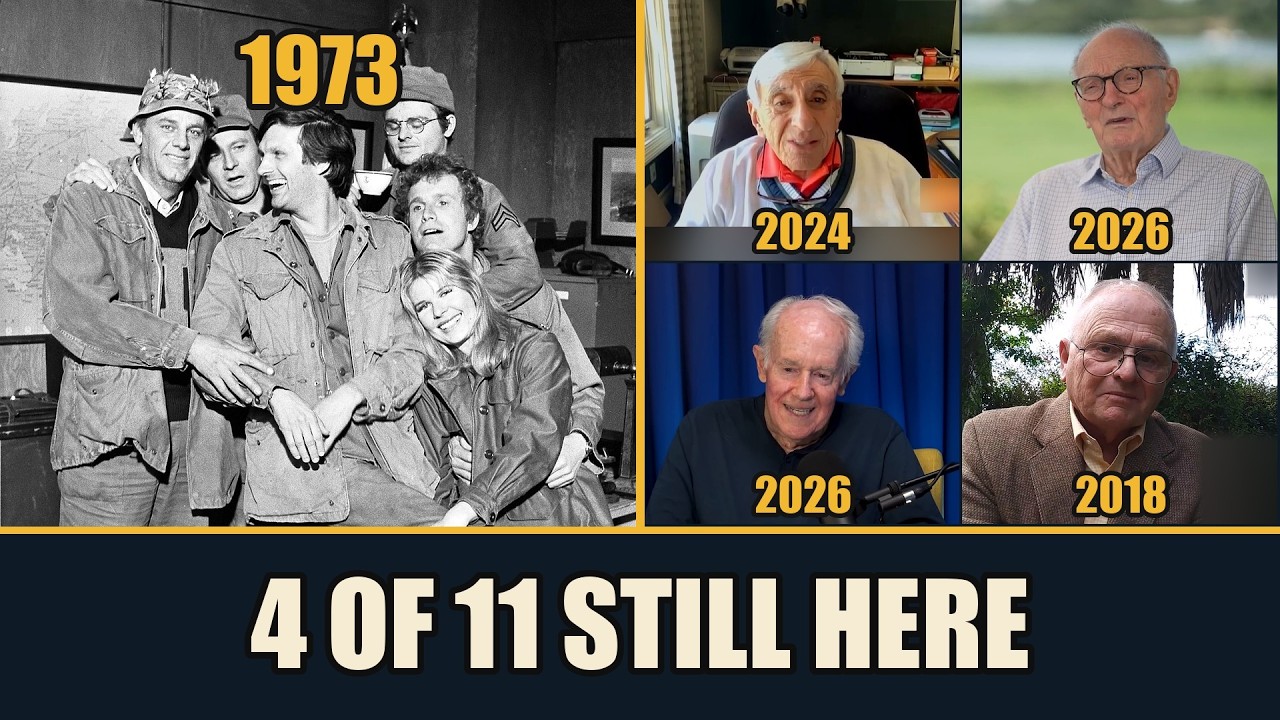
Now, fifty-four years after the premiere, the original ensemble has changed forever.
Of the eleven principal performers featured in this retrospective, only four are still alive in October 2026: Alan Alda, Jamie Farr, Mike Farrell, and Gary Burghoff.
The others, including Harry Morgan, McLean Stevenson, Wayne Rogers, Loretta Swit, Larry Linville, William Christopher, and David Ogden Stiers, have passed away.
Their careers, personal lives, and unforgettable performances reveal the remarkable legacy of a series that changed American television.
Alan Alda as Captain Benjamin Franklin “Hawkeye” Pierce
1936–Present | Age 90
Alan Alda became the defining face of MASH* through his portrayal of Hawkeye Pierce, the gifted surgeon whose humor concealed deep frustration with the realities of war.
Born Alphonso Joseph D’Abruzzo on January 28, 1936, in New York City, Alda was thirty-six when the series premiered.
His father, Robert Alda, was a successful actor and entertainer.
Growing up in a theatrical family exposed young Alan to performance from an early age.
But his childhood also included serious challenges.
At seven, he contracted polio and underwent an intensive course of treatment.
He later attended Fordham University and served in the United States Army Reserve.
Although his military experience influenced his understanding of service life, Alda did not serve in Korea.
On MASH*, Hawkeye became the show’s moral and emotional center.
He challenged military bureaucracy, questioned authority, and used jokes to cope with the suffering surrounding him.
His friendship with Trapper John, and later B.J. Hunnicutt, provided much of the series’ comedy.
But Alda’s performance also explored exhaustion, loneliness, and the psychological consequences of repeated exposure to suffering.
As the show progressed, Alda became increasingly involved in its creative direction.
He wrote and directed episodes, helping guide the program toward more emotionally ambitious storytelling.
He also wrote and directed the famous series finale.
After MASH*, Alda continued building an impressive career.
He directed and starred in The Four Seasons, appeared on The West Wing, and earned an Academy Award nomination for his performance in The Aviator.
He also hosted Scientific American Frontiers and became involved in improving communication between scientists and the public.
His interest in science eventually led to the establishment of the Alan Alda Center for Communicating Science at Stony Brook University.
In 2018, Alda publicly revealed that he had Parkinson’s disease.
Rather than retreating from public life, he began discussing the condition openly.
In an October 2026 interview with CBS Sunday Morning, Alda described the challenges of living with the disease at ninety.
He explained that ordinary activities, including writing emails and getting dressed, could require additional effort.
Yet his sense of humor remained remarkably intact.
He continued recording his podcast, Clear+Vivid, and emphasized the importance of accepting reality while maintaining curiosity and enjoyment.
Alda has been married to photographer and author Arlene Alda since March 1957.
Their marriage has lasted nearly seventy years.
They have three daughters and a large extended family.
At ninety, Alan Alda remains the oldest surviving member of the show’s principal cast featured here.
For generations of viewers, Hawkeye Pierce remains a symbol of intelligence, compassion, humor, and resistance to unnecessary suffering.
Jamie Farr as Corporal Maxwell Q. Klinger
1934–Present | Age 92
Jamie Farr never expected to become one of MASH*’s most recognizable stars.
His original role was supposed to last only a single day.
Born Jameel Joseph Farah on July 1, 1934, in Toledo, Ohio, Farr began acting during the 1950s.
His early credits included the film Blackboard Jungle.
He also served in the United States Army, spending time in Korea and Japan.
When he was hired to play Corporal Maxwell Klinger in 1972, he received approximately $250 for what was initially a brief guest appearance.
Klinger’s unusual strategy for obtaining a military discharge quickly attracted attention.
He frequently wore women’s clothing, hoping that his commanding officers would declare him unfit for service.
But the character’s absurd behavior concealed intelligence, warmth, and extraordinary loyalty.
Farr’s comic timing made Klinger popular with audiences.
The producers repeatedly invited him back.
By 1975, he had become a regular member of the cast.
Klinger’s references to Toledo became another recognizable feature of the character.
He frequently mentioned the Toledo Mud Hens baseball team and Tony Packo’s restaurant.
Those references eventually made Farr an unofficial ambassador for his hometown.
As the series progressed, Klinger developed beyond the original running joke.
He gradually assumed greater responsibility, eventually taking over important administrative duties after Radar’s departure.
The character also became involved in more serious personal storylines.
Farr later explained that changes to Klinger’s portrayal were influenced partly by his desire to prevent his own children from being teased.
After MASH*, Farr continued acting.
He appeared in The Cannonball Run films and performed in stage productions, including Guys and Dolls.
He also became closely associated with a professional golf tournament in Toledo that raised money for charitable causes.
In 2017, the Toledo Mud Hens honored Farr and his famous television character through their Celebrity Hall of Fame.
Farr married Joy Ann Richards in 1963.
Their marriage has endured for more than six decades.
At ninety-two in 2026, he remains one of the last surviving members of the original principal cast.
His remarkable journey from a one-day guest performer to a beloved television regular remains one of MASH*’s greatest behind-the-scenes stories.
Mike Farrell as Captain B.J. Hunnicutt
1939–Present | Age 87
Mike Farrell joined MASH* in 1975, replacing Wayne Rogers as Hawkeye’s closest friend and surgical partner.
Born on February 6, 1939, in St. Paul, Minnesota, Farrell moved to Hollywood as a child.
Before becoming an actor, he served in the United States Marine Corps.
His experiences gave him familiarity with military life, although his later public career became strongly associated with humanitarian causes and opposition to capital punishment.
On MASH*, Farrell portrayed Captain B.J. Hunnicutt, a surgeon who deeply missed his wife Peg and their daughter Erin.
Unlike Hawkeye, B.J. had a stable marriage waiting for him at home.
That difference became one of the defining features of their friendship.
B.J. shared Hawkeye’s frustration with the war but often expressed it through quieter sarcasm and emotional reflection.
Farrell gradually became an essential part of the ensemble.
He also wrote and directed episodes.
His character provided one of the finale’s most memorable images.
As Hawkeye departed the camp by helicopter, he looked down and discovered that B.J. had arranged stones on the ground to spell the word “GOODBYE.”
The simple gesture became a powerful symbol of friendship and separation.
After MASH*, Farrell continued acting and producing.
He portrayed veterinarian Jim Hansen on Providence and appeared in numerous other television productions.
He also dedicated considerable time to humanitarian work.
Farrell became involved with Amnesty International and organizations opposing the death penalty.
His activism often focused on human rights, criminal justice, and international humanitarian concerns.
In his personal life, Farrell married actress Shelley Fabares in 1984.
Fabares was famous for The Donna Reed Show, One Day at a Time, and Coach.
Their marriage lasted more than forty years.
On August 22, 2026, Fabares died in Los Angeles at eighty-two.
Farrell publicly paid tribute to his wife, remembering her warmth, humor, loyalty, and courage.
Her passing marked a devastating personal loss.
At eighty-seven, Farrell remains active in public life and continues to be remembered as one of television’s most compassionate performers.
His portrayal of B.J. Hunnicutt remains an enduring example of how quiet loyalty can be just as powerful as dramatic heroism.
Gary Burghoff as Corporal Walter “Radar” O’Reilly
1943–Present | Age 83
Gary Burghoff holds a unique place in MASH* history.
He was the only principal actor from the original 1970 film to reprise his character in the television adaptation.
Born on May 24, 1943, in Bristol, Connecticut, Burghoff portrayed Corporal Walter Eugene O’Reilly, better known as Radar.
Radar was the young company clerk whose ability to anticipate his commanding officers’ needs frequently seemed almost supernatural.
He could detect incoming helicopters before anyone else heard them.
He knew when supplies were needed and often understood what Colonel Blake wanted before the colonel had spoken.
Burghoff gave Radar a mixture of innocence, intelligence, and vulnerability.
The character became particularly beloved because he represented a young man far from home who struggled to preserve his sense of goodness amid war.
One of Radar’s most devastating moments occurred in the third-season finale.
After receiving news that Colonel Blake’s plane had been shot down, Radar entered the operating room and delivered the announcement.
The scene became one of television’s most unforgettable dramatic moments.
Burghoff also possessed talents beyond acting.
He was an accomplished jazz drummer and performed music during the series.
His live drum solo in the episode Showtime demonstrated that musical ability.
In 1977, he won an Emmy Award for portraying Radar.
But by the late 1970s, Burghoff had become increasingly concerned about the demands of television production.
He wanted more time with his family and greater freedom to pursue personal interests.
He left the show in 1979.
Radar’s departure was portrayed through the two-part episode Goodbye, Radar.
The character returned to Iowa, leaving behind the military hospital and the friends who had become his second family.
After acting, Burghoff pursued wildlife painting, conservation interests, and other creative activities.
He also became involved in caring for injured animals.
His inventive interests included developing practical products and fishing equipment.
In later interviews, Burghoff explained that leaving MASH* allowed him to reconsider his priorities and build a different life.
At eighty-three in 2026, he remains one of the four surviving principal performers featured here.
Radar O’Reilly continues to represent the innocence and humanity that made MASH* so emotionally compelling.
McLean Stevenson as Lieutenant Colonel Henry Blake
1927–1996 | Died at 68
McLean Stevenson portrayed Lieutenant Colonel Henry Blake, the original commanding officer of the 4077th.
Born on November 14, 1927, in Normal, Illinois, Stevenson was already an experienced television performer when MASH* premiered.
Henry Blake was unlike most conventional military commanders.
He was disorganized, frequently overwhelmed, and often unable to maintain discipline.
But he cared deeply about the people serving under him.
Stevenson’s relaxed comic style made Henry an ideal contrast to the rigid military officers who occasionally visited the camp.
His scenes with Radar were particularly memorable.
Radar frequently performed administrative tasks that his commanding officer barely understood.
Despite Henry’s obvious shortcomings, the camp respected him.
By the third season, however, Stevenson wanted to leave the series.
He believed he could achieve greater recognition as the star of his own television program.
The producers agreed to his departure.
But they chose an ending that would permanently alter the show’s history.
In the episode Abyssinia, Henry, the colonel received his discharge and prepared to return home.
The staff gathered to say goodbye.
Henry departed by helicopter, apparently heading toward the peaceful future he had long desired.
Then came the unexpected operating-room announcement.
Radar revealed that Henry’s plane had been shot down.
The shocking ending reminded viewers that the series’ comedy existed within a war where tragedy could strike without warning.
Stevenson later starred in several television projects, including The McLean Stevenson Show, In the Beginning, and Hello, Larry.
But none achieved the lasting success of MASH*.
He also frequently guest-hosted The Tonight Show.
In later interviews, Stevenson expressed regret about leaving the series, acknowledging how difficult it had been to find another equally talented ensemble and writing team.
He died on February 15, 1996, at sixty-eight, following a heart attack.
His portrayal of Henry Blake remains unforgettable, particularly because his final episode helped establish MASH* as a comedy willing to confront tragedy without warning.
Wayne Rogers as Captain “Trapper John” McIntyre
1933–2015 | Died at 82
Wayne Rogers portrayed Captain Trapper John McIntyre, Hawkeye’s original tentmate and closest friend.
Born on April 7, 1933, in Birmingham, Alabama, Rogers graduated from Princeton University and served in the United States Navy before becoming an actor.
His portrayal of Trapper combined humor, medical skill, and a rebellious attitude toward military authority.
The character’s friendship with Hawkeye became central to the show’s early success.
Together, they challenged regulations, played practical jokes, and tried to maintain their humanity amid the pressures of war.
But Rogers became dissatisfied with the direction of his character.
He believed the series increasingly concentrated on Hawkeye while reducing Trapper’s professional importance.
Contract disputes also complicated his relationship with the producers.
Rogers ultimately left the show after its third season.
His character’s departure occurred between seasons rather than through a major farewell episode.
Rogers subsequently continued acting.
He starred in House Calls, the medical comedy series opposite Lynn Redgrave.
But his career also developed in a completely different direction.
Rogers became a successful businessman and investor.
He developed considerable expertise in finance and later appeared as a market commentator.
His work included discussions of investment strategy and economic policy on business television.
He also testified before Congress about financial issues.
Rogers died on December 31, 2015, at eighty-two.
His career remains an example of a performer who achieved major recognition in entertainment before building a substantial second professional identity outside Hollywood.
Harry Morgan as Colonel Sherman T. Potter
1915–2011 | Died at 96
Harry Morgan joined MASH* as Colonel Sherman T. Potter after Henry Blake’s departure.
But he had already appeared on the series in a completely different role.
During the third season, Morgan portrayed the eccentric Major General Bartford Hamilton Steele.
His guest performance impressed the producers.
When they needed a new commanding officer, Morgan returned as Potter.
Born Harry Bratsberg on April 10, 1915, in Detroit, Michigan, Morgan had enjoyed a successful entertainment career for decades.
He appeared in numerous films and became familiar to television audiences through Dragnet, portraying Officer Bill Gannon.
Colonel Potter brought a different leadership style to the 4077th.
Unlike Henry Blake, Potter was a career military officer.
He understood discipline, regulations, and the responsibilities of command.
But he also possessed compassion and a dry sense of humor.
His love of his horse Sophie became one of the character’s memorable personal details.
Morgan gave Potter authority without making him intimidating.
The colonel frequently acted as a father figure to the younger doctors and nurses.
His relationship with Hawkeye was especially interesting.
Although they disagreed about military procedures, both men respected professional competence and compassion.
In 1980, Morgan won an Emmy Award for the role.
After MASH*, he reprised Potter in the spin-off AfterMASH.
Morgan continued acting into later life.
He died on December 7, 2011, at ninety-six.
For many viewers, Colonel Potter remains one of television’s greatest examples of leadership built on experience, humor, and genuine concern for others.
Larry Linville as Major Frank Burns
1939–2000 | Died at 60
Larry Linville played Major Frank Burns, the rigid, insecure, and frequently hypocritical surgeon who became one of MASH*’s most recognizable antagonists.
Born on September 29, 1939, in Ojai, California, Linville trained as an actor before joining the series.
Frank Burns believed strongly in military authority and frequently criticized Hawkeye and Trapper for their irreverent behavior.
But the character’s arrogance often concealed professional incompetence and emotional insecurity.
His affair with Major Margaret Houlihan provided many early comic storylines.
Linville’s performance was deliberately exaggerated.
Frank could be pompous, petty, jealous, and absurdly self-important.
Yet those qualities helped create an effective comic contrast with Hawkeye’s more compassionate approach to medicine.
By the end of his fifth season, Linville believed the character had reached the limits of its development.
He chose not to renew his contract.
Frank Burns departed the series and was replaced by Major Charles Emerson Winchester III.
After leaving MASH*, Linville continued working as a guest actor.
His credits included Murder, She Wrote, The Love Boat, and several films.
He also participated in events connected with military history and the series’ legacy.
In the late 1990s, Linville faced serious health difficulties.
He died on April 10, 2000, at sixty, from complications following cancer surgery.
His portrayal of Frank Burns remains an essential part of the show’s early identity.
William Christopher as Father Francis Mulcahy
1932–2016 | Died at 84
William Christopher portrayed Father Francis Mulcahy, the gentle chaplain whose kindness provided emotional stability amid the chaos of the 4077th.
Born on October 20, 1932, in Evanston, Illinois, Christopher had appeared in several television productions before joining MASH*.
He was particularly familiar to audiences as Private Lester Hummel on Gomer Pyle, U.S.M.C.
On MASH*, Father Mulcahy became one of the show’s most compassionate figures.
Unlike the surgeons, he could not solve medical problems through operations.
Instead, he offered spiritual guidance, emotional support, and practical assistance.
His quiet personality occasionally caused him to be overlooked.
But the character repeatedly demonstrated extraordinary courage and dedication.
Christopher’s understated performance helped make Mulcahy one of the show’s most beloved supporting characters.
Away from television, Christopher became deeply involved in supporting families affected by autism.
His son Ned was diagnosed with autism, and Christopher and his wife Barbara worked to raise awareness and encourage better understanding.
In 1988, they published Mixed Blessings, a book discussing their family’s experiences.
Christopher continued portraying Father Mulcahy in AfterMASH.
He also appeared in stage productions and other television projects.
He died on December 31, 2016, at eighty-four, following lung cancer.
His passing came exactly one year after Wayne Rogers died on the same calendar date.
Father Mulcahy remains remembered for showing that quiet compassion can be one of the strongest forms of courage.
David Ogden Stiers as Major Charles Emerson Winchester III
1942–2018 | Died at 75
David Ogden Stiers joined MASH* in 1977 as Major Charles Emerson Winchester III.
The character replaced Frank Burns but introduced an entirely different kind of rivalry.
Charles Winchester was intelligent, highly skilled, cultured, and frequently arrogant.
Unlike Frank, he could genuinely compete with Hawkeye and B.J. professionally.
Stiers portrayed the character with extraordinary precision.
His refined speech and intellectual confidence made Winchester seem completely out of place in the improvised conditions of the 4077th.
But the character gradually revealed unexpected generosity and emotional depth.
One of his most memorable storylines involved teaching music to Chinese prisoners.
When he later learned of their fate, his reaction became one of the series’ most devastating emotional moments.
Stiers received Emmy nominations for his work on MASH*.
After the series, he developed a remarkable career in film, television, voice acting, and music.
He became particularly well known to younger audiences as the voice of Cogsworth in Disney’s Beauty and the Beast.
He also voiced characters in Pocahontas, The Hunchback of Notre Dame, and other animated films.
Beyond acting, Stiers developed a serious interest in orchestral music.
He worked as a conductor and collaborated with musical organizations.
His passion for classical music created an interesting parallel with Winchester’s sophisticated tastes.
In 2009, Stiers publicly discussed his sexuality, explaining that he had previously worried about how openness might affect his professional opportunities.
He died on March 3, 2018, at seventy-five, from bladder cancer.
His legacy extends across drama, comedy, animation, and classical music.
For MASH* viewers, Charles Winchester remains a reminder that even the most arrogant character can possess unexpected compassion.
Loretta Swit as Major Margaret “Hot Lips” Houlihan
1937–2025 | Died at 87
Loretta Swit portrayed Major Margaret Houlihan, the chief nurse whose transformation became one of the show’s most important character developments.
Born on November 4, 1937, in Passaic, New Jersey, Swit was thirty-four when MASH* premiered.
Initially, Margaret was presented as a strict military professional whose relationship with Frank Burns made her a frequent target of Hawkeye’s jokes.
Her nickname, Hot Lips, reflected the show’s early comic approach to the character.
But Swit wanted Margaret to become more than a stereotype.
As the series progressed, she encouraged the writers to explore the character’s intelligence, professional commitment, emotional vulnerability, and independence.
Margaret gradually became one of the show’s most complex personalities.
She developed stronger friendships, confronted romantic disappointments, and learned to balance military discipline with compassion.
Swit’s performance earned ten Emmy nominations.
She won twice, in 1980 and 1982.
Her contribution was important not only because Margaret became a beloved character, but because the role demonstrated how a long-running television series could allow a woman to develop beyond her original comic function.
After MASH*, Swit remained active in theater and television.
She also became a passionate advocate for animal welfare.
Her charitable work included supporting animal protection organizations and promoting humane treatment.
Swit enjoyed painting and eventually published SwitHeart, a book combining her artwork with her love of animals.
On May 30, 2025, Loretta Swit died at her home in New York City.
She was eighty-seven.
Her passing left Alan Alda as the sole surviving principal performer who had appeared throughout the entire television run.
Alda paid tribute to Swit, recognizing both her acting talent and her contribution to the development of Margaret Houlihan.
For millions of viewers, Margaret remains one of television’s most memorable military women.
The Four Surviving MAS*H Stars in 2026
More than half a century after the series began, four of the eleven principal cast members featured here remain alive.
| Actor | Character | Age in October 2026 |
|---|---|---|
| Jamie Farr | Maxwell Klinger | 92 |
| Alan Alda | Hawkeye Pierce | 90 |
| Mike Farrell | B.J. Hunnicutt | 87 |
| Gary Burghoff | Radar O’Reilly | 83 |
Each represents a different part of the show’s history.
Jamie Farr began with a one-day guest appearance that became a career-defining role.
Alan Alda remained at the center of the series throughout its run.
Mike Farrell arrived during a major cast transition and became one of its emotional anchors.
Gary Burghoff connected the original film with the television adaptation and gave the show one of its most beloved characters.
Their lives after MASH* have included family, activism, creative work, professional reinvention, and personal challenges.
For viewers who grew up watching the series, their continued presence offers a living connection to a remarkable television era.
The Seven Beloved Cast Members We Have Lost
| Actor | Character | Years |
|---|---|---|
| McLean Stevenson | Henry Blake | 1927–1996 |
| Larry Linville | Frank Burns | 1939–2000 |
| Harry Morgan | Sherman Potter | 1915–2011 |
| Wayne Rogers | Trapper John | 1933–2015 |
| William Christopher | Father Mulcahy | 1932–2016 |
| David Ogden Stiers | Charles Winchester | 1942–2018 |
| Loretta Swit | Margaret Houlihan | 1937–2025 |
Their performances created much of the humor, humanity, and emotional strength that defined the series.
Some left the show while it was still in production.
Others remained until the finale.
But all became part of television history.
Why MAS*H Changed American Television Forever
When MASH* premiered in 1972, it challenged conventional expectations about television comedy.
The series used humor to expose the absurdity of military bureaucracy, but it never entirely ignored the suffering surrounding its characters.
Its doctors confronted impossible decisions.
Its nurses struggled to maintain professionalism amid exhaustion and fear.
Its commanding officers faced responsibility for people whose lives could change in an instant.
The show also evolved over time.
Its early seasons emphasized irreverent comedy.
Later episodes explored psychological trauma, moral uncertainty, grief, friendship, and the emotional consequences of war.
The characters matured as the writers gradually expanded their personalities.
Margaret Houlihan became more independent.
Charles Winchester revealed unexpected compassion.
B.J. Hunnicutt struggled with separation from his family.
Hawkeye confronted the limits of using humor as protection against emotional pain.
And Colonel Potter demonstrated that authority and kindness could coexist.
The series finale, Goodbye, Farewell and Amen, became a defining moment in American television.
More than 100 million viewers watched as the Korean War ended for the characters they had followed for eleven seasons.
The episode concluded not with a spectacular battle but with a message of friendship.
B.J. spelled goodbye in stones.
Hawkeye saw the message from above.
And the fictional 4077th disappeared into television history.
Decades later, that image remains powerful.
The Legacy That Continues in 2026
In 2026, MASH* is more than fifty years old, yet its themes remain recognizable.
The series explored how people cope with uncertainty, loss, institutional pressure, and the need to protect others.
It celebrated friendship without pretending that friendship could solve every problem.
It used comedy without suggesting that suffering was insignificant.
And it created characters whose imperfections made them deeply human.
The passing of Loretta Swit in 2025 marked another emotional moment for the show’s surviving audience.
Mike Farrell’s loss of Shelley Fabares in August 2026 added a deeply personal note to the year’s reflections on the cast.
Meanwhile, Alan Alda continued speaking publicly about his experience with Parkinson’s disease.
At ninety, his determination to approach life’s difficulties with curiosity and humor echoed qualities that audiences had admired in Hawkeye for decades.
Jamie Farr remained a beloved figure from the show’s earliest years.
Gary Burghoff continued to represent the innocence and warmth of Radar.
And Mike Farrell’s humanitarian work reflected the compassion he brought to B.J. Hunnicutt.
For viewers who remember watching MASH* with their parents or grandparents, returning to the series can feel like revisiting an important part of family history.
The helicopters still arrive.
The operating room is still busy.
Klinger is still looking for a way home.
Radar is still anticipating the next emergency.
And Hawkeye is still finding a reason to laugh when the world around him seems impossible to understand.
The actors have grown older. Seven of the eleven principal performers are gone.
But the characters remain.
Fifty-four years after MAS*H first appeared on television, its greatest achievement is not simply that it made audiences laugh during stories about war. It reminded millions of viewers that even in the most difficult circumstances, compassion, friendship, and humanity are worth fighting to preserve.


