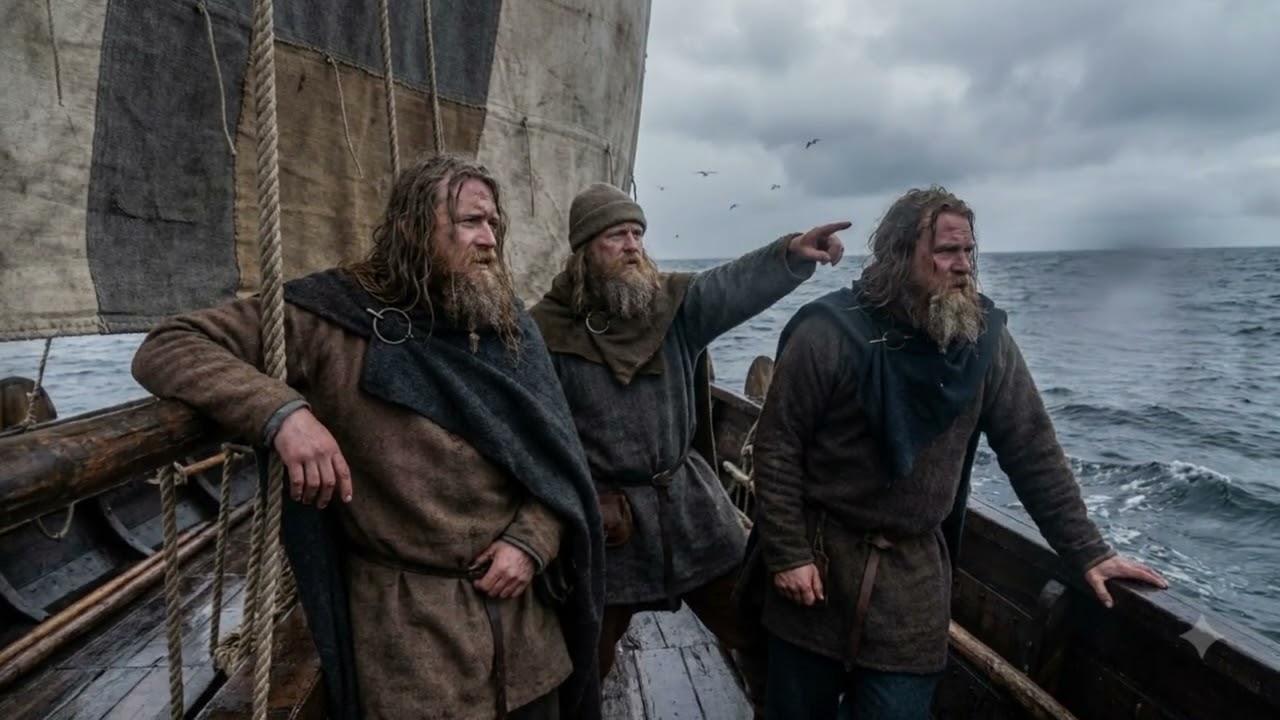
The story sounds almost impossible to resist.
A thousand-year-old Viking longship locked inside a glacier.
Dead sailors preserved beside it.
Secret navigation records pulled from the wreck.
Forensic evidence supposedly proving the crew survived Atlantic storms by eating fermented organs, covering themselves in walrus fat, and chewing a mysterious psychoactive moss that shut down the body’s response to freezing.
Then comes the final twist.
A museum allegedly knew about everything and buried the results until a whistleblower leaked the laboratory files.
It is exactly the kind of discovery that would rewrite Viking history.
There is just one major problem.
There is currently no credible archaeological evidence that this discovery exists.
No recognized archaeological institution has announced a frozen circa-1000 longship containing crew remains and navigation logs.
No peer-reviewed study has identified Viking sailors who coated their bodies with walrus blubber to prevent frostbite.
No authenticated laboratory report has identified a psychoactive moss used to suppress the body’s cold response.
And no credible evidence establishes a multimillion-dollar museum conspiracy to conceal such findings.
The real archaeological story of Viking survival at sea is less sensational.
It is also much more remarkable.
Because the Norse genuinely crossed waters that could kill poorly prepared sailors within hours.
They reached Iceland.
They colonized Greenland.
And by the beginning of the eleventh century, they had crossed the North Atlantic all the way to North America.
Scientists have now established an exact calendar year for Norse activity at L’Anse aux Meadows in Newfoundland.
AD 1021.
Researchers identified a cosmic-radiation spike preserved inside tree rings and counted outward to the bark of wood cut with metal tools.
Three separate pieces converged on the same year.
That provides the earliest securely dated European presence in the Americas, nearly five centuries before Columbus.
So the fundamental premise behind the viral story contains one genuine mystery.
How did people sailing open wooden vessels survive these voyages?
They had no GPS.
No engines.
No heated cabins.
No modern waterproof suits.
No satellite forecasts.
And apparently very little protection from the North Atlantic itself.
Experimental archaeology offers a brutal glimpse of what that meant.
The Viking Ship Museum in Roskilde has sailed reconstructed Viking ships over long distances, including the famous Sea Stallion reconstruction.
Crew diaries describe hours of cold rain, spray pouring over the sides, soaked clothing, violent seasickness and people shivering under wool blankets and tarpaulins.
During one difficult Atlantic stretch, crew members had to pump more than twenty tons of water from the vessel while several sailors became so cold and sick they were transferred to a support ship.
That experiment used modern safety equipment.
The original Norse sailors did not have that advantage.
Their solution appears to have been far more practical than a secret biochemical trick.
Clothing mattered enormously.
Wool was one of the critical materials of the northern maritime world.
It traps insulating air, remains useful when damp and can be layered heavily.
Reconstruction crews using Viking-style wool have found that it can remain remarkably effective in cold maritime conditions, although prolonged exposure to spray and wind remains miserable and dangerous.
Leather and animal skins also mattered.
Later North Atlantic maritime traditions preserved sophisticated ways of combining wool with treated skin outer layers to block wind and water.
That offers a far more plausible survival model than sailors smearing exposed skin with thick walrus blubber.
There is currently no archaeological evidence establishing that Viking crews coated their bodies in walrus fat as a systematic frostbite barrier.
Walruses certainly mattered to the Norse world.
Their ivory became a valuable trade commodity.
Marine mammals also supplied meat, hides and fats.
But knowing that people exploited walruses does not demonstrate that longship crews covered their skin with blubber before Atlantic crossings.
That specific claim requires evidence that has not appeared.
Food presents another fascinating part of the puzzle.
The viral story claims sailors survived by consuming “raw fermented organs.”
Viking diets really did include organ meat.
The National Museum of Denmark notes that Norse households used offal and blood in foods such as sausages, while meat and fish could be dried, salted or otherwise preserved for long storage.
Fermentation itself was hardly unknown in ancient Scandinavia.
Archaeologists have identified evidence of fish fermentation in Scandinavia thousands of years before the Viking Age.
Preserving fish through drying, brining and fermentation later remained important across northern Europe.
But that does not prove Viking Atlantic crews deliberately relied on raw fermented organs as a secret anti-hypothermia technology.
Food aboard a ship had to survive without refrigeration.
Preserved meat, fish, bread and other long-lasting provisions were therefore logical choices.
The Viking Ship Museum notes an especially revealing detail from historical sources.
Warships apparently lacked ordinary fireplaces suitable for cooking while underway.
Norwegian legal traditions instead describe cooks going ashore to collect water and prepare meals.
The modern Sea Stallion reconstruction uses gas burners precisely because Viking cooks could not safely do the same thing while sailing.
So one part of the viral claim contains a distorted grain of truth.
Viking crews could not simply build a comfortable wooden fire in the middle of a pitching open warship whenever temperatures dropped.
Fire aboard a timber vessel filled with ropes, sailcloth and supplies was an obvious danger.
In rough weather, even modern reconstruction crews avoid cooking because pots and flames become hazardous.
But the absence of constant deck fires does not lead automatically to secret organ diets or narcotic moss.
It leads to something much more ordinary.
Preserved food.
Wool.
Animal skins.
Body heat.
Weather judgment.
Experience.
And extraordinary physical endurance.
Navigation was equally sophisticated without requiring mysterious “unredacted logs.”
The Viking Ship Museum notes that archaeological evidence for dedicated Viking navigation instruments remains limited.
Sailors could instead use coastlines, mountains, clouds, the sun, stars, birds, water depth and accumulated knowledge of routes.
Much of that knowledge would have been learned and transmitted between experienced sailors.
Old Norse sailing directions later preserved routes by describing headings and approximate sailing times.
Researchers comparing those historical directions with North Atlantic wind patterns have found that many of the quoted travel times are entirely plausible for medieval sailing vessels.
That makes the supposed discovery of intact handwritten “navigation logs” inside a frozen longship especially suspicious.
The Norse certainly possessed navigational knowledge.
Some sailing directions were eventually written down.
But there is no recognized archaeological announcement of a thousand-year-old ship suddenly yielding a leather-bound captain’s log describing Atlantic survival techniques.
The genuine archaeological record looks very different.
And glaciers really are revealing Viking-age material today.
In September 2026, Norwegian glacier archaeologists reported that rapidly melting ice in Innlandet was exposing increasingly ancient artifacts.
Among the discoveries are arrows dating back roughly six thousand years.
Researchers noted that finds from the Viking Age are actually becoming less common at some melting ice patches because archaeologists are now reaching layers even older than the Viking period.
Another famous Norwegian ice discovery revealed a lost mountain route at Lendbreen.
More than a thousand objects emerged from melting ice, showing that travelers crossed the high mountains for centuries.
The discoveries included tools, transportation equipment and ordinary objects lost by people moving through the landscape.
These are astonishing discoveries.
But they are not ocean-going ships preserved intact inside glaciers.
Longships occupied a completely different archaeological environment.
Some of the best-known vessels survived because they were intentionally buried inside mounds.
Oseberg and Gokstad are famous examples.
Others survive mostly through iron rivets, outlines or small sections of wood.
At Ladby, for example, almost all of the ship’s timber disappeared while its iron fastenings remained in place, allowing archaeologists to reconstruct the vessel’s original form.
The psychoactive-moss claim contains perhaps the most intriguing distortion.
There really is evidence that psychoactive plants existed within Viking culture.
At the Viking fortress of Fyrkat in Denmark, archaeologists discovered henbane seeds in the grave of a woman interpreted as a possible seeress.
Henbane is poisonous and can produce hallucinations and altered mental states.
Researchers have consequently debated whether it may have been connected to ritual practices.
Other Viking-period contexts have also produced unusual botanical remains associated with ritual specialists.
But this is not evidence that sailors chewed a hallucinogenic moss to “switch off” their freezing response.
Henbane is not moss.
It is a toxic flowering plant.
And altering perception would not magically prevent hypothermia.
Someone who no longer feels cold can still become dangerously cold.
Indeed, losing awareness of physiological danger could make survival harder rather than easier.
There is therefore a massive difference between saying:
“Viking-age Scandinavians knew psychoactive plants.”
And saying:
“Viking sailors used psychoactive moss to shut down hypothermia.”
The first has archaeological support.
The second currently does not.
What archaeology actually reveals about Norse Atlantic survival is arguably more impressive because it required no secret drug.
Consider the vessel itself.
Viking ships were lightweight, flexible and capable of moving quickly under sail.
Their clinker-built hulls allowed planks to overlap, helping the structure flex with waves instead of behaving like a rigid box.
The design created extraordinary seagoing capability for its period.
But comfort was minimal.
There was little genuine shelter.
The crew lived almost directly inside the weather.
Modern Sea Stallion sailors have described sleeping packed together beneath tarpaulins while cold penetrated clothing, bedding and the deck beneath them.
That environment makes Norse expansion across the North Atlantic even more extraordinary.
The great technological secret may not have been one secret at all.
It was a system.
Shipbuilding.
Sailing knowledge.
Seasonal timing.
Route memory.
Preserved provisions.
Wool clothing.
Animal skins.
Crew organization.
Experience reading weather.
Knowledge of landfalls.
And the willingness to endure conditions most modern travelers would consider intolerable.
The ocean crossings were also not necessarily one enormous blind leap.
Norse expansion proceeded through stepping stones.
Norway to the northern islands.
Then Iceland.
Then Greenland.
Then farther west.
Greenland provided another staging point before voyages toward North America.
Each successful settlement extended the geographic knowledge available to later sailors.
By AD 1021, the Norse were cutting trees at L’Anse aux Meadows.
That fact needs no museum cover-up to be astonishing.
People using wooden sailing ships had crossed the North Atlantic and reached another continent.
They survived seas capable of overwhelming modern crews even when those crews wear waterproof clothing and carry radios.
They did it without modern forecasting.
And the knowledge that allowed them to do it was largely preserved through practical maritime culture rather than secret frozen manuscripts.
That does not mean every mystery has been solved.
Far from it.
Researchers still debate exactly how different Norse crews navigated long open-water passages.
The degree to which particular instruments were used remains uncertain.
The Viking Ship Museum explicitly notes that proposed devices such as sun compasses remain difficult to prove archaeologically.
Dietary evidence continues evolving.
Isotope analysis can reveal how much marine protein particular communities consumed.
Organic residue analysis can show what kinds of fats were cooked inside pottery.
Ancient DNA can reconstruct population movements.
Melting ice is returning artifacts no archaeologist expected to see again.
Future discoveries may absolutely change our understanding of Viking travel.
Someone may eventually recover extraordinary material from ice, wetlands or ocean sediments.
But extraordinary claims still require identifiable evidence.
A location.
An excavation team.
Artifact numbers.
Radiocarbon dates.
Stratigraphy.
Laboratory methods.
Named researchers.
Peer-reviewed analysis.
A museum accession record.
Without those things, phrases such as “quarantined glacier,” “rogue archaeologists,” “unredacted navigation logs” and “underground lab results” are warning signs rather than proof.
The authentic discoveries coming from northern archaeology are already dramatic enough.
A ship burial in Norway recently pushed Scandinavian ship-burial traditions farther back than scholars once expected.
Melting ice is revealing Stone Age arrows thousands of years older than the Viking Age.
And cosmic radiation preserved inside Newfoundland tree rings has allowed scientists to identify the exact year Norse people were working in North America.
1021.
Those findings changed history through evidence.
Not anonymous leaks.
And they leave us with an image of the Viking Atlantic sailor that may be more intimidating than the viral version.
No magical moss.
No biological off-switch for freezing.
No secret coating that made the ocean harmless.
Just an open wooden ship pitching through freezing spray while sailors wrapped themselves in wool, protected themselves as best they could, ate food capable of surviving the voyage, watched the sky and sea for navigation clues, pumped water from the hull, and waited for land to appear.
The North Atlantic remained lethal.
The Norse crossed it anyway.
That is the real secret.


