A sensational claim alleging A’ja Wilson was arrested for sabotaging Caitlin Clark’s business interests is circulating rapidly across social media.
The narrative alleges Wilson targeted a multimillion-dollar Gainbridge arrangement involving Clark through blackmail, secretly recorded conversations, and corporate interference.
It goes considerably further, claiming heavily armed federal agents arrested Wilson after Clark supposedly revealed incriminating audio evidence publicly.
If authenticated, allegations involving blackmail, commercial sabotage, wire recordings, and federal intervention would represent an extraordinary sports-business scandal.
But current evidence points in precisely the opposite direction, making the distinction between viral fiction and documented events critically important.
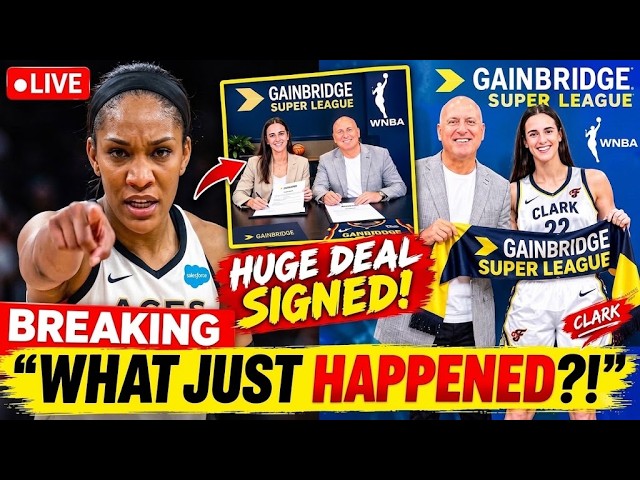
No credible federal announcement reviewed for this article identifies Wilson as arrested, charged, or investigated over Clark or Gainbridge.
Current WNBA records instead show Wilson actively competing for Las Vegas immediately before the league’s 2026 postseason began Sunday.
The Las Vegas Aces announced Friday that Wilson had received her record-tying thirty-third WNBA Player of the Week honor.
That announcement documented Wilson averaging 27.8 points while leading Las Vegas through four consecutive victories following the World Cup break.
Wilson then entered Sunday’s playoff schedule preparing for something dramatically different from federal custody: a matchup against Clark’s Indiana Fever.
The timing alone creates a major factual problem for claims depicting Wilson being removed publicly by heavily armed federal agents.
WNBA’s current Wilson archive contains recent highlights, awards, playoff material, and regular-season performances without documenting the alleged federal incident.
Official league video from September 25 shows Wilson’s 34-point performance against Phoenix from the previous evening.
The Aces also documented Wilson producing 30 points against Seattle while reaching 1,000 points during another historic season.
Those contemporary records do not merely lack corroboration for the arrest story; they establish Wilson’s documented professional activity immediately beforehand.
No evidence located from federal authorities substantiates claims of an FBI raid connected with Wilson, Clark, or Gainbridge either.
That absence is especially significant because federal arrests generally create documentation through criminal complaints, indictments, court proceedings, or agency announcements.
High-profile arrests involving one of American basketball’s most recognizable athletes would also predictably attract immediate reporting across major national outlets.
Instead, searches of current federal and sports sources produced unrelated federal cases alongside extensive documentation of Wilson’s basketball accomplishments.
That contrast means the alleged arrest cannot responsibly be presented as fact without authenticated evidence establishing an actual federal proceeding.
The supposed hidden wiretap requires equal skepticism because recording laws, admissibility standards, consent requirements, and investigative procedures vary considerably.
A recording’s mere existence would not automatically prove blackmail, conspiracy, extortion, fraud, or any other federal criminal offense occurred.
Investigators would require context, authentication, corroborating evidence, jurisdiction, and facts satisfying specific statutory elements before prosecutors could pursue charges.
Nothing reviewed establishes that Clark recorded Wilson, played such audio publicly, or supplied federal investigators with incriminating communications.
Likewise, no reliable evidence establishes Wilson attempted to blackmail Clark concerning any Gainbridge agreement or other commercial relationship.
The accusation is particularly serious because it attributes intentional criminal behavior and personal motives to a living identifiable professional athlete.
Wilson’s documented current position instead places her among basketball’s most successful players entering another postseason with the Las Vegas Aces.
She completed the regular season averaging a league-leading 26.2 points, according to the Aces’ September 25 announcement.
Wilson also finished with twenty double-doubles and thirteen 30-point performances while continuing her ascent through historical WNBA statistical rankings.
Those achievements explain why an invented rivalry narrative can generate substantial engagement whenever Wilson and Clark become attached to opposing storylines.
Both athletes command enormous audiences, possess major commercial profiles, and represent franchises meeting during the highest-stakes portion of the season.
Their real competitive rivalry offers enough material for substantial sports-business analysis without manufacturing federal crimes around either player personally.
The first-round playoff matchup itself creates valuable national inventory because Indiana and Las Vegas bring unusually recognizable stars into direct competition.
WNBA’s official postseason preview confirmed Las Vegas entered as the third seed while Indiana held the sixth position.
The Aces simultaneously entered postseason competition following another dominant Wilson campaign, reinforcing her extraordinary value to their basketball operation.
Clark brings a different but similarly significant form of economic gravity because Indiana games consistently attract unusually intense consumer attention.
That attention can influence television audiences, merchandise demand, arena attendance, sponsorship activation, secondary ticketing, and digital media engagement.
The business implications explain why companies associated with Clark frequently become ingredients inside sensational stories about supposed corporate warfare around her.
Gainbridge represents an especially recognizable name within the Indiana basketball ecosystem because its branding is attached prominently to the Fever’s home arena.
But arena naming rights, franchise sponsorships, athlete endorsements, and personal investment arrangements remain distinct financial structures requiring separate documentation.
A company’s commercial relationship with an arena does not automatically mean every prominent athlete playing there possesses a direct individual contract.
Likewise, an athlete’s personal endorsement relationship does not necessarily provide ownership rights, franchise influence, or control over organizational financial decisions.
Understanding those distinctions becomes essential whenever viral posts describe vaguely defined “empires” supposedly worth enormous amounts of money overnight.
Sports sponsorship economics can involve guaranteed payments, performance incentives, hospitality inventory, media rights, appearances, licensing, and intellectual-property permissions.
Some partnerships additionally contain exclusivity provisions preventing athletes or organizations from promoting competitors within carefully defined commercial categories.
Termination provisions can protect counterparties against specific contractual breaches, although exact language generally remains confidential unless disclosed publicly.
None of those ordinary commercial mechanisms provides evidence that Wilson attempted criminal interference with any Clark-related business arrangement whatsoever.
Yet the underlying question of Clark’s commercial value remains legitimate because her popularity has changed Indiana’s economic profile substantially.
The Fever increasingly operate not merely as a local basketball franchise but as a nationally followed sports entertainment property.
That transition creates opportunities for sponsors seeking consumer attention across television, digital platforms, merchandise, live events, and social engagement.
Clark’s influence becomes especially valuable because professional sports audiences increasingly fragment across numerous streaming and traditional distribution platforms.
Live sporting events retain scarcity because audiences consume them simultaneously, making advertising inventory more valuable than many prerecorded entertainment formats.
A superstar capable of attracting incremental casual viewers therefore creates economic benefits extending considerably beyond her direct playing compensation.
Networks receive larger audiences, sponsors receive additional impressions, venues receive spectators, and opposing franchises can experience stronger ticket demand.
Indiana benefits directly through ticketing, premium seating, merchandise, partnerships, and stronger leverage when negotiating future commercial relationships with corporations.
Those economics provide a legitimate explanation for why Clark-related sponsorship stories generate intense interest throughout the professional sports industry.
They do not provide evidence that another WNBA player attempted to sabotage those relationships because of jealousy or competitive resentment.
Claims about Wilson’s supposed motive are especially unsupported because personal jealousy cannot be established merely from professional rivalry or opposing-team competition.
Wilson and Clark can compete fiercely on basketball courts while simultaneously operating within a league benefiting commercially from both athletes’ popularity.
Indeed, professional sports leagues generally become more valuable when multiple recognizable stars create compelling matchups rather than one athlete dominating attention.
Wilson provides extraordinary sporting credibility through championships, individual awards, statistical production, and sustained excellence across multiple professional seasons.
Clark brings another enormous audience alongside her distinctive long-range shooting, passing, transition offense, and cultural visibility throughout American basketball.
Putting those stars opposite each other can create precisely the premium event broadcasters, advertisers, sponsors, and league executives seek commercially.
The WNBA therefore possesses strong economic incentives to promote their competition without converting it into fabricated allegations of criminal hostility.
Modern digital publishing unfortunately rewards precisely those exaggerations because conflict frequently generates stronger engagement than nuanced business analysis.
Terms including “FBI raid,” “arrested,” “blackmail,” “hidden recording,” and “banned audio” create immediate urgency for social-media audiences.
They also create an appearance of specificity, making unsupported stories seem documented even when no primary evidence accompanies them.
A timestamp, supposed recording, named corporation, and dramatic enforcement description can collectively imitate the surface characteristics of investigative journalism.
Actual investigative reporting works differently because each extraordinary allegation requires independent sourcing and documentary corroboration before publication as fact.
An arrest should produce identifiable authorities, jurisdiction, charges, booking information, court records, or attributable statements from involved government agencies.
A corporate sabotage allegation should identify contracts, counterparties, communications, damages, and conduct supporting the claimed interference with economic relationships.
A blackmail allegation requires evidence of threats or coercive demands rather than simply hostility, criticism, competition, or uncomfortable private conversations.
A wiretap claim additionally demands clarity regarding who recorded whom, where recording occurred, and under what legal circumstances.
None of those foundational pieces accompanies the Wilson narrative circulating around Clark’s supposed multimillion-dollar Gainbridge business interests currently.
Instead, the most recent reliable material depicts Wilson performing at an elite level as Las Vegas prepared for postseason basketball.
On September 24, Wilson scored 34 points and grabbed ten rebounds during Las Vegas’ victory over Phoenix.
That performance concluded a regular season in which she became the first WNBA player with multiple 1,000-point campaigns.
The league subsequently highlighted her performance prominently across its official media operation heading into the playoffs.
Wilson also received another major honor Sunday when Associated Press voters recognized her season immediately before postseason competition began.
Those are independently observable events occurring during the exact period when viral narratives portray her professional circumstances entirely differently.
The contradiction illustrates why contemporaneous sourcing matters enormously whenever sensational claims emerge about celebrities, athletes, executives, or corporations.
Social-media narratives can travel faster than corrections because dramatic allegations reward immediate emotional reaction while verification requires additional time.
Once repeated by multiple accounts, the same unsupported assertion can appear independently confirmed even when every account shares one origin.
That dynamic resembles financial-market rumor propagation, where repeated speculation can temporarily influence perceptions without creating new underlying information.
Professional investors respond by tracing claims toward primary documentation rather than counting how many secondary accounts repeat identical language.
Sports-business readers should apply the same discipline, particularly when criminal allegations are mixed with complex sponsorship or contract stories.
The legitimate financial story surrounding Clark provides abundant material because her audience has created unusually strong demand throughout professional basketball.
Indiana’s commercial challenge involves converting that superstar-driven attention into durable franchise value capable of surviving inevitable roster changes eventually.
This requires building sponsor relationships around the Fever brand while maximizing the extraordinary visibility Clark brings during her playing career.
Long-term partners generally prefer predictable engagement rather than relying exclusively upon temporary spikes connected to one athlete or moment.
The strongest franchises therefore convert superstar popularity into customer databases, season-ticket relationships, merchandise habits, community programs, and recurring corporate partnerships.
Clark can accelerate that process dramatically because she provides Indiana with an unusually powerful consumer-acquisition engine across national markets.
Every televised performance can introduce new viewers to teammates, opponents, league storylines, sponsors, and the broader women’s basketball product.
Wilson contributes similarly by offering established excellence and championship credibility capable of retaining audiences attracted initially by newer stars.
From the WNBA’s perspective, these complementary economic roles should strengthen leaguewide value rather than necessarily create zero-sum commercial competition.
The league benefits when Clark succeeds because her audience expands the addressable market for women’s professional basketball and related products.
It benefits when Wilson succeeds because sustained superstar excellence produces recognizable narratives, postseason stakes, and historically significant athletic performances.
It benefits most when both compete against each other because rivalry concentrates consumer attention into premium nationally marketable sporting events.
That economic structure makes unsupported claims of corporate sabotage particularly counterproductive because they obscure the actual financial relationship between competitors.
Athletes can compete for awards, championships, endorsements, and cultural relevance without engaging in criminal efforts to destroy one another financially.
Brands similarly can sponsor rival players because consumer marketing frequently benefits from competitive narratives rather than requiring universal athlete alignment.
Nike, Adidas, Under Armour, financial institutions, insurers, beverage companies, and technology businesses routinely participate across competing sports properties simultaneously.
Sponsorship portfolios frequently diversify across athletes and teams because corporations want exposure to different audiences and demographic segments.
Commercial competition therefore does not provide evidence of illegal interference, even when endorsement values or media attention differ dramatically between players.
Clark’s potential long-term earnings nevertheless remain a compelling business topic because her basketball salary captures only one component of her economics.
Endorsements can potentially provide guaranteed compensation dramatically exceeding league salary while offering bonuses, royalties, and intellectual-property opportunities beyond basketball.
Equity investments can create another wealth-building channel when athletes exchange promotional participation or capital for ownership in growing businesses.
Media production represents another opportunity because athlete-controlled companies can monetize documentaries, podcasts, branded content, licensing, and direct audience relationships.
Clark’s enormous following creates potential leverage across all these categories, particularly if her playing career maintains elite performance and visibility.
But the precise value of any individual Clark agreement must come from documented contractual reporting rather than extrapolation from popularity.
Describing something as “multimillion-dollar” without identifying the contract value, duration, counterparty, and payment structure provides limited analytical information.
The same discipline applies to Gainbridge because corporate relationships can encompass multiple entities operating within related sports and entertainment ecosystems.
Naming-rights economics differ from personal endorsement economics because arena agreements purchase visibility around facilities rather than individual athlete services.
Team sponsorships differ again because corporations may receive branding rights, hospitality inventory, digital activations, signage, and community-program integration.
Individual endorsement contracts primarily purchase association with an athlete’s name, image, likeness, appearances, and promotional participation under negotiated conditions.
Conflating these categories can create misleading impressions that one athlete personally controls corporate arrangements extending across an entire sports organization.
Clark’s influence can increase the economic attractiveness of those arrangements without granting her contractual ownership of every dollar they generate.
Likewise, Wilson’s competitive success cannot legally interfere with Clark’s commercial relationships simply because both athletes pursue overlapping audience attention.
For criminal sabotage to exist, investigators would need evidence of specific unlawful conduct extending well beyond ordinary competitive or commercial rivalry.
Federal criminal prosecutions also operate under procedural safeguards that sensational headlines routinely omit when describing supposed immediate guilt and punishment.
Even when authorities arrest someone, an arrest establishes an accusation and legal process rather than proving guilt beyond reasonable doubt.
The Justice Department itself routinely emphasizes that defendants charged federally remain presumed innocent unless proven guilty through appropriate proceedings.
That fundamental principle would apply even if authentic charges involving a famous athlete eventually emerged in an unrelated future matter.
Here, however, the problem arises earlier because no credible evidence establishes the claimed arrest or underlying federal prosecution at all.
The phrase “forced agents to drag Wilson away” therefore presents cinematic imagery unsupported by the contemporary record available for verification.
Similarly, describing agents as heavily armed intensifies the narrative emotionally without providing any identifiable operation, field office, warrant, or jurisdiction.
Authentic FBI actions typically involve specific investigative offices and prosecutorial partners whose identities become visible through subsequent federal court documentation.
Searches of the FBI’s public material produced no corroborating announcement involving A’ja Wilson and the alleged Clark-related corporate sabotage.
Meanwhile, current league documentation continues displaying Wilson’s performances and awards during the days immediately preceding Indiana’s playoff meeting with Las Vegas.
That playoff context provides a more plausible explanation for why fabricated conflict narratives could attract substantial attention precisely at this moment.
High-profile postseason matchups naturally intensify fan loyalties, comparisons, debates, and emotionally charged narratives surrounding opposing stars and franchises.
Social publishers can exploit that intensity by converting basketball rivalry into supposedly personal hostility, conspiracy, or even invented criminal conduct.
The business model is straightforward: stronger outrage can produce more comments, shares, viewing time, click-throughs, and advertising impressions.
Adding promises of “banned audio” or disappearing evidence creates another engagement mechanism by suggesting exclusive access unavailable through conventional journalism.
Users are then encouraged to comment particular keywords, which can increase visible engagement and potentially trigger automated direct-message marketing funnels.
None of those tactics demonstrates the promised evidence exists, and urgency itself should never substitute for independent authentication.
For Clark and Wilson, the actual financial stakes surrounding Sunday’s matchup remain substantial even without any criminal storyline whatsoever.
Strong postseason audiences can reinforce broadcaster confidence in premium WNBA programming and increase sponsor enthusiasm surrounding future playoff inventory.
Successful games can also strengthen ticketing demand, merchandise sales, digital subscriptions, social engagement, and subsequent regular-season marketing campaigns.
Repeated high-profile postseason matchups can create rivalry equity comparable to valuable recurring narratives throughout established men’s professional sports leagues.
That rivalry equity has financial value because audiences understand the protagonists and arrive already invested in the competitive storyline.
Clark versus Wilson provides exactly that possibility because both possess distinct basketball identities and unusually recognizable public profiles across America.
The challenge for the league is nurturing competitive intensity without allowing unsupported personal accusations to dominate public understanding of players.
For sponsors, brand safety becomes relevant because partnerships benefit from passionate engagement but can suffer when misinformation overwhelms authentic sporting narratives.
Corporations generally seek association with achievement, excitement, community, excellence, and positive consumer emotion rather than fabricated allegations of federal crimes.
That provides another reason commercial partners would approach extraordinary accusations cautiously before changing relationships with athletes or league properties.
A genuine criminal investigation could obviously trigger contractual reviews depending upon applicable morality clauses and specific endorsement language between counterparties.
But activating such provisions based solely upon unsupported social-media allegations could create substantial legal and reputational risks for corporations themselves.
Companies therefore typically rely upon counsel, verified developments, contractual rights, and formal processes before taking significant actions against sponsored athletes.
The hypothetical Gainbridge dispute described online skips those mechanisms entirely and jumps directly from jealousy to blackmail to federal arrest.
That progression may produce effective dramatic storytelling, but it does not resemble documented evidence surrounding Wilson’s current professional circumstances.
The larger economic lesson involves distinguishing commercial influence from contractual control and competitive rivalry from unlawful interference between athletes.
Clark unquestionably possesses substantial commercial influence because audiences respond intensely to her performances and public presence throughout professional basketball.
Wilson unquestionably possesses enormous sporting value because her historic production, awards, and championship credentials anchor the Las Vegas Aces’ identity.
Neither proposition requires portraying one athlete’s success as evidence that another athlete secretly attempted to destroy her financial opportunities.
Indeed, their combined visibility may create more aggregate value for women’s basketball than either athlete could generate without elite competition.
A compelling sports economy requires protagonists, rivals, uncertainty, recognizable excellence, and contests carrying meaningful consequences for audiences emotionally.
Wilson and Clark naturally supply those ingredients whenever Las Vegas and Indiana meet with postseason advancement potentially hanging in balance.
That competition can increase sponsorship value while simultaneously generating stronger broadcast inventory and higher fan engagement across numerous platforms.
For Indiana, postseason success could deepen Clark’s association with winning and potentially strengthen the Fever’s long-term national commercial identity.
For Las Vegas, another strong postseason run could reinforce Wilson’s established legacy while sustaining the Aces’ championship-era brand value.
For the league, either outcome generates narratives capable of carrying consumer attention into future seasons, sponsorship cycles, and media negotiations.
Those represent real business consequences investors and sports executives can analyze using audiences, attendance, sponsorship pricing, and merchandise demand.
The alleged FBI operation offers none of those analytical foundations because its central factual claims remain unsupported by credible evidence.
No verified criminal evidence has emerged showing Wilson blackmailed Clark over a Gainbridge agreement or attempted unlawful corporate sabotage.
No authenticated recording has emerged establishing the supposed telephone call that Clark allegedly played before federal agents intervened dramatically.
No credible federal source currently establishes Wilson’s arrest, prosecution, raid, or detention over anything involving Clark’s commercial relationships.
Instead, the documented record places Wilson among the WNBA’s leading performers immediately entering the September 27 postseason schedule.
Her latest official statistics depict an athlete pursuing championships and historical records rather than confronting the federal criminal proceedings described online.
Clark’s documented story remains similarly compelling because her presence continues reshaping assumptions about individual commercial influence within women’s basketball.
The two stories intersect naturally on the basketball court, where economic value emerges precisely because elite competition attracts paying audiences.
That reality may appear less sensational than secret recordings, armed agents, steel handcuffs, and supposedly banned evidence disappearing online.
But for anyone studying sports economics, the authentic rivalry contains something more durable than a manufactured scandal can provide.
It demonstrates how superstar competition can transform individual athletic excellence into franchise value, sponsor visibility, and leaguewide commercial momentum.
That transformation remains one of the most important financial stories surrounding American professional sports as women’s basketball continues expanding rapidly.
The evidence available today supports analyzing that growth while rejecting unsupported criminal allegations against identifiable athletes as established factual events.
Until authentic federal records demonstrate otherwise, Wilson remains documented as an active Las Vegas superstar entering postseason competition against Indiana.
And the supposedly chilling recording forcing her arrest remains exactly what credible evidence currently supports calling it: an unverified viral claim.


