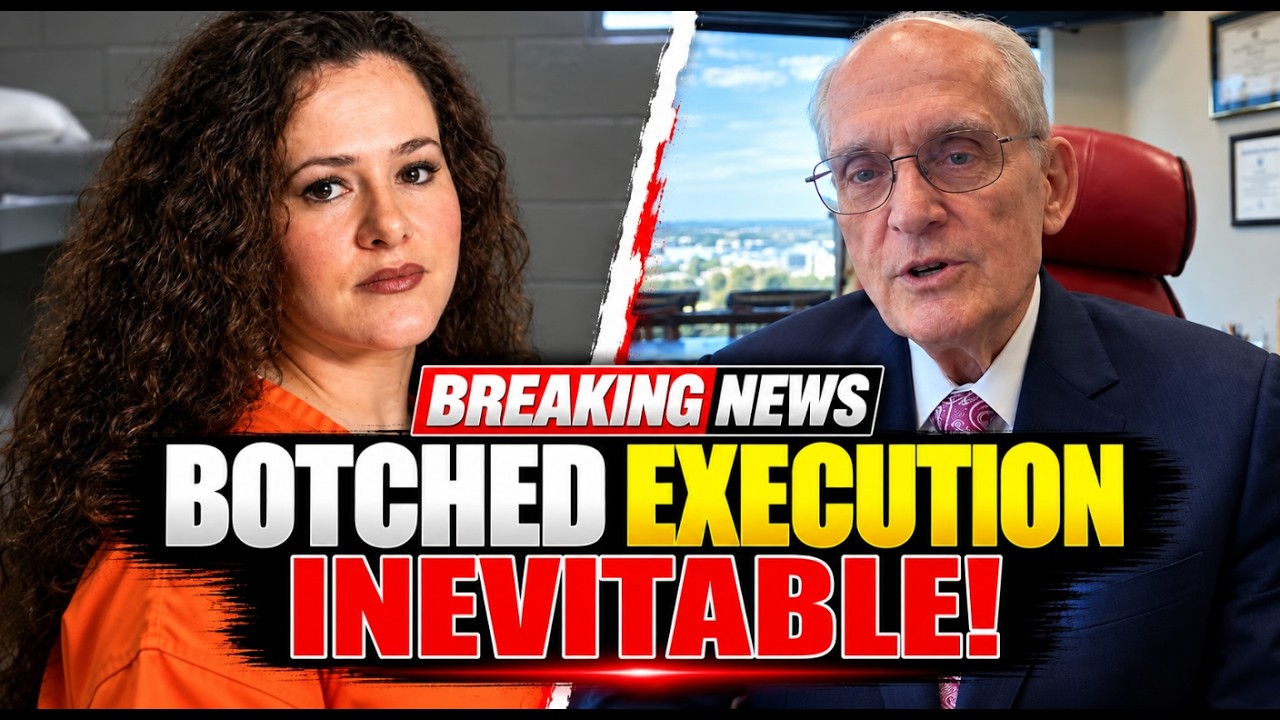
The man who helped write Tennessee’s modern death-penalty law says he was not shocked when the state failed to execute Christa Pike.
He used stronger words than that.
David Raybin says what happened was becoming “almost inevitable.”
That is an extraordinary accusation coming from someone who is not simply an outside anti-death-penalty activist.
Raybin is a veteran Tennessee criminal lawyer and former assistant state attorney general who says he drafted the state’s death-penalty statute in 1976.
And after Pike survived Tennessee’s September 30 execution attempt despite receiving two doses of pentobarbital, Raybin’s central question is brutally simple:
If Tennessee followed its protocol and the prisoner still survived, what exactly does that say about the protocol?
Because Pike is alive.
She has now been discharged from the hospital and returned to the Debra K. Johnson Rehabilitation Center, where she remains a prisoner and continues receiving medical care.
There is no new execution date.
Tennessee’s remaining executions for 2026 are paused.
An independent review is underway.
Evidence from the execution chamber has been ordered preserved.
And the legal battle over whether Tennessee could ever try again is only beginning.
Raybin Says the Warning Signs Were Already There
Raybin’s argument does not begin with Pike.
It begins months earlier.
Tennessee had already experienced another failed execution attempt in May 2026.
In that case, officials were unable to establish the two functioning IV lines required by protocol.
The execution was stopped.
That should have been a warning, Raybin argues.
Then came Pike.
Her attorneys had already raised concerns before September 30 about her veins and the possibility that intravenous access could cause serious complications.
And yet the state proceeded.
Then Pike received two doses of pentobarbital.
And survived.
“That’s why,” Raybin argued in the interview summarized in the source, “it was almost inevitable that this happened.”
That is not an official finding.
Ed Stanton’s independent review has not yet produced the definitive explanation for what failed.
But Raybin’s argument is that Tennessee did not walk blindly into an unforeseeable disaster.
There had already been warnings.
The State Says It Followed the Protocol
That sentence may become one of the most important in the entire Pike case.
After the September 30 attempt, Tennessee officials said the execution team followed the state’s procedures.
Normally, that sounds like a defense.
Raybin believes it may actually make the situation worse.
His reasoning is straightforward.
If employees ignored the protocol, then Tennessee can theoretically identify the mistake, discipline or retrain personnel, and argue that the written system itself remains sound.
But if the protocol was followed correctly and still produced a catastrophic failure, then the problem may be deeper.
The procedure itself may be inadequate.
Raybin called the “we followed protocol” response a damning indictment of the system in the interview that generated the “almost inevitable” headline.
That question is now at the heart of Tennessee’s review.
What Happened to Pike Was Different From a Simple IV Failure
This distinction could become central in court.
Many previous failed executions stopped before lethal drugs were successfully administered.
Pike’s case went much further.
Tennessee administered the execution drug.
Then administered the backup dose.
She remained alive.
Witnesses reported that she continued breathing after both doses.
Eventually an ambulance transported her from the prison to a hospital.
Her lawyers later described burns, swelling and other serious medical complications.
She was unconscious.
She required ventilation.
Days later, she regained consciousness.
She eventually began speaking, eating and walking with assistance.
Now she is back in prison.
That sequence is why her case may be harder for Tennessee than earlier failed executions.
Raybin Says Willie Francis Is Not a Perfect Comparison
The case Tennessee will almost certainly rely on is Louisiana ex rel. Francis v. Resweber.
In 1946, seventeen-year-old Willie Francis survived an attempted execution in Louisiana’s electric chair after the equipment malfunctioned.
His lawyers argued that executing him again would violate the Constitution.
The U.S. Supreme Court disagreed in a 5–4 decision.
Louisiana executed Francis the following year.
That ruling remains formidable precedent for Tennessee.
A failed execution does not automatically prevent a second attempt.
But Raybin believes Pike’s case is distinguishable.
With Francis, the machine failed.
With Pike, according to Tennessee, the execution protocol was carried through.
The drugs were given.
Twice.
She survived.
To Raybin, that difference could matter enormously when a federal judge evaluates whether another attempt would amount to cruel and unusual punishment.
There Is Another Difference: Foreseeability
The Supreme Court majority in the Francis case treated the first failure as an accident.
Raybin’s argument attacks that concept directly in Pike’s case.
Was September 30 really unforeseeable?
Tennessee had already experienced another failed execution attempt months earlier.
The state had previously commissioned a major review of its execution system.
That review found serious failures.
Pike’s attorneys had raised medical concerns before her execution.
And the state knew IV access was one of the most difficult and dangerous parts of lethal injection.
Raybin therefore believes a court could view September 30 not as a freak accident, but as the culmination of warnings that were already visible.
Again, that remains his argument.
The independent review must determine what the evidence actually shows.
Ed Stanton Has Been Here Before
Former U.S. Attorney Ed Stanton has been appointed to conduct the independent review of Tennessee’s handling of Pike’s execution.
That name matters because Stanton previously reviewed Tennessee’s execution system after Governor Bill Lee halted an execution in 2022.
The earlier investigation found that Tennessee had repeatedly failed to comply with portions of its own lethal-injection procedures, including required drug testing.
The findings led to changes in the state’s execution protocol.
Now Stanton has been asked to return.
Different execution.
Different failure.
Same state system.
The new review is expected to examine whether the September 30 protocol was followed and what changes may be required.
The Evidence Is Now Protected by Court Order
Pike’s attorneys moved quickly.
Hours after the failed execution, they began demanding that evidence be preserved.
They wanted drugs.
Syringes.
IV lines.
Execution logs.
Medical records.
Photographs.
Video.
Audio.
Electronic communications.
Monitoring information.
Anything capable of reconstructing what happened inside the chamber.
On October 7, a Tennessee judge granted a broad preservation order.
That matters because the next legal case may turn on details measured in millimeters and minutes.
Where was the IV?
Was it functioning properly?
Where did the pentobarbital travel?
When did officials realize something had gone wrong?
What happened after the first dose?
Why did the second fail?
What did monitors show?
What did witnesses observe?
The constitutional argument will eventually need evidence, not headlines.
Some Evidence Apparently Left the Prison With Pike
One of the strangest moments in the court fight came when Tennessee acknowledged that portions of medical equipment may have left the execution chamber when Pike was transported to the hospital.
That creates chain-of-custody questions.
Some of the most important physical evidence may not initially have remained in direct Department of Correction possession.
The court therefore ordered extremely broad preservation.
Raybin praised that approach.
His basic point was that nobody yet knows which small piece of evidence may become decisive.
Destroying something now because it looks unimportant could make it impossible to answer a critical question later.
Pike’s Medical Recovery Has Moved Faster Than Early Reports Suggested
The first days produced extremely grave reports.
Her lawyers feared devastating neurological injury.
She remained unconscious and required a ventilator.
Then her condition changed.
She woke.
She spoke.
Her attorneys said she had periods of confusion.
At one point she reportedly did not immediately recognize lawyers who had represented her for years.
She asked where she was.
Later, she asked about her legal team and Colleen Slemmer’s family.
By October 10, she had improved enough to leave the hospital and return to prison while continuing to receive medical treatment.
That recovery does not answer the legal questions.
It may complicate them.
Her Recovery Could Help Tennessee
This is one of the stranger consequences of death-penalty law.
If Pike suffers permanent cognitive impairment severe enough that she cannot understand the reason for her execution, her attorneys could raise competency arguments.
The Supreme Court has held that states cannot execute prisoners who lack a rational understanding of why they are being put to death.
But the more Pike recovers cognitively, the weaker that particular argument may become.
If she understands who she is, why she is imprisoned, what Tennessee attempted on September 30, and what a future execution would mean, the state may argue that she remains competent.
So improvement is medically good for Pike.
Legally, it may reopen danger.
The Stronger Battle May Be the Eighth Amendment
Raybin expects Pike’s lawyers to make an Eighth Amendment claim.
Their argument would not necessarily be:
She cannot understand execution.
It would be:
Tennessee has already subjected her to an execution attempt that caused extraordinary suffering, and attempting the same punishment again would create an unconstitutional risk of additional suffering.
That is a different theory.
And unlike the competency question, it focuses on what Tennessee did rather than Pike’s mental condition.
Raybin has suggested that a federal judge could ultimately block another attempt permanently.
That would not mean Pike becomes free.
Raybin Says She Would Stay in Prison
This is an essential distinction.
Raybin is not predicting that Christa Pike walks out of prison.
The source describes his expected outcome much more narrowly.
If courts block another execution, Pike could remain imprisoned for life while Tennessee is prevented from carrying out the death sentence.
Her own attorneys have asked for the cleaner version of that result:
Commutation to life without parole.
She remains incarcerated.
Tennessee stops trying to execute her.
That is fundamentally different from release.
Double Jeopardy Will Be Raised — But It Faces Obstacles
Pike’s lawyers have also discussed double jeopardy.
The intuitive argument is powerful:
The state already punished her once.
It cannot punish her twice.
But constitutional doctrine is more complicated.
Tennessee will argue that there has always been only one sentence.
Death.
September 30 was a failed attempt to carry out that sentence, not a separate punishment followed by a second sentence.
The Francis precedent gives the state substantial support.
Pike’s attorneys will respond that receiving two full doses of execution drugs makes her case materially different.
Courts will decide whether that distinction has constitutional significance.
Tennessee’s Protocol Did Not Explain What Came Next
This may be one of the strangest details in the source.
The protocol apparently provides for the initial dose.
Then a backup sequence.
But what happens if the prisoner remains alive after the protocol has been completed?
That is exactly what happened to Pike.
The written procedure reached its endpoint.
Pike’s life did not.
The state had instructions for administering death.
It did not have instructions for survival afterward.
That gap could become central to arguments that Tennessee was institutionally unprepared for the predictable failure Raybin says should have been anticipated.
Tennessee Had Already Been Forced to Stop Another Execution
The May 2026 execution attempt involving Tony Carruthers had already gone wrong when officials were unable to establish the required backup IV line.
That execution was halted.
Pike’s lawyers later cited problems with the state’s IV procedures while challenging her own execution.
Then September 30 happened.
Pike’s case was worse because the drugs actually entered the process.
Two troubled execution attempts in only a few months created a systemic question:
Was Tennessee dealing with bad luck?
Or with a system that was not functioning reliably?
The Stanton review is supposed to help answer that.
The Prison Commissioner Resigned
Within days of Pike’s failed execution, Tennessee Department of Correction Commissioner Frank Strada announced his resignation.
His departure came while the department responsible for carrying out the execution was facing extraordinary scrutiny.
A resignation does not establish personal fault.
Nor does timing alone prove causation.
But symbolically, the sequence was difficult to ignore.
Failed execution.
National scrutiny.
Independent review.
Commissioner leaving.
Remaining executions paused.
This was no longer simply one prisoner’s legal case.
It had become a crisis for Tennessee’s execution system.
Governor Bill Lee Froze the Rest of 2026
Following Pike’s execution attempt, Governor Bill Lee paused the remaining Tennessee executions scheduled for the year while the state investigates.
As of October 12, that pause remains the clearest immediate policy consequence of September 30.
It does not commute Pike’s sentence.
It does not abolish the death penalty.
And it does not guarantee Tennessee will never try again.
It buys time.
Time for evidence.
Time for review.
Time for litigation.
Some Tennessee Officials Want Another Method
The political response has not been uniform.
Some lawmakers argue the state should continue enforcing death sentences but move away from lethal injection if the method cannot be carried out reliably.
Electric-chair proposals have reentered the debate.
Tennessee law already contains circumstances under which electrocution can be used, and death-penalty policy is likely to become part of broader legislative and gubernatorial discussions.
Those are political proposals, not Pike’s current execution order.
There is no new date today.
There is no confirmed decision to execute her by electricity.
And any renewed attempt would face major litigation.
Raybin Is Not Simply Saying “Abolish the Death Penalty”
That makes his criticism more striking.
His argument, as presented in the interview, is not primarily ideological abolition.
He has described capital punishment as a system that, if a state chooses to maintain it, must be properly funded and competently administered.
His criticism of Tennessee is that a punishment this irreversible cannot tolerate casual administration.
The state gets one body.
One procedure.
One irreversible outcome.
If the process fails, “we followed protocol” is not necessarily enough.
His History Gives the Criticism Unusual Weight
Raybin has written publicly that he drafted Tennessee’s death-penalty statute in 1976.
A Tennessee Bar Journal biographical note confirms that role, and Tennessee media have likewise described him as helping draft the state’s modern capital-punishment law.
So when he says the system failed, he is criticizing a legal structure with which he has been involved for decades.
That does not make him automatically correct.
It does make the criticism harder to dismiss as coming from someone unfamiliar with Tennessee capital law.
“Almost Inevitable” Still Has to Be Proven
This is where the distinction between commentary and evidence matters.
Raybin believes the warning signs made Pike’s failed execution foreseeable.
The state has not accepted that conclusion.
The independent review has not yet issued findings establishing it.
No court has ruled that Tennessee knowingly ignored a failure certain to occur.
So “almost inevitable” belongs in quotation marks for a reason.
It is Raybin’s assessment.
The upcoming evidence will determine how much factual weight it deserves.
One Question Will Matter More Than Almost Everything Else
Where did the pentobarbital go?
If the drug entered Pike’s bloodstream correctly, her survival would raise extraordinary pharmacological and procedural questions.
If it entered surrounding tissue because an IV infiltrated, that could explain both the failure to kill her and the severe arm injuries reported afterward.
Her lawyers have leaned toward the IV-infiltration theory.
The state has said it followed its protocol.
A judge has not yet decided what actually happened.
That is why the tubing, syringes, records, photographs and medical observations matter so much.
And Pike Herself Is Now Evidence
Her injuries may tell doctors what occurred.
The pattern of swelling.
Burning.
Tissue damage.
Blood concentrations.
Neurological effects.
Medical imaging.
Those findings may help reconstruct whether pentobarbital reached the intended circulation.
Her body may become one of the strongest pieces of evidence in the constitutional case against a second execution.
That is an extraordinary position.
The state tried to make Pike the subject of punishment.
Her survival transformed her into evidence about the punishment itself.
Colleen Slemmer Cannot Disappear From This Story
There is another person whose name must remain present.
Colleen Slemmer was nineteen when she was murdered in 1995.
Pike was convicted for that killing and sentenced to death.
Colleen’s family has carried the consequences for more than three decades.
For them, September 30 was supposed to end an extraordinarily long legal process.
Instead, Pike survived.
Now there are new hearings.
New lawyers.
New investigations.
New constitutional arguments.
More uncertainty.
The state’s failure created another chapter the victim’s family never asked to experience.
Two Things Can Be True at Once
The crime against Colleen Slemmer was horrific.
And Tennessee’s execution process may have failed disastrously.
Recognizing one does not erase the other.
A justice system is judged not only by whether the person it punishes committed a terrible crime.
It is also judged by whether the government obeys its own constitutional limits while imposing punishment.
That is the uncomfortable territory Pike’s case now occupies.
Can Tennessee Try Again?
Legally, another attempt is not automatically prohibited.
The Francis precedent exists.
Pike’s death sentence remains intact.
No court has permanently blocked a second execution.
But Tennessee would face litigation unlike anything it has handled in this case before.
Eighth Amendment claims.
Potential double-jeopardy arguments.
Medical competency issues.
Challenges to whatever execution method Tennessee proposes.
Evidence from September 30.
Findings from Stanton’s review.
And perhaps civil litigation over Pike’s injuries.
Nothing about a second attempt would be quick.
Would Tennessee Use Lethal Injection Again?
Nobody can say today.
That may depend heavily on Stanton’s findings.
If the review concludes that individual mistakes caused the September 30 failure, Tennessee could argue that correction and training make future lethal injection possible.
If it concludes that the protocol itself is fundamentally unreliable, pressure to move toward another method would increase.
If courts find another execution unconstitutional regardless of method, the question could disappear entirely for Pike.
Those possibilities remain unresolved.
And That Is Why Raybin’s Warning Matters
“Almost inevitable” is not just dramatic language.
It asks whether Tennessee was given opportunities to recognize danger before September 30.
A previous failed execution.
A prior review.
Concerns about IV access.
Medical warnings.
A protocol whose backup procedure had a final dose but apparently no meaningful plan for what happened if death still did not occur.
If the investigation eventually validates those concerns, September 30 will look much less like a freak accident.
It will look like a failure that had been approaching for months.
Pike Is Back Behind Prison Walls
That is where the case stands on October 12.
Christa Pike survived.
She recovered enough to leave the hospital.
She has returned to the Debra K. Johnson Rehabilitation Center and continues receiving medical care.
Her death sentence remains.
No new execution date has been set.
Tennessee’s executions remain paused for the rest of 2026.
The independent investigation continues.
The evidence is under preservation order.
And her lawyers continue arguing that she should never be placed on an execution gurney again.
The Man Who Helped Write the Law Now Says the System Failed
That is what gives this update its extraordinary final irony.
Nearly fifty years ago, David Raybin helped write the legal framework allowing Tennessee to sentence people to death.
Now he is looking at the state’s attempt to carry out one of those sentences and asking whether Tennessee itself failed the law.
Not because Christa Pike is innocent.
She is not.
Not because Colleen Slemmer’s murder became less horrific.
It did not.
But because capital punishment demands something the government rarely gets to demand in ordinary life:
Near-perfect performance at an irreversible moment.
There is no correction after death.
No retrial for the body.
No apology that restores what the state has destroyed.
Tennessee intended September 30 to be the final chapter of Christa Pike’s case.
Instead, the execution chamber produced an ambulance.
The state administered two doses.
The protocol ended.
Pike continued breathing.
And now the man who helped create Tennessee’s modern death-penalty law is saying the country should not treat that outcome as an inexplicable accident.
He believes the warnings were already there.
Whether the official investigation agrees could decide much more than what happens to Christa Pike.
It could decide whether Tennessee trusts its own execution system ever again.


