CHRISTA PIKE BACK IN PRISON 10 DAYS AFTER FAILED EXECUTION: WHAT HER RETURN REVEALS ABOUT HER RECOVERY, MEDICAL CARE, AND TENNESSEE’S UNANSWERED QUESTIONS
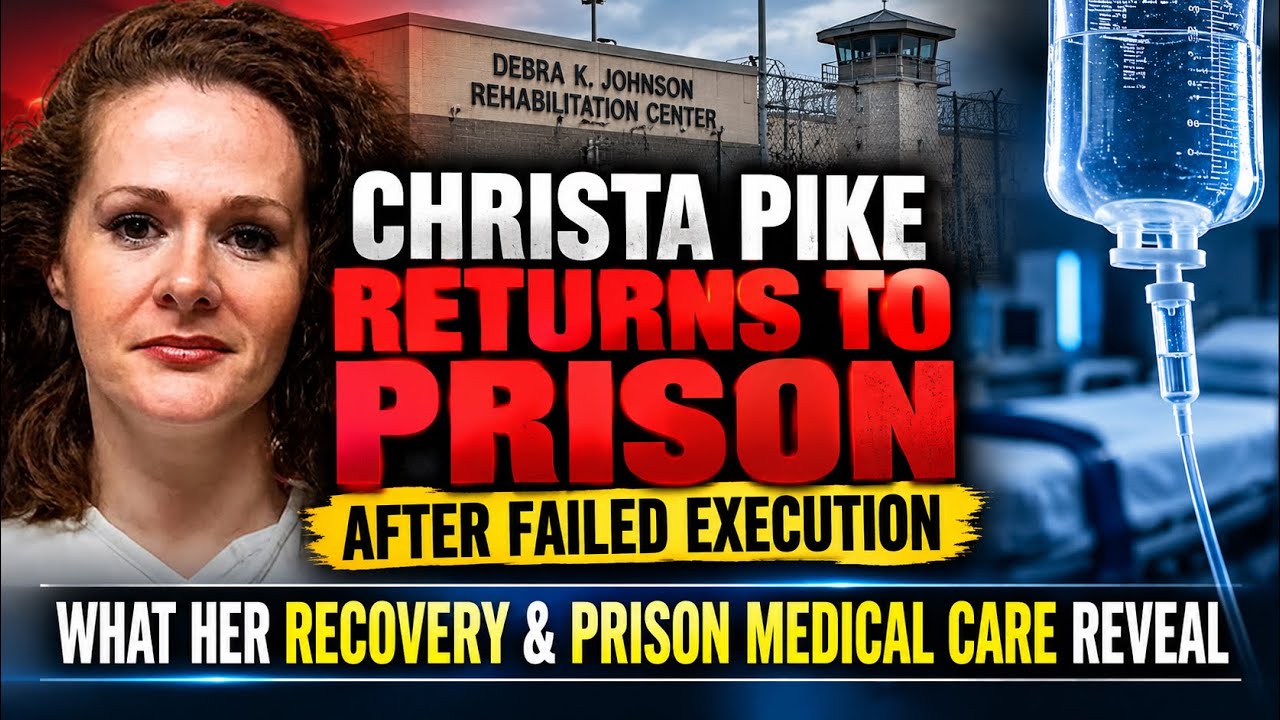
Just ten days after Tennessee’s attempt to execute Christa Pike ended in failure, the woman who reportedly faced a life-threatening medical crisis has been discharged from the hospital and returned to the prison where she has spent decades behind bars.
The development marks a significant turning point in a case that has raised extraordinary questions about the death penalty, the limits of execution protocols, and the medical consequences of a procedure that did not end as state officials intended.
But while Pike’s return to the Deborah K. Johnson Rehabilitation Center in Nashville may suggest that her condition has improved, it does not necessarily mean she has recovered fully, and the distinction between leaving a hospital and regaining one’s health is central to understanding what happens next.
According to a statement from her attorneys reported by the Associated Press on Saturday, October 10, Pike has been discharged from the hospital and is continuing to receive medical care inside the correctional facility.
Her legal team also expressed gratitude to the first responders and medical professionals who treated her during what they described as extraordinary circumstances, while confirming that they would continue monitoring her recovery.
The announcement came approximately ten days after Tennessee attempted to execute Pike by lethal injection on September 30, a procedure that was halted after the reported administration of two doses of pentobarbital failed to result in her death.
Pike had remained hospitalized following the failed execution, and earlier updates from her attorneys described a frightening medical situation that raised concerns about whether she would survive.
Now, she is back in prison, and the immediate question has changed from whether she would regain consciousness to what level of care she still requires and whether her reported improvement will continue.
A dramatic change in just ten days
The timeline surrounding Pike’s medical condition helps explain why her return to prison has attracted so much attention.
On September 30, Tennessee attempted to carry out her execution for the 1995 murder of her classmate, Colleen Slemmer, but the procedure did not conclude with Pike’s death, and she was subsequently taken for emergency medical treatment.
In the days that followed, she remained hospitalized while her attorneys communicated increasingly serious concerns about her condition, describing complications that made her prognosis appear uncertain.
At one point, her legal representatives raised concerns that she might be brain dead, although that characterization came from her attorneys and should not be treated as a confirmed medical diagnosis.
The situation appeared to change as additional updates emerged during the following week, with her legal team reporting that she had regained consciousness, could communicate, was eating regular meals, and had begun walking with assistance.
Those developments suggested meaningful progress compared with the condition described in the earlier statements, although they did not establish the full extent of her physical or neurological recovery.
Then came the October 10 announcement that Pike had been discharged and returned to the Deborah K. Johnson Rehabilitation Center, where she will continue receiving medical attention while remaining in state custody.
The speed of that transition is striking, but it is important not to confuse a substantial improvement with a complete recovery.
A patient may no longer require the intensive services of a hospital while still needing medication, nursing supervision, rehabilitation, mobility assistance, or follow-up examinations for complications that have not fully resolved.
In Pike’s case, the public does not yet have a complete medical report describing her condition at discharge, the treatment orders provided to prison staff, or the prognosis established by her treating physicians.
Consequently, the available information supports the conclusion that she was considered suitable to leave the hospital, not that every medical concern associated with the failed execution has disappeared.
What kind of medical care can Pike receive inside prison?
Pike’s return raises another important question: what happens when an incarcerated person leaves a community hospital after a major medical emergency and must continue treatment inside a correctional institution?
According to the correctional healthcare information discussed in the source report, the Deborah K. Johnson Rehabilitation Center has a documented role in providing medical services beyond routine sick-call examinations, including extended-care and subacute-care functions.
That distinction matters because a correctional institution may have medical housing, nursing services, medication management, and facilities for monitoring patients who no longer need the full resources of an acute-care hospital.
An infirmary can provide a setting for continued observation and treatment, but it is not necessarily equipped to deliver every service available in a hospital, particularly when a patient develops complications requiring specialized equipment or emergency intervention.
The source report identifies an infirmary at the Deborah K. Johnson facility, but the current bed capacity, staffing arrangements, and precise operational capabilities were not independently established in the material reviewed.
It is therefore reasonable to consider the infirmary as a possible setting for Pike’s ongoing care, but it would be premature to state as a confirmed fact that she is currently housed there.
Her attorneys have said that she continues receiving medical care at the prison, without publicly specifying the precise location of her medical housing or the details of her treatment plan.
From a correctional-administration perspective, the transition requires coordination between the hospital and the prison’s healthcare personnel, who must review discharge instructions and determine what supervision, medication, mobility assistance, or restrictions remain necessary.
Custody staff may also need to accommodate medical limitations affecting transportation, daily activities, and housing arrangements.
If the facility can safely provide the care ordered by the treating physicians, continued treatment inside the prison may be appropriate.
If Pike develops a serious complication or requires a service the institution cannot provide, arrangements for outside medical evaluation or hospital treatment may become necessary.
That does not mean she will automatically return to the hospital if she experiences a setback, but it does mean that her discharge should not be interpreted as the end of her access to hospital-level care if medical circumstances later require it.
Why returning to prison does not mean she is fully recovered
One of the most important distinctions in this story is the difference between being medically stable enough for discharge and being healthy enough to function independently.
Hospitals generally discharge patients when their treating teams determine that inpatient acute care is no longer required and that an appropriate plan exists for continued treatment.
That decision does not necessarily mean the patient has regained normal physical strength, recovered all neurological functions, or reached the end of rehabilitation.
Someone can breathe independently but continue to experience weakness, communicate clearly but struggle with concentration, or walk with assistance while still being unable to move safely without support.
These distinctions are particularly relevant to Pike because her attorneys previously described improvements in breathing, eating, communication, and mobility while also raising concerns about possible continuing problems.
Earlier statements referenced concerns involving her arm, concentration, memory, and cognitive functioning, but the available information does not establish whether those difficulties have resolved.
Nor is there public confirmation in the source material that Pike can now walk independently, perform everyday activities without assistance, or return to her previous level of physical and cognitive functioning.
Those unanswered questions are important because a person’s visible ability to communicate or leave a hospital does not reveal the full extent of any injuries sustained during a medical emergency.
The next stage of Pike’s recovery may involve continued monitoring, rehabilitation, medication, or specialist appointments, depending on the actual findings and discharge instructions issued by her medical team.
At present, however, those details remain private or unconfirmed.
The most accurate conclusion is that Pike’s reported condition improved enough for a transition out of the hospital, while the extent of her remaining medical needs is still unknown.
Is Christa Pike recovering faster than expected?
The reported progress has prompted an obvious question: does Pike’s return to prison suggest that she is recovering faster than anyone anticipated?
Her attorneys previously described a critical situation and expressed fears about whether she would survive, making the subsequent reports of consciousness, communication, eating, and assisted walking significant developments.
Nevertheless, determining whether her recovery is faster than expected would require information that has not been made public, including her physicians’ initial prognosis, the clinical findings recorded during hospitalization, and the medical criteria used to authorize discharge.
Without that information, it is not possible to establish whether her progress exceeded the expectations of her treating team.
Recovery from a serious medical event can also be uneven, with improvements in one area occurring alongside continuing problems in another.
A patient may become more alert while experiencing lingering cognitive difficulties, or regain some mobility while continuing to require physical assistance and close supervision.
For that reason, the more meaningful question is not simply whether Pike is improving, but how much of her physical and cognitive functioning she may ultimately regain.
That answer may take considerably longer to establish than the initial decision to discharge her from the hospital.
The source report also raises the possibility that statements from attorneys could reflect strategic legal considerations, particularly in litigation involving the death penalty.
However, there is no established evidence in the material provided that Pike’s attorneys exaggerated her condition or misrepresented her recovery, and speculation about their motives cannot substitute for medical documentation.
At the same time, the seriousness of the reported procedure provides a legitimate reason to seek transparent information about what happened and what consequences, if any, Pike continues to experience.
A failed execution involving the administration of lethal-injection drugs is an extraordinary event, and questions about potential physical injury or psychological trauma should be evaluated carefully rather than dismissed without evidence.
Could Pike return to a general-population housing unit?
Another issue raised by Pike’s return concerns where she will live inside the prison once her medical needs have been assessed.
The source report notes that Pike had previously been permitted to interact with other incarcerated women, including during a period in 2024, before she was moved into a more isolated setting as her execution approached.
Her return after the failed procedure creates uncertainty about whether she will resume a previous housing arrangement, remain in a medical unit, or receive a different assignment based on her current condition and institutional requirements.
It would be premature to assume that she will immediately return to general population, because that decision could depend on medical clearance, available housing, security assessments, and the prison’s operational procedures.
Likewise, there is no confirmed information in the material reviewed establishing that prison officials intend to continue isolating her or that a particular housing assignment has already been approved.
If her medical team determines that she no longer needs infirmary-level supervision, officials will still need to consider whether her physical condition allows her to function safely within the designated housing environment.
Her attorneys may also scrutinize any restrictions placed on her movement or interactions, particularly if those restrictions are connected to the circumstances surrounding the failed execution.
For now, the only established development is that Pike has returned to the institution and will continue receiving medical care there.
The details of her eventual housing arrangement remain unknown.
Tennessee’s correctional healthcare system and its limitations
The discussion of Pike’s care also highlights the practical challenges correctional systems face when an incarcerated person requires treatment beyond what a particular institution can provide.
The source report references the Lois M. DeBerry Special Needs Facility in Nashville as another component of Tennessee’s correctional healthcare system, with specialized medical and behavioral-health services for incarcerated people who require additional treatment.
However, the report also identifies an important limitation: the facility is designated for male incarcerated individuals, meaning it should not be presented as an available transfer destination for Pike without evidence that an appropriate and authorized placement exists.
Its existence demonstrates that Tennessee has specialized correctional medical resources, but it does not establish that those resources are suitable or accessible for every patient in state custody.
Because Pike is incarcerated at a women’s facility, the practical options discussed in the source report center on the medical services available at Deborah K. Johnson and access to outside hospitals when necessary.
The report also references a healthcare renovation and addition project approved in 2025, valued at approximately $4.75 million, involving buildings at the Deborah K. Johnson facility.
That investment may provide useful context for understanding Tennessee’s plans for correctional healthcare infrastructure, but the available information does not establish whether the project has been completed or whether it affects the care Pike is currently receiving.
Ultimately, medical placement should depend on a patient’s clinical needs, the capabilities of the institution, and the availability of appropriate treatment, rather than assumptions about what a particular facility can provide.
The public still needs more information before it can determine precisely how Pike’s continued care is being managed.
The failed execution investigation is far from over
Even as attention turns toward Pike’s medical recovery, her return to prison does not resolve the larger questions surrounding September 30.
Tennessee attempted to execute Pike using pentobarbital, but the procedure was halted after the reported administrations failed to result in her death.
State officials have maintained that personnel followed the established execution protocol, but that assertion alone does not explain why the procedure failed or establish whether every part of the process functioned as intended.
Questions remain about vascular access, drug administration, monitoring of Pike’s condition, the decisions made during the procedure, and whether the protocol itself requires further examination.
According to the source report, Governor Bill Lee ordered an independent review, a judge directed the preservation of evidence connected to the failed procedure, and Tennessee postponed its remaining scheduled executions for 2026.
Those developments make the investigation especially consequential because its purpose should be to establish what happened, how it happened, and whether changes are necessary to prevent a similar failure.
The source report also raises concerns about whether a review would be sufficiently independent if people involved in developing or assessing earlier procedures were placed in a position to evaluate their own work.
That is a question of investigative independence rather than proof of misconduct, and the material provided does not establish that any particular official acted improperly.
A credible review should examine both the implementation of the existing protocol and the protocol itself, using evidence and independent expertise to determine where responsibility lies.
It should not assume that compliance with written procedures necessarily proves that those procedures were adequate, nor should it presume that a failed outcome automatically establishes a specific error by an individual.
The preservation of evidence and a thorough examination of the events are therefore important regardless of how Pike’s medical recovery ultimately unfolds.
If she makes a full recovery, the state will still need to explain why the execution attempt failed.
If she experiences lasting physical or neurological consequences, those findings may raise additional questions about the medical effects of the procedure and the responsibilities of the officials involved.
Her recovery and the investigation are connected, but they are separate matters that must be evaluated on their own evidence.
What happens next for Christa Pike?
For now, Pike’s return to the Deborah K. Johnson Rehabilitation Center marks a new phase in a case that has already taken an extraordinary turn.
Her discharge from the hospital is an encouraging development in the limited sense that she was considered ready to continue treatment outside the hospital, but it does not establish that she has recovered completely or that her medical risks have disappeared.
The most important outstanding questions concern her current physical and neurological condition, the level of supervision she requires, the location in which she is receiving treatment, and whether further rehabilitation or outside medical appointments will be necessary.
Additional statements from her attorneys, the Tennessee Department of Correction, or her treating medical professionals could clarify some of those issues, although detailed medical information may remain private.
At the same time, the investigation into the failed execution must continue independently of the public’s interest in Pike’s recovery.
The events of September 30 raise questions that cannot be answered simply by observing that she survived, regained consciousness, or returned to prison.
The state must still account for what occurred during the procedure, and the public deserves an evidence-based explanation of why an execution intended to end in death did not proceed as planned.
Ten days ago, the central concern was whether Christa Pike would survive the medical crisis that followed Tennessee’s failed execution attempt.
Today, she is reportedly back behind prison walls and receiving continued medical care, but her long-term recovery remains uncertain, and the questions surrounding the procedure remain unresolved.
Her return to prison is a significant development, not a final answer. The coming weeks may provide a clearer picture of her medical condition, while the independent review will be critical to understanding what went wrong during one of the most extraordinary execution cases in recent American history.


