BREAKING: CHRISTa PIKE WINS A MAJOR COURT BATTLE — JUDGE ORDERS TENNESSEE TO PRESERVE EVERY PIECE OF EVIDENCE FROM FAILED EXECUTION
The court has taken a significant step in the legal battle surrounding Christa Pike’s failed execution, ordering Tennessee officials to preserve evidence ranging from lethal-injection drugs and medical equipment to photographs, recordings, and private communications, as new questions emerge about what happened inside the execution chamber on September 30.
For Christa Pike, the woman who survived Tennessee’s failed attempt to execute her, the fight has entered a new and potentially decisive phase, one that could determine how investigators reconstruct the procedure, how her lawyers challenge the state’s account, and whether another execution attempt will ever take place.
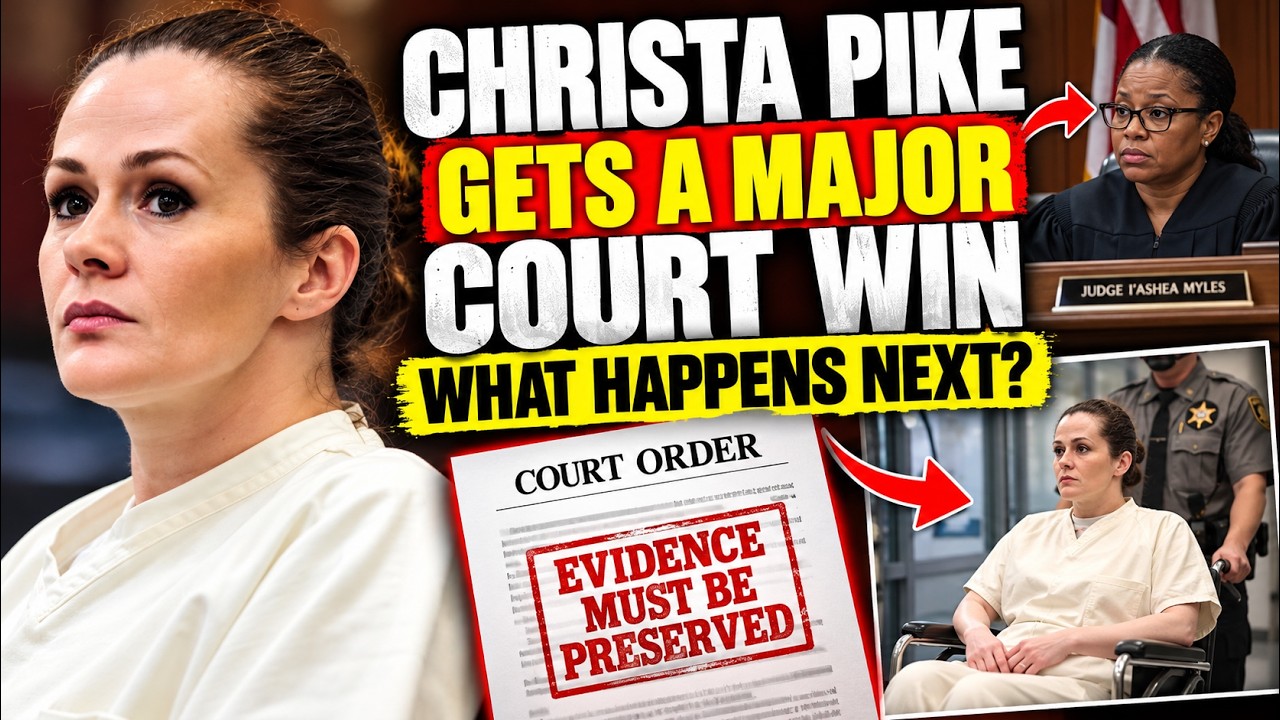
On October 7, Davidson County Chancery Court Judge Aisha Miles granted Pike’s request for an order requiring Tennessee officials to preserve evidence connected to the botched execution, warning through the scope of the ruling that relevant material must not be lost, misplaced, discarded, or accidentally deleted before it can be examined.
The order reaches far beyond ordinary paperwork, encompassing the drugs and equipment used during the procedure, the medical supplies present inside the execution chamber, photographs and recordings from that evening, and communications that could help establish what officials knew as events unfolded.
For Pike’s legal team, preserving that material is an essential first step toward determining whether the procedure followed Tennessee’s established execution protocol, as state officials have maintained, or whether the problems alleged by her attorneys contributed to the extraordinary outcome.
But the ruling also carries an important limitation: the judge has not found that Tennessee violated its procedures, and the order does not establish that any individual or agency was responsible for the failed execution.
Instead, the court has ensured that evidence potentially relevant to those questions remains available while the investigation and legal proceedings continue.
A Court Order Covering Far More Than Paper Records
The breadth of the preservation order is one of the most significant developments in the case.
According to the proceedings described in the transcript, Pike’s lawyers sought to preserve virtually every category of material that could shed light on the September 30 procedure, including drugs, syringes, IV lines, tubing, needles, catheters, medical supplies, restraints, and the gurney used inside the execution chamber.
The request also included medical waste, drug packaging, product labels, manufacturer information, and other materials associated with the lethal-injection drugs and the equipment used to administer them.
Photographs, video recordings, audio recordings, and surveillance footage were also included, extending the preservation requirement to relevant recordings from the execution chamber and witness areas.
Written records and electronic communications form another crucial part of the picture, with the order covering handwritten notes, checklists, timelines, incident reports, witness accounts, emails, and text messages connected to the procedure.
Each category could help answer a different question.
Medical records may help reconstruct Pike’s physical condition and the complications she experienced, while equipment records and physical evidence could help investigators determine how the procedure was carried out.
Internal messages, written logs, and witness accounts may establish the sequence of events, including what officials observed, what problems they recognized, and when particular decisions were made.
Taken together, these materials could provide a more complete picture than any single account of the night.
Yet their preservation does not automatically establish what they will reveal, and the contents of the evidence have not been fully presented as definitive findings in the transcript.
For now, the court has secured the opportunity for a closer examination rather than delivered a final explanation.
Two Competing Accounts of What Happened
The legal dispute stems from conflicting descriptions of the failed execution.
Tennessee’s Department of Correction has maintained that its personnel followed the state’s established execution protocol.
Pike’s attorneys, however, have alleged that problems obtaining IV access prevented the lethal-injection drugs from being properly delivered, raising questions about how the procedure was conducted and what happened after complications arose.
Her lawyers have also described serious injuries to her arms, which they say were associated with the ordeal.
Those allegations remain subject to investigation and have not been established by a final independent finding.
That distinction is essential because the preservation order does not resolve the disagreement between the state and Pike’s legal team.
It creates the conditions under which investigators and attorneys can examine relevant material rather than relying solely on competing descriptions of events.
If the records establish a detailed timeline, investigators may be able to compare what was supposed to happen with what actually occurred.
If the physical evidence raises questions about the equipment or the administration of the drugs, those questions can be examined through the appropriate investigative and legal processes.
And if communications reveal how officials responded to emerging complications, those records may help clarify the decisions made during the procedure.
The evidence may support, challenge, or complicate aspects of the accounts already given.
Until it has been examined and the findings are made available, however, it would be premature to declare that any specific failure has been proven.
Pike’s Recovery Has Taken a Dramatic Turn
While the legal fight intensifies, Pike’s medical condition has also changed significantly since the execution attempt.
In the immediate aftermath, her attorneys described a severe medical crisis involving breathing support, extensive swelling in both arms and hands, a blood clot in one arm, pneumonia, and uncertainty about whether she would regain normal function.
At one point, her lawyers said she could not swallow, had not been able to eat, and was unable to move either arm.
The extent of the injuries raised concerns not only about her immediate survival but also about the possibility of lasting physical damage.
According to updates from her attorneys on October 8, however, Pike had begun walking with assistance and had returned to eating a regular diet.
Her lawyers also reported that her lungs were clear and that movement and strength were returning to her arms as the wounds began to heal.
Those developments marked a substantial change from the first days following the failed execution, when the possibility of recovery remained deeply uncertain.
Nevertheless, improvement does not mean that the consequences have disappeared.
Pike’s attorneys have said she continues to experience difficulties with concentration and memory, alongside psychological trauma associated with the experience.
Her lawyers have also described significant pain from burns on her arms and hands, reporting that the injuries made ordinary tasks difficult, including holding a pen and signing documents.
According to the medical updates relayed by her legal team, doctors have cautioned that it could take months to determine whether she has suffered lasting cognitive injuries.
Her recovery therefore remains an evolving medical issue, with both the extent of her injuries and the possibility of long-term consequences still uncertain.
The court proceedings now unfold alongside that recovery, creating a situation in which Pike’s medical condition, her ability to communicate with her attorneys, and the preservation of evidence are all closely connected.
The Judge Also Addressed Access to Pike’s Lawyers
The hearing was not limited to the preservation of physical and documentary evidence.
It also addressed Pike’s ability to communicate with her legal team while she remains hospitalized.
According to the transcript, the judge ordered prison officials to respond to requests for in-person visits from Pike’s attorneys within two hours.
That requirement matters because her lawyers need to communicate with her as her medical condition changes and as decisions about future legal challenges develop.
A preservation order can protect evidence, but it cannot replace the need for an attorney to understand a client’s condition, obtain instructions, and discuss possible legal strategies.
The ruling should not, however, be interpreted as granting Pike’s lawyers unrestricted access to every record connected to the execution.
Nor does it mean that the public is now automatically entitled to view the execution footage, medical records, or internal communications.
Those are separate legal questions that may depend on future court proceedings, confidentiality rules, and decisions governing the use or disclosure of particular materials.
For now, the immediate result is narrower but still significant: Tennessee must preserve the relevant evidence, and prison officials must respond to requests for in-person legal access within the period established by the court.
Will the Public Ever See the Execution Recordings?
One question is likely to remain at the center of public interest: will the evidence preservation order eventually allow people outside the legal proceedings to see what happened inside the execution chamber?
The answer is not yet clear.
Preserving evidence and releasing it to the public are different legal processes.
The order requires Tennessee officials to retain relevant material, but it does not automatically make every photograph, recording, medical document, or internal message publicly accessible.
Some material may be considered in future legal proceedings, while other records could remain subject to restrictions governing medical information, confidential communications, or investigative files.
Pike’s lawyers may seek access to particular items as they prepare their challenges, but any further disputes over disclosure would need to be addressed through the applicable legal process.
The distinction is especially important in a case where the evidence could be central to determining whether the state’s execution procedure was carried out as intended.
The public may want immediate answers, but the existence of preserved evidence is not the same as having a complete, independently verified account of what occurred.
The next stage will depend on what investigators and attorneys are able to examine, what findings they produce, and whether further court decisions address access to the material.
Governor Bill Lee’s Independent Review Could Become Critical
The court’s preservation order is also separate from the independent review ordered by Tennessee Governor Bill Lee.
That review is intended to examine why the September 30 execution attempt failed and whether the state’s execution procedures were followed.
The preserved evidence could be relevant to that investigation, potentially helping reviewers reconstruct the procedure and assess the competing accounts offered by the state and Pike’s attorneys.
Investigators will need to establish the sequence of events, identify any complications that occurred, and determine whether the established protocol was implemented properly.
Physical evidence, medical information, records, and witness accounts may all contribute to that process.
However, the review has not yet produced final findings in the material described by the transcript.
That means no particular explanation for the failed execution can responsibly be presented as settled fact.
The investigation will need to distinguish between what the evidence directly establishes, what witnesses report, and what remains uncertain.
The preservation order is designed to protect the material needed for that work, but the ultimate conclusions will depend on the investigation itself.
Tennessee has also paused its remaining executions scheduled for 2026 while the review proceeds, according to the transcript.
That pause gives the state time to examine the failure and consider what it means for its execution procedures, although it does not, by itself, determine the future of Pike’s individual sentence.
Could Tennessee Attempt to Execute Pike Again?
Perhaps the most consequential question is whether Tennessee will ever attempt to execute Pike again.
Her death sentence remains in place, but there is no new execution date, and the legal consequences of the failed attempt remain unresolved.
Pike’s attorneys are urging Governor Lee to commute her sentence to life imprisonment without the possibility of parole.
Their position is that Pike should not face another execution attempt after surviving the September 30 procedure and suffering the injuries described by her legal team.
The possibility of another attempt raises difficult legal questions, including potential constitutional challenges involving the prohibition against cruel and unusual punishment and arguments concerning double jeopardy.
Those questions cannot be answered simply by pointing to the evidence preservation order.
The judge has not commuted Pike’s sentence, declared another execution unconstitutional, or prohibited Tennessee from ever pursuing another attempt.
At the same time, the failed procedure has created a set of circumstances that will have to be examined through future legal filings, medical assessments, and the findings of the independent review.
Any decision about what happens next could depend on how those separate developments unfold.
The preserved evidence may become particularly important if Pike’s attorneys argue that the circumstances of the first attempt make a second one legally impermissible.
But whether such arguments will succeed remains uncertain.
For now, the state’s death sentence remains unchanged while the broader legal battle continues.
Four Developments That Could Shape the Next Chapter
The next phase of the case is likely to turn on several developments.
First, Pike’s medical team will continue assessing her physical recovery, including the healing of her arms and the possibility of lasting cognitive effects.
Second, her attorneys will be able to rely on the preservation order as they pursue access to relevant evidence and prepare any future legal challenges.
Third, Governor Lee’s independent review will need to examine the circumstances of the failed execution and determine what the available evidence establishes about the procedure.
Finally, Pike’s request for clemency remains unresolved, leaving open the question of whether her sentence will be commuted or whether Tennessee will pursue further legal steps toward another execution attempt.
These developments are related, but they are not interchangeable.
A medical recovery does not resolve whether the execution protocol was followed, and a preservation order does not determine whether clemency should be granted.
Likewise, the independent review may clarify the events of September 30 without necessarily settling every constitutional question raised by Pike’s attorneys.
Each process has its own purpose, and the outcome of one may influence the others without automatically deciding them.
A Major Procedural Victory, but Not the Final Answer
Judge Aisha Miles’s ruling represents an important development for Christa Pike because it requires Tennessee to preserve material that could prove essential to understanding the failed execution.
It ensures that potentially relevant drugs, equipment, medical supplies, recordings, photographs, reports, and communications must remain available rather than being lost or discarded before they can be examined.
But the limits of the ruling are just as important as its reach.
The judge has not found that Tennessee violated its protocol, has not ordered the public release of every execution record, and has not changed Pike’s death sentence.
What comes next will depend on the evidence itself, the findings of the independent review, Pike’s continued medical recovery, and the legal arguments presented in the months ahead.
For the moment, Tennessee’s official position and Pike’s attorneys’ allegations remain in conflict, and the full explanation for what happened on September 30 has not yet been established.
The preservation order does not answer the central question.
It makes it harder for the evidence needed to answer that question to disappear.
And with Pike now reportedly walking with assistance and eating again, the case has moved beyond the immediate emergency into a wider legal and investigative struggle whose consequences could extend well beyond her individual sentence.
What will the preserved evidence ultimately reveal about the execution Tennessee says followed its protocol, yet ended with Christa Pike still alive?
That answer has not arrived, and the next major developments may depend on what investigators discover, what the court considers in future proceedings, and whether Tennessee’s review can provide a clear account of one of the most consequential failures in the state’s modern execution history.


