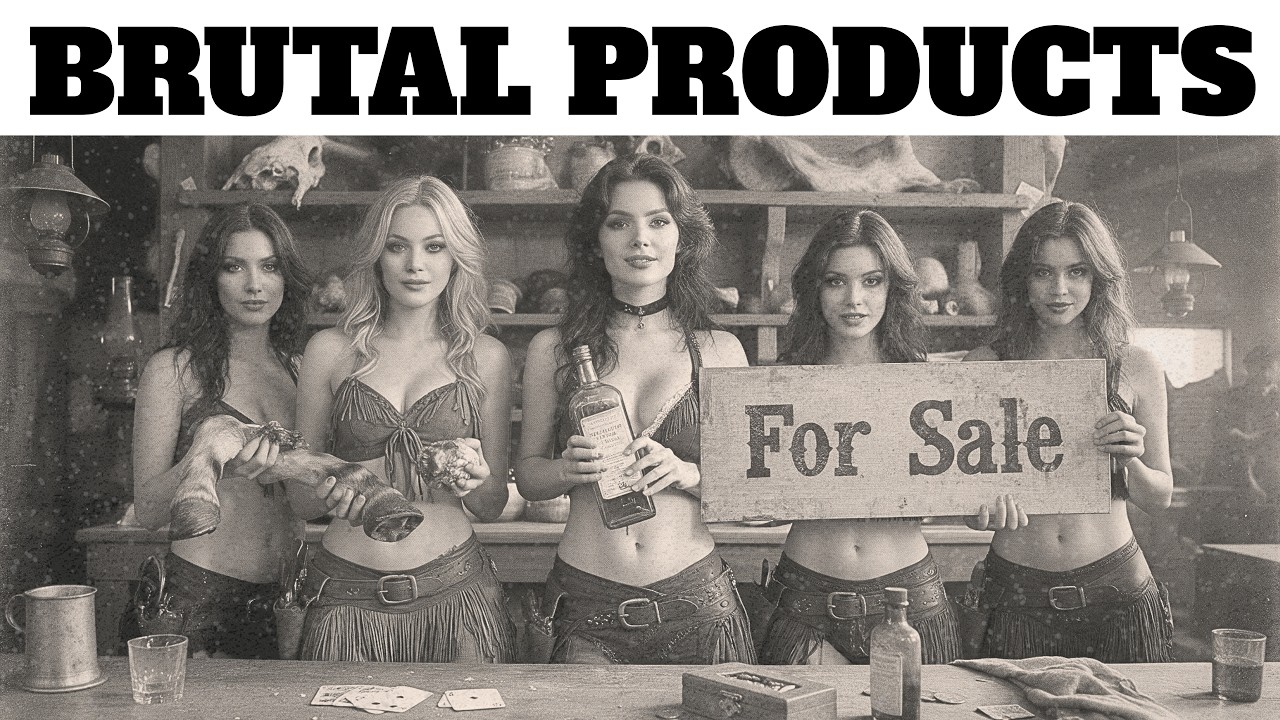
On August 2, 1876, Wild Bill Hickok sat down inside Saloon No. 10 in Deadwood with almost no money left.
He had been losing at poker.
So he turned to bartender Harry Young and asked for fifty dollars in “pocket checks” — the saloon’s own poker chips — on nothing more than his word.
Young handed them over.
A few hours later, Jack McCall shot Hickok from behind.
The debt was never repaid.
That single moment reveals more about the real Old West saloon than a hundred Hollywood movies.
Because the saloon was not simply a place where men bought whiskey.
It functioned as a lender.
A gambling exchange.
A restaurant.
A post office.
A news desk.
A political headquarters.
A courtroom.
A labor broker.
A place where gold dust was weighed.
And, for some women working inside it, a system that controlled both income and debt.
According to the transcript, the records behind this history come from frontier newspapers, census sheets, court documents, memoirs, and later historians who reconstructed saloon life from those surviving sources.
Here are twenty things a Wild West saloon really sold.
20. Beer
Hollywood built the Western saloon around whiskey.
But beer was everywhere.
German immigrants carried brewing traditions into mining regions, and brewers followed expanding camps almost as quickly as miners did.
Beer was practical.
A man could sit with it longer than a shot of whiskey.
It was something to drink slowly after work rather than something swallowed in seconds.
For laborers who had to be awake before sunrise, that mattered.
The classic saloon image therefore misses an ordinary detail.
The most common drink in the room might not have been brown liquor at all.
It might have been a heavy glass of beer leaving condensation on unfinished pine.
19. Whiskey by the Glass
The Western hero often slaps down a coin and receives a whole bottle.
Real saloon economics were usually tighter.
According to the source, most customers bought individual pours.
In many boomtowns, a drink might cost two bits — a quarter.
The bartender controlled the pour.
He determined how full the glass was.
He decided which barrel it came from.
That seems minor.
But it shows the basic power structure.
The customer paid.
The bartender measured.
The saloon controlled the unit of exchange.
Before the night became complicated, the bar had already decided exactly what a man’s quarter bought.
18. Cigars and Chewing Tobacco
Tobacco was not merely something men carried in their pockets.
It was inventory.
Cigars could be purchased individually.
Chewing tobacco could be sold by the plug.
And just like drinks, tobacco could go onto a customer’s tab.
That small detail mattered.
A man did not need money tonight.
He only needed the bartender to believe he would have money later.
This turned the saloon into something larger than a shop.
It became a creditor.
The line between customer and debtor could begin with something as small as a cigar.
17. “Free” Food Designed to Make You Thirsty
The famous saloon free lunch was not generosity.
It was marketing.
A customer bought a drink and received food.
But the menu was designed to encourage another drink.
Salt pork.
Pickles.
Cheese.
Hard crackers.
Foods heavy enough in salt to send the customer back toward the bar.
In larger towns this became a familiar business model.
Give away inexpensive food.
Sell more alcohol.
The plate might have been free.
The thirst was not.
The saloon understood customer behavior long before modern restaurants invented the phrase “loss leader.”
16. Gambling Space
Many saloons made money from gambling even when the saloon owner did not personally run the game.
Tables could be leased to professional gamblers.
Dealers paid rent or shared revenue.
The saloon earned money whether the player won or lost.
The transcript cites Wyatt Earp’s involvement with gambling interests at the Oriental Saloon in Tombstone.
That detail complicates another Hollywood division.
Lawman on one side.
Gambler on the other.
Frontier life was messier.
The same man could enforce laws, own business interests, gamble, and socialize in the same room.
The saloon did not need to beat every player.
It only needed the table occupied.
15. Mail and Information
Early mining camps often lacked formal institutions.
No permanent post office.
No newspaper office.
Sometimes no town hall.
What they did have was a saloon.
Letters could be left behind the bar.
Notices could be posted on walls.
A stage driver arriving with outside news might stop there first.
If someone found gold, disappeared, died, or skipped town owing money, the saloon often heard about it before anyone else.
The bartender remembered faces.
Names.
Debts.
Rumors.
Movements.
The saloon was not just where people drank.
It was where information accumulated.
In that sense, the bar became the town’s memory.
14. Gold-Dust Exchange
In mining camps, money did not always arrive as coins.
It arrived in leather pouches.
Gold dust.
And someone had to decide what that dust was worth.
The saloon kept scales.
A miner poured dust into a small weighing pan.
The bartender examined the weight and estimated purity.
Then the transaction began.
This gave the saloon extraordinary power.
It did not merely sell the drink.
It helped determine the value of the money used to buy it.
The scale became as important as the whiskey bottle.
A man entered with raw gold.
The saloon translated it into spending power.
13. Courtroom Space
Law did not always live inside a courthouse.
Sometimes it lived beside the beer taps.
The transcript points to Justice of the Peace Roy Bean, who famously operated his court from his Jersey Lilly saloon in Langtry, Texas.
The most outrageous legends told about Bean are not all supported by court records.
But the courtroom-saloon itself was real.
In small settlements, the largest available room might be inside a drinking establishment.
Hearings.
Inquests.
Disputes.
Rulings.
All could occur where men were also buying alcohol.
Hollywood often separates civilization from the saloon.
On the frontier, government could literally operate from behind the same door.
12. Whiskey as Medicine
In the nineteenth century, whiskey was not viewed only as recreation.
It was listed in the United States Pharmacopoeia and prescribed as medicine.
People used it for cold.
Pain.
Exhaustion.
Fever.
Shock.
Grief.
In remote camps with few physicians, the saloon could resemble an informal pharmacy.
A sick man might not seek a doctor.
He might seek the bartender.
The same barrel provided the drink for celebration and the “medicine” for illness.
That gave whiskey a legitimacy that modern viewers easily miss.
People were not always purchasing intoxication.
Sometimes they believed they were purchasing treatment.
11. Whiskey That Wasn’t What the Customer Thought
The irony is that the product sold as medicine could itself be adulterated.
Before stronger labeling and purity protections, buyers had limited ways to know what was inside a bottle.
Alcohol could be watered.
Colored.
Flavored.
Blended.
Passed off as something older or better than it really was.
The Bottled-in-Bond Act of 1897 responded partly to the problem of inconsistent and adulterated spirits by creating federal standards for certain whiskey.
Before that, trust mattered enormously.
The customer trusted the bartender.
The bartender controlled the barrel.
And the customer often had no practical way to verify what he was drinking.
The saloon sold confidence as much as liquor.
10. A Woman’s Time by the Dance
Not every woman working inside a saloon sold sex.
Some sold dances.
The transcript describes “hurdy-gurdy” houses where men paid to dance with women by the set.
Music began.
The customer paid.
The couple danced.
Then the music ended and another man paid.
The woman could repeat the cycle for hours.
Her time itself became the product.
And the saloon usually kept a portion.
That is an important distinction because movies often merge every female saloon worker into one category.
Historically, there were dancers.
Waitresses.
Drink sellers.
Entertainers.
Sex workers.
Sometimes those roles overlapped.
Sometimes they did not.
9. The Percentage Drink
A woman sitting beside a customer might appear to be sharing his whiskey.
She may actually have been selling him another round.
According to the source, some women earned commissions on drinks purchased in their company.
The customer might buy her a “whiskey.”
Her glass could contain tea or colored water.
She stayed sober.
He kept drinking.
The saloon tracked the transaction with tokens or brass checks.
At the end of the night, she exchanged those markers for her share.
Her conversation had value.
Her presence had value.
Her apparent drinking had value.
The glass in her hand was not necessarily a drink.
It was a sales instrument.
8. Political Influence
The saloon also sold access.
People gathered there.
Politicians knew it.
In Denver, the transcript cites saloon keepers who served on city councils and operated businesses that doubled as political headquarters.
That created a powerful loop.
The saloon owner could extend credit.
He controlled a meeting place.
He heard local news.
He knew who owed money.
And he might also help write the ordinances regulating alcohol and the women working inside saloons.
Political organization happened where people congregated.
In many frontier neighborhoods, that meant the bar.
A campaign handbill beside a beer tap could be as effective as a speech at city hall.
7. Rooms Upstairs and Cribs Out Back
Hollywood prefers velvet parlor houses.
The source says many women selling sex lived somewhere much smaller.
A crib.
A narrow rented room.
A bed.
A washstand.
A lamp.
Perhaps a door opening toward an alley.
Historians studying census records and police files found that elaborate brothels represented the high end of the trade.
Many women worked from crude rooms near or behind saloons.
The customer bought whiskey inside.
Then walked out the back.
The next transaction might happen only a few steps away.
The saloon and sex trade could be separate businesses but part of the same economic ecosystem.
6. Debt
This is where the saloon economy becomes darker.
A woman might owe money for her room.
Food.
Clothing.
Liquor.
Travel.
A dress.
The people charging those expenses might also control her income.
So every payment reduced one debt while another charge appeared.
The ledger became a trap.
No iron chain was necessary.
Leaving town meant leaving money owed to people who often knew the saloon owner, sheriff, landlord, and other employers.
The transcript makes debt the central hidden product of the entire saloon economy.
A man like Hickok could receive credit based on reputation.
A woman working the floor might receive credit because debt made her easier to control.
Same mechanism.
Very different consequences.
5. Drugged Drinks and Robbery
Not every saloon transaction was voluntary.
Waterfront districts became notorious for robberies involving drugged drinks.
A customer drank.
Lost consciousness.
Woke later without his money.
Watch.
Clothes.
Or boots.
Some stories describe men being “shanghaied” — kidnapped or deceived onto ships desperate for crew.
The transcript relies partly on Herbert Asbury’s later writing about San Francisco’s Barbary Coast and correctly notes that his work mixes journalism with colorful storytelling.
So individual episodes should be handled carefully.
But the broader pattern of waterfront robbery, drugging, and coercive recruitment was real enough to become part of urban vice history.
The saloon could sell a drink.
Then take everything back while the customer slept.
4. Laudanum and Morphine
Women working in saloon and brothel economies faced another market.
Drugs.
Laudanum — opium dissolved in alcohol — was widely available.
Morphine could also be obtained much more easily than today.
Women used opiates for pain.
Insomnia.
Illness.
Emotional distress.
Some developed dependence.
Some died.
The transcript describes historians finding repeated cases of poisoning and suicide in coroner reports and newspapers.
Often the record was heartbreakingly short.
A name.
Sometimes only a nickname.
A room.
A bottle.
The word “poison.”
The Western movie remembers gun deaths.
The historical record contains quieter deaths too.
3. Julia Bulette’s Death Became a Legend
Julia Bulette became one of Virginia City’s most remembered women.
She was found murdered in January 1867.
Her jewelry, furs, and clothing had been stolen.
A man named John Millain was later arrested after evidence connected him with her belongings.
He was convicted and hanged in 1868.
Bulette’s funeral became part of Comstock legend, and later stories emphasized her generosity and popularity.
But the source asks readers to look beneath the legend.
In life, she sold her time.
In death, newspapers turned her into a symbol.
Even her stolen clothes became evidence and commodities.
The woman became a story only after she could no longer control how that story was told.
2. Violence Happened Inside the Saloon World, Not Only in the Street
The famous Western gunfight usually happens at noon.
Two men.
Empty street.
Hands near revolvers.
Real violence could be much messier.
The transcript recounts the October 1871 confrontation in Abilene involving Wild Bill Hickok and gambler Phil Coe.
Coe was shot.
Then another figure ran from the darkness.
Hickok fired again.
It was Mike Williams, a special policeman and Hickok’s friend, apparently coming to assist him.
Williams died.
The source says Hickok carried his friend into the saloon and placed him on a billiard table.
No heroic duel.
No perfect aim.
No cinematic clarity.
A frightened second.
A mistaken target.
A body lying across green felt.
1. What the Saloon Really Sold Was Debt
Put the entire list together.
Beer.
Whiskey.
Tobacco.
Food.
Gambling.
Mail.
News.
Gold exchange.
Courtroom space.
Medicine.
Dances.
Drink commissions.
Rooms.
Drugs.
Political access.
Credit.
Every transaction had one thing in common.
The saloon controlled the measure.
The price.
The ledger.
The token.
The scale.
The tab.
The house took its share.
That is why Harry Young could hand Wild Bill Hickok fifty dollars in saloon chips with no contract.
Those chips were not gold.
Outside Saloon No. 10, they had little value.
Inside, they were money because the house said they were.
The saloon created its own miniature financial world.
Hickok’s reputation was collateral.
The bartender’s memory was the credit report.
His word was the signature.
And when Hickok died, the debt disappeared with him.
That is what makes the comparison in the source so powerful.
His unpaid debt became part of a legend.
Women’s debts became part of daily life.
Their room was charged.
Their dresses were charged.
Their food was charged.
Their drinks were charged.
Their wages flowed back through the same business that created the debt.
The famous gunfighter walked away from fifty dollars he never repaid.
The women working the floor might spend years paying for things they had already used simply to continue working.
The Records Remembered the Men Better
That imbalance continues in the historical record.
Harry Young left a memoir.
Wild Bill Hickok received biographies.
Cowboys dictated memories.
Army wives wrote books.
Lawmen became legends.
Women working inside dance halls and brothels rarely left comparable records.
Calamity Jane’s famous 1896 pamphlet turned her into an adventurous frontier figure.
But according to the transcript, much of her real connection to saloons and dance halls disappeared from the story she sold publicly.
The heroic version had value.
The working woman’s version did not.
Even when male memoirists wrote warmly about saloon women, they usually recorded what the women looked like and how they behaved from a customer’s perspective.
They rarely recorded wages.
Debt.
Expenses.
Where the woman went when the cattle drive ended.
The men wrote about losing money.
Few wrote about what the women owed.
The Law Punished Women Differently
Court records reveal another economic contradiction.
Women associated with saloons and prostitution could be arrested repeatedly.
Fined.
Named publicly in newspapers.
Then arrested again.
Meanwhile, the men purchasing their services frequently remained anonymous.
The town could collect licensing revenue from a saloon.
Collect fines from women working around it.
Allow customers to continue spending.
And publicly claim it was enforcing morality.
According to the source, historians found regular fines operating almost like municipal revenue streams in some places.
The woman paid twice.
First through the saloon’s economic system.
Then through the town’s legal system.
Her name appeared in the paper.
The customer’s usually did not.
Then Hollywood Cleaned the Entire Room
The source argues that the movie version was not simply inaccurate by accident.
Beginning in the 1930s, Hollywood’s Production Code restricted depictions of prostitution and controlled how drinking and sexuality could appear on screen.
That reshaped the Western saloon.
The prostitute became a singer.
The percentage girl became a charming hostess.
Debt disappeared.
The upstairs rooms became vague suggestions.
The saloon became warm.
Friendly.
Almost respectable.
Later television carried the cleaned-up version further.
For twenty years, Gunsmoke gave American viewers Miss Kitty and the Long Branch Saloon.
She became one of television’s most recognizable Western women.
But the financial machinery described in frontier records — commissions, debt, fines, room charges, dependence on the house — remained largely absent.
The bar survived.
The ledger disappeared.
What Hollywood Got Wrong
Hollywood taught generations to focus on the man sitting at the poker table.
Wild Bill.
Wyatt Earp.
Doc Holliday.
The cowboy losing his wages.
The gambler drawing cards.
The gunman watching the door.
But the real saloon economy extended far beyond the poker table.
Look behind the bartender.
There are letters waiting for men without addresses.
Gold dust waiting to be weighed.
A tab waiting for payday.
A politician waiting for votes.
A gambler paying rent on a table.
A woman collecting brass tokens for drinks she never actually drank.
Another woman in a small room behind the building, still owing money on the dress she is wearing.
And somewhere in the ledger, every transaction becomes a number.
That was the real power of the Wild West saloon.
It did not simply sell whiskey.
It sold access.
Credit.
Time.
Information.
Entertainment.
Risk.
And debt.
Wild Bill Hickok’s last debt was fifty dollars.
It became a historical anecdote because the man owing it became a legend.
The women’s debts rarely made the biographies.
They were too ordinary.
Too repetitive.
Too inconvenient.
They were simply written into the books night after night.
Hickok died before his tab could be collected.
The women kept working until theirs was.
That may be the biggest thing the movies got wrong.
The most powerful person in the saloon was not always the man with the gun.
Sometimes it was the person holding the ledger.


