Tony the Greek Claimed He Helped Kill Jimmy Hoffa, but FBI Never Proved His Story
For more than half a century, the disappearance of Jimmy Hoffa has generated enough confessions, burial maps, mob legends, prison whispers and supposed deathbed revelations to fill an entire library.
Few stories were more graphic than the one told by Donald Frankos.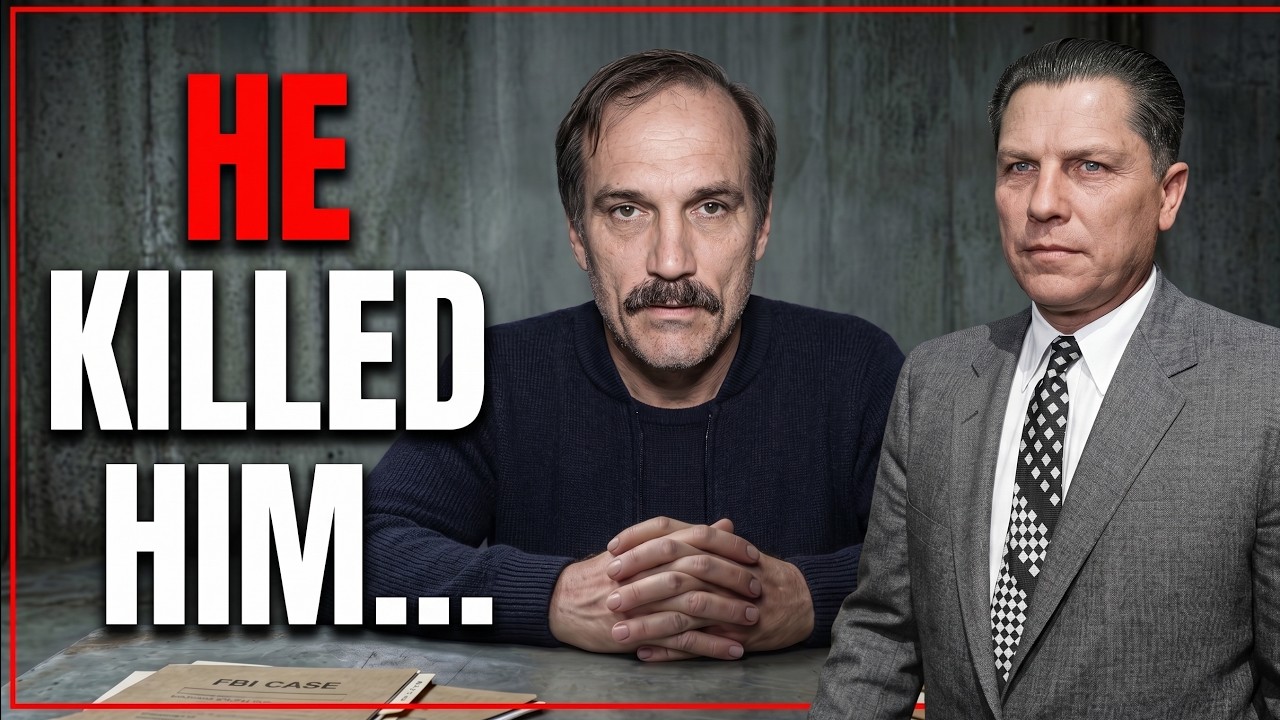
Known as “Tony the Greek,” Frankos was a convicted criminal, self-described contract killer and later government witness whose name exploded into the Hoffa mystery in 1989.
His account had everything a sensational crime story could possibly contain.
A Mafia execution.
A secluded house outside Detroit.
A gunshot.
A chainsaw.
A freezer.
Plastic bags.
An oil drum.
A cross-country transport operation.
And, finally, the claim that Jimmy Hoffa had been buried beneath or near Giants Stadium in New Jersey.
But the most important part of the story is not how shocking Frankos’s version sounded.
It is how poorly that version survived scrutiny.
Frankos did tell reporters that he possessed inside knowledge about Hoffa’s killing.
He did say he had given information to federal investigators.
He did claim that mob figures killed and dismembered Hoffa.
He did help popularize one of the most famous burial theories in American criminal history.
But the FBI never publicly established that his story was true.
Retired investigators later said they did not consider him reliable.
And Frankos himself eventually admitted that some of the most explosive claims attributed to him were not accurate.
That makes the newest viral version especially misleading.
The caption says America’s greatest missing-person mystery was “covered up by the government” after Frankos confessed that he personally pulled the trigger.
It says corrupt prison guards secretly released him on fake furloughs so he could commit Mafia murders.
It says he personally dismembered Hoffa in a basement.
And it suggests federal officials buried his confession because exposing it would reveal a catastrophic prison scandal.
There are fragments of real history inside that story.
But the fragments have been rearranged into something much more definitive than the evidence allows.
Jimmy Hoffa disappeared on July 30, 1975.
The former Teamsters president had been trying to regain influence inside the union after serving time in federal prison.
He had powerful enemies.
Federal investigators quickly focused on organized-crime figures connected to Detroit and New Jersey.
Hoffa was never found.
No one was ever convicted of killing him.
He was declared legally dead in 1982.
The FBI investigation produced thousands of pages of records, many of which are now publicly accessible through the bureau’s online vault.
Over the decades, investigators received countless tips.
Some pointed to Michigan.
Others to New Jersey.
Others to Florida.
Some implicated Teamsters officials.
Some implicated Mafia figures.
Some claimed Hoffa was cremated.
Others said he was buried beneath concrete.
One of the most famous theories came from Donald Frankos.
In 1989, Playboy published an interview in which Frankos described a version of Hoffa’s murder that immediately captured national attention.
According to contemporary reporting, Frankos claimed Hoffa had been killed at a house near Mount Clemens, Michigan.
He said alleged Irish mob boss Jimmy Coonan and others were involved.
He claimed Hoffa’s body was dismembered, placed in bags, stored in a freezer for months and eventually transported to New Jersey.
The destination was supposedly the Meadowlands complex.
Frankos claimed Hoffa’s remains ended up at Giants Stadium.
That single allegation became one of the most durable myths surrounding the disappearance.
For years, jokes circulated that Hoffa was beneath an end zone.
Sportswriters repeated it.
Comedians repeated it.
Football fans repeated it.
When Giants Stadium was demolished decades later, the Hoffa rumor returned again.
But federal investigators had already rejected the story.
Retired FBI agent Jim Kossler later said investigators considered the Giants Stadium theory essentially dead before Playboy even published Frankos’s account.
Kossler said agents had examined Frankos’s claims and concluded he was not reliable.
That matters because the viral caption presents Frankos’s account as a suppressed confession that solved the case.
It did not.
The FBI did not publicly treat it as a solved confession.
And several details created major problems.
One of the biggest involved Frankos’s own whereabouts.
The Washington Post reported in 1989 that Frankos said he had actually been asked to participate in Hoffa’s killing but could not because he was incarcerated.
According to that report, Frankos said other criminals later told him what happened.
That alone contradicts the viral claim that Frankos personally “pulled the trigger.”
The story became even more complicated after publication of the book Contract Killer in 1992.
Written by William Hoffman and private investigator Lake Headley, the book presented Frankos’s life and criminal claims in dramatic first-person form.
Its marketing emphasized his supposed participation in Hoffa’s murder.
Publishers Weekly summarized the book by saying Frankos claimed he had been on the hit team and had helped dismember Hoffa’s body using a chainsaw and meat cleaver.
The same book also contained extraordinary allegations about prison corruption.
A review said Frankos claimed he bribed prison officials to obtain illegal furloughs and used those opportunities to commit contract killings.
This is likely where the newest viral story gets its “corrupt guards let him out to commit hits” element.
But there is a critical distinction.
That was a claim appearing in a crime book built around Frankos’s stories.
It was not the same thing as a federal finding proving that New York prison officials operated a secret murder-furlough system.
And later, Frankos undercut that claim himself.
In a 1994 interview published in Prison Life magazine, Frankos admitted that many events attributed to him in Contract Killer had been exaggerated or reassigned.
He said, in substance, that he had placed himself inside stories that had actually happened to other people.
Most importantly, he specifically said the story that he personally received prison furloughs to commit hits was not true.
He said he had heard of such things happening, but they had not happened to him.
That same interview is devastating to the viral Hoffa claim.
Frankos reportedly acknowledged that he did not personally kill Hoffa.
He said he was not there.
He instead named John Sullivan and Salvatore “Sally” Bones as the killers and said Jimmy Coonan dismembered the body.
That is an extraordinary reversal.
A man publicly linked to one of the most sensational Hoffa confessions eventually said he had not actually committed the murder himself.
That does not automatically mean every detail he ever supplied was false.
Informants can possess real information while exaggerating their own role.
Criminals sometimes learn details secondhand.
Some stories can contain accurate names or locations mixed with fabrication.
But it means Frankos cannot responsibly be described as a man who definitively confessed to personally shooting Hoffa.
The historical record is much messier.
The burial story also faced practical problems.
Officials connected to Giants Stadium noted that the facility was already largely complete before Hoffa disappeared.
One official said roughly 90 percent of the stadium had already been constructed, undermining the idea that Hoffa’s body could simply have been hidden inside unfinished structural concrete after July 1975.
Supporters of the theory sometimes modified the claim.
Maybe the remains were not beneath the stadium itself.
Maybe they were outside it.
Maybe they were near a parking area.
Maybe they were beneath surrounding construction.
Frankos himself later altered aspects of the location claim.
That shifting geography weakened confidence.
The FBI never found evidence at Giants Stadium confirming his story.
When the stadium was later demolished, federal authorities did not treat the event as a final chance to excavate a known grave.
Former investigators said they had already concluded Frankos’s account did not merit that response.
The government-cover-up allegation is equally unsupported.
The FBI unquestionably kept many details of the Hoffa investigation confidential for years.
That is normal in an active organized-crime investigation.
The bureau accumulated thousands of pages of interviews, surveillance information, intelligence reports and leads.
Many sections were redacted.
Some names were protected.
Some records were withheld.
But secrecy inside an investigation is not automatically proof of a conspiracy to hide the killer.
Today, significant portions of the FBI’s Hoffa file are publicly available through the bureau’s own vault.
Those files demonstrate the scale of the investigation.
They do not establish that the FBI possessed a proven confession from Frankos and intentionally buried it.
Contemporary reporting is also inconsistent with the idea of a fully suppressed confession.
Frankos spoke publicly.
His claims appeared in Playboy.
They appeared in newspapers.
They later appeared in a commercially published book.
The Giants Stadium theory became one of the most famous mob stories in America.
A claim that was openly printed, promoted and debated is difficult to describe as something federal officials successfully buried from the public.
What the FBI did do was refuse to validate Frankos’s account.
At the time, officials declined detailed comment because the Hoffa case remained open.
Later, former agents openly criticized the theory.
That is not the same as suppressing proven evidence.
Another problem is that Frankos was not the only criminal claiming to know what happened to Hoffa.
Long before his Playboy interview, other mob-connected figures offered competing versions.
Self-described hitman Charles Allen told a Senate subcommittee in 1982 that Hoffa had been killed and his remains disposed of elsewhere.
Allen’s version placed Hoffa’s remains in the Florida Everglades.
Investigators never produced evidence establishing that story either.
Other accounts pointed toward Detroit.
Some implicated Salvatore Briguglio.
Others centered on Anthony “Tony Pro” Provenzano.
Others involved Anthony Giacalone.
Later, Frank Sheeran famously claimed he personally shot Hoffa inside a Detroit-area house.
Sheeran’s story became the basis of the book I Heard You Paint Houses and later Martin Scorsese’s film The Irishman.
That version also remains disputed.
The point is not that every confession was worthless.
The point is that the Hoffa investigation became saturated with mutually incompatible stories.
Each new informant seemed to produce another grave.
Another killer.
Another car.
Another building.
Another burial site.
Frankos’s story belonged to that tradition.
It stood out because it was unusually vivid.
Vividness, however, is not proof.
The FBI’s investigation did produce some stronger evidence in other areas.
For example, later DNA testing linked a hair found in a vehicle associated with the investigation to Hoffa.
But prosecutors still concluded there was not enough evidence to charge anyone.
That illustrates the central difficulty of the case.
Investigators often had suspicious associations.
Physical evidence.
Mob connections.
Witness statements.
But converting those fragments into a murder prosecution required proof beyond reasonable doubt.
No confession ever crossed that threshold.
Frankos’s account certainly did not.
His own credibility problems were substantial.
He was a convicted criminal.
He cooperated with authorities.
He spoke to magazines.
He participated in a lucrative true-crime publishing project.
And he later admitted exaggerating portions of his criminal résumé.
That does not mean everything he said must automatically be discarded.
But any responsible account has to treat his statements as allegations, not established fact.
This is especially important regarding the fake-furlough claim.
Contract Killer helped spread the idea that prison officials secretly allowed Frankos out to commit murders.
Book reviews repeated it as one of the work’s most shocking allegations.
But the later Prison Life interview recorded Frankos backing away from precisely that story.
He said it had not happened to him.
Therefore the viral statement that guards “let him slip out on fake furloughs to execute mob hits” should not be presented as a proven government scandal.
It comes from a contested criminal memoir whose central subject later contradicted the claim.
The same is true of the dismemberment account.
Frankos’s published stories placed Hoffa’s dismemberment inside a mob safe house.
Some versions described chainsaws and meat cleavers.
Others said Frankos personally participated.
Later he said another man had done the cutting.
Those contradictions matter.
They do not prove Hoffa was not dismembered.
Many investigators have long believed Hoffa was murdered shortly after disappearing, and disposal of the body has always been a central unresolved question.
But no forensic evidence has confirmed the specific Frankos dismemberment story.
No body was recovered.
No basement was conclusively tied to the killing through physical evidence.
No chainsaw was linked to Hoffa.
No blood evidence has publicly established the scene described in Frankos’s account.
And no court ever accepted the story as proven.
The phrase “explosive files reveal” is therefore misleading unless those files are precisely identified.
There are real FBI files.
There are interviews.
There are records about Hoffa’s associates.
There are government documents connected to organized crime figures.
But no newly surfaced FBI document establishes that Donald Frankos pulled the trigger, used a prison furlough to reach Detroit, dismembered Hoffa, and then returned to custody while federal officials knowingly concealed everything.
That combination of claims is not supported by the public record.
The strongest factual summary is far narrower.
Donald “Tony the Greek” Frankos existed.
Verified.
He was a convicted criminal and government witness.
Verified.
He claimed to know what happened to Jimmy Hoffa.
Verified.
He gave a sensational account involving Hoffa being killed near Detroit, dismembered, frozen and eventually transported to New Jersey.
Verified as Frankos’s claim.
He helped popularize the theory that Hoffa’s remains were buried near or beneath Giants Stadium.
Verified.
The FBI investigated the theory.
Supported by statements from former investigators.
Investigators concluded Frankos was unreliable.
Supported by retired FBI agent Jim Kossler.
Frankos personally shot Hoffa.
Not established.
In one contemporary account, Frankos said he could not participate because he was incarcerated.
Frankos later said he was not present at Hoffa’s murder.
Reported in his later interview.
Frankos personally received illegal prison furloughs to commit murders.
Not established.
He later said that claim was not true about him.
Corrupt guards knowingly released him specifically to kill Hoffa.
No credible evidence establishes that.
The FBI possessed a fully verified confession and buried it.
No credible evidence establishes that.
The government covered up Hoffa’s murder to protect prison officials.
Not established.
Hoffa was definitively dismembered in a basement.
Not proven.
Hoffa was definitively buried at Giants Stadium.
Not proven.
His body has never been recovered.
That remains the defining fact.
The enduring power of Donald Frankos’s story comes from how perfectly it satisfies the public desire for an ending.
A named killer.
A named house.
A gruesome disposal method.
A famous burial site.
A corrupt government system.
A suppressed confession.
Everything fits into a cinematic narrative.
The actual evidence is less satisfying.
Frankos told different versions.
Investigators doubted him.
He later admitted exaggerating elements of his criminal history.
The alleged burial site produced nothing.
And the FBI never transformed his account into a prosecutable Hoffa murder case.
Jimmy Hoffa’s disappearance remains unsolved.
Donald “Tony the Greek” Frankos became one of its most notorious storytellers.
But the public record does not support the claim that he definitively solved the mystery, confessed to personally firing the fatal shot, and was protected by a federal cover-up.
More than fifty years after Hoffa vanished, that distinction still matters.
The mystery is real.
Frankos’s story is real as a story.
The proof is still missing.


