John Gotti’s Street-Fighter Legend Grew Larger Than the Evidence Behind the Supposed Boxer Showdown Story
John Gotti built a reputation powerful enough that decades after his death, stories about his toughness still circulate like urban legends.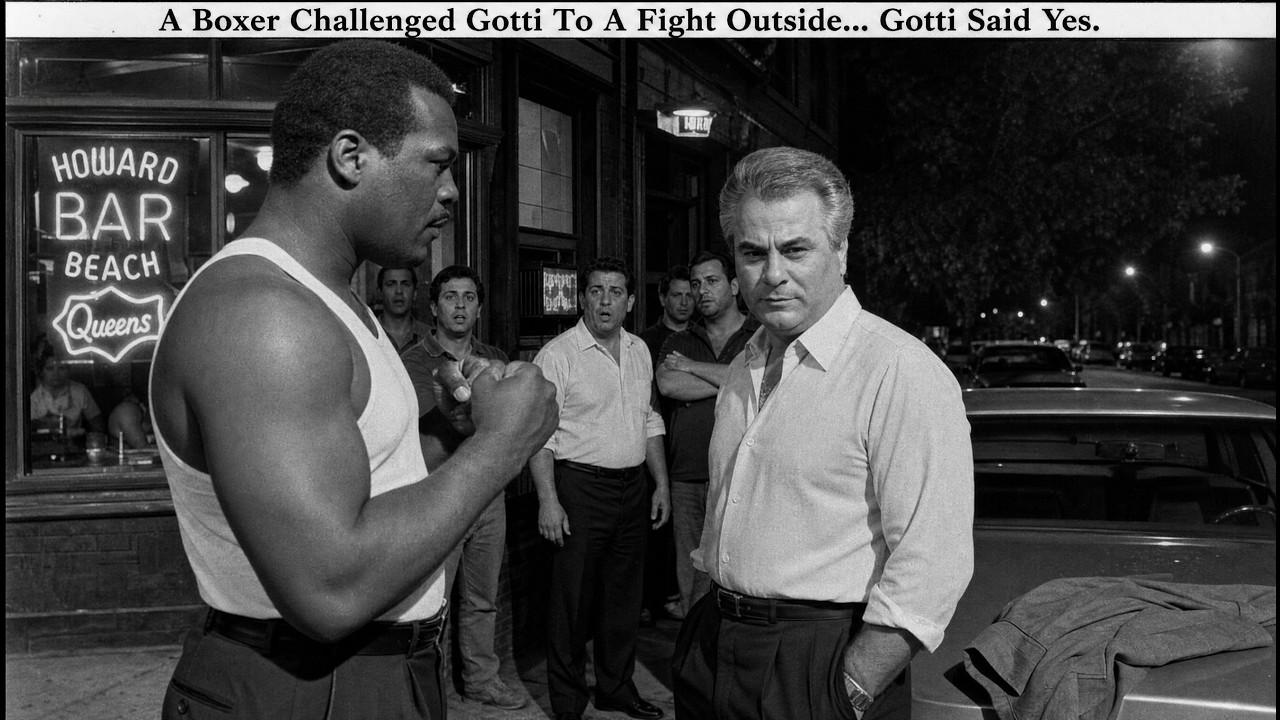
One of the most dramatic versions describes a towering professional boxer confronting Gotti on a New York sidewalk while members of the Gambino crime family watched.
According to the story, the fighter challenged Gotti directly, expecting armed bodyguards to intervene before the confrontation could become physical.
Instead, Gotti supposedly waved his men away, removed his jacket, stepped onto the pavement and prepared to settle the dispute with his bare hands.
The tale ends with everyone watching realizing that the future “Teflon Don” was willing to fight anyone personally.
It is a perfect John Gotti story.
There is only one problem.
There is no reliable historical evidence establishing that this particular professional-boxer showdown happened as described.
No contemporary newspaper account located in a review of Gotti’s documented history identifies the supposed boxer.
No FBI history of Gotti mentions the confrontation.
No established biography examined here provides a date, location, opponent or independently corroborated eyewitness account matching the viral version.
What can be documented is something both less cinematic and more revealing.
John Gotti really did grow up fighting.
He really did develop a reputation for violence long before he became the impeccably dressed boss photographed outside Manhattan courthouses.
Police records from his youth included street fighting, public intoxication and car theft.
By the time he was barely an adult, authorities already regarded him as a low-level associate of the criminal crew connected to Carmine Fatico.
That background provides fertile ground for stories about Gotti accepting fights in the street.
But background evidence is not proof of a specific bare-knuckle showdown.
Gotti was born in the Bronx in 1940 and grew up in a large working-class family before settling in East New York.
He became involved with neighborhood gangs at a young age.
By approximately twelve years old, he was reportedly running errands around a club associated with Fatico, a captain connected to the Gambino organization.
His adolescence was violent and chaotic.
Gotti dropped out of Franklin K. Lane High School at sixteen.
He became involved with the Fulton-Rockaway Boys, a street gang associated with robberies and car theft.
Biography.com notes that arrests for street fighting were already part of his record before he entered the organized-crime hierarchy that would eventually make him nationally famous.
That matters because the later image of Gotti as a man who would never back down did not appear from nowhere.
He cultivated it.
People around him understood that Gotti could be volatile.
Federal investigators later described him as violent and ruthless.
Former associates portrayed him as intensely concerned with respect and status.
The FBI’s own historical account characterizes him as a violent mobster who repeatedly moved in and out of prison during the early years of his criminal career.
Yet the viral professional-boxer story contains unusually specific cinematic details without supplying the information historians would normally need to verify them.
Who was the boxer?
What was his professional record?
When did the confrontation occur?
Where exactly did it happen?
Who witnessed it?
Was Gotti already a Gambino captain, or was he still a neighborhood criminal?
Did police respond?
Did anyone receive medical treatment?
Was the incident discussed on an FBI recording?
Those questions remain unanswered.
That does not prove no confrontation resembling the story ever occurred.
Organized-crime history contains countless incidents that were never reported to police or newspapers.
Participants had powerful reasons to remain silent.
But it means the dramatic account should be treated as an underworld anecdote rather than established historical fact.
The distinction becomes especially important with Gotti because myth followed him everywhere.
Unlike many Mafia bosses who tried to stay invisible, Gotti embraced attention.
He wore expensive suits.
He cultivated reporters.
Crowds gathered outside his court appearances.
The press called him the “Dapper Don.”
After a series of headline-grabbing acquittals, another nickname became even more famous: the “Teflon Don.”
That public image transformed him into something larger than an ordinary criminal defendant.
To admirers, he represented old-school toughness.
To investigators, he was a dangerous organized-crime leader whose apparent invincibility depended partly on intimidation and corruption.
Those two versions of Gotti eventually blended together.
Street stories became legend.
Legends became repeated as biography.
And repeated anecdotes gradually acquired details that were difficult to trace to any original source.
The supposed boxer confrontation fits that pattern almost perfectly.
It presents Gotti as physically fearless.
It places armed bodyguards nearby but makes him refuse their protection.
It creates a public audience.
It introduces an opponent who should theoretically dominate him physically.
Then it makes Gotti win the psychological confrontation simply by stepping forward.
Whether punches were actually exchanged almost becomes irrelevant.
The point of the story is Gotti’s fearlessness.
That is precisely how mob mythology works.
Many organized-crime legends are less concerned with literal accuracy than with communicating a reputation.
A boss who personally accepts a challenge appears more dangerous than one who orders subordinates to handle problems.
A smaller man standing against a professional fighter becomes a symbol of courage.
A criminal leader waving away armed protection becomes someone who supposedly lives by his own rules.
Every element reinforces the Gotti persona.
But the documented record shows that Gotti’s real power ultimately came from something more consequential than fistfights.
It came from organized violence.
After emerging from the Fatico crew, Gotti became deeply involved in hijacking, gambling and other criminal activity.
In 1968, federal authorities arrested him in connection with cargo thefts near John F. Kennedy International Airport.
He eventually served a prison sentence before returning to the crew.
His criminal trajectory became far more serious afterward.
In 1973, Gotti participated in the killing of Jimmy McBratney, who had been blamed for the abduction and murder of a Gambino associate.
The operation was supposed to be an abduction.
Instead, McBratney was shot.
Gotti was identified by witnesses, arrested and ultimately accepted a plea agreement that resulted in a prison sentence.
That episode reveals something important about the difference between documented Gotti violence and later folklore.
There were witnesses.
There was an arrest.
There was a prosecution.
There was a court outcome.
The documentary trail exists.
The boxer story has none of those anchors.
By the early 1980s, Gotti had become a significant figure within the Gambino organization.
His gambling habits, temperament and increasingly conspicuous behavior drew attention not only from law enforcement but also from his own superiors.
Then came the event that changed organized crime in New York.
On December 16, 1985, Gambino boss Paul Castellano and associate Thomas Bilotti were murdered outside Sparks Steak House in Manhattan.
According to later testimony and federal investigators, Gotti arranged the assassination and watched from nearby.
After Castellano was eliminated, Gotti emerged as the new Gambino boss.
That was the foundation of his true reputation.
Not a mysterious sidewalk boxing match.
Not a bare-knuckle duel.
A carefully organized underworld power struggle ending in murder.
As boss, Gotti presided over an organization with hundreds of made members and associates.
Investigators estimated that the Gambino network generated hundreds of millions of dollars through illegal activities.
The FBI increasingly relied on informants, surveillance and electronic interception to penetrate the organization.
Gotti nevertheless acted differently from many traditional Mafia leaders.
He seemed to enjoy being recognized.
He played to cameras.
He dressed conspicuously.
He became a neighborhood celebrity.
And each courtroom victory reinforced his image of invulnerability.
By 1986, Gotti had become something resembling a folk hero to some residents of Howard Beach and other New York neighborhoods.
That popularity was profoundly misleading.
His acquittals did not necessarily demonstrate innocence.
Investigators later discovered misconduct and corruption surrounding at least one major trial.
Biography.com notes that the jury foreman in a racketeering case had been compromised, contributing to the acquittal that strengthened the “Teflon Don” legend.
The myth of the untouchable street warrior consequently developed alongside a more complicated reality.
Gotti was undeniably tough.
But he was also protected by an organized criminal structure.
He had soldiers.
He had associates.
He benefited from intimidation.
He commanded people capable of violence.
That context makes the image of Gotti casually dismissing bodyguards to engage a professional boxer somewhat ironic.
By the time he became the Gambino boss, physical combat was hardly the source of his authority.
His orders carried far greater consequences than his fists.
Even the famous description of him as someone who “backed down from nobody” needs qualification.
Gotti could be bold.
He could also be strategically cautious.
The Castellano assassination was not a spontaneous confrontation.
It was planned.
Shooters were positioned.
Gotti observed from a vehicle rather than personally walking up to Castellano.
According to the FBI account, he even arranged for his car to pass the murder scene afterward so he could confirm the killing had been completed.
That does not resemble a man proving himself through honorable hand-to-hand combat.
It resembles an organized-crime leader using coordinated lethal violence.
The distinction matters because popular entertainment frequently romanticizes Mafia figures by translating organized criminal power into old-fashioned personal courage.
A gunman becomes a warrior.
A racketeer becomes a neighborhood protector.
A murder conspiracy becomes evidence of leadership.
A volatile temper becomes fearlessness.
And unverifiable bar or sidewalk confrontations become proof that the boss possessed almost superhuman courage.
Gotti was particularly vulnerable to this transformation because his public personality was so vivid.
He looked like a movie gangster.
He spoke like one.
He challenged prosecutors publicly.
He smiled for cameras.
He could appear relaxed while surrounded by federal agents.
Those qualities made every story about him easier to believe.
The FBI eventually defeated that mythology with exactly the kind of evidence missing from the boxer tale.
Investigators installed listening devices and captured Gotti speaking privately.
Those recordings exposed a different side of the supposedly untouchable boss.
Federal prosecutors obtained evidence connecting him to murders, racketeering and other crimes.
Most damagingly, underboss Salvatore “Sammy the Bull” Gravano agreed to cooperate with the government after hearing recorded conversations in which Gotti discussed criminal activity and disparaged him.
In 1992, Gotti was convicted on multiple federal charges.
The man who had repeatedly walked away from courtrooms finally received a life sentence.
The celebrated Teflon coating had disappeared.
James Fox, then head of the FBI’s New York office, declared that the “Teflon” was gone and that the charges had finally stuck.
Gotti spent the remainder of his life in federal custody and died from cancer in 2002.
That ending provides a revealing contrast with the street-fighter legend.
The most important battle of John Gotti’s life was never decided with bare knuckles.
It was decided by surveillance recordings, cooperating witnesses, federal racketeering law and courtroom evidence.
His intimidation could not defeat recorded conversations.
His public confidence could not neutralize Gravano’s testimony.
His reputation could not overcome a jury once prosecutors constructed a sufficiently strong case.
None of that means Gotti was physically timid.
The available historical record points strongly in the opposite direction.
He had a documented history of street fighting.
He grew up around violence.
He accumulated arrests while still young.
He spent decades operating inside a criminal organization where threats and violence were routine.
The claim that he was willing to fight someone personally is therefore plausible in a general sense.
But plausibility is not proof.
A credible historical account of the supposed boxer showdown would require substantially more.
At minimum, the fighter would need to be identified.
A time and place would be necessary.
Independent witnesses would strengthen the story.
Contemporary reporting, police documents, court testimony, FBI files or firsthand memoir evidence could provide corroboration.
Without those elements, the showdown remains a story attached to a man whose reputation encouraged exactly that kind of storytelling.
There is also a modern twist that can create confusion.
John Gotti’s grandson, John Gotti III, actually became a professional combat-sports athlete.
He competed professionally in mixed martial arts beginning in 2017 and later boxed, including exhibition bouts connected with Floyd Mayweather Jr.
Gotti III has openly discussed carrying the family name into professional fighting while trying to create an identity separate from his grandfather’s criminal legacy.
That contemporary combat-sports connection can make older stories about the original John Gotti fighting professional boxers sound more believable.
But they involve different generations.
John Gotti III really pursued professional fighting.
His grandfather did not.
No credible historical source examined here describes the elder Gotti as a trained professional boxer.
The elder Gotti was a street criminal who became a Mafia boss.
Those are very different things.
The broader lesson is that John Gotti’s documented life rarely needs embellishment.
He rose from an impoverished New York childhood into one of America’s most powerful organized-crime positions.
He accumulated arrests while young.
He participated in violent crimes.
He survived prosecutions that seemed certain to destroy him.
He orchestrated the removal of a sitting Gambino boss.
He became one of the most recognizable criminals in the country.
Then federal surveillance and betrayal from within his own organization finally brought him down.
Those facts are extraordinary.
The sidewalk boxer story may have grown precisely because audiences wanted one additional scene explaining the character they thought they understood.
A huge fighter challenges him.
His bodyguards reach for weapons.
Gotti waves them away.
The crowd goes silent.
The mob boss steps forward alone.
It reads like the origin scene of the “Teflon Don.”
But history does not become more accurate merely because a story fits its subject perfectly.
Based on the reliable material currently available, John Gotti unquestionably had a documented street-fighting background and a long record of violence.
He was also known for swagger, confrontation and a fierce concern with respect.
What cannot currently be established is the specific cinematic claim that an identified professional boxer publicly challenged him before his Gambino crew and that Gotti dismissed armed guards to settle the dispute bare-knuckle.
Until a named opponent, authenticated eyewitness testimony or documentary evidence emerges, that showdown belongs in the category of Mafia lore rather than verified history.
The real John Gotti was dangerous enough without the legend.


