Christa Pike Received Two Doses of Pentobarbital, Yet Survived Tennessee’s Execution Attempt — Now a Criminal Defense Lawyer Is Asking What Happens Next
The state of Tennessee prepared to carry out a death sentence that had stood for more than three decades, but when the lethal injection failed to kill Christa Pike, a criminal defense attorney was left asking a question officials could no longer avoid: what happens when the government attempts to execute someone, the procedure fails, and the condemned prisoner survives?
Bruce Rivers, a board-certified criminal defense lawyer and host of Criminally Reacts, has never hidden his opposition to capital punishment, yet Pike’s case has pushed his concerns into especially disturbing territory, forcing him to confront not only the original crime but also the constitutional, ethical, and practical consequences of a failed execution.
Rivers began his discussion with a blunt declaration that he does not believe in the death penalty, arguing that the United States stands apart from other Western democracies by continuing to execute prisoners, while raising serious questions about whether the government should possess the authority to deliberately end a human life.
His position, however, does not mean he considers Pike innocent, harmless, or absolved of responsibility, because the case involves the brutal killing of nineteen-year-old Colleen Slemmer, a young woman whose death became the foundation of a capital prosecution that has followed Pike for most of her adult life.
The disturbing details of the crime remain central to the controversy, but Rivers believes the state’s response has created another set of questions, ones that cannot be answered simply by pointing to the severity of the original offense or insisting that a jury already delivered its verdict.
Pike was sentenced to death after participating in a 1995 killing involving Slemmer, a fellow participant in a job-training program connected to the University of Tennessee, and the circumstances surrounding the murder were so shocking that they helped establish the case as one of Tennessee’s most notorious capital prosecutions.
According to the account Rivers discussed, Pike and two other people lured Slemmer to an isolated location on campus, where the young woman was beaten to death, and Pike was associated with the removal of part of the victim’s skull or skin, a detail that continues to horrify anyone examining the case.
The crime was exceptionally violent, and Rivers made no attempt to minimize the suffering inflicted on Slemmer or the seriousness of Pike’s actions, repeatedly acknowledging that the victim deserved justice and that society has a legitimate responsibility to protect people from individuals who commit terrible acts of violence.
But he draws a distinction between holding someone accountable and authorizing the state to kill that person, arguing that a sentence of life imprisonment can permanently remove a dangerous offender from society without requiring government officials to carry out an irreversible execution.
That distinction has become especially important now that Pike, who was approximately fifty years old at the time of the attempted execution described in the video, has reportedly survived a lethal-injection procedure that was supposed to end her life.
For Rivers, the immediate question is no longer simply whether Pike deserved the punishment imposed by the court, but whether Tennessee can justify attempting the procedure again after the first attempt failed and left her requiring hospital treatment.
The situation is made more troubling by the reported circumstances inside the execution chamber, where Pike was strapped to a gurney, intravenous lines were inserted, and the process began under the authority of the state, only for the expected outcome not to occur.
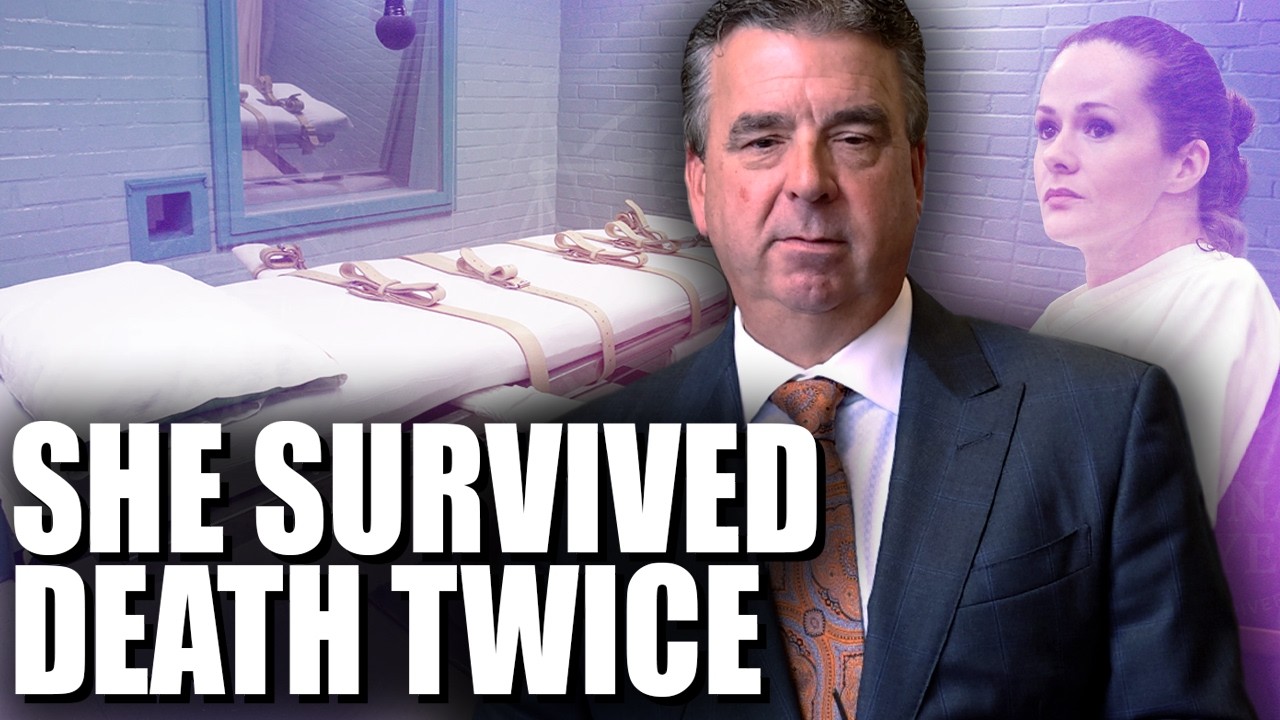
Rivers recounts reports that Pike’s arm began swelling and that she appeared to whimper as the procedure progressed, raising concerns about whether the injection was being administered successfully and whether the condemned prisoner was experiencing pain or distress during the attempt.
The transcript identifies the execution drug as phenobarbital in one portion, while the video’s title refers to pentobarbital and two doses, so those medication details should not be treated as independently confirmed or interchangeable based on the transcript alone.
What the account makes clear is that the lethal-injection attempt did not result in Pike’s death, and that she was subsequently described as being hospitalized and placed on a ventilator, transforming a scheduled execution into an extraordinary medical and legal crisis.
Instead of leaving the execution chamber dead, Pike reportedly remained alive in a hospital bed, while questions emerged about her condition, the state’s responsibility toward her, and whether Tennessee had any clear plan for what should happen next.
Rivers describes the contradiction in stark terms: the government had tried to end Pike’s life, yet the state was now reportedly involved in efforts to keep her alive, a reversal that he considers both disturbing and emblematic of the unresolved problems surrounding capital punishment.
The situation also raises a difficult question about the Eighth Amendment to the United States Constitution, which prohibits cruel and unusual punishment, and which has long been central to legal disputes over execution methods and the limits of government authority.
Rivers argues that the constitutional prohibition against cruel and unusual punishment exists because the state should not be permitted to torture people, even when those people have been convicted of exceptionally serious crimes, and he questions whether a failed execution can be reconciled with that principle.
A failed procedure does not, by itself, establish every legal conclusion about whether the Constitution has been violated, but the reported circumstances make the question difficult to dismiss, particularly if an execution attempt causes substantial physical suffering or leaves a prisoner in a serious medical condition.
For a defense attorney who already opposes capital punishment, Pike’s survival illustrates the dangers of allowing the state to use a procedure that can fail, especially when the consequences may include both an attempted killing and the possibility of another attempt.
The controversy also arrives after years of litigation in which Pike’s lawyers challenged the sentence and sought intervention from Tennessee officials, including Governor Bill Lee, who ultimately declined to grant clemency, according to the account reviewed by Rivers.
Her legal team had argued that her childhood trauma and psychological history deserved greater consideration, including claims that she experienced sexual abuse beginning when she was very young, and that the prospect of being restrained on an execution gurney could trigger severe psychological suffering.
Those arguments did not persuade the state to halt the execution, and the Tennessee attorney general’s office reportedly maintained that a court had already considered the claims about possible mental harm and found the predicted effects too speculative to justify blocking the procedure.
The state proceeded after Pike’s remaining request for relief was denied, leaving her lawyers heartbroken and the execution machinery in motion, but the subsequent failure has brought renewed attention to the very concerns that the final appeals could not resolve.
Rivers does not claim that Pike’s traumatic childhood excuses the murder, and he repeatedly warns against confusing an explanation of someone’s background with an argument that the person should face no consequences.
Instead, he asks whether the jury that sentenced Pike to death had access to information that might have affected its decision, including evidence about her early experiences, psychological condition, and vulnerability when she was a teenager.
Her lawyers have argued that this material could have served as mitigating evidence, potentially changing the sentence even if it did not alter the verdict, although it remains impossible to know with certainty how a different jury would have evaluated the case.
That uncertainty is one reason Rivers believes capital punishment deserves exceptional scrutiny, because an error in an ordinary prison sentence can sometimes be corrected, while an execution cannot be undone after the government has carried it out.
He invokes historical cases involving people who were executed and later found to have been innocent, including the case of a fourteen-year-old Black boy executed in South Carolina in 1944 after a hurried trial over the deaths of two white girls.
That case is widely associated with George Stinney Jr., whose conviction was later vacated, and Rivers uses the example to illustrate how racial prejudice, inadequate proceedings, and a rush toward punishment can produce consequences that no subsequent court ruling can fully repair.
He also recalls a Minnesota execution from the early twentieth century that he believes was later shown to involve an innocent man, using the historical example to reinforce his argument that the government cannot guarantee perfect accuracy in every capital case.
The broader point is not that every person sentenced to death is innocent, nor that every execution is necessarily wrongful, but that the consequences of a mistaken judgment are uniquely permanent when the sentence is carried out.
Rivers believes the justice system should be capable of protecting the public without exercising that irreversible power, and he argues that life imprisonment can serve as a severe punishment for a person convicted of murder while eliminating the possibility of a state-sanctioned killing.
For those who support the death penalty primarily as retribution, however, that alternative may seem inadequate, particularly in a case as disturbing as Slemmer’s murder, where the brutality of the crime can provoke an understandable desire for the harshest available punishment.
Rivers recognizes that anger, grief, and a demand for accountability are natural responses to violent crime, but he warns that emotional certainty does not automatically resolve the moral question of whether the government should have the power to execute a person.
He recalls a priest’s observation that every person is worth more than their worst act, a principle that does not erase responsibility but asks society to consider whether even the most serious wrongdoing should permanently strip someone of the right to remain alive.
For Pike, that philosophical debate is now complicated by the fact that she has reportedly spent approximately thirty-two years under a death sentence, a period long enough for the teenager who committed the crime to become a middle-aged woman.
Rivers asks whether a person at fifty is necessarily the same person they were at eighteen, and whether decades of incarceration should matter when authorities decide whether to carry out a death sentence imposed for a crime committed in youth.
The question is especially significant because Pike’s case involved two other participants whose sentences differed dramatically from hers, creating a disparity that her lawyers have argued deserves closer examination.
Darrell Ship, Pike’s boyfriend at the time, was seventeen when the crime occurred and was sentenced to life imprisonment, remaining eligible for parole under the account described in the video.
Ship testified during a post-conviction proceeding that he had carved a pentagram into Slemmer’s chest, according to the information discussed by Rivers, a detail that adds to the disturbing picture of the crime and the different legal outcomes for those involved.
The third participant, Shadolla Peterson, who was eighteen and reportedly served as a lookout, received probation in exchange for cooperating with authorities, leaving Pike as the only one of the three to receive a death sentence.
The differences in age, participation, cooperation, and legal circumstances matter when comparing the sentences, and they do not automatically establish that Pike’s punishment was unlawful or that the other participants should have received the same sentence.
Nevertheless, Rivers sees the disparity as another reason to question how the death penalty is applied, particularly when a person’s life can depend on the details of the prosecution, the quality of legal representation, and the decisions made by individual officials.
Pike’s attorneys have also argued that contemporary research on adolescent brain development would provide a stronger basis for understanding the decisions of a teenager than the information available during her original trial, although the relevance of such research must be evaluated within the specific legal record.
The video also notes that prosecutors had offered a potential plea arrangement involving life imprisonment without parole, which Pike’s lawyers argue could have produced a different outcome had the defense accepted it.
Whether accepting that agreement would have been the better decision is a question shaped by the circumstances of the original case and the information available to the lawyers and defendant at the time, rather than something that can be settled simply by looking backward.
Rivers’ broader concern is that the death penalty can magnify every weakness in the legal process, turning mistakes, unequal representation, and differences in prosecutorial decisions into questions of life and death.
He argues that defendants with financial resources may have better access to attorneys and experts capable of challenging evidence, while poorer defendants can struggle to obtain the investigative and legal assistance necessary to mount an equally effective defense.
That concern does not establish that every capital conviction is unreliable, but it reflects a longstanding debate over whether the death penalty is imposed consistently and fairly across different social and economic circumstances.
The case of Gail Owens, another Tennessee death-row prisoner whose sentence was commuted to life imprisonment by Governor Phil Bredesen in 2010, further illustrates how executive decisions can produce dramatically different outcomes for people facing the ultimate punishment.
Rivers describes the difference as partly a matter of which governor happens to hold office, highlighting the extraordinary influence that a single clemency decision can have when the underlying sentence is death.
Pike’s lawyers sought similar intervention from Governor Lee, but he chose to uphold the sentence after what he described as deliberate consideration, leaving the courts as the remaining avenue for relief before the execution attempt.
Now that the attempt has failed, Rivers questions whether Tennessee should attempt to execute Pike again, especially if she remains unconscious or medically unstable, and whether officials can ethically proceed without first resolving the uncertainty surrounding her condition.
The transcript does not establish Pike’s precise current medical status, whether she remains unconscious, or what doctors have concluded about her chances of recovery, so those details remain essential unknowns rather than settled facts.
Rivers asks whether the state can legally take the life of someone who is unconscious, but the answer would depend on the governing law, the medical circumstances, and the specific legal issues presented, not simply on the fact that the first procedure failed.
He also raises the possibility of legal action against Tennessee, asking whether Pike or her representatives could sue over the botched execution and what damages might be available when the state attempted to carry out a death sentence but the prisoner survived.
That question is unresolved in the discussion, and the transcript does not establish that a lawsuit has been filed or that Pike would necessarily prevail in any future claim.
Still, the potential legal consequences are substantial, because an execution attempt that allegedly results in serious injury may trigger disputes over constitutional protections, medical treatment, procedural safeguards, and the state’s obligations toward a prisoner in its custody.
The state cannot simply treat the situation as though nothing unusual happened, because the reported outcome is fundamentally different from the death that officials intended to carry out.
Rivers also questions whether Tennessee’s reported temporary moratorium on executions will lead to meaningful changes or merely postpone the next scheduled execution while officials examine what went wrong.
A pause can provide time for investigation, but it does not automatically resolve the deeper questions about execution protocols, the reliability of lethal-injection procedures, or whether capital punishment should remain part of the state’s criminal justice system.
The distinction matters because the public debate can quickly narrow to whether officials can improve the procedure enough to make it work, when Rivers believes the more fundamental question is whether government should be attempting to kill prisoners at all.
His position is not that Slemmer’s death should be forgotten or that Pike should simply be released, but that punishment can be severe without becoming an execution, and that society should be capable of protecting the public while avoiding an irreversible act by the state.
He acknowledges that his opposition will provoke anger from people who believe the brutality of the murder makes death the only appropriate response, but he rejects the idea that a demand for retribution should end the discussion.
For him, the failed execution exposes a contradiction at the center of the system: Tennessee intended to end Pike’s life, yet after the procedure failed, the situation reportedly required hospital treatment and renewed attention to preserving her life.
The question is no longer merely whether the sentence can be carried out, but what obligations arise when the government has already attempted to execute a prisoner and the attempt leaves that person alive and potentially suffering.
Rivers ends without offering a confident prediction about what Tennessee will do next, acknowledging that the legal and medical questions are difficult and that he cannot determine from the available information whether Pike has a viable claim against the state.
But his uncertainty points toward the central issue that officials must confront before any further action: a death sentence may remain legally in place, yet the failure of an execution creates a new situation that cannot be resolved by pretending the first attempt never happened.
If Tennessee eventually considers another attempt, it will face questions about Pike’s health, the circumstances of the failed procedure, constitutional protections, and the public’s right to know whether the state has adequately investigated what happened.
If officials instead decide to halt the process for an extended period, they will face pressure from those who view the death sentence as a promise of justice that must ultimately be fulfilled, regardless of the medical crisis.
And if Pike remains alive, the state must confront the practical reality that its actions have created a human being whose condition, legal rights, and future cannot be reduced to a line in a sentencing order.
The original crime remains horrific, and nothing about the failed execution changes the loss suffered by Colleen Slemmer or the responsibility of those convicted in connection with her death.
Yet accountability for that crime and scrutiny of the state’s conduct are not mutually exclusive, because a justice system that demands responsibility from individuals must also be prepared to explain its own decisions when a punishment does not proceed as intended.
Bruce Rivers believes life imprisonment can protect society without granting the government the power to carry out an irreversible killing, and Christa Pike’s survival has made that argument more urgent than ever in Tennessee.
For now, the most consequential question remains unanswered: after the state tried to execute Christa Pike and failed, will officials attempt to finish the sentence, or will the medical, constitutional, and ethical consequences force Tennessee to reconsider what happens next?


